

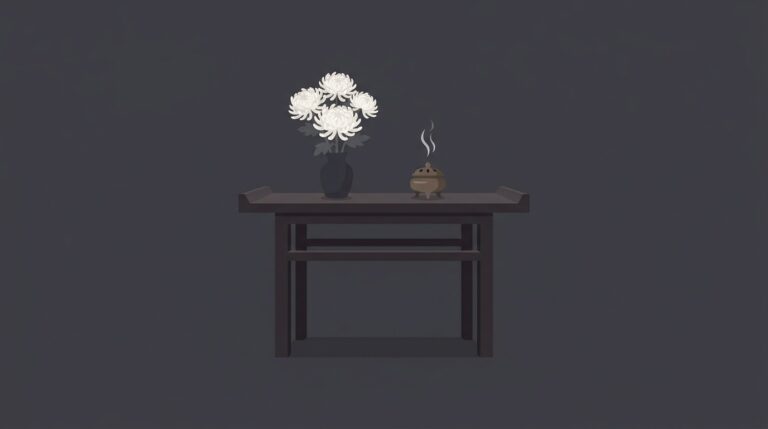
Phase 1: 공감 (Story-Driven Opening)
안녕하세요! 매일한글 에디터입니다.
Imagine this scenario: It is 8:30 PM on a brisk Thursday in Seoul. Your smartphone buzzes with a KakaoTalk notification containing an unfamiliar, solemn layout—a Bugo (부고, obituary notice). A senior director at your company has lost his mother, and your colleagues are quietly coordinating to visit the funeral hall (Jangnyesikjang, 장례식장) at Severance Hospital after work. You rush to change into a somber dark suit, but as you approach the entrance lined with towering floral wreaths (Geunjo hwan, 근조화환), a cold wave of anxiety hits you.
How many times do I bow? Is it once? Twice? Three times? What if I hold my hands the wrong way? Is it disrespectful to talk about death directly?
If you have ever felt your stomach drop at the thought of making an unforgivable cultural misstep during Korea’s most sacred ritual of grief, you are not alone. Through hundreds of cultural mentoring sessions with expatriate executives and advanced C2 learners, I have observed that funeral etiquette is universally cited as the most nerve-wracking social obligation in South Korea. The stakes feel impossibly high because grief is raw, and Koreans place immense weight on solemn non-verbal propriety.
Today, we are taking you beyond textbook platitudes. This guide provides an authentic, high-level navigational blueprint to Korean funeral condolences, deciphering the ritualized geometry of the bows (Jeol), the precise syntax of condolence, and the unspoken communal psychology behind the funeral hall feast.
Phase 2: Core Expressions in Depth
1. 삼가 고인의 명복을 빕니다 (Samga goin-ui myeongbogeul bimnida)
- Pronunciation: [Sam-ga go-in-ui myeong-bo-geul bim-ni-da] (Sounds like: “Sahm-gah go-een-wee myung-boh-guhl beem-nee-dah”)
- Meaning: “Humbly, I pray for the blessed bliss of the deceased in the afterlife.”
- K-Culture Moment: The standard, formal phrase inscribed on condolence banners and spoken in solemn K-Dramas like My Mister (Naui Ajeossi) when characters pay their formal respects at the altar.
- Editor’s Insight: Samga (삼가) is an archaic adverb meaning “with utmost humility and discreet care.” Myeongbok (명복) refers to blessings in the underworld (Myeongbu). Because this phrase carries Buddhist and classical metaphysical undertones, conservative Christian mourners occasionally substitute it with biblical condolences, yet it remains the undisputed gold standard in general adult society.
- Situation Spectrum: Casual 🚫 | Semi-formal ⚠️ | Formal ✅
- 🤔 Think About It: Notice how the subject (“I”) is completely omitted. What does the grammatical suppression of the self convey about Korean collectivist deference during tragedy?
2. 얼마나 상심이 크십니까 (Eolmana sangsim-i keusimnikka)
- Pronunciation: [Eol-ma-na sang-sim-i keu-sim-ni-kka] (Sounds like: “Uhl-mah-nah sahng-sheem-ee koo-sheem-nee-kkah”)
- Meaning: “How immense your sorrow and heartbreak must be.”
- K-Culture Moment: Spoken by an empathetic colleague directly to the chief mourner (Sangju, 상주) when exchanging mutual bows after the formal altar bows.
- Editor’s Insight: Rather than asserting an unsolicited “I know how you feel” (which can feel intrusive in Korean communicative norms), this expression validates the mourner’s grief through an empathetic honorific inquiry. It gently invites the mourner to receive comfort without demanding an elaborate conversational response.
- Situation Spectrum: Casual ⚠️ | Semi-formal ✅ | Formal ✅
- 🤔 Think About It: Why does Korean funeral rhetoric favor honoring the scale of another’s pain over sharing personal anecdotes of one’s own losses?
3. 부디 좋은 곳으로 가셨기를 바랍니다 (Budi joeun goseuro gasyeotgireul baramnida)
- Pronunciation: [Bu-di jo-eun go-seu-ro ga-syeot-gi-reul ba-ram-ni-da] (Sounds like: “Boo-dee joh-oon goh-soo-roh gah-shyut-gee-rool bah-rahm-nee-dah”)
- Meaning: “I sincerely wish they have departed to a peaceful and noble place.”
- K-Culture Moment: Often murmured softly in private conversations in the dining hall when comforting a close friend or colleague who has suffered a sudden familial bereavement.
- Editor’s Insight: This phrase employs the euphemism gasida (가시다, honorific for “to go/pass away”) paired with budi (부디, an earnest supplication meaning “by all means / I earnestly pray”). It is comforting, non-denominational, and softer than rigid Sino-Korean terminology.
- Situation Spectrum: Casual ⚠️ | Semi-formal ✅ | Formal ✅
- 🤔 Think About It: How does the linguistic euphemism of “traveling to a good place” reflect the East Asian perception of death as a journey rather than a terminal point?
Phase 3: Textbook Korean vs. Real Korean
Situation 1: Offering words of comfort directly to the Chief Mourner (Sangju)
- 📖 교과서 한국어 (Textbook Korean):
삼가 고인의 명복을 빌며, 유가족분들께 깊은 애도를 표합니다.
(Samga goin-ui myeongbogeul bilmyeo, yugajok-bundeulkke gipeun aedoreul pyohamnida.)
“I pray for the deceased’s bliss in the afterlife, and express profound condolences to the bereaved family.” - 🗣️ 진짜 한국어 (Real Korean):
고생 많으셨습니다. 얼마나 마음이 아프십니까…
(Gosaeng maneusyeotsumnida. Eolmana ma-eum-i apeusimnikka…)
“You have endured so much suffering. How your heart must ache…” - 💡 왜 다를까? (Why the Difference?): Textbook phrases are designed for written telegrams or funeral ribbon wreaths. In face-to-face interactions, elaborate literary syntax sounds clinical. Real native speakers use low, emotionally heavy phrases acknowledging the exhaustion and visceral heartache of the family, often trailing off into silence (Mal-jul-im-pyo).
Situation 2: Inquiring about the deceased’s passing without causing offence
- 📖 교과서 한국어 (Textbook Korean):
사망 원인이 무엇입니까?
(Samang won-in-i mueosimnikka?)
“What was the cause of death?” - 🗣️ 진짜 한국어 (Real Korean):
그동안 병환이 깊으셨습니까? / 편안하게 가셨습니까?
(Geudong-an byeonghwani gipeusyeotsumnikka? / Pyeon-anhage gasyeotsumnikka?)
“Had they been dealing with severe illness for some time? / Did they pass away peacefully?” - 💡 왜 다를까? (Why the Difference?): Asking for the “cause of death” directly is deeply offensive and clinical. At advanced C2 proficiency, you must utilize euphemistic framing like byeonghwan (병환, honorific for illness) or ask if they departed peacefully (pyeon-anhage), prioritizing the mourner’s psychological comfort over curiosity.
Phase 4: K-Culture Deep Dive & Non-Verbal Manners
4-1. 눈치 (Nunchi), Hand Placement (Gongsu), & Bowing Counts
In Korean rites of passage, non-verbal precision carries ten times the weight of spoken language. When you cross the threshold into the altar room (Binso, 빈소), keep the following physical grammar in mind:
- Hand Placement (Gongsu-beop, 공수법):
- In traditional Korean etiquette, hand positioning follows Gongsu. For joyful occasions (weddings, Seollal), men place their left hand over the right, and women place their right hand over the left.
- At a funeral, this rule strictly reverses: Men place their RIGHT hand over the left; Women place their LEFT hand over the right. Crossing hands inappropriately is an immediate faux pas observed by elders.
- The Incense and Flower Offering:
- Approach the altar. Kneel before the incense burner (Hyangno). Pick up one or two sticks of incense with your right hand, light it with a candle, and never blow it out with your mouth. Gently wave your hand or shake it vertically to extinguish the flame. Insert it into the burner, supporting your right wrist with your left hand.
- If offering a white chrysanthemum (Gukhwa), hold the stem with your right hand, supporting your right wrist with your left hand, and place it on the table so the blossom faces the deceased’s portrait.
- The Bowing Count (절하는 횟수): The 2.5 Bow Rule:
- Two full deep bows (Keunjeol, 큰절) followed by one half-bow (Ban-jeol, 반절) to the deceased portrait.
- Count: Bow completely to the floor twice. Stand up straight, then perform a 45-degree respectful head nod (half-bow).
- The Critical Distinction: One bow is for the living; two bows are exclusively for the deceased (ancestors and deceased spirits). Bowing only once to the deceased’s portrait is an insult reserved for casual living encounters!
- Religion Note: If you or the bereaved family are devout Christians, two deep bows are replaced by standing silently for a moment of prayer (Muk-do, 묵도) with hands folded and head bowed.
- Bowing to the Chief Mourner (Sangju):
- Turn toward the chief mourner and family standing to the side.
- Bow ONE full deep bow (or one deep 90-degree waist bow) to each other. Here, you exchange one short sentence of condolence.
4-2. Cultural Code Analysis: The Paradox of the Dining Hall & Yukgaejang
If you have watched K-Dramas like Hospital Playlist (Seulgiroun Uisasaenghwal) or Move to Heaven, you will notice that right outside the tearful altar room sits a bustling dining hall where people eat, drink soju, and converse.
Why do Koreans serve spicy beef soup (Yukgaejang, 육개장)? Red chili and beef traditionally symbolize vitality, warding off malevolent spirits (Aek-un) from the grieving household. More importantly, mourning in Korean culture is communal. Staying late into the night (Bamsaeum, 밤새움) prevents the bereaved from feeling lonely in the sudden void of death. However, remember the cardinal rule of the dining hall: Never clink glasses when drinking soju (건배 금지). Clinking glasses denotes celebration; at a funeral, you drink quietly without touching cups.
Phase 5: Real-Life Role-Play Scenario
Setting: Seoul National University Hospital Funeral Hall (Room 3). You arrive in a charcoal suit. Park Min-ho (42, Senior Manager), the chief mourner, stands beside the altar in a traditional black mourning suit with a white armband (Wan-jang).
- Turn 1 (Min-ho):
오시느라 고생 많으셨습니다. 먼 길 와주셔서 감사합니다.
(Osineura gosaeng maneusyeotsumnida. Meon gil wajusyeoseo gamsahamnida.)
“You have endured much hardship coming here. Thank you for making the long journey.”
🎭 [Drained voice, eyes swollen, hands clasped low in front.] -
Turn 2 (Learner):
갑작스러운 비보에 황망한 마음을 금할 길이 없습니다.
(Gapjakseureoun bibo-e hwangmanghan ma-eumeul geumhal giri eopsumnida.)
“Upon this sudden, tragic news, I cannot restrain my profound shock and grief.”
🎭 [Standing upright, hands folded with right over left, bowing head slightly.] -
Turn 3 (Learner):
먼저 분향부터 올리겠습니다.
(Meonjeo bunhyangbuteo olligessumnida.)
“I will first offer incense at the altar.”
🎭 [Stepping forward slowly toward the portrait of the deceased.] -
Turn 4 (Min-ho):
네, 편하게 하십시오.
(Ne, pyeonhage hasipsio.)
“Yes, please take your time.”
🎭 [Steps half a pace backward, bowing his head in quiet gratitude.] -
Turn 5 (Learner):
(Performs incense offering, completes two full deep prostrations followed by a standing half-bow to the portrait, then steps sideways toward Min-ho.)
🎭 [Steps smoothly into alignment with the Chief Mourner.] -
Turn 6 (Learner):
얼마나 상심이 크십니까. 뭐라 드릴 말씀이 없습니다.
(Eolmana sangsim-i keusimnikka. Mweora deuril malsseumi eopsumnida.)
“How immense your sorrow must be. I am truly at a loss for words.”
🎭 [Completes one deep reciprocal bow, maintaining a solemn, low gaze.] -
Turn 7 (Min-ho):
어머니께서 마지막엔 고통 없이 평안하게 눈을 감으셨습니다. 찾아주셔서 큰 힘이 됩니다.
(Eomeonikkeseo majimage-n gotong eopsi pyeong-anhage nuneul gameusyeotsumnida. Chajajusyeoseo keun him-i doemnida.)
“In her final moments, Mother closed her eyes peacefully without pain. Your visit gives us great strength.”
🎭 [Slightly bows his head with a tearful, restrained half-smile.] -
Turn 8 (Learner):
부디 기운 잃지 마시고 몸 잘 추스르시길 바랍니다.
(Budi giun ilchi masigo mom jal chuseureusigil baramnida.)
“Please do not lose heart, and take tender care of your health and body.”
🎭 [Gently places left hand over right, taking two respectful steps backward before turning.]
🔀 Interactive Decision Fork
As you prepare to move toward the dining hall, Min-ho asks:
“식사는 하고 가실 거지요? 안쪽에 자리 있습니다.” (You will eat before you leave, right? We have seats inside.)
- Choice A: “아닙니다. 바빠서 바로 가보겠습니다.” (No, I’m busy so I will head out immediately.)
👉 Feedback [BAD]: Bluntly declining food by saying you are busy minimizes the family’s hospitality. In Korea, accepting the funeral meal (Jomun-bap) is seen as sharing their burden of grief. Even if pressed for time, sitting for 10 minutes to take a spoonful of soup or a glass of water is proper etiquette. - Choice B: “네, 국 한 그릇 감사히 먹고 상주님 곁을 조금 더 지키다 가겠습니다.” (Yes, I will gratefully have a bowl of soup and stay a little longer by your side.)
👉 Feedback [BEST]: Exemplary C2-level communicative elegance! It accepts the hospitality with cultural humility and signals emotional companionship (Dongji-ui-sik). - Choice C: “네! 배고팠는데 육개장 한 그릇 시원하게 먹겠습니다!” (Yes! I was hungry, so I’ll eat a piping hot bowl of yukgaejang refreshingly!)
👉 Feedback [RISK]: Dangerously tone-deaf. Even though Yukgaejang is tasty, portraying the funeral hall as a restaurant or expressing enthusiastic hunger disrupts the somber atmosphere of grief.
Phase 6: 10-Second Emotion Shadowing Drill
Read these essential lines aloud, matching the pause markers (/) and emotional milestones.
[🕊️ 무겁고 차분하며, 끝을 낮게 가라앉히듯]
삼가 / 고인의 명복을 / 빕니다.
(Samga / goin-ui myeongbogeul / bimnida.)
(“Humbly / for the departed’s bliss / I pray.”)-
[🤝 상대의 비통함을 온전히 품어주는 나지막한 어조로]
얼마나 / 상심이 / 크십니까. / 뭐라 위로의 말씀을 / 드려야 할지 모르겠습니다.
(Eolmana / sangsim-i / keusimnikka. / Mweora wiro-ui malsseumeul / deuryeoya halji moreugessumnida.)
(“How / your heartbreak / must be. / What words of comfort / I should offer, I know not.”) -
[🤍 비탄에 빠진 유가족을 염려하는 진심 어린 온도로]
부디 / 슬픔 중에도 / 몸 건강 / 잘 챙기십시오.
(Budi / seulpeum jung-edo / mom geon-gang / jal chaeng-gisipsio.)
(“I pray / amidst this sorrow / your physical health / you care for well.”)
Phase 7: K-Culture Mini Dictionary
-
상주 (Sangju – 喪主)
Translation: Chief Mourner.
Usage: Typically the eldest son or closest direct descendant who oversees the funeral. You address them with extreme deference and offer your mutual bow directly to them. -
조의금 / 부의금 (Joeuigeum / Bu-uigeum – 弔意金 / 賻儀金)
Translation: Condolence money.
Usage: Monetary gift placed in a clean white envelope (Bujot-bongtu) to help offset funeral costs and show communal solidarity. Hand it to the reception desk (Jeopsu-dae) before entering the altar, writing your name and affiliation vertically on the back left. -
완장 (Wanjang – 腕章)
Translation: Mourner’s Armband.
Usage: Black-striped white armbands worn by male mourners. Two black stripes indicate the chief mourner (Sangju); one stripe indicates male relatives (brothers, grandsons). -
벽제 / 발인 (Barin – 發引)
Translation: The funeral procession / departure ceremony.
Usage: Taking place on the third day (Sam-il-jang), signaling the physical departure of the casket from the funeral hall to the cremation ground or cemetery.
Phase 8: Survival Kit for Travelers
Top 3 Immediate Survival Phrases
- Phrase 1: 부의금 봉투는 어디에 있습니까?
(Bu-uigeum bongtuneun eodie itsumnikka?)
Pro Tip: Funeral halls provide white condolence envelopes at the lobby entrance desk, often pre-printed with the hanja characters 賻儀 (Buyi) or 弔意 (Joyi). Ask the reception quietly if you didn’t prepare one in advance. - Phrase 2: 분향을 하면 됩니까, 헌화를 하면 됩니까?
(Bunhyang-eul hamyeon doemnikka, heonhwareul hamyeon doemnikka?)
Pro Tip: Look at the table before bowing. If there are chrysanthemums arranged, you offer flowers (Heonhwa). If there are incense sticks and a burner, you offer incense (Bunhyang). - Phrase 3: 상주님과 동기(동료) 사이입니다.
(Sangjunimgwa donggi(dongryo) sai-imnida.)
Pro Tip: When signing the condolence book (Bangmyeongnok) at the reception desk, write your relationship clearly to help the family identify you later.
Editor’s Travel Note
- Cash Preparation: Condolence money (Bu-uigeum) cannot be paid by credit card. If you are rushing to a funeral hall, make sure to locate an ATM beforehand. Use Naver Map App Download to search for “ATM” or find the funeral center’s convenience store (Pyeonuijeom), which always has cash dispensing machines.
- Condolence Amount Guide: Standard amounts follow odd numbers (auspicious in yin-yang cosmology): ₩50,000 for casual acquaintances/colleagues, ₩100,000 for close colleagues or team members, and ₩150,000~₩200,000+ for close personal friends or mentors.
Phase 9: “A Step Deeper” (Reflective Prompt)
In Western bereavement, grief is frequently treated as an intensely private psychological space where visitors give the immediate family a respectful distance. In Korea, however, a funeral is an act of Pasi (파시)—a vibrant communal embrace where friends, coworkers, and alumni gather to physically occupy the silence left behind by the deceased. By staying late into the night, sharing warm soup, and contributing Bu-uigeum, the Korean community builds a collective shield around the mourners, ensuring they do not collapse under the weight of sudden isolation.
Death in Korea is not experienced in solitude; it is weathered together.
💬 Your Turn: Have you ever attended a memorial or funeral ceremony in another culture where the communal obligations surprised you? How does your culture balance privacy versus communal presence during mourning? Leave your reflection in the comments below!
Phase 10: FAQ & Avoiding Misunderstandings
Q: What should I wear if I don’t own a solid black suit in Korea?
A: Dark navy or charcoal gray suits and slacks are completely acceptable. The most critical, frequently overlooked detail is socks: you will take off your shoes before stepping onto the altar mats. Wearing bare feet, white athletic socks, or brightly patterned socks is considered extremely rude. Always wear plain, solid black socks.
Q: I am Christian and my religion forbids bowing to photos or spirits. What should I do?
A: Koreans completely understand and respect religious convictions. Instead of performing the two full bows, step up to the altar, offer a chrysanthemum, bow your head at a 45-degree angle, and hold a moment of silent prayer (Muk-do, 묵도) for 10-15 seconds. Then, step over to the chief mourner and exchange a respectful waist bow.
Q: Can I wear makeup or jewelry to a Korean funeral?
A: Keep jewelry minimal (wedding bands and simple stud earrings only). Avoid bold lipstick, heavy perfume, or flashy watches. The visual aesthetic should project modesty, humility, and quiet respect.
🚨 Common Mistakes Warning Board
- Mistake: Bowing only ONCE to the portrait of the deceased.
Correct Action: Bow TWO full bows + one half-bow to the deceased. One bow is reserved for living elders during New Year greetings (Sebae). - Mistake: Clinking glasses (Geonbae) while sharing drinks with friends in the dining area.
Correct Action: Drink quietly without clinking glasses. Clinking denotes celebration. - Mistake: Asking the chief mourner intrusive questions about the inheritance, hospital bills, or graphic medical details.
Correct Action: Keep speech to the minimum. Empathy in Korean funerals is best communicated through restrained presence rather than inquisitive conversation.
Phase 11: Action Mission & Engagement
- 🥉 Bronze Level: Stand in front of a mirror and practice the hand placement (Gongsu): Right hand over left for men; Left hand over right for women. Say aloud: “삼가 고인의 명복을 빕니다.” with the correct pause markers.
- 🥈 Silver Level: Share this guide on your social media or with a friend living in Korea, accompanied by a post summarizing the difference between 1 bow (living) and 2 bows (deceased).
- 🥇 Gold Level: Watch an episode of a Korean drama featuring a funeral scene (such as My Mister, Move to Heaven, or The Glory). Note the physical interactions at the altar, the armbands of the mourners, and the quiet dining atmosphere.
🎮 K-Culture Mission: In Episode 1 of the drama Move to Heaven, observe the solemn respect shown by trauma cleaners when gathering the deceased’s belongings. Notice how they address the deceased before beginning. Can you spot any of the formal terms we analyzed today?
Phase 12: Interactive Quiz Challenge
Test your mastery of Korean funeral etiquette! Click the toggles below to check your answers.
Question 1: Situation Judgment
You are standing in front of the altar at your colleague’s father’s funeral. You have just lit an incense stick. How should you extinguish the flame on the incense?
* A) Blow it out quickly with a gentle puff of air.
* B) Wave your hand gently through the air or shake the stick vertically.
* C) Lick your fingers and pinch the ember.
👉 View Answer & Feedback
Correct Answer: B
Feedback: Never blow out funeral incense with your breath! In Korean ancestral and funeral traditions, human breath touching the sacred flame is viewed as unclean (Bujeong). Gently waving your hand or shaking the stick is the proper, dignified method.
Question 2: Fill-in-the-Blank
Complete the sentence offered to the chief mourner:
“얼마나 _________이 크십니까. 뭐라 드릴 말씀이 없습니다.”
(Hint: A Sino-Korean noun meaning deep grief/heartbreak).
👉 View Answer & Feedback
Correct Answer: 상심 (Sangsim – 傷心)
Full Sentence: 얼마나 상심이 크십니까. 뭐라 드릴 말씀이 없습니다.
Feedback: Sangsim translates literally to “injured heart” and is the most respectful term to acknowledge the immense emotional toll experienced by the bereaved.
Question 3: True or False
“When placing condolence money (Bu-uigeum) into an envelope, it is standard practice to use even-numbered denominations like ₩40,000 or ₩80,000 for good fortune.”
* True
* False
👉 View Answer & Feedback
Correct Answer: False
Feedback: Condolence amounts follow odd numbers (3, 5, 7, 10—where 10 is considered a complete number in yin-yang philosophy). The number 4 is especially avoided due to its phonetic association with death (Sa, 死). The standard starting gift is ₩50,000 or ₩100,000.







