

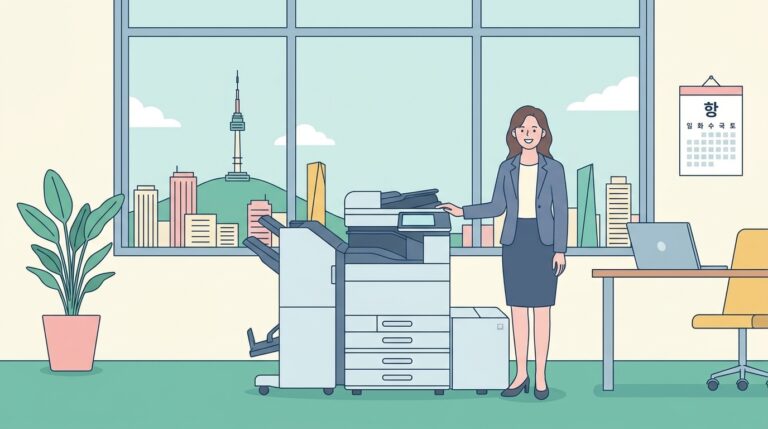
Survive Your First Day at a Korean Office: Easy Phrases to Master the Copy Machine
Phase 1: Empathy (Welcome to the Real Korean Office!)
안녕하세요! I’m your Daily Hangul editor, your trusted cultural navigator and Korean learning bestie! Picture this: It is 8:55 AM on your very first week at a dynamic office in Gangnam or Yeouido. Your team leader briskly turns to you and asks for ten copies of the quarterly project overview before the 9:00 AM kickoff. You dash over to the colossal multifunction photocopier in the corner. The screen is flashing rapidly with unfamiliar Korean letters, an ominous red light starts beeping, and you realize: the paper is jammed! Your heart races, your palms sweat, and your mind goes blank.
Take a deep breath! You are not alone. Every single Korean rookie—and every expat professional we have coached over the past ten years—has experienced this exact moment of sheer panic. Navigating office technology in another language can feel overwhelming, but mastering just a few authentic, bite-sized A1-level phrases will turn that intimidating printer into an opportunity to showcase your politeness and build instant rapport with your teammates. Let’s make you look like a seasoned office pro!
Phase 2: 3 Key Expressions Deep Dive
1. 복사해 주세요 (Boksahae juseyo)
- Pronunciation: [Bok-sa-hae ju-se-yo] (Sounds like “Boke-sah-hay joo-say-yo”, rhyming with poke-sa-hey)
- Meaning: Literal: “Please make copies” | Actual Nuance: “Could you please photocopy this?”
- K-Culture Moment: In the hit workplace K-Drama Misaeng: Incomplete Life (미생), rookie intern Jang Geu-rae is handed towering stacks of briefing packets with this quintessential phrase.
- Editor’s Insight: For A1 beginners, “주세요 (Juseyo)” is your ultimate golden ticket. Attaching it to the action noun “복사 (Boksa – copy)” creates a respectful, crystal-clear request that fits right into any modern workspace without sounding bossy.
- Situation Spectrum: Casual: 🚫 | Semi-formal: ⚠️ | Formal: ✅
- 🤔 Think About It: In English, we often ask “Can you copy this?” In Korean, asking directly with “~해 주세요” highlights your polite reliance on team cooperation rather than questioning the other person’s capability.
2. 종이가 걸렸어요 (Jong-iga geollyeosseoyo)
- Pronunciation: [Jong-i-ga geol-lyeo-sseo-yo] (Sounds like “Jong-ee-gah gull-yuh-ssuh-yo”)
- Meaning: Literal: “The paper got caught” | Actual Nuance: “There is a paper jam!”
- K-Culture Moment: In the workplace comedy drama Gaus Electronics, office chaos always erupts the second someone encounters a mysterious printer jam.
- Editor’s Insight: The verb “걸리다 (Geollida)” means to get trapped or stuck. Notice how Korean grammar describes the situation passively. You are not saying “I broke the machine”—you are simply stating that the paper got caught. It eliminates blame instantly!
- Situation Spectrum: Casual: ⚠️ | Semi-formal: ✅ | Formal: ✅
- 🤔 Think About It: Notice the emotional relief of using passive phrasing! By not saying “I jammed it,” you keep workplace interactions stress-free and collaborative.
3. 이거 어떻게 해요? (Igeo eotteoke haeyo?)
- Pronunciation: [I-geo eo-tteo-ke hae-yo] (Sounds like “Ee-guh uh-ttoh-kay hay-yo”)
- Meaning: Literal: “How do (I) do this?” | Actual Nuance: “Could you show me how to use this?”
- K-Culture Moment: The classic scene where a nervous newcomer timidly taps a friendly sunbae (senior) on the shoulder while clutching an unfamiliar piece of tech.
- Editor’s Insight: Point at the touchscreen, tray, or staple feeder and say this with a soft, inquiring pitch. Korean colleagues appreciate junior team members who ask for help early rather than wrestling silently with equipment.
- Situation Spectrum: Casual: ⚠️ | Semi-formal: ✅ | Formal: ✅
- 🤔 Think About It: In Korean corporate culture, asking how to do something shows an eager “배우려는 자세 (attitude to learn),” which is highly valued in newcomers.
Phase 3: Textbook Korean vs. Real Korean
Situation 1: Asking someone to handle a print job
📖 교과서 한국어 (Textbook Korean):“이 문서를 복사하십시오.” (I munseoreul boksahasipsio. – “Photocopy this document.”)🗣️ 진짜 한국어 (Real-World Korean):“이것 좀 복사해 주세요.” (Igeot jom boksahae juseyo. – “Could you please copy this for me?”)💡 왜 다를까? (Why is it different?):The textbook command ending “-하십시오” sounds overly rigid, almost like a military order or an automated system message. In real offices, inserting “좀 (jom – a little/please)” softens the tone wonderfully.
Situation 2: When the paper tray is empty
📖 교과서 한국어 (Textbook Korean):“기기 내부에 인쇄용지가 부족합니다.” (Gigi naebue inswe-yongjiga bujokhamnida. – “Printing media inside the device is insufficient.”)🗣️ 진짜 한국어 (Real-World Korean):“A4 용지 다 떨어졌어요!” (A-four yongji da tteoreojyeosseoyo! – “We’re completely out of A4 paper!”)💡 왜 다를까? (Why is it different?):Everyday professionals avoid stiff technical terms like “인쇄용지 (printing media)” and instead say “A4 용지 (A4 paper)” combined with the conversational verb “떨어지다 (run out)”.
Phase 4: K-Culture Deep Dive & Non-verbal Manners
4-1. 눈치 (Nunchi) & Office Gestures
When handing over freshly printed pages or receiving papers from a colleague, never use just one hand! Always use two hands (두 손), or place your left hand gently under your right wrist or elbow as a sign of respect. Furthermore, keep your 눈치 (social situational radar) active: if a senior manager (부장님 or 팀장님) approaches the printer while you are running a 50-page printout, immediately step aside with a slight bow and say, “먼저 하세요 (Please go ahead first).”
4-2. The Printing Station as a Social Oasis
In Korean office dramas like What’s Wrong with Secretary Kim, the copy room is never just about hardware. It is the unofficial office lounge! Colleagues cross paths, chat about lunch menus, whisper company gossip, and de-stress. Rescuing someone from a stubborn paper jam is one of the fastest ways to gain an office ally in Korea.
Phase 5: Real Role-play Scenario
Setting: 9:15 AM in the 6th-floor printer corner. Assistant Manager Kim (김 대리님), holding an iced Americano and wearing an employee lanyard, walks over to refill her mug.
- You: 김 대리님, 혹시 바쁘세요?
(Gim daerinim, hoksi bappeuseyo? / “Assistant Manager Kim, are you busy by any chance?”)
🎭 Hesitantly clutching a stack of papers with both hands and bowing slightly -
김 대리: 아니요, 괜찮아요! 무슨 일 있어요?
(Aniyo, gwaenchannayo! Museun il isseoyo? / “No, I’m okay! What’s going on?”)
🎭 Pauses with a warm, encouraging smile -
You: 저… 이거 어떻게 해요? 복사기가 안 돼요.
(Jeo… igeo eotteoke haeyo? Boksagiga an dwaeyo. / “Um… how do I do this? The copier isn’t working.”)
🎭 Pointing nervously at the blinking red indicator light -
김 대리: 아, 종이가 걸렸어요? 제가 한번 볼게요.
(A, jong-iga geollyeosseoyo? Jega hanbeon bolgeyo. / “Ah, is the paper jammed? Let me take a look.”)
🎭 Sets down her coffee and smoothly unlatches the side panel -
You: 도와주셔서 정말 감사합니다!
(Dowajusyeoseo jeongmal gamsahamnida! / “Thank you so much for helping me!”)
🎭 Giving a polite, sincere 30-degree bow -
김 대리: 여기 2번 트레이에 종이가 걸렸네요. 이렇게 살살 빼면 돼요.
(Yeogi ibeon teureie jong-iga geollyeonneyo. Ireoke salsal ppaemyeon dwaeyo. / “Ah, the paper got caught here in tray 2. You just pull it out gently like this.”)
🎭 Carefully slides the crumpled sheet out without tearing it -
You: 아! 그렇게 하는군요. 이제 알겠어요.
(A! Geureoke haneungunyo. Ije algesseoyo. / “Ah! That is how you do it. Now I understand.”)
🎭 Nodding attentively with bright, relieved eyes -
김 대리: 다행이네요! 다음에도 모르면 언제든 편하게 물어보세요.
(Dahaeng-ineyoyo! Daeum-edo moreumyeon eonjedeun pyeonhage mureoboseyo. / “Glad that helped! Feel free to ask anytime if you get stuck again.”)
🎭 Flashes a cheerful thumbs up and takes a sip of coffee
🔀 Interactive Decision Point
Assistant Manager Kim just cleared the jam and the green light turned on. What is your next move?
- Option A: Say “감사합니다! 제가 다시 해볼게요.” (Thank you! I will try it again myself.) and bow politely.
- Option B: Say “오케이, 땡큐!” (Okay, thank you!) and walk away leaving your original sheets on the glass tray.
- Option C: Press all the blinking buttons on the console rapidly to see if the scanner responds.
Feedback:
* Choice A (Best! ⭐⭐⭐): Excellent! You expressed genuine gratitude using proper honorifics and displayed proactive initiative to complete your task.
* Choice B (Bad! ❌): Never use informal English slang with a senior colleague, and leaving your documents behind creates clutter for the next person!
* Choice C (Risk! ⚠️): Rapidly pressing buttons while the copier is re-calibrating can trigger system errors. Give the machine a moment to breathe!
Phase 6: 10-Second Emotional Shadowing Drill
Practice reading these out loud! Follow the rhythm pauses (/) and embody the emotion tagged before each line:
[😰 당황스럽고 조심스럽게 / Flustered & Cautious]
저… / 복사기가 / 안 돼요.
(Jeo… / boksagiga / an dwaeyo.)-
[💡 깨달음을 얻고 안도하며 / Enlightened & Relieved]
아! / 종이가 / 걸렸어요!
(A! / jong-iga / geollyeosseoyo!) -
[😊 정중하고 진심 어린 미소로 / Polite & Heartfelt]
도와주셔서 / 정말 / 감사합니다!
(Dowajusyeoseo / jeongmal / gamsahamnida!)
Phase 7: K-Culture Mini Dictionary
- 복사기 (Boksagi) | Photocopier / Multi-function Printer | The central office hardware hub where documents, scans, and spontaneous hallway chats occur.
- 이면지 (Imyeonji) | Scratch Paper / Single-sided Reuse Paper | Blank-backed paper collected in dedicated trays for internal drafts. A hallmark of eco-friendly Korean office culture!
- 토너 (Toneo) | Toner Cartridge | The ink unit. When the screen announces “토너 부족 (Toner low),” inform the administrative management team (총무팀).
- 종이 걸림 (Jongi geollim) | Paper Jam | The universal status alert shown on Korean digital control panels.
Phase 8: Survival Kit for Travelers & Expats
Top 3 Survival Phrases
- 인쇄 돼요? (Inswae dwaeyo?) – Can I print here?
(Pro Tip: Indispensable when stepping into a local stationery shop or neighborhood printing nook). - 스캔도 가능해요? (Seukaendo ganeunghaeyo?) – Is scanning also possible?
(Pro Tip: Great for urgent visa filings, passport copies, or official forms). - 흑백으로 해 주세요 (Heukbaeg-euro hae juseyo) – Please print in black and white.
(Pro Tip: Color printing is significantly more expensive; specifying black and white saves you money).
Editor’s Travel & Living Note
Don’t have access to a corporate office printer? No problem! Korea has automated, 24-hour self-service print kiosks all over university districts and subway stations. Look for automated storefronts like Print Cafe on your map app by searching [프린트카페 네이버 지도 검색]. You can plug in a USB or download files from your cloud storage, swipe an international credit card, and print without interacting with anyone!
Phase 9: “One Step Deeper” (Reflective Prompt)
In Korean corporate society, asking for assistance is not viewed as a sign of weakness or technical incompetence. Rooted in the communal spirit of “우리 (We / Together),” teams function as interconnected units where senior members naturally anticipate guiding newcomers through everyday hurdles. When you ask for guidance with sincere respect, you give your teammates a chance to mentor you, which builds mutual affection and trust (정, Jeong).
💬 Your Turn: Have you ever felt nervous asking for technical help at work or school? How does the workplace culture in your home country compare to Korea’s team-first mentality? Let’s talk in the comments below!
Phase 10: FAQ & Avoiding Misunderstandings
Q: Can I just say “도와줘 (Dowajwo)” when asking a coworker to unjam the machine?
A: Definitely not in a workplace! “도와줘” is intimate, informal language (반말) reserved only for close childhood friends. In any workplace environment, you should always say “도와주세요 (Dowajuseyo)” or the even more polite “도와주실 수 있으세요? (Dowajusil su isseuseyo?)”.
Q: What is the exact difference between 복사 (Boksa) and 인쇄 (Inswae)?
A: “복사 (Boksa)” refers specifically to duplicating a physical, paper-to-paper hard copy. “인쇄 (Inswae)” or “프린트 (Peurinteu)” refers to printing digital files directly from a computer or mobile phone.
Q: Where do Korean offices store spare reams of paper?
A: Extra paper is usually stacked directly beneath the printer trays or in the supply cabinet labeled “비품함 (Office Supplies Cabinet)”. If you can’t locate it, ask: “A4 용지 어디 있어요? (A-four yongji eodi isseoyo?)”.
🚨 Common Mistakes Alert Board
- Handing documents with one hand: Never pass printed packets to a senior teammate using a single hand while holding your smartphone. Always hold papers with both hands and incline your head slightly.
- Shouting across the open office: Yelling “복사기 고장 났어요! (The copier is broken!)” across the room creates unnecessary disruption. Walk up to a nearby peer and speak quietly.
- Leaving jammed scraps behind: If a sheet rips inside the machine rollers, do not leave it hidden inside. Inform a colleague right away so technical support can handle it properly.
Phase 11: Action Mission & Engagement
- 🥉 Bronze Mission (Solo Practice): Stand in front of your home printer or a mirror and repeat “종이가 걸렸어요!” out loud 5 times until the sounds flow effortlessly.
- 🥈 Silver Mission (Social Share): Record yourself saying “도와주셔서 감사합니다!” on your phone voice memo and share your pronunciation with our community using the tag #DailyHangulOffice!
- 🥇 Gold Mission (Real-World Test): Next time you visit a local Korean print shop or your workplace copy center, point to a function and ask a colleague or staff member: “이거 어떻게 해요?”.
🎮 K-Culture Mission:
Watch Episode 1 of the workplace drama Misaeng: Incomplete Life (미생). Notice the body language, respectful hand gestures, and tone used whenever the interns interact near the office equipment!
Phase 12: Interactive Quiz Challenge
Test your knowledge with these three quick questions!
- Situational Check: You need to print a 10-page document, but the machine screen blinks red and stops. What should you say to a colleague nearby?
- A) 복사하십시오! (Boksahasipsio!)
- B) 종이가 걸렸어요. (Jong-iga geollyeosseoyo.)
- C) 도와줘! (Dowajwo!)
- Fill in the Blank: “A4 용지가 다 ________.” (We are completely out of A4 paper.)
- A) 걸렸어요 (geollyeosseoyo)
- B) 떨어졌어요 (tteoreojyeosseoyo)
- C) 복사했어요 (boksahaesseoyo)
- True or False: In Korea, handing a freshly printed report to your manager using only one hand is considered normal and casual office etiquette.
- [True / False]
👉 Click to reveal answers & explanations!
-
Answer: B) 종이가 걸렸어요.
Explanation: Stating “종이가 걸렸어요” accurately and politely informs your colleague that paper is jammed without placing blame. Choice A is too commanding, and Choice C is informal speech. -
Answer: B) 떨어졌어요.
Explanation: The verb “떨어지다” idiomatically describes running out of office consumables like paper or coffee beans. -
Answer: False!
Explanation: Always present documents using both hands (두 손) to show respect and professional courtesy in Korean work environments.







