

Phase 1: 공감 (Story-Immersive Opening)
안녕하세요! 매일한글 에디터입니다.
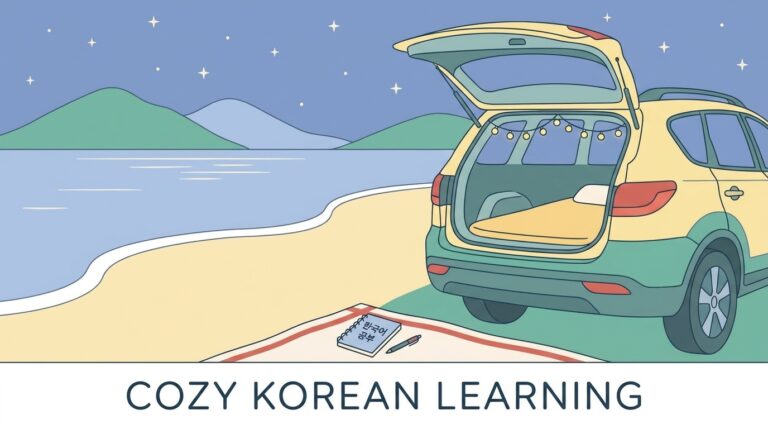
Imagine this: You have just rented a sleek SUV in Gangwon-do, inspired by those dreamy healing scenes in K-dramas where characters flip open their car trunk facing an ocean sunset, drape glowing fairy lights over the tailgate, and boil a steaming pot of ramyeon. But as dusk falls over the coastal pine grove, reality strikes. You pull up near a scenic beach spot, yet you notice subtle signs warning against unauthorized setups. Other Korean campers are parked nearby with their trunks open, yet nobody is pitching ground tents. You wonder: Can I actually sleep in my car here? Where do I plug in my electric blanket? How do I ask the campground manager if overnight vehicle stays are permitted without sounding like an absolute beginner?
If you have ever felt hesitant about diving into Korea’s booming outdoor subculture, you are not alone. Many intermediate learners know standard travel Korean, but outdoor slang and situational vocabulary in Korea move at lightning speed. Over the past five years, our Daily Hangul learners have constantly asked how to navigate local camping etiquette and car-stay culture—known locally as 차박 (Chabak). This curated guide draws directly from real-life camper feedback and local insider tips so you can turn your SUV into a cozy mobile oasis with confidence and respect.
Phase 2: 핵심 표현 3선 심층 분석 (Deep-Dive Core Expressions)
1. 차박 가능한가요? (한글)
- Pronunciation: Chabak ganeunghangayo? (Pronounce cha-bak like “cha” in “charm” followed by “bahk” like “bark” without the English hard R)
- Meaning: Literal: “Is car-sleeping possible?” / Nuance: “Is car camping (sleeping inside one’s vehicle overnight) permitted at this location?”
- K-Culture Moment: Frequently heard when travelers roll their camper vans into local seaside parking spots on variety shows like House on Wheels (바퀴 달린 집).
- Editor’s Insight: In Korea, pitch camping (야영) and vehicle-based camping (차박) are legally distinct in many coastal municipal zones. Asking 차박 가능한가요? immediately signals that you understand the local nuance, distinguishing you from tourists who simply set up unauthorized ground tents.
- Situation Spectrum: Casual: ⚠️ (Use 차박 돼? with peers) | Semi-formal: ✅ | Formal: ✅
- 🤔 Think About It: In English, we simply say “camp here.” Why did Korean culture create a dedicated compound word combining 차 (cha, car) and 박 (bak, overnight stay)? How does this reflect the rapid adaptation of urbanites seeking spontaneous nature getaways without heavy gear?
2. 평탄화 작업 (한글)
- Pronunciation: Pyeongtanhwa jageop (Think pyeong-tahn-hwa, where hwa sounds like “h-wah” in “what”, plus jah-geop)
- Meaning: Literal: “Leveling work” / Nuance: “The process of folding down car seats and leveling the floor into a flat bed”
- K-Culture Moment: The signature montage in YouTube camping vlogs where creators struggle to make back seats lie completely horizontal using custom boards or thick air mattresses.
- Editor’s Insight: If your car seats slope even five degrees, you will slide down in your sleeping bag all night! Intermediate learners will sound like seasoned pros when discussing vehicle specs: “이 차 완전 평탄화 돼요?” (Does this car fold completely flat?).
- Situation Spectrum: Casual: ✅ | Semi-formal: ✅ | Formal: ✅
- 🤔 Think About It: Korean outdoor culture places huge emphasis on precision and comfort gear (장비빨). How does the hyper-specific term 평탄화 reveal the societal love for optimized preparation?
3. 불멍 때리다 (한글)
- Pronunciation: Bulmeong ttaerida (Sounds like bool-meong tay-ree-dah; bul rhymes with “wool”, meong like “dung” with an M)
- Meaning: Literal: “To hit fire-daze” / Nuance: “To zone out peacefully while staring into a crackling campfire”
- K-Culture Moment: Mentioned in almost every K-Pop idol healing retreat vlog (such as BTS In the SOOP), where members sit in camp chairs silently gazing at burning wood.
- Editor’s Insight: The root 멍 때리다 means to zone out blankly. In fast-paced Korea, doing nothing is often accompanied by guilt, so Koreans invented legitimate sensory ways to relax: 물멍 (water-gazing), 숲멍 (forest-gazing), and the ultimate favorite, 불멍.
- Situation Spectrum: Casual: ✅ | Semi-formal: ⚠️ (Adjust to: 불멍 하고 있어요) | Formal: 🚫
- 🤔 Think About It: Why do you think modern Koreans needed to invent compound slang words specifically for the act of therapeutic zoning out?
Phase 3: 교과서 한국어 vs 진짜 한국어 (Textbook vs. Real Korean)
Situation 1: Asking if overnight car parking and camping is allowed
- 📖 교과서 한국어: 여기서 자동차에서 잠을 자도 됩니까? (Yeogiseo jadongcha-eseo jameul jado doebnikka? – “May one sleep inside an automobile here?”)
- 🗣️ 진짜 한국어: 여기 차박 해도 돼요? (Yeogi chabak haedo dwaeyo? – “Can we do chabak here?”)
- 💡 왜 다를까? Textbook Korean uses long-winded descriptive clauses. Native speakers immediately deploy the established compound noun 차박 paired with the pragmatic ending -해도 돼요?, which sounds friendly and conversational rather than robotic.
Situation 2: Suggesting starting the campfire to chill
- 📖 교과서 한국어: 모닥불을 피우고 멍하니 쳐다봅시다. (Modakbureul piugo meonghani cheodabopsida. – “Let us light a campfire and stare blankly.”)
- 🗣️ 진짜 한국어: 슬슬 장작 넣고 불멍 때릴까요? (Seulseul jangjak neoko bulmeong ttaerilkkayo? – “Shall we toss in firewood and start zoning out by the fire?”)
- 💡 왜 다를까? Natives naturally sprinkle in expressive adverbs like 슬슬 (gently, gradually/about time) and the trendy collocation 불멍 때리다 instead of stiff instructional imperatives.
Phase 4: K-Culture 딥다이브 & 비언어적 매너 (Culture Deep Dive & Etiquette)
4-1. 눈치 (Nunchi) & Non-Verbal Manners for Korean Car Camping
- Headlight Etiquette (스텔스 차박 모드): When pulling into a campsite or scenic lot after 8 PM, immediately turn off your vehicle headlights and switch to daytime running lights or parking lights. Blinding fellow campers relaxing in camp chairs is considered a major lack of 눈치 (situational etiquette).
- The Nodding Greeting (가벼운 목례): When setting up your trunk space close to another car, make brief eye contact, give a gentle two-second head bow, and say 안녕하세요 (Annyeonghaseyo). It marks you as a respectful neighbor sharing a tight communal outdoor zone.
- Trunk Button Dimming: Modern SUVs light up the trunk interior continuously when the tailgate remains open. Experienced Korean campers bring carabiners to latch the trunk lock mechanism shut, preventing battery drain and keeping bright interior LEDs from disturbing neighbors.
4-2. Cultural Code Analysis: 감성 캠핑 (Gamseong Camping) & Healing
In South Korea, car camping is rarely about roughing it in the wild; it is an extension of aesthetic home decor called 감성 (Gamseong – emotional vibe). Because most Koreans live in high-rise concrete apartment complexes, vehicle camping transformed into personal, customizable micro-real-estate. People pack wooden roll-top tables, vintage gas lanterns, and Bluetooth speakers playing acoustic indie tracks. Understanding 감성 캠핑 means recognizing that the ambiance, ambient lighting, and shared comfort food matter just as much as the destination itself.
Phase 5: 실전 롤플레이 시나리오 (Interactive Roleplay Scenario)
Setting: You have arrived at a pine-shaded seaside auto-campsite in Yangyang, Gangwon-do. Uncle Min (민 사장님), a genial camp host in a khaki bucket hat and fleece vest, strolls over with a clipboard.
- Turn 1 (민 사장님): 안녕하세요! 예약자 성함이 어떻게 되시나요? (Annyeonghaseyo! Yeyakja seonghami eotteoke doesinayo? – “Hello! What name is the reservation under?”)
- Turn 2 (You): 🎭 Checking your smartphone screen while smiling warmly
김민수 이름으로 예약했는데요, 오늘 차박 자리 맞죠? (Gim Minsu ireumeuro yeyakhaenneundeyo, oneul chabak jari matjyo? – “I booked under Kim Minsu. This is the spot for car camping, right?”) - Turn 3 (민 사장님): 네, 7번 사이트예요. 차 뒤쪽을 바다 쪽으로 대시면 뷰가 끝내줍니다. (Ne, chilbeon saiteuyeyo. Cha dwijjogeul bada jjogeuro daesimyeon byuga kkeunnaejumnida. – “Yes, Site 7. If you back your car toward the ocean, the view is spectacular.”)
- Turn 4 (You): 🎭 Nodding thoughtfully while glancing at your car’s power cable
감사합니다! 혹시 사이트에서 전기 사용 가능한가요? (Gamsahamnida! Hoksi saiteueseo jeongi sayong ganeunghangayo? – “Thank you! By any chance, is electricity accessible at the site?”) - Turn 5 (민 사장님): 배전함 바로 옆에 있어요. 단, 소비전력 600와트 넘는 고출력 전열기구는 차단기 내려가니까 조심하세요. (Baejeonham baro yeope isseoyo. Dan, sobijeonryeok yukbaekwateu neomneun gochullyeok jeonyeolgiguneun chadangi naeryeoganikka josimhaseyo. – “The distribution box is right next to it. But be careful: heaters exceeding 600 watts will trip the circuit breaker.”)
- Turn 6 (You): 🎭 Giving an understanding nod
네, 전기장판만 약하게 틀게요. 매너타임은 몇 시부터예요? (Ne, jeongijangpanman yak-hage teulgeyo. Maeneota-imeun myeot sibuteoyeyo? – “Understood, I’ll only use an electric heating mat on low. What time do quiet hours start?”) - Turn 7 (민 사장님): 밤 열 시부터니까, 그 전까지만 불멍 즐기시고 정리해 주세요. 쓰레기봉투는 여기 있습니다. (Bam yeol sibuteonikka, geu jeonkkajiman bulmeong jeulgisigo jeongnihae juseyo. Sseuregibongtuneun yeogi itseumnida. – “Starting at 10 PM. Please enjoy your campfire before then and wind down. Here is your trash bag.”)
- Turn 8 (You): 🎭 Receiving the bag with two hands politely
친절하게 알려주셔서 감사합니다. 깨끗하게 쓰고 갈게요! (Chinjeolhage allyeojusyeoseo gamsahamnida. Kkaekkeuthage sseugo galgeyo! – “Thank you for explaining so kindly. We’ll leave it spotless!”)
🔀 인터랙티브 분기점 (Interactive Choice Point)
It is 10:30 PM. Your neighbor’s car headlights are flashing brightly into your trunk bed while they pack gear with loud dance music playing. What do you do?
- Choice A: Walk up aggressively and shout: “지금 몇 시예요? 당장 불 끄세요!” (Do you know what time it is? Turn off the lights right now!)
- 👉 Feedback [Risk]: Far too aggressive. Causes extreme social embarrassment (갑분싸) and potential conflict. Campsite disputes in Korea are handled through polite indirect reminders or through the manager.
- Choice B: Walk over with an apologetic smile, clasp your hands slightly, and say: “저기 죄송한데, 매너타임이라 라이트랑 음악 소리 조금만 줄여주실 수 있을까요?” (Excuse me, sorry to bother you, but since it’s quiet hours, could you dim your lights and volume just a little bit?)
- 👉 Feedback [Best]: Perfect polite Korean communication. Uses softeners (죄송한데, 조금만) while clearly referencing the shared rule (매너타임).
- Choice C: Suffer in silence all night with a sleep mask and complain bitterly on online review boards the next morning.
- 👉 Feedback [Bad]: Ruins your healing trip completely! Polite communication solves 99% of these issues instantly in Korean camping grounds.
Phase 6: 10초 감정 섀도잉 드릴 (10-Second Emotion Shadowing Drill)
Practice matching the cadence, pausing at slashes (/), and adopting the emotional state indicated in brackets:
[😊 설레고 들뜬 목소리로 / Excited & Anticipatory]- “드디어 / 바다 앞에서 / 차박 한다! / 뷰 진짜 미쳤다!”
- Deudieo / bada apeseo / chabak handa! / Byu jinjja michyeotta!
- (“Finally, car camping right in front of the sea! This view is absolutely insane!”)
[😌 나른하고 편안하게 / Relaxed & Healing]- “장작 타는 소리 들으면서 / 불멍 때리니까 / 힐링 제대로 되네.”
- Jangjak taneun sori deureumyeonseo / bulmeong ttaerinikka / hilling jedaero doene.
- (“Listening to the crackling firewood while zoning out… this is genuine healing.”)
[🤝 정중하고 조심스럽게 / Respectful & Inquiring]- “사장님, / 혹시 여기 / 텐트 도킹 텐트도 / 쳐도 되나요?”
- Sajangnim, / hoksi yeogi / tenteu doking tenteudo / chyeodo doenayo?
- (“Boss, by any chance, are we allowed to pitch a trunk-docking tent here as well?”)
Phase 7: K-Culture 미니 사전 (Mini Dictionary)
- 차크닉 (Chakeunik)
- Translation: Car Picnic (차 + 피크닉)
- Usage: A daytime outing where you set up your car trunk with blankets, food, and music for an afternoon without sleeping overnight. Extremely popular along the Han River parks.
- 캠린이 (Kaemrini)
- Translation: Camping Newbie (캠핑 + 어린이)
- Usage: Self-deprecating term used when asking questions on outdoor forums: “캠린이라 그런데 난로 추천 부탁드려요” (I’m a total camping baby, please recommend a heater).
- 매너타임 (Maeneota-im)
- Translation: Campsite Quiet Hours (“Manner Time”)
- Usage: Usually between 10 PM and 7 AM at registered campsites. Loud music, bright lanterns, and heavy engine revving are strictly prohibited during this window.
- 클린캠핑 (Keullinkaemping)
- Translation: Clean Camping / Leave No Trace
- Usage: The golden principle of Korean chabak—taking every piece of garbage back home, including gray water and used charcoal ashes (흔적 남기지 않기).
Phase 8: 여행자를 위한 생존 키트 (Traveler’s Survival Kit)
Top 3 Survival Expressions
- “화장실이랑 개수대는 어디에 있어요?” (Hwajangsirirang gaesudaeneun eodie isseoyo?)
- Pro Tip: 개수대 (dishwashing sink) is essential vocabulary. Public restrooms are often separated from cookware cleaning stations.
- “시동 끄고 전기장판만 켜둘게요.” (Sidong kkeugo jeongijangpanman kyeodulgeyo.)
- Pro Tip: Reassures campsite neighbors that your noisy engine will not be idling all night.
- “종량제 봉투 어디서 살 수 있나요?” (Jongnyangje bongtu eodiseo sal su innayo?)
- Pro Tip: Official municipality trash bags (종량제 봉투) vary by county. Buying one at a nearby convenience store earns instant respect from campsite managers.
Editor’s Travel Note
- Navigation & Finding Legal Spots: Never park blindly on coastal roads. Check campsite apps like 캠핏(Camfit) 예약 플랫폼 확인하기 or search for “차박 전용 오토캠핑장” using the 네이버 지도 앱 확인하기.
- Rental Car Checklist: When renting via SoCar or Lotte Rent-a-Car, make sure to ask: “2열 완전 평탄화 지원되나요?” (Do the second-row seats fold completely flat?). Popular models like Hyundai Tucson, Santa Fe, and Kia Carnival are the gold standards for comfortable vehicle sleeping.
Phase 9: “한 발 더 깊이” (Cultural Reflection)
Korean outdoor culture reflects a captivating tension between ultra-modern density and an innate craving for communal mindfulness. In a country where apartment living demands constant awareness of footstep noise (층간소음) between neighbors, 차박 offers an autonomous bubble of personal space. Yet the moment you arrive at a campsite, the communal principle of 배려 (consideration) immediately reasserts itself through strict quiet hours and meticulous waste sorting. Car camping in Korea is not a rugged defiance of society, but rather an artful way of carrying civilized respect into the great outdoors.
💬 Your Turn: In your home country, is vehicle camping seen as rugged survivalism, a budget alternative, or an aesthetic lifestyle? How does the Korean concept of 불멍 compare to how you unwind by a fire? Share your thoughts below!
Phase 10: FAQ & 흔한 실수 경고 (FAQ & Common Mistakes)
Q: Can I do chabak for free at any Han River public park?
A: No. While daytime car picnics (차크닉) are common during allowed daytime hours, overnight sleeping inside cars and setting up tailgating gear overnight in Han River public parking lots is strictly prohibited and subject to municipal fines.
Q: How do campers stay warm in winter without running the vehicle engine?
A: Never keep an engine running overnight due to exhaust hazard and noise. Campers use a dedicated power bank (파워뱅크), 12V DC heating pads (탄소 온열매트), and certified cold-weather down sleeping bags. In auto-camping sites with electricity, 500W-limit electric blankets are standard.
Q: What is the difference between 노지 차박 and 오토캠핑장?
A: 노지 (Noji) refers to undeveloped wild lands (like natural beaches or riverbanks) with no electrical hookups or flush toilets. 오토캠핑장 (Auto campsite) has marked parking bays, electrical distribution boxes, shower rooms, and running water.
🚨 Common Mistakes (흔한 실수 TOP 3)
- Mistake: Burning firewood directly on public beaches or parking asphalt.
- Correct Action: Always use an elevated fire pit (화로대) and carry home your cooled ashes in a designated ash container or sealed bag.
- Mistake: Using charcoal briquettes or portable gas stoves inside a fully enclosed car.
- Correct Action: Fatal carbon monoxide hazard! Cooking must always be done outside, and portable carbon monoxide alarms (일산화탄소 경보기) must be hung near the car ceiling whenever using portable heating units.
- Mistake: Washing camp dishes in public beach hand-washing sinks.
- Correct Action: Public restrooms are strictly for hand hygiene. Always clean dishes at designated campsite sculleries (개수대) or wipe them with paper towels and wash at home.
Phase 11: 액션 미션 & 참여 유도 (Action Missions)
- 🥉 Bronze Mission (Solo Shadowing): Stand in front of your mirror and practice saying: “여기 차박 가능한가요?” three times with a confident, friendly smile.
- 🥈 Silver Mission (Social Media Spotting): Search the hashtag
#차박or#차크닉on Instagram. Find one aesthetic vehicle interior setup and identify three vocabulary items (e.g., 감성조명, 평탄화, 테이블). - 🥇 Gold Mission (Real-world Challenge): Next time you watch a Korean camping show (like House on Wheels or a camping vlog), listen closely and write down every time someone uses the term 불멍 or mentions 매너타임.
- 🎮 K-Culture Mission: Watch an episode of MBC’s I Live Alone (나 혼자 산다) featuring an outdoor trip. Notice how the cast arranges their car trunk cushions and food preparations!
Phase 12: 인터랙티브 퀴즈 챌린지 (Interactive Quiz Challenge)
1. Situation Judgment Quiz
You pull into an auto-campsite at 10:15 PM. You want to make your dinner quickly. What is the most culturally considerate decision?
* (A) Crank up the Bluetooth speaker so other campers hear you apologizing for being late.
* (B) Avoid chopping loud food or using loud gas burners; quietly prepare a simple meal and keep headlights switched off.
* (C) Run the car engine to power an 1800W induction cooker.
2. Fill-in-the-Blank
캠핑장에서는 밤 10시 이후 조용히 해야 하는 [ ________ ]을(를) 꼭 지켜야 합니다.
(At campsites, you must observe [ ________ ], which requires quiet after 10 PM.)
3. True or False Cultural Quiz
In Korea, leaving your trash bags tied up next to a public telephone pole on a wild beach after 차박 is considered acceptable as long as it’s neatly bundled.
* (True / False)
👉 Click to view answers and explanations!
- Answer: (B) – At 10:15 PM, 매너타임 has already commenced. Minimizing noise and disabling bright vehicle beams is standard Korean camp etiquette.
- Answer: 매너타임 (Manner Time / Quiet Hours) – The golden rule of all shared Korean campgrounds.
- Answer: False – This is illegal fly-tipping (무단 투기). Responsible Korean campers practice 클린캠핑 (Clean Camping), hauling every shred of garbage back to their own district or utilizing paid official trash bags within designated campground dumping facilities.







