

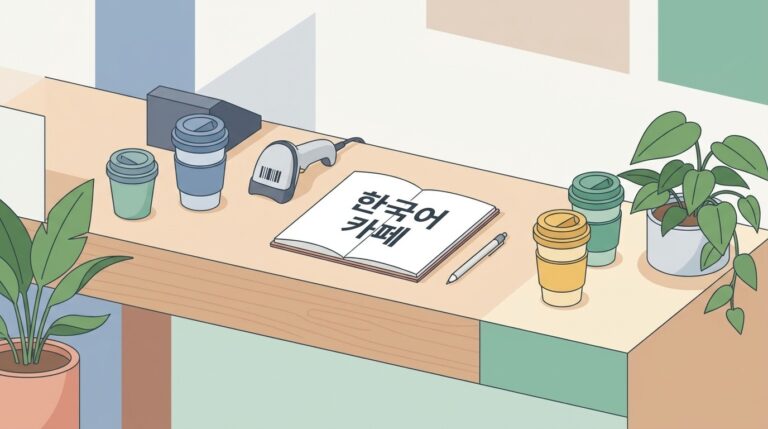
Why Your Iced Americano Costs 300 Won More: Mastering Korea’s Plastic Cup Deposit System
Phase 1: 공감 (Storytelling Opening)
안녕하세요! 매일한글 에디터입니다.
Picture this: You are exploring the breezy coastal streets of Jeju Island or strolling through the administrative hub of Sejong City. You step into a cozy, aesthetic cafe to quench your thirst with the nation’s unofficial soul drink—an icy Ah-Ah (아이스 아메리카노). The menu board clearly reads 4,500원, but when the friendly barista swipes your card, the notification pings: 4,800원.
Wait, did they just overcharge you? Did you accidentally pick a premium bean? Before you panic or quietly retreat into polite confusion, take a deep breath. You haven’t been scammed! You’ve just met Korea’s 일회용 컵 보증금 제도 (Single-use Cup Deposit System). That extra 300 won is simply a temporary security deposit for the plastic cup—and you can get every single won back if you know what to say.
Many intermediate Korean learners freeze here because standard textbook dialogues only teach you how to ask “How much is it?” (Eolmayeyo?). They don’t prepare you for civic policies, app-based barcodes, and eco-refund vocabulary. As your local culture navigator with 10 years of guiding expats through Korea’s hyper-organized recycling ecosystem, I’m here to ensure you never leave money behind at a cafe counter again. Let’s turn this mildly awkward moment into your most confident, eco-friendly Korean flex!
Phase 2: 핵심 표현 3선 심층 분석 (Core Expressions)
1. 보증금 포함된 가격인가요?
- Pronunciation: [Bojeunggeum pohamdoen gagyeog-ingayo?] (Pronunciation tip: Say ‘Bo-jeung-geum’ with a tight, bouncy ‘g’ sound, like ‘gum’ in English.)
- Meaning: “Is the deposit included in the price?”
- K-Culture Moment: You will hear this exact cadence in office K-Dramas like Misaeng or Extraordinary Attorney Woo, when colleagues pick up a massive tray of 8 iced lattes for team meetings and need to balance company card receipts down to the single won.
- Editor’s Insight: The noun 보증금 (bojeunggeum) means “deposit.” While Koreans use it for rental housing deposits (which run into thousands of dollars!), here it refers specifically to the nominal 300-won eco-deposit. Using 포함되다 (pohamdoeda – to be included) marks you as a sophisticated B2 speaker.
- Situation Spectrum: Casual ⚠️ | Semi-formal ✅ | Formal ✅
- 🤔 Think About It: In many Western countries, recycling surcharges (like bottle bills) are quietly folded into item retail prices. Why does Korean society highlight the deposit separately on the receipt?
2. 이 컵 반납하고 보증금 돌려받을 수 있나요?
- Pronunciation: [I keop bannaphago bojeunggeum dollyeobadeul su innayo?]
- Meaning: “Can I return this cup and get my deposit back?”
- K-Culture Moment: Seen frequently in vloggers’ travel clips across Jeju Island. When tourists finish their beverage after walking along the Olle Trail, they step into any participating franchise to cash out the reusable cup.
- Editor’s Insight: Notice the compound construction: 반납하다 (bannaphada – to return a borrowed/rented object) + 고 (-go – and) + 돌려받다 (dollyeobatta – to receive back). In Korean, civic transactions often pair the action of returning with the specific act of receiving reimbursement.
- Situation Spectrum: Casual ⚠️ | Semi-formal ✅ | Formal ✅
- 🤔 Think About It: Notice the difference between hwanbulhada (refund for a returned purchase) and dollyeobatta (getting your own held collateral back). Language reflects legal ownership!
3. 바코드 찍고 계좌로 환불해 주세요.
- Pronunciation: [Bakodeu jjikgo gyejwaro hwanbulhae juseyo.] (Pronunciation tip: ‘Jjikgo’ has a crisp, sharp double-J sound like ‘tch-ee-k’ followed by a firm stop.)
- Meaning: “Please scan the barcode and refund it to my account.”
- K-Culture Moment: When a trendy tech-savvy Korean student walks up to an unmanned recycling kiosk or cafe counter, pulls out their smartphone showing the Resource Circulation App barcode, and taps it smoothly.
- Editor’s Insight: The verb 찍다 (jjikda) literally means to stamp, print, or chop, but in modern retail it universally means “to scan” a barcode or QR code. 계좌 (gyejwa) means bank account.
- Situation Spectrum: Casual 🚫 | Semi-formal ✅ | Formal ✅
- 🤔 Think About It: Korea’s cashless, hyper-digital infrastructure allows a 300-won micro-refund to transfer to your bank in less than two seconds. How does this compare with the recycling systems in your home country?
Phase 3: 교과서 한국어 vs 진짜 한국어 (Textbook vs. Real-World)
Situation 1: Returning the cup at the pickup counter
- 📖 교과서 한국어 (Textbook):
저 이 일회용 컵을 반환하겠습니다. (Jeo i ilhoeyong keobeul banhwanhagesseumnida.) — “I shall return this single-use cup.” - 🗣️ 진짜 한국어 (Real-World):
컵 반납할게요! 보증금 현금으로 받을 수 있어요? (Keop bannaphalgeyo! Bojeunggeum hyeongeumeuro badeul su isseoyo?) — “Returning a cup! Can I get the deposit in cash?” - 💡 왜 다를까? (Why the difference?):
“반환 (banhwan)” sounds like a formal declaration from a legal contract or a diplomatic treaty. Real native speakers use the active verbal ending ~할게요 (~halgeyo – I will do…) with 반납 (bannap) to announce their intent politely.
Situation 2: Inquiring if a take-out order has the extra fee
- 📖 교과서 한국어 (Textbook):
이 음료의 결제 금액에 보증금이 부과되어 있습니까? (I eumnyo-ui gyeolje geumaeg-e bojeunggeumi bugwadoeeo itsseumnikka?) — “Is the deposit levied upon the payment amount of this beverage?” - 🗣️ 진짜 한국어 (Real-World):
테이크아웃 하면 컵 보증금 따로 붙나요? (Teikeu-aut hamyeon keop bojeunggeum ttaro bungnayo?) — “If I do takeout, is the cup deposit added separately?” - 💡 왜 다를까? (Why the difference?):
Koreans rely on dynamic, spatial verbs. Instead of the formal Sino-Korean 부과되다 (to be levied), locals ask if the cost 붙다 (butda – to stick / be attached).
Phase 4: K-Culture 딥다이브 & 비언어적 매너 (Deep Dive & Manners)
4-1. 눈치 (Nunchi) & Counter Etiquette
Returning a deposit cup isn’t just about handing over dirty plastic. To display top-tier Korean nunchi:
1. Empty and Rinse: Never return a cup half-full of melted ice or soggy boba. Dump the liquid in the waste receptacle (퇴식구) first.
2. Strip the Accessories: The deposit applies strictly to the cup! Peel off the plastic lid (뚜껑), pull out the straw (빨대), and toss them in the designated bin. Present only the cup.
3. Show the Sticker: Look for the small blue-and-white security barcode sticker on the side of the cup. Rotate the cup so this barcode faces the barista or the kiosk scanner. Handing it over barcode-first saves everyone time and earns you an appreciative nod from the staff!
4-2. Cultural Code: The Evolution of Korea’s Green Cafe Culture
South Korea ranks among the world’s top consumers of coffee per capita. With the beloved lifestyle concept of Eol-Juk-Ah (얼어 죽어도 아이스 아메리카노 — “Freezing to death, but still drinking iced Americano”), millions of plastic cups were discarded daily.
To combat this, the government piloted the 자원순환보증금 (Resource Circulation Deposit System), primarily testing in Jeju and Sejong. Major franchises in Seoul also implement reusable container systems (like Dahweyong Cup systems). Today, returning cups is viewed as basic civic etiquette rather than penny-pinching. You are partaking in Korea’s collective communal responsibility!
Phase 5: 실전 롤플레이 시나리오 (Real-World Roleplay)
Setting: A sun-drenched cafe near Sejong Government Complex.
Characters:
* Leo (레오): An intermediate-level expat exploring the city.
* Minji (민지): An energetic barista handling a busy morning rush.
Turn 1
민지: 어서 오세요! 주문 도와드릴까요?
(Eoseo oseyo! Jumun dowadeurilkkayo?)
“Welcome! Can I help you order?”
🎭 (Hands resting on the POS register, smiling warmly)
Turn 2
레오: 아이스 아메리카노 한 잔 테이크아웃이요. 혹시 컵 보증금 포함된 가격인가요?
(Aiseu amerikano han jan teikeu-aut-iyo. Hoksi keop bojeunggeum pohamdoen gagyeog-ingayo?)
“One Iced Americano to-go, please. By any chance, is the cup deposit included in this price?”
🎭 (Points lightly toward the price board while making eye contact)
Turn 3
민지: 네, 음료 가격에 일회용 컵 보증금 삼백 원이 추가로 결제돼요. 다 드시고 반납하시면 돌려받으실 수 있어요!
(Ne, eumnyo gagyeoge ilhoeyong keop bojeunggeum sambaek won-i chugaro gyeoljedaeyo. Da deusigo bannaphasimyeon dollyeobadeusil su isseoyo!)
“Yes, a 300-won single-use cup deposit will be added to the drink price. If you return it after drinking, you can get it back!”
🎭 (Taps the 300 won deposit icon on the screen)
Turn 4
레오: 아, 그렇군요! 그럼 영수증이랑 같이 결제해 주세요.
(A, geureokgunyo! Geureom yeongsujeung-irang gachi gyeoljehae juseyo.)
“Ah, I see! Please ring it up and give me the receipt as well.”
🎭 (Hands over credit card with two hands)
(Two hours later, Leo finishes his coffee, empties the cup, removes the lid, and walks back to the counter)
Turn 5
레오: 저기요, 컵 반납하고 보증금 돌려받으려고 하는데요.
(Jeogiyo, keop bannaphago bojeunggeum dollyeobadeuryeogo haneundeyo.)
“Excuse me, I’d like to return this cup and get my deposit back.”
🎭 (Places the clean plastic cup on the return tray with the barcode facing Minji)
Turn 6
민지: 네, 컵 바코드 확인했습니다! 환불은 앱으로 받으시겠어요, 아니면 현금으로 드릴까요?
(Ne, keop bakodeu hwaginhaesseumnida! Hwanbureun aebeuro badeusigesseoyo, animyeon hyeongeumeuro deurilkkayo?)
“Great, I checked the cup barcode! Would you like the refund via the app, or shall I give you cash?”
🎭 (Beeps the barcode scanner over the cup sticker)
Turn 7
레오: 현금으로 환불해 주세요. 제가 아직 앱이 없어서요.
(Hyeongeumeuro hwanbulhae juseyo. Jega ajik aebi eopseoseoyo.)
“Please refund it in cash. I don’t have the app installed yet.”
🎭 (Smiles bashfully, gesturing with an apologetic half-nod)
Turn 8
민지: 네, 여기 삼백 원 돌려드렸습니다. 좋은 하루 보내세요!
(Ne, yeogi sambaek won dollyedeoryeotseumnida. Joeun haru bonaeseyo!)
“Sure, here is your 300 won back. Have a wonderful day!”
🎭 (Neatly hands over three 100-won coins with both hands)
🔀 인터랙티브 분기점 (Branching Decision)
At Turn 7, Minji asks how you want your refund. How do you respond?
- Option A: “아무거나요! 그냥 알아서 주세요.” (Whatever! Just give it however you want.)
- Feedback [Bad 🚫]: Saying amugeonayo (whatever) sounds blunt and dismissive to service staff. Staff must register the refund method specifically in the POS system.
- Option B: “자원순환보증금 앱 바코드 찍고 계좌로 넣어 주세요.” (Please scan my Resource Circulation App barcode and send it to my bank account.)
- Feedback [Best ⭐]: Ultra-slick B2 mastery! If you have the official COSMO app, this deposits the 300 won directly to your linked Korean bank balance instantly.
- Option C: “그냥 카드 취소해서 삼백 원 빼 주세요.” (Just cancel my credit card transaction and deduct 300 won.)
- Feedback [Risk ⚠️]: While logical in theory, standard Korean retail POS systems cannot easily process a partial 300-won cancellation on a finalized card transaction. It will cause severe system confusion for the barista.
Phase 6: 10초 감정 섀도잉 드릴 (Emotional Shadowing Drill)
Read these aloud, pausing at the / marks and channeling the indicated mood!
[😊 명쾌하고 상냥하게 - Cheerful & clear]
“테이크아웃 할게요! / 혹시 컵 보증금 / 포함된 가격인가요?”
(Teikeu-aut halgeyo! / Hoksi keop bojeunggeum / pohamdoen gagyeog-ingayo?)-
[🤝 정중하고 자신감 있게 - Polite & confident]
“다 마신 컵 / 반납할게요. / 보증금은 / 현금으로 돌려받을 수 있나요?”
(Da masin keop / bannaphalgeyo. / Bojeunggeumeun / hyeongeumeuro dollyeobadeul su innayo?) -
[⚡ 빠르고 깔끔하게 - Crisp & native-speed]
“깨끗이 헹궈 왔어요. / 여기 바코드 / 찍어 주세요!”
(Kkaekkeusi henggwo wasseoyo. / Yeogi bakodeu / jjigeo juseyo!)
Phase 7: K-Culture 미니 사전 (Mini Dictionary)
-
자원순환보증금 (Ja-won-sun-hwan-bo-jeung-geum)
Translation: Resource Circulation Deposit.
Usage: The formal legal term for environmental deposits on disposable cups and beverage bottles. You will see this printed on receipts and official recycling kiosks. -
다회용기 / 다회용 컵 (Da-hoe-yong-gi / Da-hoe-yong keop)
Translation: Multi-use container / Reusable cup.
Usage: Increasingly popular in districts like Seoul City Hall. Unlike disposable cups with sticker barcodes, these are sturdy plastic tumblers provided by companies like Happy Habit that require a 1,000 won deposit. -
분리배출 (Bun-ri-bae-chul)
Translation: Segregated discharge (Sorting recyclables).
Usage: Beyond cafes, this word governs Korean daily life. It refers to separating paper, vinyl, plastic, and general waste according to national guidelines. -
무인 회수기 (Mu-in hoe-su-gi)
Translation: Unmanned return kiosk.
Usage: Automated machines found inside subways, government buildings, and Starbucks outlets where you insert the cup and scan your barcode without talking to a human.
Phase 8: 여행자를 위한 생존 키트 (Traveler’s Survival Kit)
Survival Expressions TOP 3
- “보증금 영수증 주세요.” (Bojeunggeum yeongsujeung juseyo.)
Pro Tip: In some pilot areas, you can redeem your refund using the barcode printed on the paper receipt if you lack the smartphone app. - “뚜껑이랑 빨대는 어디에 버려요?” (Ttukeong-irang ppaldaeneun eodie beoryeoyo?)
Pro Tip: “Where do I throw away the lid and straw?” Asking this prevents you from accidentally clogging the cup-only return machine. - “다른 매장 컵인데 여기서도 환불돼요?” (Dareun maejang keobinde yeogiseodo hwanbuldaeyo?)
Pro Tip: “This is a cup from another store, can I get a refund here too?” Cross-brand returns depend on the local municipal ordinance.
Editor’s Travel Note
If you plan to stay in Jeju or Sejong for more than a few days, search for and complete the 자원순환보증금 앱 다운로드 on Google Play or iOS App Store. The app provides a personal barcode that credits refunds directly to your account. Remember that KakaoPay and Naver Pay users can also link their balance for swift returns.
Phase 9: “한 발 더 깊이” (Cultural Essay)
To foreigners, paying 300 won extra and scrubbing a plastic cup in a cafe restroom can feel like unnecessary hassle. Yet, this system reflects Korea’s unique civic philosophy of 공동체 의식 (gongdongche uisik – communal consciousness). In a geographically compact, resource-poor nation, recycling isn’t viewed as a casual personal choice—it is a collective social contract.
Just as Koreans banded together during national crises, the society approaches climate challenges with rapid, structural coordination. When you take the extra minute to peel off a plastic sticker and return a cup, you are not merely reclaiming 300 won; you are actively participating in the Korean rhythm of communal respect.
💬 Your Turn: Does your home country charge deposits on takeout containers? Would you prefer an automated app refund or cash in hand? Drop your thoughts below!
Phase 10: FAQ & 흔한 실수 (FAQ & Common Mistakes)
Q: Can I return any plastic cup to any cafe in Korea?
A: No. The deposit system applies strictly to standard regulated cups featuring the official resource-circulation barcode sticker. Cups from unparticipating mom-and-pop cafes or cups with missing barcode stickers cannot be redeemed.
Q: What if I lose the plastic lid or bend the cup?
A: You will still receive your 300 won deposit! The lid is not part of the deposit valuation, and light physical denting is fine—as long as the blue-and-white barcode sticker on the cup remains intact and scannable.
Q: Is this cup deposit mandatory across the entire country of Korea?
A: Currently, the mandatory 300-won single-use cup deposit is concentrated primarily in Jeju Island and Sejong City, alongside voluntary participation across various university campuses and districts in Seoul. However, nationwide expansion remains under active policy review.
🚨 Common Mistakes Alert!
- Mistake 1: Trying to return an unrinsed cup containing ice/milk.
Correct Action: Empty fluids into the cafe drain or trash station first. Returning sticky cups is considered rude (sil-rye). - Mistake 2: Leaving the barcode sticker submerged in hot water.
Correct Action: If the thermal barcode sticker peels off or is damaged, the scanner cannot read it, and you forfeit your 300 won. - Mistake 3: Shoving the cup into general waste bins.
Correct Action: Look for dedicated collection bins or return kiosks to protect the circular ecosystem.
Phase 11: 액션 미션 & 참여 유도 (Action Missions)
- 🥉 Bronze Mission: Practice saying “컵 반납하고 보증금 돌려받을게요” aloud three times in front of the mirror with crisp diction.
- 🥈 Silver Mission: Next time you order coffee at a franchise, take a snapshot of your receipt and identify where the 300-won deposit (보증금) is listed. Share it on Instagram with the tag
#DailyHangulEco! - 🥇 Gold Mission: Walk into a participating cafe, complete a full takeout order and subsequent cup return entirely in Korean without switching to English!
- 🎮 K-Culture Mission: Watch a recent Korean lifestyle vlog set in Jeju and see if you can spot the colorful deposit return machines located at Jeju International Airport!
Phase 12: 인터랙티브 퀴즈 챌린지 (Interactive Quiz)
Q1. [상황 판단] Cafe counter staff hands you your iced tea. You want to verify if the 300 won deposit is already on the bill. What is the most natural B2-level phrase?
* A) 이거 돈 더 냈어요? (Igeo don deo naesseoyo?)
* B) 보증금 포함된 가격인가요? (Bojeunggeum pohamdoen gagyeog-ingayo?)
* C) 컵 값을 환불해 주십시오. (Keop gapseul hwanbulhae jusipsio.)
Q2. [빈칸 채우기] Fill in the blank with the appropriate B2 vocabulary:
“다 마신 컵은 깨끗이 씻어서 매장에 _________ 보증금을 돌려받을 수 있습니다.”
Q3. [True / False]
You must always retain the paper straw and plastic lid and present them together to claim your cup deposit. (T / F)
정답 확인하기 (Click to reveal answers & explanations)
- Q1 Answer: B)
Explanation: “보증금 포함된 가격인가요?” is the exact polite, natural inquiry used across Korean establishments. Option A is overly accusatory, and Option C is an awkward demand for a refund before drinking. - Q2 Answer: 반납해야 (bannaphaeya) / 반납하면 (bannaphamyeon)
Explanation: The verb 반납하다 (to return a rented/borrowed item) is the precise standard term for returning cups. - Q3 Answer: False (F)
Explanation: Only the cup bearing the certified barcode sticker is eligible and required for the deposit refund. Straws and lids should be separated and placed into the regular plastic/waste receptacles!







