

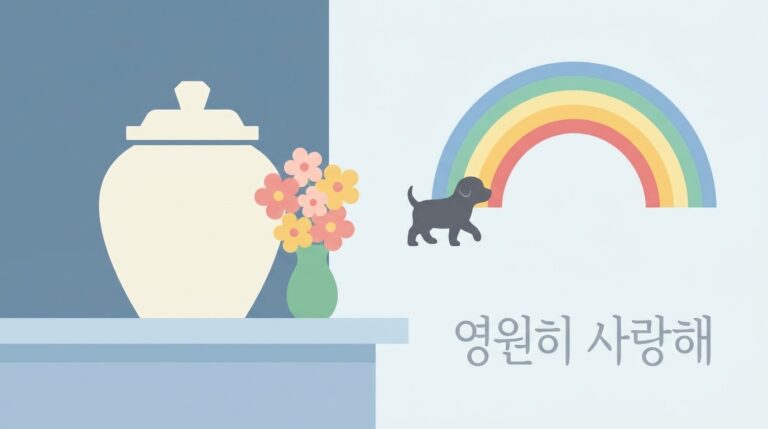
Phase 1: Empathy (Story-Driven Opening)
안녕하세요! 매일한글 에디터입니다. (Hello! This is your Daily Hangul editor.)
Picture this: You are having an evening tea with your Korean colleague, Ji-won, when you notice her eyes look exhausted and red. When you gently ask if everything is alright, she hesitates, looks down at her phone screen showing a sweet golden retriever, and whispers, “우리 보리가… 어제 무지개다리를 건넜어요.” (Uri Boriga… eoje mujigaedarireul geonneosseoyo. / “Our Bori… crossed the rainbow bridge yesterday.”) Her voice quivers as she shares that she spent the entire morning at a pet funeral facility (반려동물 장례식장) and has no idea how to process the overwhelming emptiness.
In that delicate moment, what do you say? If you revert to rigid textbook Korean like “그것 참 안됐네요” (That’s too bad) or clinical phrasing like “개가 죽어서 슬프겠어요” (You must be sad that the dog died), the warmth instantly vanishes. You might even inadvertently sound dismissive or cold. In modern South Korea, pets are rarely viewed as merely animals; they are genuine family members—반려가족 (companion family). Mourning a pet follows profound emotional codes, unique euphemisms, and heartfelt etiquette that even advanced learners often stumble upon.
Today, drawing from years of real-life intercultural mentoring and feedback from our advanced learners, we are diving deep into the sensitive, compassionate world of Korean pet bereavement culture. By mastering these C1-level expressions and non-verbal nuances, you won’t just speak Korean—you will be able to sit with someone in their grief and offer genuine, unforgettable comfort.
Phase 2: Core Expressions (Deep Analysis of 3 Expressions)
1. 무지개다리를 건너다 (Muji-gae-da-ri-reul geon-neo-da)
- Pronunciation: [Moo-jee-gae-dah-ree-reul geon-nuh-dah] (Think of Moo like a cow’s moo, jee like a gym, gae like ‘get’ without the ‘t’, and geon-nuh sounding like ‘gun’ + ‘nut’ without the ‘t’)
- Meaning: Literally “To cross the rainbow bridge” | Actual Nuance: The universal, poetic, and most respectful way to express that a beloved pet has passed away peacefully.
- K-Culture Moment: Seen ubiquitously in variety shows like TV Animal Farm (TV 동물농장) or celebrity vlogs when mourning a pet. A host will say: “오랜 시간 가족 곁을 지킨 아이가 어제 별이 되어 무지개다리를 건넜습니다.” (The little one who stayed by the family’s side for so long crossed the rainbow bridge and became a star yesterday.)
- Editor’s Insight: Never use crude verbs like “죽다” (to die) when speaking of someone’s pet. In modern Korea, pets cross the rainbow bridge or “별이 되다” (become a star). Using this phrase acknowledges the owner’s deep emotional bond and conveys that the pet has transitioned to a pain-free paradise.
- Situation Spectrum: Casual ✅ | Semi-formal ✅ | Formal ✅ (When referring to pets, this is standard across all registers)
- 🤔 Think About It: Does your native culture use poetic euphemisms for pet loss, or is the language more direct? How does attributing an afterlife journey (무지개다리) reshape our respect for animal souls?
2. 좋은 곳으로 갔을 거예요 (Joeun goseuro gasseul geoyeyo)
- Pronunciation: [Joh-eun go-seu-roh gah-sseul guh-yeh-yoh] (Sound analogy: Joh-eun flows like “joe” + soft “un”, gas-seul resembles “got” said smoothly with an ‘s’ sound)
- Meaning: Literally “They must have gone to a good place” | Actual Nuance: “They are in a better, peaceful place now—free from pain.”
- K-Culture Moment: In K-Dramas where a main character loses their childhood dog, a trusted senior colleague hands over a warm beverage and says: “스스로 너무 자책하지 마요. 분명 좋은 곳으로 가서 편히 쉬고 있을 거예요.” (Don’t blame yourself. I’m certain they went to a good place and are resting peacefully.)
- Editor’s Insight: Pet owners almost always suffer from intense guilt (죄책감), wondering if they could have detected the illness earlier or loved the pet more. This expression shifts focus away from earthly suffering and soothes the mourner’s guilt by affirming the pet’s eternal peace.
- Situation Spectrum: Casual ✅ | Semi-formal ✅ | Formal ⚠️ (Slightly warmer and softer than rigid formal condolences)
- 🤔 Think About It: Why is reassuring a grieving friend that their pet is “in a good place” more powerful than simply telling them “don’t be sad”?
3. 마음 잘 추스르세요 (Maeum jal chuseureuseyo)
- Pronunciation: [Mah-eum jal choo-seu-reu-seh-yoh] (Sound analogy: Choo as in “choose”, seu-reu rhymes with a gentle European “sir-ruh”)
- Meaning: Literally “Please gather/tuck in your mind well” | Actual Nuance: “Please take gentle care of your heart and give yourself time to heal.”
- K-Culture Moment: Written in condolence cards or discreet KakaoTalk messages sent to a friend on pet bereavement leave (반려동물 장례 휴가): “갑작스러운 이별이라 경황이 없으실 텐데, 모쪼록 마음 잘 추스르시길 바랍니다.” (It was such a sudden parting, you must be overwhelmed; I sincerely hope you can take gentle care of your heart.)
- Editor’s Insight: The verb 추스르다 means to tidy up disordered hems or lift oneself up after a collapse. It implies that grief naturally disarrays one’s composure, so there is no rush—one must lovingly gather one’s emotional state together piece by piece.
- Situation Spectrum: Casual ⚠️ (With close friends, 마음 잘 추슬러 is used) | Semi-formal ✅ | Formal ✅
- 🤔 Think About It: Contrast the phrase “Get over it” with “Gather your heart gently.” Notice how Korean linguistic imagery treats grief as fragile silk that needs delicate folding rather than an obstacle to simply overcome.
Phase 3: Textbook Korean vs. Real Korean
Situation 1: Offering Condolences for Pet Loss
- 📖 교과서 한국어 (Textbook): 개가 세상을 떠나서 유감스럽습니다. (Gae-ga se-sang-eul tteo-na-seo yu-gam-seu-reop-seum-ni-da. / It is regrettable that your dog departed this world.)
- 🗣️ 진짜 한국어 (Real-world C1): 소식 듣고 정말 가슴이 덜컥 내려앉았어요. 아이가 떠나서 집안이 많이 적적하시겠어요. (So-sik deut-go jeong-mal ga-seum-i deol-keok nae-ryeo-an-jass-eo-yo. A-i-ga tteo-na-seo jib-an-i man-i jeok-jeok-ha-si-gess-eo-yo. / My heart sank when I heard the news. The house must feel so terribly quiet and empty without your little one.)
- 💡 왜 다를까? (Why the difference?): Koreans rarely refer to someone’s companion pet as “개” (dog) in emotional contexts; they use “아이” (child/baby) or their pet’s name. Phrases like “가슴이 덜컥 내려앉다” (one’s heart sinks) and “적적하다” (the melancholic, quiet emptiness of an empty space) reflect native sensory empathy.
Situation 2: Talking About Memorial Remains or Ashes
- 📖 교과서 한국어 (Textbook): 동물 병원에서 시체를 소각 처리했습니다. (Dong-mul byeong-won-e-seo si-che-reul so-gak cheo-ri-haess-seum-ni-da. / We incinerated the corpse at the veterinary hospital.)
- 🗣️ 진짜 한국어 (Real-world C1): 장례식장에서 정성껏 화장해 주고, 유골은 메모리얼 스톤으로 만들어 곁에 두기로 했어요. (Jang-nye-sik-jang-e-seo jeong-seong-kkeot hwa-jang-hae ju-go, yu-gol-eun me-mo-ri-eol seu-ton-eu-ro man-deul-eo gyeot-e du-gi-ro haess-eo-yo. / We held a cremation with care at the pet funeral parlor, and decided to transform the ashes into a memorial stone to keep close by.)
- 💡 왜 다를까? (Why the difference?): Words like “시체” (corpse) or “소각” (incineration) feel industrial, medical, and emotionally callous. Pet owners use dignified funeral terms like “화장” (cremation), “정성껏 보내주다” (to send off with devotion), and “메모리얼 스톤” (memorial gem).
Phase 4: K-Culture Deep Dive & Non-Verbal Manners
4-1. 눈치 (Nunchi) & Gestures: Navigating Pet Bereavement
When visiting a Korean friend who has experienced pet loss, non-verbal cues (비언어적 태도) are everything:
* The Lowered Gaze & Silent Nod: When they speak of their pet, do not stare aggressively into their eyes demanding emotional disclosures. Maintain a gentle, 45-degree lowered gaze with slow, empathetic head nods.
* The Fatal Faux Pas: Never utter dismissive lines like “그래도 개잖아” (It’s just a dog), “새로 한 마리 입양하면 되지” (You can just adopt another one), or “나이가 많았으니 갈 때 됐지” (It was old anyway, time to go). In Korean society, this marks you as fundamentally devoid of 눈치 (situational emotional intelligence) and disrespectful toward their family bond.
* Warm Silence Over Cliché Advice: If you run out of words, placing a warm beverage in both hands while saying “많이 힘들죠…” (It must be so hard…) followed by listening in quiet solidarity is viewed as the height of maturity.
4-2. Cultural Code: The Pet Funeral Boom & Rituals in Korea
South Korea has witnessed a seismic demographic shift with over 15 million pet guardians (반려인). This has birthed specialized, legally certified pet funeral facilities (정식 등록 반려동물 장례식장).
* Buddhist Heritage Meets Pet Loss: Many pet guardians conduct the 49재 (Sip-gu-jae—a traditional 49-day Buddhist mourning ritual to guide the soul toward reincarnation), offering the pet’s favorite treats and dried pollack (북어국) at small altars.
* From Ashes to Gems: Because burying pet remains in public grounds is illegal in Korea and apartment living makes backyard burials impossible, guardians opt for clean cremation followed by the creation of 메모리얼 스톤 (memorial stones/gems—ashes melted into colorful, odorless pebbles) or keeping an elegant 유골함 (ceramic urn) inside a specialized 봉안당 (columbarium).
Phase 5: Real-Life Roleplay Scenario
Setting: A tranquil reception lounge of an aesthetic pet funeral parlor in Gyeonggi-do. Soft instrumental piano plays in the background. Min-jun (민준), whose 14-year-old rescue maltese ‘Dudu’ (두두) passed away yesterday, sits cradling a small ceramic urn wrapped in ivory silk cloth.
- Turn 1 (Learner):
- Korean: 민준 씨, 소식 듣고 바로 달려왔어요. 얼굴이 많이 상하셨네요…
- Romanization: Min-jun ssi, so-sik deut-go ba-ro dal-lyeo-wass-eo-yo. Eol-gul-i man-i sang-ha-syeon-ne-yo…
- English: Min-jun, I rushed right over after hearing the news. You look so worn out and pale…
- 🎭 Action: Hands over a warm, soothing cup of barley tea with both hands while speaking softly.
- Turn 2 (Min-jun):
- Korean: 와줘서 고마워요… 어제 새벽에 갑자기 숨이 가빠지더니… 손쓸 틈도 없이 무지개다리를 건넜어요.
- Romanization: Wa-jwo-seo go-ma-wo-yo… eo-je sae-byeog-e gap-ja-gi sum-i ga-ppa-ji-deo-ni… son-sseul teum-do eop-si mu-ji-gae-da-ri-reul geon-neoss-eo-yo.
- English: Thank you for coming… In the early hours of yesterday his breathing suddenly grew shallow… Before I could even do anything, he crossed the rainbow bridge.
- 🎭 Action: Wipes a tear from his eye while looking down at the silk-wrapped urn.
- Turn 3 (Learner):
- Korean: 아이고, 세상에… 얼마나 놀라셨을까요. 그동안 민준 씨가 두두를 얼마나 지극정성으로 돌봤는지 다들 알아요.
- Romanization: A-i-go, se-sang-e… eol-ma-na nol-ra-syeoss-eul-kka-yo. Geu-dong-an Min-jun ssi-ga Du-du-reul eol-ma-na ji-geuk-jeong-seong-eu-ro dol-bwan-neun-ji da-deul al-a-yo.
- English: Oh dear, goodness… You must have been in such immense shock. Everyone knows how devotedly you cared for Dudu all these years.
- 🎭 Action: Sits down gently beside him, keeping a respectful distance.
- Turn 4 (Min-jun):
- Korean: 마지막 가는 길에 더 맛있는 것도 못 챙겨주고… 혼자 차가운 병원에 보낸 것 같아 죄책감이 너무 커요.
- Romanization: Ma-ji-mak ga-neun gil-e deo mas-iss-neun geot-do mot chaeng-gyeo-ju-go… hon-ja cha-ga-un byeong-won-e bo-naen geot gat-a joe-chaek-gam-i neo-mu keo-yo.
- English: I couldn’t even give him tastier treats on his final journey… I feel so guilty thinking I left him in that cold clinic all alone.
- 🎭 Action: Grips his trembling fingers tightly on the table.
- Turn 5 (Learner):
- Korean: 스스로 너무 자책하지 마세요. 두두는 민준 씨를 만나서 평생 넘치는 사랑을 받다 간 걸요. 분명 좋은 곳으로 갔을 거예요.
- Romanization: Seu-seu-ro neo-mu ja-chaek-ha-ji ma-se-yo. Du-du-neun Min-jun ssi-reul man-na-seo pyeong-saeng neom-chi-neun sa-rang-eul bat-da gan geol-yo. Bun-myeong jo-eun gos-eu-ro gas-seul geoy-e-yo.
- English: Please don’t blame yourself. Dudu met you and lived a life overflowing with boundless love. I know for sure he has gone to a beautiful place.
- 🎭 Action: Speaks with a warm, steady, reassuring cadence.
- Turn 6 (Min-jun):
- Korean: 그렇게 말해줘서 고마워요… 오늘 염습하고 화장까지 마치고 나니까 이제야 실감이 나네요.
- Romanization: Geu-reoh-ge mal-hae-jwo-seo go-ma-wo-yo… o-neul yeom-seub-ha-go hwa-jang-kka-ji ma-chi-go na-ni-kka i-je-ya sil-gam-i na-ne-yo.
- English: Thank you for telling me that… Only after finishing the shroud dressing and cremation today does it finally feel real.
- 🎭 Action: Takes a long, shaky breath, slightly loosening his tense shoulders.
- Turn 7 (Learner):
- Korean: 당분간은 마음이 많이 허전하고 적적하시겠지만, 억지로 참지 마시고 마음 잘 추스르세요.
- Romanization: Dang-bun-gan-eun ma-eum-i man-i heo-jeon-ha-go jeok-jeok-ha-si-gess-ji-man, eok-ji-ro cham-ji ma-si-go ma-eum jal chu-seu-reu-se-yo.
- English: Your heart will feel so empty and quiet for a while, but please don’t suppress your tears. Take gentle care of your heart.
- 🎭 Action: Bows head slightly in deep solidarity.
- Turn 8 (Min-jun):
- Korean: 네… 곁에 있어 줘서 정말 큰 위로가 돼요. 잊지 않을게요.
- Romanization: Ne… gyeot-e iss-eo jwo-seo jeong-mal keun wi-ro-ga dwae-yo. It-ji anh-eul-ge-yo.
- English: Yes… Having you by my side brings me tremendous comfort. I won’t forget this.
- 🎭 Action: Smiles faintly through misty eyes with genuine gratitude.
🔀 Interactive Branching Choice:
At Turn 5, Min-jun reveals his crippling guilt (죄책감). What would you reply next?
- Option A: “그래도 다른 강아지 입양하면 슬픔이 금방 잊힐 거예요.” (Still, if you adopt another puppy, you’ll forget the sadness quickly.)
- Option B: “스스로 너무 자책하지 마세요. 두두는 평생 사랑받은 기억을 안고 좋은 곳으로 갔을 거예요.” (Please don’t blame yourself. Dudu embraced a lifetime of love and went to a peaceful place.)
- Option C: “울어봤자 이미 떠난 개가 돌아오진 않으니 얼른 일상으로 복귀하세요.” (Crying won’t bring back a dead dog, so hurry and get back to your daily routine.)
Detailed Feedback:
* 🚫 Option A [Bad]: Suggesting replacement animals to someone grieving is a cardinal sin in contemporary pet etiquette. It invalidates the unique identity of the deceased pet.
* ✅ Option B [Best]: Perfect C1 empathy. You validate the pet’s joyful life, relieve the guardian’s toxic guilt, and deliver comfort through respectful euphemisms.
* ⚠️ Option C [Risk/Offensive]: Extremely insensitive. Telling a grieving Korean to snap out of it breaks emotional safety (공감대) and will severely rupture your relationship.
Phase 6: 10-Second Emotion Shadowing Drill
Sharpen your intonation and pacing by practicing these emotional markers. The slash (/) indicates a natural micro-pause for emotional breath control.
[🥺 깊은 위로와 울컥함 (Deep sorrowful empathy)]- “갑작스러운 소식에 / 가슴이 너무 먹먹해요… / 얼마나 상심이 크실까요.”
- (Gap-jak-seu-reon so-sik-e / ga-seum-i neo-mu meong-meok-hae-yo… / eol-ma-na sang-sim-i keu-sil-kka-yo.)
- Translation: At this sudden news / my chest feels so heavy and choked up… / how immense your heartbreak must be.
[🕊️ 잔잔하고 따뜻한 위로 (Gentle, serene soothing)]- “그곳에서는 아프지 않고 / 친구들과 / 신나게 뛰어놀고 있을 거예요.”
- (Geu-gos-e-seo-neun a-peu-ji anh-go / chin-gu-deul-gwa / sin-na-ge ttwieo-nol-go iss-eul geoy-e-yo.)
- Translation: Over there, free from pain / with good friends / they must be running and playing with delight.
[🤍 배려 깊은 권유 (Considerate, mindful blessing)]- “아이와의 따뜻한 기억만 남기시고, / 모쪼록 / 몸과 마음 잘 추스르시길 바라요.”
- (A-i-wa-ui tta-tteut-han gi-eok-man nam-gi-si-go, / mot-jjo-rok / mom-gwa ma-eum jal chu-seu-reu-si-gil ba-ra-yo.)
- Translation: Keeping only the warm memories of your little one, / by all means / I hope you gently take care of your body and soul.
Phase 7: K-Culture Mini Dictionary
- 펫로스 증후군 (Pet-ro-seu Jeung-hu-gun) | Pet Loss Syndrome
- Usage: A clinically recognized term across Korean psychology, media, and human resources. Used to describe severe depression, insomnia, and bereavement experienced after a pet dies. Many Korean companies now offer 반려동물 사별 휴가 (pet bereavement leave) to combat this syndrome.
- 봉안당 / 납골당 (Bong-an-dang / Nap-gol-dang) | Columbarium / Ossuary
- Usage: While historically used for human ashes, dedicated 반려동물 봉안당 (pet columbaria) are common in cities like Gimpo, Ilsan, and Gwangju. Families place the urn alongside the pet’s favorite squeaky toys, snacks, and framed photos.
- 메모리얼 스톤 (Me-mo-ri-eol Seu-ton) | Memorial Stone (Gem)
- Usage: Pure bone ash processed into smooth mineral pearls or gemstones (often called 루세떼 / Lucete). Because guardians can keep them at home without decay or moisture concerns, this term frequently appears in discussions on modern memorial options.
- 아이 (A-i) | Literally “Child”, figuratively “Beloved Pet”
- Usage: In everyday pet culture, owners rarely say “내 개” (my dog) or “우리 동물” (our animal). Instead, they tenderly call their pets “우리 아이” (our kid/baby). Referring to a friend’s pet as 아이 demonstrates top-tier cultural respect.
Phase 8: Survival Kit for Travelers & Expats
Survival Expressions TOP 3
- “아이가 무지개다리를 건너서 장례 절차를 알아보고 있어요.”
(A-i-ga mu-ji-gae-da-ri-reul geon-neo-seo jang-nye jeol-cha-reul al-a-bo-go iss-eo-yo.)
Pro Tip: Use this when calling animal hospitals or specialized services. It shows dignity and clarity. -
“정부 정식 등록된 합법 반려동물 장례식장인가요?”
(Jeong-bu jeong-sik deung-rok-doen hap-beop ban-ryeo-dong-mul jang-nye-sik-jang-in-ga-yo?)
Pro Tip: Critical legal check. Illegal mobile cremation vans exist; asking if they are 합법 등록 (legally registered) prevents exploitation. -
“유골을 수습해서 메모리얼 스톤으로 제작 가능한가요?”
(Yu-gol-eul su-seub-hae-seo me-mo-ri-eol seu-ton-eu-ro je-jak ga-neung-han-ga-yo?)
Pro Tip: If you plan to move abroad later, ask this early since international pet urn transport is subject to strict customs regulations, whereas certified stones are easier to travel with.
Editor’s Travel & Living Note
If you reside in Korea with a companion animal, keep a digital bookmark for the official national animal registry portal: 동물보호관리시스템 공식 웹사이트 확인하기. Under their licensed facilities tab, you can verify certified pet funeral providers (동물장묘업 등록업체). Remember that taking pet remains onto public transit (subway, regular city buses) without an enclosed carrier or covered urn is restricted, so consider booking a dedicated pet taxi (카카오 T 펫 / 펫택시) for serene transportation.
Phase 9: “한 발 더 깊이” (Reflective Humanities Essay)
Not long ago in Korean history, domestic animals were primarily categorized through utility: village watchdogs guarded the courtyards (마당개), and cats roamed the granaries to catch rodents. Yet, within a single generation, Korea’s hyper-dense urbanization, shrinking household sizes, and hyper-connected yet lonely modern lifestyles transformed these animals into indispensable emotional lifelines: 반려동물 (literally, animals that walk the journey of life with you).
When a companion pet passes away, the surrounding condolences echo the deeply ingrained Confucian concepts of 예의 (propriety) and 정 (unbreakable emotional attachment). In Korean linguistic thought, grief is not an individual’s private defect to be hidden away; it is a shared community responsibility. By offering respectful, refined honorifics to another person’s four-legged companion, you acknowledge that their small life held equal dignity, and that their mourning deserves the very same reverent space.
💬 Your Turn: Have you ever experienced pet loss, or supported a loved one through it? What phrase in your native tongue brings the deepest comfort, and how does it compare to the Korean idea of “gathering one’s disarrayed heart” (마음 추스르기)? Drop your reflections in the comments below!
Phase 10: FAQ & Avoiding Misunderstandings
Q: Can I send condolence money (조의금) to a Korean friend whose pet passed away?
A: While condolence money (부의금/조의금) is mandatory for human funerals in Korea, it is generally not expected or customary for pet funerals. Handing cash can sometimes make the guardian feel burdened. Instead, sending a curated flower basket (위로 꽃바구니), a heartfelt handwritten card, or a digital gift voucher for coffee/tea via KakaoTalk Gift (카카오톡 선물하기) with the message “따뜻한 차 한잔 마시며 힘내요” is considered much more thoughtful and appropriate.
Q: Is it disrespectful to use the verb “죽다” (to die) when talking about a pet?
A: In informal English, saying “my dog died” is common. However, in Korean conversation with the owner, saying “개가 죽었어요” sounds harsh, blunt, and emotionally disconnected. Always substitute it with “무지개다리를 건넜어요” (crossed the rainbow bridge), “떠났어요” (departed), or “별이 되었어요” (became a star).
Q: Can I bury my deceased pet in a scenic mountain or nearby park in Korea?
A: No, absolutely not. Under Article 8 of the Korean Waste Management Act and the Animal Protection Act, burying animal remains in public or unauthorized private land (including public mountains and parks) is strictly illegal and subject to heavy fines. Deceased pets must be cremated via registered pet funeral centers (반려동물 장례식장) or handled according to medical waste standards via veterinary clinics.
🚨 Common Mistakes (흔한 실수) Warning Board
- Calling the pet a ‘Dog/Cat’ instead of its name or ‘아이’
- Incorrect: “그 개는 나이가 몇 살이었어요?” (How old was that dog?)
- Correct Action: “그 아이는 몇 살이었어요?” or use the pet’s name: “두두는 몇 살이었어요?”
- Rushing into toxic positivity
- Incorrect: “이제 슬퍼하지 말고 웃으세요!” (Stop being sad and smile now!)
- Correct Action: “슬픈 마음이 드는 건 당연해요. 실컷 울고 그리워해도 괜찮아요.” (It is completely natural to feel sorrow. It is okay to cry and miss them all you need.)
- Using high-level archaic ancestral funeral terms meant exclusively for human elders
- Incorrect: “삼가 고견의 명복을 빕니다” (Over-formalized, clumsy mixing of human Buddhist obituary formulas).
- Correct Action: Keep it warm and sincere: “무지개다리 너머에서 편히 쉬기를 진심으로 기도할게요.” (I sincerely pray they rest in peace beyond the rainbow bridge.)
Phase 11: Action Missions & Engagement
- 🥉 Bronze Mission (Self-Practice): Record your voice on your phone reciting the Phase 6 shadowing sentences. Focus on maintaining a compassionate, soft, and unhurried cadence with appropriate breathing at the slash marks.
- 🥈 Silver Mission (Social Sharing): Write a mock condolence message in Korean for an imaginary friend whose cat crossed the rainbow bridge. Post it in the comments below or in your study notes using 무지개다리, 좋은 곳, and 추스르다.
- 🥇 Gold Mission (Real-world Empathy): Next time an acquaintance or Korean influencer on Instagram shares news of their pet passing, leave a polite comment using: “무지개다리 건너 좋은 곳에서 편히 쉬길 바랄게요. 마음 잘 추스르세요.” Witness how profoundly touched they will be.
- 🎮 K-Culture Mission: Watch an episode of SBS’s TV 동물농장 (TV Animal Farm) or search the hashtag
#무지개다리on Instagram. Observe the photos, customized urns, and the loving tributes Korean guardians write to their fur-babies.
Phase 12: Interactive Quiz Challenge
Test your mastery of Korean pet bereavement culture! Check your answers below.
1. Situational Judgment Quiz:
Your team manager looks devastated because his 15-year-old cat passed away this morning. Which response is the most culturally refined and comforting?
* (A) “부장님, 주말에 새로 예쁜 고양이 한 마리 분양받으러 가시죠!”
* (B) “부장님, 소식 듣고 마음이 너무 아팠어요. 그동안 아이가 큰 사랑 받고 떠났으니, 분명 좋은 곳으로 갔을 거예요.”
* (C) “고양이가 죽어서 유감입니다. 일에 집중하시면 금방 잊으실 겁니다.”
2. Fill-in-the-Blank Quiz:
Fill in the missing native verb that means to gently gather and heal one’s sorrowful heart:
“갑작스러운 이별이라 경황이 없으실 텐데, 모쪼록 마음 잘 (________)세요.”
3. True or False Culture Quiz:
(True / False): In South Korea, it is considered legally acceptable and traditional to bury your deceased pet under a tree in a quiet public mountain forest.
👉 Click to reveal answers & explanations!
Answers & Explanations:
- Answer: (B)
- Explanation: Option (A) is deeply offensive (suggesting replacement), while Option (C) is cold, mechanical, and suppresses grief. Option (B) affirms the pet’s beloved status (아이), acknowledges the guardian’s care, and uses the comforting idiom 좋은 곳으로 갔을 거예요.
- Answer: 추스르 (추스르다 -> 추스르세요)
- Explanation: 마음을 추스르다 is the quintessential Korean idiom for tenderly pulling oneself together during deep grief or trauma.
- Answer: False
- Explanation: Backyard or mountain burial in unauthorized ground is strictly prohibited by South Korean sanitation and waste management laws. Cremation through certified pet funeral homes (합법 반려동물 장례식장) is the legal and modern norm.
- Explanation: Backyard or mountain burial in unauthorized ground is strictly prohibited by South Korean sanitation and waste management laws. Cremation through certified pet funeral homes (합법 반려동물 장례식장) is the legal and modern norm.







