

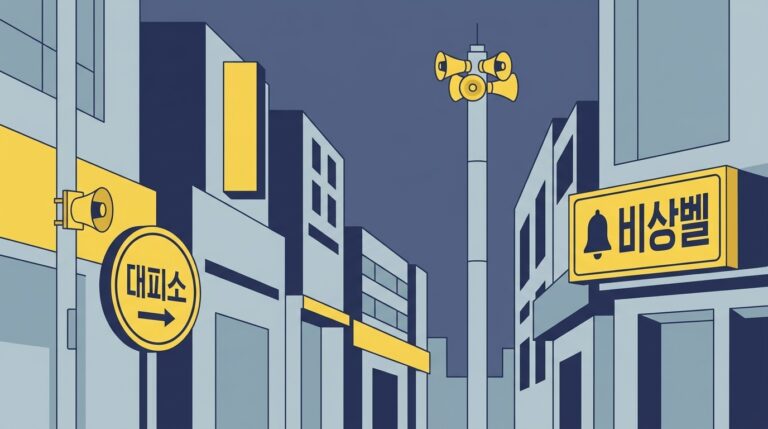
Phase 1: Empathy (Story Immersion Opening)
안녕하세요! 매일한글 에디터입니다.
Imagine this: You are sipping an iced Americano in your high-rise officetel in an industrial-adjacent hub like Ulsan, Yeosu, or Gumi, when suddenly, an ominous, shrill siren pierces the room. Your phone explodes with a piercing crimson alert: a 긴급재난문자 (Disaster Cell Broadcast). You squint at the screen and see terms that look like they were pulled straight from an advanced civil defense briefing: 유독가스 누출 사고 발생 (Toxic Gas Spill Incident Occurred), followed by 풍하측 주민 대피 (Evacuation of Downwind Residents) and 실내 밀폐 대피 (In-place Shelter Mandate).
Your heart races. You’ve mastered ordering food on Baemin and debating character arcs in high-brow K-Dramas like Designated Survivor: 60 Days, but bureaucratic crisis vocabulary is another beast entirely. Do you run outside? Do you shut the windows? Which direction is “downwind” when the sirens are wailing?
Many of our advanced C2 learners tell us: “I can read economic editorials, but when real-time emergency PA systems announce evacuation coordinates, I freeze.” You are not alone. Navigating a hazardous chemical spill in South Korea demands instant recognition of high-register Sino-Korean administrative jargon and swift community action. Today, we break down South Korea’s chemical evacuation architecture so you can protect yourself and those around you with absolute native-level fluency and confidence.
Phase 2: Core Expressions Deep Dive
1. 바람을 등지고 직각 방향으로 대피하십시오 (Barameul deungjigo jikgak banghyang-euro daepihasipsio)
- Pronunciation: bah-rahm-eul deung-jee-goh jeek-gahk bahng-hyahng-eu-roh dae-pee-hah-sheep-shee-oh (Think of “jikgak” like geek-gawk with a sharp, crisp stop).
- Meaning: Literal: “Please evacuate at a right angle with the wind at your back.” | Nuanced context: “Evacuate crosswind / move perpendicular to the wind direction immediately.”
- K-Culture Moment: In the cult-favorite urban disaster film Exit (엑시트), the protagonists constantly monitor smoke dispersion and industrial gas vectors, shouting instructions to avoid running directly downwind of the plumes.
- Editor’s Insight: In chemical defense terminology, running downwind (풍하측) is lethal, while running directly into the wind (풍상측) might head straight toward the ground-zero release point. Moving 직각 방향 (crosswind/perpendicularly) is standard protocol.
- Situation Spectrum: Casual: 🚫 | Semi-formal: ⚠️ | Formal/Emergency Broadcast: ✅
- 🤔 Think About It: Does your home country drill geometric navigation (crosswind angles) in general emergency warnings, or does public safety simply advise “head away”?
2. 실내로 들어가 창문을 닫고 외부 공기 유입을 차단하세요 (Silnae-ro deureoga changmuneul datgo oebu gonggi yuibeul chadanhaseyo)
- Pronunciation: sheel-nae-roh deu-reo-gah chahng-moon-eul daht-goh we-boo gong-gee yoo-eep-eul chah-dahn-hah-seh-yoh (Emphasize the staccato click of datgo [closing]).
- Meaning: Literal: “Enter indoors, close windows, and block the inflow of outside air.” | Nuanced context: “Take immediate shelter-in-place and seal off all exterior ventilation systems.”
- K-Culture Moment: Heard blaring from apartment complex wall-pad speakers (월패드 방송) when industrial particulate or toxic vapors breach residential boundaries.
- Editor’s Insight: Pay close attention to 공기 유입 차단 (blocking air intake). In modern Korean smart apartments, this doesn’t just mean slamming windows; it explicitly commands turning off the 전열교환기 (heat recovery ventilation system) and sealing kitchen exhaust vents.
- Situation Spectrum: Casual: ⚠️ | Semi-formal: ✅ | Formal/Broadcast: ✅
- 🤔 Think About It: How does the reliance on high-density apartment automated infrastructure shape disaster directives in Korea compared to low-density suburban housings?
3. 유독 물질 유출 우려가 있으니 풍하측 주민은 즉각 대피 바랍니다 (Yudok muljil yuchul uryeoga isseuni punghacheuk jumineun jeukgak daepi baramnida)
- Pronunciation: yoo-dohk mool-jeel yoo-chool oo-ryeo-gah ee-sseu-nee poong-hah-cheuk joo-meen-eun jeuk-gahk dae-pee bah-rahm-nee-dah (punghacheuk sounds like “poong-hah-chook” with an aspirated puff of air on cheuk).
- Meaning: Literal: “As there is concern over toxic substance leakage, residents on the downwind side please evacuate immediately.” | Nuanced context: “Residents located downwind of the chemical release zone must evacuate right away.”
- K-Culture Moment: Common syntax seen on real-time cell broadcast banners sent by the 행정안전부 (Ministry of the Interior and Safety).
- Editor’s Insight: The suffix -측 (側) specifies direction/side. Recognizing 풍하측 (downwind) versus 풍상측 (upwind) within 3 seconds can genuinely be a matter of life or death.
- Situation Spectrum: Casual: 🚫 | Semi-formal: ⚠️ | Formal/Disaster Alert: ✅
- 🤔 Think About It: Notice the polite grammatical ending -바랍니다 (we request/hope) used even in urgent evacuation mandates. Why does Korean administrative culture preserve high formality even during extreme crises?
Phase 3: Textbook Korean vs. Real Korean
Situation 1: Apartment Guard/Neighbor Announcing Immediate Hazard in the Hallway
- 📖 교과서 한국어 (Textbook Korean): 주민 여러분께서는 신속히 지정된 대피소로 이동해 주시기 바랍니다. (Jumin yeoreobunkkeseoneun sinsokhi jijeongdoen daepisoro idonghae jusigi baramnida. / “Residents, please move quickly to the designated evacuation shelter.”)
- 🗣️ 진짜 한국어 (Real Korean): 공장 가스 누출됐대요! 절대 밖으로 나가지 말고 문 꽉 닫고 환풍기 다 끄세요! (Gongjang gaseu nuchul-dwaetdaeyo! Jeoldae bakkeuro nagaji malgo mun kkwak datgo hwanpunggi da kkeuseyo! / “They say gas leaked from the factory! Do not go outside under any circumstances; lock your doors tightly and turn off every ventilator!”)
- 💡 왜 다를까?: Official broadcasts use hyper-polite Sino-Korean administrative formulas, but in high-stakes human encounters, native speakers immediately strip down to visceral native imperatives (문 꽉 닫고, 절대 나가지 말고) to convey life-preserving urgency.
Situation 2: Reacting to Directional Gas Dispersion on the Street
- 📖 교과서 한국어 (Textbook Korean): 풍향을 확인한 후 바람의 직각 방향으로 피난하십시오. (Punghyangeul hwaginhang hu baramui jikgak banghyangeuro pinanhasipsio. / “After checking the wind direction, evacuate in a direction perpendicular to the wind.”)
- 🗣️ 진짜 한국어 (Real Korean): 냄새 나는 쪽 정면으로 뛰지 말고 옆 골목으로 꺾어서 빠져요! (Naemsae naneun jjok jeongmyeon-euro ttwiji malgo yeop golmogeuro kkeokkeoseo ppajyeoyo! / “Don’t run straight away from the smell; cut through the side alley perpendicular to it!”)
- 💡 왜 다를까?: On the ground, abstract meteorological concepts like 풍향 (wind direction) and 직각 (perpendicular) are translated into intuitive sensory actions (냄새 나는 쪽, 옆으로 꺾어서).
Phase 4: K-Culture Deep Dive & Non-verbal Manners
4-1. 눈치 (Nunchi) & Crisis Decorum
When hazardous chemical alerts sound in Korea, public discipline is intensely collective. You will notice people immediately observing others’ actions (눈치 보기) not out of hesitation, but to synchronize community response.
* Protective Gesture: Wetting a towel, handkerchief, or even pulling a KF94 mask tight against the nasal bridge while covering the nose and mouth with your sleeve. Walking briskly without running or pushing in stairwells is paramount.
* Elevator Prohibition: Never use an elevator during a chemical spill or fire. Take the stairwell (비상계단) and ensure fireproof doors (방화문) latch shut behind you to stop gas channeling.
4-2. Cultural Code: The Legacy of 민방위 (Civil Defense) & Urban Vigilance
South Korea maintains one of the world’s most responsive civil defense networks. Monthly sirens, public air-raid shelters marked on subways and underground basements (민방위 대피소), and cell alerts are ubiquitous. Pop culture frequently mirrors this resilience—disaster cinema like The Host (괴물) and Exit showcases citizens relying on ingenuity, municipal maps, and rapid communal coordination. In a chemical hazard, this means following civil defense wardens (통장/이장/민방위대원) without arguing or disrupting crowd momentum.
Phase 5: Real-Life Roleplay Scenario
Setting: A residential complex 2 km away from a regional bio-chemical industrial park. The apartment emergency speaker cracks open, and your building superintendent (관리소장) frantically checks the floor hallway.
- Turn 1 (Superintendent): 🎭 Panting, knocking loudly on hallway doors
주민 여러분! 방금 인근 공장에서 암모니아성 화학물질이 누출됐다는 비상 통보가 왔습니다!
(Jumin yeoreobun! Banggeum ingeun gongjang-eseo ammoniaseong hwahakmuljiri nuchuldwaetdaneun bisang tongboga watseumnida! / “Residents! We just received an emergency notice that ammonia-based chemicals have leaked from a nearby factory!”) -
Turn 2 (You): 🎭 Opening the door with a KF94 mask securely worn
관리소장님, 지금 밖으로 대피해야 합니까, 아니면 실내 대피령입니까?
(Gwallisojangnim, jigeum bakkeuro daepihaeya hamnikka, animyeon silnae daepiryeong-imnikka? / “Manager, should we evacuate outside right now, or is this an in-place shelter order?”) -
Turn 3 (Superintendent):
바람이 단지 쪽으로 불고 있어서 풍하측에 해당한답니다. 즉시 문 닫고 실내 밀폐 대피하세요!
(Barami danji jjogeuro bulgo isseoseo punghacheuge haedanghandamnida. Jeuksi mun datgo silnae milpye daepihaseyo! / “The wind is blowing toward our complex, so we are in the downwind path. Seal your doors and shelter indoors immediately!”) -
Turn 4 (You):
알겠습니다. 창문 닫고 세대 환기장치랑 주방 후드 전원도 전부 차단하겠습니다.
(Algetseumnida. Changmun datgo sedae hwangijangchirang jubang hudeu jeonwondo jeonbu chadanhagetseumnida. / “Understood. I will shut the windows and completely shut off the apartment unit ventilator and kitchen range hood.”) -
Turn 5 (Superintendent):
네, 젖은 수건으로 문틈 막으시고, 관리실 안내방송 나올 때까지 절대로 외출하시면 안 됩니다!
(Ne, jeojeun sugeoneuro munteum mageusigo, gwallisil annaebangsong naol ttaekkaji jeoldaero oechulhasimyeon an doemnida! / “Yes, seal door gaps with wet towels, and never venture outside until the administrative office broadcasts an all-clear!”) -
Turn 6 (You):
혹시 몸에 이상 증상이 있거나 가스가 스며들면 어떻게 조치해야 하나요?
(Hoksi mome isang jeungsangi itgeona gaseuga seomyeodeulmyeon eotteoke jochihaeya hanayo? / “If anyone experiences symptoms or gas seeps in, what action should we take?”) -
Turn 7 (Superintendent):
욕실이나 가장 안쪽 방으로 들어가 샤워기를 틀어 유해가스를 희석시키고, 119에 즉각 연락하세요!
(Yoksirina gajang anjjok bang-euro deureoga syawogireul teureo yuhaegaseureul hiseoksikigo, 119-e jeukgak yeollakhaseyo! / “Move to the bathroom or innermost room, run the shower to dilute toxic vapors, and call 119 immediately!”) -
Turn 8 (You):
침착하게 대응하겠습니다. 고생 많으십니다, 소장님!
(Chimchakhage dae-eunghagetseumnida. Gosaeng maneusimnida, sojangnim! / “I will handle this calmly. Thank you for your hard work, Manager!”)
🔀 Interactive Choice Junction
What would you do if the alert suddenly updates: “Wind direction shifted. All residents must evacuate to the designated gymnasium crosswind”?
* Option A: Run down the hallway stairs immediately with your luggage without covering your face.
* Option B: Wet a clean cloth, check the wind vane/trees outside the window, grab ID/phone, and move crosswind on foot.
* Option C: Get into your car in the underground parking lot and try driving through the main boulevard.
- Feedback:
- Choice A (Bad): Moving without respiratory protection exposes mucous membranes to toxic agents; luggage impedes rapid transit.
- Choice B (Best): Perpendicular foot evacuation with wet respiratory filtration avoids vehicle gridlocks and prevents wind-vector inhalation.
- Choice C (Risk): High risk of suffocating if vehicle HVAC pulls in toxic ambient air, plus catastrophic traffic jams will trap you in the danger zone.
Phase 6: 10-Second Emotion Shadowing Drill
[🚨 긴박하고 단호하게 - Urgent and Decisive]
“지금 / 유독가스가 누출되었으니 / 절대로 / 밖으로 나가지 마세요!”
(Jigeum / yudokgaseuga nuchuldwoeeosseuni / jeoldaero / bakkeuro nagaji maseyo!)-
[😨 겁에 질렸지만 신속하게 - Frightened but Swift]
“바람 부는 방향 확인했어? / 풍하측 피해서 / 옆 골목으로 / 직각으로 뛰어야 해!”
(Baram buneun banghyang hwaginhaesseo? / Punghacheuk pihaeseo / yeop golmogeuro / jikgageuro ttwieoya hae!) -
[🧘 침착하고 체계적으로 - Calm and Authoritative]
“창틀 틈새를 / 젖은 수건으로 완전히 밀폐하고 / 환기 장치를 / 즉시 꺼주십시오.”
(Changteul teumsaereul / jeojeun sugeoneuro wanjeonhi milpyehago / hwanggi jangchireul / jeuksi kkeojusipsio.)
Phase 7: K-Culture Mini Dictionary
- 풍하측 (Punghacheuk – Downwind Zone): The geographical sector toward which the wind carries airborne contaminants. Knowing this term determines whether you flee or shelter.
- 밀폐 대피 (Milpye Daepi – In-place Shelter / Sealing Shelter): Protocol mandating closing all openings, turning off ventilation, and taping or blocking gaps with damp fabrics to prevent airborne chemical ingress.
- 제독소 (Jedokso – Decontamination Station): A specialized field facility erected by fire and military CBRN units to wash off hazardous residue from evacuees.
- 안전안내문자 (Anjeon Annae Munja – Public Safety Alert): The high-priority nationwide cellular broadcast system tiered into Emergency Alerts (긴급재난문자) and Disaster Alerts (안전안내문자).
Phase 8: Survival Kit for Travelers
- Survival Phrase 1: 공기가 매캐해요, 화학물질 누출인가요? (Gonggiga maekaehaeyo, hwahakmuljil nuchulingayo? / “The air is acrid and stinging; is this a chemical leak?”) — Pro Tip: Use “매캐하다” (stinging/acrid smoke smell) to vividly report hazardous air.
- Survival Phrase 2: 가장 가까운 실내 대피소가 어디입니까? (Gajang gakkaun silnae daepisoga eodi-imnikka? / “Where is the nearest indoor evacuation shelter?”) — Pro Tip: Emergency shelters are often basements of major bank buildings or subway stations.
- Survival Phrase 3: 방독면이 비치되어 있나요? (Bangdongmyeoni bichidoeeo innayo? / “Are there gas masks stocked here?”) — Pro Tip: Look for silver or orange metal cabinets marked ‘화재용/민방위 방독면’ inside any subway station.
Editor’s Travel Note
Make sure to install the government’s official emergency app via the Emergency Ready App download page before traveling outside Seoul. When traveling along manufacturing regions like Pohang, Ulsan, or Daesan, switch on location services so emergency push alerts translate critical disaster updates.
Phase 9: A Step Deeper (한 발 더 깊이)
South Korea’s spatial layout—dominated by sprawling high-rise complexes (아파트 단지) situated in close proximity to high-tech manufacturing parks—creates a unique disaster sociology. The promptness of emergency notifications reflects a society engineered for swift collective defense (공동체 중심의 안전망). In Western contexts, crisis evacuation often emphasizes personal autonomy and immediate private vehicular egress. In Korea, however, survival protocol emphasizes synchronous community coordination: adhering strictly to PA broadcasts, respecting building maintenance managers, and sealing collective living units. The language used in these moments is precise, respectful, yet extraordinarily unyielding.
💬 Your Turn: In your home country, how are chemical hazards communicated to the public? Would you feel comfortable trusting a centralized building broadcast over your own instinct to flee? Share your thoughts below!
Phase 10: FAQ & Common Mistakes
Q: What is the primary difference between 풍하측 (Downwind) and 풍상측 (Upwind)?
A: 풍하측 (Downwind) is the direction where the wind blows to—carrying toxic gas directly toward that area. 풍상측 (Upwind) is where the wind originates from. If a spill occurs, never remain in or evacuate toward the 풍하측; always evacuate crosswind (직각 방향) toward an upwind safe zone.
Q: Does a regular KF94 mask protect against chemical gas leaks?
A: While a KF94 mask blocks particulate aerosols, it does not completely filter volatile chemical vapors (like chlorine, ammonia, or phosgene). However, a tightly sealed KF94 or wet cloth slows inhalation of caustic micro-droplets until you reach an airtight indoor shelter.
Q: Should I call a taxi or drive my rental car to escape the area?
A: No. Driving during a chemical release is dangerous. Roads immediately become congested, hindering fire trucks and ambulances. Furthermore, vehicle air intake systems can suck toxic vapors directly into the cabin. Evacuate on foot crosswind or remain sealed indoors.
🚨 Common Mistakes Warning Board
- Mistake: Opening windows to “air out” an acrid smell during a broadcast alert.
Correct Action: Immediately shut and tape windows; do not air out rooms until the local government declares all-clear (상황 해제). - Mistake: Running straight in the direction the wind is blowing.
Correct Action: Move perpendicular (at a 90-degree angle) to the wind vector to quickly clear the toxic plume’s path. - Mistake: Taking apartment elevators down to the lobby.
Correct Action: Toxic gases rise and concentrate along elevator shafts; always take the emergency fire stairs (비상계단).
Phase 11: Action Mission & Engagement
- 🥉 Bronze Mission (Solo Shadowing): Practice reading Phase 6 Drill #1 three times without hesitating on “유독가스가 누출되었으니”.
- 🥈 Silver Mission (Community Check): Check your current living space or hotel room. Locate the ventilation toggle (환기 장치) and identify the nearest emergency stairwell.
- 🥇 Gold Mission (Real-life Fluency): Explain the concept of 풍하측 대피 (downwind evacuation protocol) in Korean to a language partner or tutor using the phrase 바람을 등지고 직각 방향으로.
🎮 K-Culture Mission: Watch the film Exit (2019) or the first episode of Designated Survivor: 60 Days. Spot how many times sirens, evacuation warnings, or broadcast banners appear, and listen for terms like 대피, 누출, and 통제!
Phase 12: Interactive Quiz Challenge
1. Situational Judgment: You hear a siren and an emergency broadcast stating: “현재 서풍이 불고 있으며 공장 동쪽 지역에 풍하측 피해가 예상됩니다.” (Currently, a west wind is blowing, and downwind damage is expected in the eastern sector of the factory.) Which direction should you evacuate if you are located near the factory?
* A) Due East (동쪽)
* B) Due North or Due South (남쪽 또는 북쪽 – 직각 방향)
* C) Due West directly toward the factory gate
2. Fill-in-the-Blank: 실내 대피 시 외부 공기 유입을 막기 위해 환기 시스템을 ( )해야 합니다.
* A) 가동 (operate)
* B) 차단 (shut off/block)
* C) 점검 (inspect)
3. True or False: Chemical spill evacuation commands in South Korea recommend driving private cars on major highways immediately after the siren sounds. (T/F)
👉 Click to reveal answers & explanations
- Answer: B. If the wind is blowing from the West to the East (서풍), the East is the downwind danger sector (풍하측). Evacuating perpendicularly—North or South (직각 방향)—allows you to exit the plume’s trajectory in the shortest distance.
- Answer: B (차단). You must cut off all external airflow (공기 유입 차단).
- Answer: False. Private vehicular evacuation causes massive traffic paralysis and exposes drivers to air intake risks. Evacuate on foot crosswind or practice in-place indoor sheltering (밀폐 대피).







