

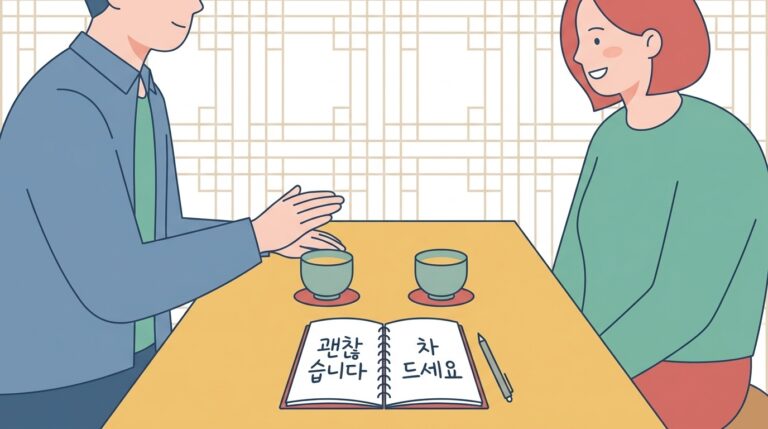
Phase 1: Empathy (Opening Story)
안녕하세요! 매일한글 에디터입니다.
Have you ever found yourself in a cozy Korean restaurant where the warm-hearted owner (Imo or Halmeoni) cheerfully places an extra mountain of fried dumplings (Gun-mandu) on your table with a booming, “This is on the house! (Service-ya!)”—even though you are already bursting at the seams? Or maybe your beloved Korean colleague offers to buy you a third round of iced Americano, or invites you to an impromptu dinner after a grueling 9-hour workday. Your mind screams, “I need to sleep!”, but your tongue freezes.
In Western communication, a crisp, polite “No, thank you” is considered efficient and respectful of boundaries. But in Korea, dropping a cold “아니요 (Aniyo – No)” often feels like shattering an invisible porcelain vase of warm human connection. This emotional adhesive is what Koreans call 정 (Jeong)—the deep, sticky bond of affection, mutual care, and hospitality built over time.
Refusing someone when Jeong is involved triggers intense guilt for foreign learners. You don’t want to hurt their feelings, yet you can’t say yes to everything! Based on real coaching sessions with over 500 intermediate Korean learners, this guide is designed to rescue your schedule and protect your relationships. By the end of this lesson, you will master the art of the “cushioned refusal”—saying no with grace, warmth, and authentic B1-level fluency.
Phase 2: Core 3 Expressions In-Depth
1. 마음만 받을게요 (Maeumman badeulgeyo)
- Pronunciation: [Mae-um-man ba-deul-ge-yo] (Think: “Mah-oom-mahn” + “bah-deul-geh-yo”)
- Meaning:
- Literal: “I will only accept your heart/mind.”
- Actual Nuance: “Thank you so much for the thought, but I must respectfully decline the offer/gift.”
- K-Culture Moment: You see this constantly in K-dramas like Hospital Playlist or Reply 1988. A warm neighbor brings over a massive box of fresh fruit or asks to pay for a meal, and the recipient places a hand gently on their chest, smiling warmly while saying this phrase.
- Editor’s Insight: This is the ultimate Korean social shield. Instead of rejecting the physical object or action, you accept the emotion behind it. It honors the giver’s Jeong while drawing a clear, polite boundary.
- Situation Spectrum: Casual: ✅ | Semi-formal: ✅ | Formal: ⚠️ (Use 마음만 감사히 받겠습니다 for strict corporate settings)
- 🤔 Think About It: In English, we say “It’s the thought that counts.” How does actively stating “I accept your thought” shift the social dynamic from a rejection to an emotional embrace?
2. 어쩌죠? 제가 선약이 있어서요 (Eojjeojyo? Jega seonyagi isseoseoyo)
- Pronunciation: [Eot-jjeo-jyo? Je-ga seon-ya-gi it-sseo-seo-yo] (Sounds like: “Uh-jjo-jyo? Jeh-gah sun-yah-gee ee-suh-suh-yo”)
- Meaning:
- Literal: “What to do? Because I have a prior appointment.”
- Actual Nuance: “Oh no, what a pity! I would love to, but I already have plans.”
- K-Culture Moment: Classic office drama scenario in Misaeng! A team lead says, “Let’s grab samgyeopsal tonight!” A savvy junior employee sighs with authentic regret, tilting their head, using this exact cushion.
- Editor’s Insight: Notice that this starts with “어쩌죠? (What should I do?)”. By expressing helpless frustration that circumstances beyond your control are keeping you apart, you validate their invitation before delivering the “No.”
- Situation Spectrum: Casual: ✅ (Drop ‘-yo’: 어쩌지? 나 선약 있어) | Semi-formal: ✅ | Formal: ✅
- 🤔 Think About It: Why does opening with empathetic self-distress make a refusal sound significantly kinder in high-context cultures?
3. 정말 감사하지만, 이번엔 좀 어려울 것 같아요 (Jeongmal gamsahajiman, ibonen jom eoryeoul geot gat-ayo)
- Pronunciation: [Jeong-mal gam-sa-ha-ji-man, i-beo-nen jom eo-ryeo-ul geot ga-ta-yo]
- Meaning:
- Literal: “I am really grateful, but this time it seems a bit difficult.”
- Actual Nuance: “I really appreciate it, but I won’t be able to make it work this time.”
- K-Culture Moment: When a mentor offers to introduce you to a blind date (Sogeting) or invites you to an intense weekend hiking trip, this phrase softens the blow with textbook politeness.
- Editor’s Insight: Korean speech patterns love softening clauses with ~것 같아요 (~it seems like) and the magic word 좀 (jom – a little/a bit). Never say “I cannot do it.” Say “It seems a bit difficult this time.” It leaves the door open for future harmony.
- Situation Spectrum: Casual: ⚠️ (A bit too stiff for close friends) | Semi-formal: ✅ | Formal: ✅
- 🤔 Think About It: Why do Koreans avoid absolute statements like “안 돼요 (I can’t)” in favor of probabilistic hedging like “어려울 것 같아요 (It seems difficult)”?
Phase 3: Textbook Korean vs. Real Korean
Scenario 1: Turning down extra food or drinks from an elder
- 📖 교과서 한국어 (Textbook Korean): 안 먹겠습니다. (An meokgetseumnida.) — “I will not eat.”
- 🗣️ 진짜 한국어 (Real Korean): 정말 맛있는데 배가 너무 불러서 더는 못 먹겠어요! (Jeongmal masinneunde baega neomu bulleoseo deoneun mot meokgesseoyo!) — “It is so delicious, but I’m so full that I can’t eat another bite!”
- 💡 왜 다를까? (Why is it different?): Saying “안 먹겠습니다” sounds robotic and accusatory, as if you dislike the food or host. Real Koreans praise the flavor first, express personal physical limitation second, and display regretful body language.
Scenario 2: Declining an impromptu company dinner (Hoeshik)
- 📖 교과서 한국어 (Textbook Korean): 저는 가지 않겠습니다. (Jeoneun gaji anketseumnida.) — “I will not go.”
- 🗣️ 진짜 한국어 (Real Korean): 아, 진짜 가고 싶은데 하필 오늘 가족 모임이 있어서요! 다음엔 꼭 갈게요! (A, jinjja gago sipeunde hapil oneul gajok moimi isseoseoyo! Daeumen kkok galgeyo!) — “Ah, I really want to go, but of all days, I have a family gathering today! I promise I’ll join next time!”
- 💡 왜 다를까? (Why is it different?): Direct refusal cuts the team rhythm. Real Korean speakers use “하필 (hapil – of all coincidences)” to frame the rejection as bad luck rather than a personal choice, followed by an enthusiastic promise for the future.
Phase 4: K-Culture Deep Dive & Non-Verbal Manners
4-1. 눈치 (Nunchi) & Body Language Checklist
When you say no in Korea, your face and hands do 70% of the talking. If your verbal tone is polite but your body stands rigid with unblinking eye contact, you will come across as passive-aggressive.
- The Double-Palm Press or Gentle Wave: When saying “마음만 받을게요”, place one hand over your heart or gently wave both hands palms-out at chest height in small, humble motions.
- The 15-Degree Head Tilt: Tilt your head slightly to one side while softening your eyes. This visually mimics feeling apologetic (Mianhan maeum).
- The Reluctant Inhale: Start your refusal with a subtle, sharp breath through teeth (“Sss…”). In Korea, this sound instantly signals, “I want to say yes, but circumstance is forcing me to hesitate.”
4-2. The Cultural Code: Jeong vs. Personal Boundaries
In Western individualist contexts, a favor declined is just a logistical transaction. In Korea, relationships are communal. When a Korean offers you homemade kimchi or insists on paying for your meal, they are gifting you a thread of Jeong.
Refusing the object directly can feel like snapping that thread. Therefore, Korean social etiquette created Cushion Talk (쿠션어). You never swat the hand away; you bow to the warmth, sprinkle an excuse of circumstance, and preserve the communal relationship.
Phase 5: Real Role-play Scenario
Setting: A Friday afternoon at 5:45 PM in a Seoul startup office. Min-ji (your warm, dependable team mentor) approaches your desk holding two cans of iced coffee.
- 민지 (Min-ji): [🎭 두 손으로 캔커피를 건네며 활짝 웃는다] 민수 씨! 오늘 한 주 동안 고생 많았죠? 이거 마시고 힘내요! (Minsu ssi! Oneul han ju dongan gosaeng manatjyo? Igeo masigo himnaeyo! — Minsu, you worked so hard this week! Drink this and hang in there!)
- 나 (You): [🎭 양손으로 커피를 받으며 가볍게 목례한다] 와, 민지 님! 늘 챙겨주셔서 정말 감사해요. (Wa, Minji nim! Neul chaenggyeojusyeoseo jeongmal gamsahaeyo. — Wow, Minji! Thank you so much for always looking out for me.)
- 민지 (Min-ji): [🎭 눈을 반짝이며 살짝 기대에 찬 목소리로] 실은 오늘 금요일인데, 퇴근하고 삼겹살에 소주 한잔 어때요? 제가 맛있는 집 알아요! (Sireun oneul geumyoirinde, toegeunhago samgyeopsare soju hanjan eottaeyo? Jega masinneun jip arayo! — Actually, it’s Friday! How about samgyeopsal and soju after work? I know a great spot!)
- 나 (You): [🎭 안타까운 표정으로 머리를 살짝 긁적인다] 아, 삼겹살 진짜 좋아하는데… 어쩌죠? (A, samgyeopsal jinjja joahaneunde… eojjeojyo? — Ah, I love samgyeopsal so much… what should I do?)
- 민지 (Min-ji): [🎭 고개를 갸웃하며] 왜요? 오늘 무슨 일 있어요? (Waeyo? Oneul museun il isseoyo? — Why? Do you have something going on today?)
- 나 (You): [🎭 손을 모으고 진심 어린 미안함을 담아] 정말 가고 싶은데, 하필 오늘 오래전부터 잡힌 친구 선약이 있어서요. 이번엔 좀 어려울 것 같아요. (Jeongmal gago sipeunde, hapil oneul oraejeonbuteo japhin chingu seonyagi isseoseoyo. Ibonen jom eoryeoul geot gat-ayo. — I really want to go, but of all days, I have plans with a friend that were set long ago. It seems difficult this time.)
- 민지 (Min-ji): [🎭 아쉽지만 고개를 끄덕이며] 아, 약속이 있구나! 어쩔 수 없죠. 그럼 친구랑 좋은 시간 보내요! (A, yaksogi itguna! Eojjeol su eopjyo. Geureom chingurang joeun sigan bonaeyo! — Ah, you have plans! Nothing we can do. Have a wonderful time with your friend!)
- 나 (You): [🎭 밝게 웃으며 다음 기회를 약속한다] 네! 마음만 감사히 받을게요. 다음 주엔 제가 먼저 맛있는 거 사드릴게요! (Ne! Maeumman gamsahi badeulgeyo. Daeum juen jega meonjeo masinneun geo sadeurilgeyo! — Yes! I will gratefully take the thought. Next week, I’ll treat you to something delicious first!)
🔀 Interactive Decision Point
How would you respond when Min-ji asks you out for drinks?
- Option A: “싫어요. 오늘 너무 피곤해서 집에 갈 거예요.” (Sireoyo. Oneul neomu pigonhaeseo jibe gal geoyeyo. – I don’t want to. I’m too tired today, going home.)
- ❌ Bad: Brutally cold. While honest, it destroys the social atmosphere and makes Min-ji feel embarrassed for asking.
- Option B: “네, 좋아요! 가요!” (Ne, joayo! Gayo! – Yes, great! Let’s go!) [Even though you have plans]
- ⚠️ Risk: Overcommitting out of pure Jeong guilt. You will burn out, cancel on your friend, or be miserable all evening.
- Option C: “선약이 있어서 아쉬워요! 마음만 받고 다음 주에 꼭 함께해요!” (Seonyagi isseoseo aswiwoyo! Maeumman batgo daeum jue kkok hamkkehaeyo!)
- 🏆 Best: Validates the relationship, expresses genuine regret, sets a firm boundary, and proposes a future alternative.
Phase 6: 10-Second Emotional Shadowing Drill
Read these out loud! Focus on pauses (/) and musical pitch variation.
[🥺 아쉽고 곤란한 표정으로]
어쩌죠? / 하필 오늘 / 선약이 있어서요.
(Eojjeojyo? / hapil oneul / seonyagi isseoseoyo.)
Pitch: Start high on “어쩌죠”, dip low on “하필”, end with a soft trail on “있어서요”.-
[🙏 따뜻하게 감동받은 눈빛으로]
신경 써 주셔서 감사해요, / 마음만 받을게요!
(Sin-gyeong sseo jusyeoseo gamsahaeyo, / maeumman badeulgeyo!)
Rhythm: Smooth connection, emphasizing “마음만” with a gentle hand on your heart. -
[😊 미안하지만 다정하게 웃으며]
정말 가고 싶은데, / 이번엔 / 좀 어려울 것 같아요.
(Jeongmal gago sipeunde, / ibonen / jom eoryeoul geot gat-ayo.)
Timing: Insert a 1-second apologetic pause right after “이번엔”.
Phase 7: K-Culture Mini Dictionary
- 정 (Jeong): An untranslatable bond of affection, warmth, and relational attachment that grows through shared meals, time, and empathy. The core fabric of Korean social glue.
- 선약 (Seonyak): “Prior engagement / previous appointment.” The most universally accepted and unchallengeable reason to decline an invitation in Korea.
- 눈치 (Nunchi): The quick ability to read atmospheric cues, body language, and unspoken social vibes to maintain harmony.
- 거절의 미학 (Geojeorui mihak): “The aesthetics of refusal.” The art of declining an offer without making the other person lose face (Chaemyeon) or feel rejected.
Phase 8: Traveler’s Survival Kit
Top 3 Survival Phrases for Travelers
- 괜찮습니다, 구경만 할게요! (Gwaenchanseumnida, gugyeongman halgeyo!)
- Pro Tip: Perfect for Myeongdong street vendors or Insadong markets when shopkeepers eagerly try to usher you in. Smiles make it friendly.
- 배가 너무 불러서 마음만 받을게요! (Baega neomu bulleoseo maeumman badeulgeyo!)
- Pro Tip: Essential at traditional markets (like Gwangjang Market) when an Ajjumma tries to hand you free food samples you can’t eat.
- 생각해 보고 다시 올게요! (Saenggakhae bogo dasi olgeyo!)
- Pro Tip: The universal code for “I’m not buying this right now, but thank you.” It avoids awkward silence in retail stores.
Editor’s Travel Note
When wandering Seoul’s buzzing streets, download the [Naver Map app download for English navigation] to check store hours so you don’t get trapped having to decline close-to-closing invitations. Remember that tipping does not exist in South Korea; instead, a sincere “잘 먹었습니다 (I ate well)” or “마음만 받을게요” carries far more cultural weight than cash.
Phase 9: One Step Deeper (Thinking Question)
In Western communication models, personal boundaries are often conceptualized like fences: sturdy, transparent, and marked by individual autonomy. In Korean society, boundaries are more like flowing water. Relationships prioritize collective cohesion and Jeong, meaning an invitation is not simply an event—it is an investment in human connection. When you refuse, you are balancing personal autonomy with relational care.
💬 Your Turn: In your home country, is it considered polite to give an honest, blunt reason for declining an offer, or do you also rely on “white lies” and emotional cushions? Leave a comment below and share your experience!
Phase 10: FAQ & Common Mistakes
Q: Is saying “아니요, 됐어요 (Aniyo, dwaesseoyo)” rude?
A: Yes! While textbook dictionaries translate this as “No, that’s fine,” in real spoken Korean it sounds dismissive, cold, and irritable—much like saying “No, whatever!” Stick to “괜찮습니다, 감사합니다 (Gwaenchanseumnida, gamsahamnida – I’m alright, thank you)” instead.
Q: What should I do if a Korean elder keeps insisting after I say no once?
A: This is called the “three-offer dance.” In Korean culture, offering two or three times shows hospitality, not pushiness. Repeat your soft refusal with gratitude: “정말 배가 불러서 그렇습니다, 마음만 감사히 받겠습니다!” On the third attempt, a firm smile and gentle hand wave will settle it comfortably.
Q: Can I use “선약이 있어요” even if my only plan is resting on my sofa watching Netflix?
A: Absolutely! Mental rest is a valid appointment with yourself. In Korea, “선약 (prior engagement)” is a polite white lie that allows both parties to maintain face without awkward probing.
🚨 Common Mistakes Warning Board
- The Stone-Faced “안 돼요 (An dwaeyo)”: Never use “안 돼요” for social invitations. It translates to “It’s prohibited / Not allowed,” making you sound like a strict school principal.
- Correct Action: Use 어려울 것 같아요 (It seems difficult).
- Ignoring the Gift/Offer completely out of panic: Freezing up and scurrying away makes the giver feel hurt.
- Correct Action: Acknowledge the intention with 마음만 받을게요 (I’ll take the thought).
- Over-explaining every detail of your refusal: Fabricating complicated medical or logistical tales feels insincere.
- Correct Action: Keep it clean with 선약 (prior plan) or 개인적인 일 (personal matter).
Phase 11: Action Mission & Engagement
- 🥉 Bronze Mission (Solo Shadowing): Stand in front of your mirror. Practice the 15-degree head tilt and say “어쩌죠? 제가 선약이 있어서요” 5 times with a warm, apologetic tone.
- 🥈 Silver Mission (Community Share): Write your own polite refusal sentence in the comments below using the grammar pattern
~것 같아요 (it seems like). - 🥇 Gold Mission (Real Life Application): The next time someone offers you an extra snack or a drink you don’t want, smile, place your hand over your heart, and say: “감사하지만 마음만 받을게요!”
- 🎮 K-Culture Mission: Watch any episode of a slice-of-life drama (like Our Blues or Hospital Playlist). Spot a scene where someone declines an offer. Did they use body language or cushion words? Note down what you observed!
Phase 12: Interactive Quiz Challenge
Quiz 1: Situation Judgment
Your Korean language partner asks you to help them move furniture on Saturday morning, but you have an exam to study for. Which response is the most culturally natural?
A) 안 도와줄 거예요. 바빠요.
B) 정말 도와드리고 싶은데, 토요일에 시험이 있어서 이번엔 어려울 것 같아요!
C) 됐습니다. 다른 사람한테 물어보세요.
👉 Click to reveal Answer & Explanation
Answer: B
Explanation: Option B follows the golden cushion rule: it states your desire to help (정말 도와드리고 싶은데), presents an objective conflict (시험이 있어서), and uses the probabilistic softening ending (어려울 것 같아요). Option A and C are harsh and damaging to Jeong.
Quiz 2: Fill in the Blank
Complete the iconic Korean phrase used to decline a gift while accepting the person’s affectionate intention:
“감사하지만 ________만 받을게요!”
👉 Click to reveal Answer & Explanation
Answer: 마음 (Maeum)
Explanation: “마음만 받을게요” means “I will only accept your heart/thought.” It preserves the bond of Jeong without taking the physical item.
Quiz 3: True or False Cultural Check
Statement: When declining an offer in Korea, making firm, unblinking eye contact with a stoic expression is considered the most respectful way to display honesty.
👉 Click to reveal Answer & Explanation
Answer: False
Explanation: In Korean non-verbal etiquette, an apologetic head tilt, softer eye contact, and humble hand gestures (Nunchi) are vital to show that you genuinely care about the relationship even while declining.







