

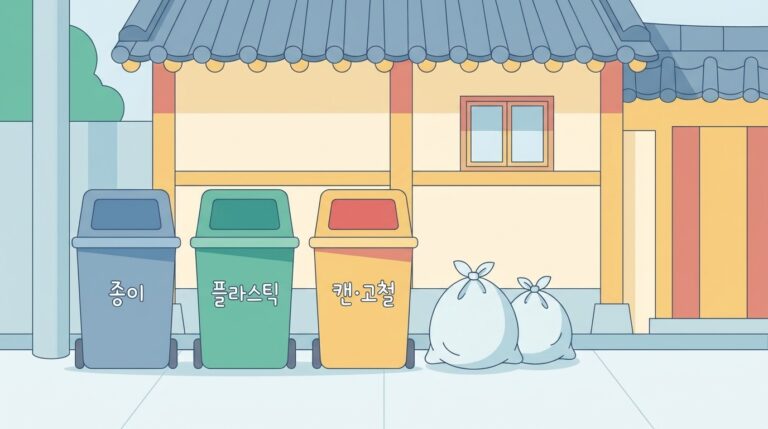
Phase 1: Empathy (Opening Story)
안녕하세요! 매일한글 에디터입니다. (Annyeonghaseyo! I am your Daily Hangul editor.)
Picture this: You just moved into a charming studio in a peaceful alleyway in Mapo-gu, Seoul. You spent your first weekend settling in, unpacking suitcases, ordering delicious late-night fried chicken, and assembling flat-pack furniture. By Sunday evening, you have accumulated several bags of packaging, empty soda cans, and food containers. Eager to be a tidy resident, you tie up your trash bag and walk downstairs to the curb at 7:00 PM, placing it neatly next to a light pole.
Suddenly, an elderly neighbor—a local ajumma wearing a brightly colored visor and rubber garden gloves—stops in her tracks. She points at your bag, waves her hands gently in an ‘X’ shape, and says with great urgency: “총각/아가씨! 오늘 아니에요! 내일 버려야 돼요!” (Chonggak/Agassi! Oneul anieyo! Naeil beoryeoya dwaeyo! – “Young man/miss! Not today! You must throw it out tomorrow!”). You freeze, holding your second bag, completely bewildered. In your home country, trash might go into a giant dumpster at any time of the week. In Korea, however, every single neighborhood has dedicated disposal days—and throwing things out on the wrong day is one of the quickest ways to accidentally earn a gentle scolding or a hefty local district fine!
Mastering trash disposal days (배출 요일 – baechul yoil) is truly your rite of passage into real Korean daily life. Based on hundreds of real coaching sessions with expat learners who felt overwhelmed by colorful bags and strict pickup schedules, this guide is designed to make you feel confident, polite, and completely at home on your Korean street.
Phase 2: Core Expressions Deep Dive
Here are the three must-know phrases for an absolute beginner (A1) navigating trash days in Korea.
1. 오늘 무슨 요일이에요? (Oneul museun yoirieyo?)
- Pronunciation: [Oh-neul moo-seun yo-ee-ree-eh-yo?] (Think of ‘Oneul’ like ‘Oh-null’, and ‘Yoirieyo’ like saying ‘Yo-eerie-eh-yo’ smoothly)
- Meaning: Literal: “Today what day of week is it?” | Nuance: “What day is it today?”
- K-Culture Moment: You’ll hear this constant question in slice-of-life K-dramas whenever a character is rushing out the door trying to remember if it is recycling day or food waste night.
- Editor’s Insight: Korean week days all end with 요일 (yo-il), representing celestial elements (Sun, Moon, Fire, Water, Tree, Metal, Earth). Knowing today’s day is step one to knowing what you are allowed to put on the curb.
- Situation Spectrum: Casual: ⚠️ (Use ‘오늘 무슨 요일이야?’ with close peers) | Semi-formal: ✅ | Formal: ✅
- 🤔 Think About It: In many Western countries, municipal trash pickup happens once or twice a week without residents constantly tracking daily categories. Why do you think Korean communities tie specific categories of waste to distinct days of the week?
2. 쓰레기 언제 버려요? (Sseuregi eonje beoryeoyo?)
- Pronunciation: [Sseu-reh-gee eon-jeh buh-ryuh-yo?] (The double ‘ss’ in Sseuregi sounds crisp, like the ‘s’ in ‘snake’ with strong breath)
- Meaning: Literal: “Trash when throw away?” | Nuance: “When do we take out the trash?”
- K-Culture Moment: Every tenant moving into an ‘officetel’ or multi-family villa inevitably asks their landlord or building manager this exact phrase on day one.
- Editor’s Insight: The verb 버리다 (beorida) means ‘to discard’ or ‘to throw away’. Combining it with 언제 (eonje – when) creates an ultra-practical, polite question suitable for any neighbor or concierge.
- Situation Spectrum: Casual: ⚠️ | Semi-formal: ✅ | Formal: ✅
- 🤔 Think About It: Koreans value community harmony (눈치 – nunchi). Asking before you discard shows you respect neighborhood rules rather than assuming you can dump items anytime.
3. 오늘은 재활용 날이에요. (Oneureun jaehwallyong narieyo.)
- Pronunciation: [Oh-neu-reun jae-hwal-yong nah-ree-eh-yo.] (‘Jae-hwal-yong’ flows like Jay-hwal-yong)
- Meaning: Literal: “Today [topic] recycling day is.” | Nuance: “Today is recycling day.”
- K-Culture Moment: The building caretaker announces this over the apartment speaker system or writes it on the communal white board at the building entrance every week.
- Editor’s Insight: 날 (nal) means ‘day’. Simply attach your category before it: 일반 쓰레기 날 (ilban sseuregi nal – general waste day) or 재활용 날 (jaehwallyong nal – recycling day).
- Situation Spectrum: Casual: ⚠️ | Semi-formal: ✅ | Formal: ✅
- 🤔 Think About It: How does naming specific days for specific materials reflect the Korean value of shared environmental responsibility?
Phase 3: Textbook Korean vs. Real-World Korean
Situation 1: Asking if today is the collection day
- 📖 교과서 한국어 (Textbook Korean): 오늘이 쓰레기를 배출하는 날입니까? (Oneuri sseuregireul baechulhaneun narimnikka? – “Is today the day on which waste is discharged?”)
- 🗣️ 진짜 한국어 (Real-World Korean): 오늘 쓰레기 버리는 날이에요? (Oneul sseuregi beorineun narieyo? – “Is today trash day?”)
- 💡 왜 다를까? (Why is it different?): Textbook Korean loves administrative words like 배출하다 (baechulhada – to discharge/dispose). In real neighborhood life, native speakers prefer the everyday verb 버리다 (beorida – to throw out). It sounds warm, natural, and friendly.
Situation 2: Confirming it is recycling day
- 📖 교과서 한국어 (Textbook Korean): 금일은 재활용품을 수거하는 일정입니다. (Geumireun jaehwalyongpumeul sugeohaneun iljeongimnida. – “Today is the schedule for collecting recyclable goods.”)
- 🗣️ 진짜 한국어 (Real-World Korean): 오늘 재활용 버리는 날이에요! (Oneul jaehwallyong beorineun narieyo! – “Today is recycling day!”)
- 💡 왜 다를까? (Why is it different?): Real Koreans use concise, punchy noun phrases in everyday speech. Replacing Sino-Korean formal terms (금일, 수거) with conversational words (오늘, 버리는 날) instantly eliminates stiffness.
Phase 4: K-Culture Deep Dive & Non-Verbal Manners
4-1. 눈치 (Nunchi) & Street Etiquette
In Korea, trash is not usually collected during broad daylight. Instead, most districts require residents to bring their bags out 일몰 후 (after sunset), usually between 7:00 PM and midnight, so the streets stay pristine during business hours. When setting your trash bag on the curb:
* Check the surrounding bags first: Practice your observational nunchi (social awareness). Look at the colors of the bags already placed outside your building gate. If everyone put out clear plastic bags with plastics and cans, but your bag is the yellow district general waste bag, pause! You might have the wrong night.
* The apologetic bow: If an elderly neighbor catches you about to drop the wrong bag, do not argue or walk away silently. Give a humble 30-degree bow, smile slightly, and say: “아, 몰랐어요! 감사합니다!” (Ah, mollasseoyo! Gamsahamnida! – “Oh, I didn’t know! Thank you!”) and bring your bag back inside. Koreans deeply appreciate anyone who accepts guidance gracefully.
4-2. Cultural Code: The Volume-Rate System (Jongnyangje)
Korea introduced the 종량제 (Jongnyangje – Volume-Based Waste Fee System) in 1995. You cannot use regular grocery shopping bags or black trash liners. You must buy designated, prepaid district bags from convenience stores (종량제 봉투). If you live in Mapo-gu, you cannot use a Yongsan-gu bag! Because each district operates its own contract trucks, each neighborhood has its own specific weekly schedule—such as Monday/Wednesday/Friday for general waste, and Tuesday/Thursday for recyclables. This system turned South Korea into one of the top recycling nations in the world!
Phase 5: Real-World Roleplay Scenario
Setting: Outside a cozy brick villa in Yeonnam-dong at 8:15 PM on a cool Tuesday evening. The streetlights glow amber. Mr. Park, the dedicated building supervisor wearing a quilted jacket, is organizing empty cardboard boxes near the front gate.
Dialogue
- You: 안녕하세요, 아저씨! (Annyeonghaseyo, ajeossi!) – 🎭 Bowing politely with both hands holding a trash bag
“Hello, Mr. Supervisor!” - Mr. Park: 어, 어서 와요! 쓰레기 버리러 나왔어요? (Eo, eoseo wayo! Sseuregi beorireo nawasseoyo?) – 🎭 Looking up with a curious smile
“Oh, welcome! Did you come out to throw away the trash?” - You: 네, 그런데 오늘 쓰레기 버리는 날이에요? (Ne, geureonde oneul sseuregi beorineun narieyo?) – 🎭 Tilting head slightly with a questioning, polite expression
“Yes, but is today trash day?” - Mr. Park: 오늘은 화요일이라 재활용 날이에요. (Oneureun hwayoirira jaehwallyong narieyo.) – 🎭 Pointing to the blue collection net for plastics
“Today is Tuesday, so it is recycling day.” - You: 아! 일반 쓰레기는 언제 버려요? (Ah! Ilban sseuregineun eonje beoryeoyo?) – 🎭 Looking at your general waste bag and realizing your mistake
“Ah! When do I throw out general waste?” - Mr. Park: 일반 쓰레기는 수요일 밤에 버려요. 내일 밤! (Ilban sseuregineun suyoil bame beoryeoyo. Naeil bam!) – 🎭 Tapping the calendar sign taped on the wall
“General waste goes out on Wednesday night. Tomorrow night!” - You: 아, 내일이군요! 다시 가져갈게요. (Ah, naeirigunyo! Dasi gajyeogalgeyo.) – 🎭 Pulling your bag back gently with an understanding nod
“Ah, it’s tomorrow! I will take it back inside.” - Mr. Park: 그래요, 내일 저녁에 내놓아요! (Geuraeyo, naeil jeonyeoge naenohayo!) – 🎭 Giving an approving nod and a warm laugh
“Alright, put it out tomorrow evening!”
🔀 Interactive Decision Point
You are standing with your bag. What do you do?
* Choice A: Leave the bag behind the tree anyway when Mr. Park looks away and walk back inside quickly.
* Choice B: Bow, say “감사합니다! 내일 다시 올게요!” (Gamsahamnida! Naeil dasi olgeyo! – “Thank you! I will come back tomorrow!”), and take the bag upstairs.
* Choice C: Open the bag in front of Mr. Park and try to dump everything into the nearest plastic bin.
Feedback:
* Choice A (Risk 🚨): Bad move! Most villa alleys have high-definition CCTV cameras monitoring waste disposal. Leaving bags on the wrong day can trigger a 100,000 KRW fine and frustrate your neighbors.
* Choice B (Best ✅): Perfect! You demonstrated respect for the community rules. Mr. Park will view you as an exemplary resident and will gladly help you in the future.
* Choice C (Bad 🚫): Disaster! Mixing general waste into the clean recycling net ruins the batch and causes immediate complaints.
Phase 6: 10-Second Emotional Shadowing Drill
Practice these core lines with natural rhythm. The slashes (/) represent brief, natural pauses.
[😊 Inquiring and polite]
오늘 / 쓰레기 버리는 날이에요? (Oneul / sseuregi beorineun narieyo?)
“Today… is it trash day?”-
[😅 Realizing and grateful]
아, / 내일 버려야 돼요? / 감사합니다! (Ah, / naeil beoryeoya dwaeyo? / Gamsahamnida!)
“Ah, I must throw it out tomorrow? Thank you!” -
[🤝 Helpful and clear]
오늘은 / 재활용 날이에요! (Oneureun / jaehwallyong narieyo!)
“Today… is recycling day!”
Phase 7: K-Culture Mini Dictionary
- 배출 요일 (Baechul yoil) | Disposal Day
- The specific days of the week designated by your municipal district when trash and recyclables can be brought to the curb.
- 종량제 봉투 (Jongnyangje bongtu) | Standard Government Trash Bag
- The mandatory fee-paid bags required for general household waste. You can buy them at any 7-Eleven, CU, GS25, or local mart by asking at the counter.
- 분리수거 (Bunrisugeo) | Waste Sorting / Recycling
- The practice of separating plastic, cans, glass, vinyl, and paper into separate streams. A staple habit of every Korean household.
- 일몰 후 (Ilmol hu) | After Sunset
- The official regulation timeframe for putting trash outside (usually from 7:00 PM onwards) to keep streets clean during daylight hours.
Phase 8: Traveler’s Survival Kit
Top 3 Survival Expressions
- 이거 어디에 버려요? (Igeo eodie beoryeoyo?)
- Pronunciation: [Ee-guh uh-dee-eh buh-ryuh-yo?]
- Pro Tip: Use this when holding an item at a guesthouse, coffee shop, or Airbnb and you aren’t sure where it goes.
- 종량제 봉투 있어요? (Jongnyangje bongtu isseoyo?)
- Pronunciation: [Jong-nyang-jeh bong-too eet-ssuh-yo?]
- Pro Tip: Say this to the cashier at any convenience store to purchase standard trash bags. They will ask you what size (usually 10리터 sip-liteo or 20리터 i-sip-liteo).
- 내일 무슨 요일이에요? (Naeil museun yoirieyo?)
- Pronunciation: [Nae-il moo-seun yo-ee-ree-eh-yo?]
- Pro Tip: Check tomorrow’s day so you can prepare your waste bags the night before!
Editor’s Travel Note
- When navigating local neighborhoods, save your district’s garbage collection notice on your smartphone. You can easily find the exact location of local centers and nearby convenience stores by using the Naver Map app navigation.
- If you are staying at an Airbnb or villa, look for a laminated A4 sheet taped behind the front door or in the elevator titled 쓰레기 배출 안내 (Waste Disposal Guide). Look for the weekday abbreviations: 월 (Mon), 화 (Tue), 수 (Wed), 목 (Thu), 금 (Fri), 토 (Sat), 일 (Sun). Note that in most of Seoul, trash is strictly never collected on Saturdays!
Phase 9: One Step Deeper
In Korean culture, clean streets are not viewed merely as the job of city cleaners; they are seen as a collective reflection of the neighborhood’s moral character (공동체 의식 – communal consciousness). When residents strictly follow the disposal days, they show consideration for the sanitation workers who arrive in the middle of the night, as well as their next-door neighbors. Discarding on the designated day is a quiet, everyday practice of community care.
💬 Your Turn: Does your home country assign specific weekdays for different types of garbage, or do you have daily drop-off dumpsters? Tell us in the comments below how it compares to Korea!
Phase 10: FAQ & Avoiding Misunderstandings
Q: Can I put trash out in the morning before leaving for work?
A: Generally, no! Most districts enforce strict rules that garbage may only be placed on the street after sunset (일몰 후, usually after 7:00 PM). Leaving trash bags under hot direct sunlight all day attracts stray animals, creates bad odors, and can result in neighbor complaints.
Q: What happens if I accidentally put trash out on Saturday night?
A: In almost all Korean cities, trash collection crews rest on Saturday nights. If you put your bags out on Saturday, they will sit on the sidewalk all through Sunday. Always wait until Sunday evening to resume disposal.
Q: Where do I buy standard trash bags (종량제 봉투)?
A: You do not need to go to a government office. Simply walk into any local convenience store (CU, GS25, 7-Eleven, Emart24) in your neighborhood and ask the clerk: “종량제 봉투 10리터 주세요” (Jongnyangje bongtu sip-liteo juseyo – “Please give me a 10-liter standard trash bag”). Keep in mind you must purchase them in the district where you live!
🚨 Common Mistakes Warning Board
- Mistake: Throwing general trash in standard supermarket plastic bags.
- Correct Action: Only use government-certified 종량제 봉투 purchased within your specific municipal district.
- Mistake: Leaving trash out whenever your apartment gets full.
- Correct Action: Memorize your villa’s designated weekdays (e.g., Mon/Wed/Sun) and place items out only between 7:00 PM and midnight on those nights.
- Mistake: Leaving plastic delivery containers with food residue inside.
- Correct Action: Thoroughly rinse all plastic containers with water before putting them out on recycling day.
Phase 11: Action Mission & Engagement
- 🥉 Bronze Mission (Solo): Memorize the days of the week in Korean: 월 (Mon), 화 (Tue), 수 (Wed), 목 (Thu), 금 (Fri), 토 (Sat), 일 (Sun). Say them out loud three times right now!
- 🥈 Silver Mission (Social): Share this guide with a friend traveling to or living in Korea, and quiz each other on what “오늘 무슨 요일이에요?” means.
- 🥇 Gold Mission (Real-World): The next time you are in Korea or at your accommodation, find the trash notice board, identify the disposal days (배출 요일), and say: “오늘은 [요일]이에요!” (Today is [day of week]!).
🎮 K-Culture Mission: In the next K-drama or Korean vlog you watch, look for scenes where characters carry translucent white or yellow bags outside their door at night. Notice the color of the bag and see if you can spot a neighborhood notice board!
Phase 12: Interactive Quiz Challenge
1. Situational Judgment
It is Tuesday night at 9:00 PM. Your district’s schedule says general waste is collected on Monday and Wednesday nights, while Tuesday is recycling only. You have a full yellow general trash bag. What should you do?
* A) Put it outside right now because it’s after dark.
* B) Keep it inside your apartment tonight, and put it out tomorrow (Wednesday) evening.
* C) Sneak it into a public trash can near the subway station.
2. Fill-in-the-Blank
Complete the sentence to ask when to throw away trash:
“쓰레기 ______ 버려요?” (When do I throw away trash?)
* Choice 1: 어디 (eodi)
* Choice 2: 언제 (eonje)
* Choice 3: 누구 (nugu)
3. True / False Cultural Quiz
- Question: In Korea, you can generally put trash out on Saturday afternoon as long as you use a proper 종량제 bag. (True / False)
Click here for Answers & Explanations
- Answer: B
- Explanation: Tuesday is recycling night only! Placing general waste out on the wrong night violates neighborhood regulations. Wait until Wednesday evening after sunset.
- Answer: Choice 2 (언제 – eonje)
- Explanation: 언제 (eonje) means ‘when’. The complete sentence is “쓰레기 언제 버려요?” (When do I throw away trash?). (어디 = where, 누구 = who).
- Answer: False
- Explanation: Trash collection is paused on Saturday nights across almost all Korean cities, and trash should never be placed out in broad daylight during the afternoon. Always wait until Sunday evening!
- Explanation: Trash collection is paused on Saturday nights across almost all Korean cities, and trash should never be placed out in broad daylight during the afternoon. Always wait until Sunday evening!







