

Mastering Korean Business Small Talk: How to Break the Ice with Confidence and Warmth
Phase 1: Empathy (Story-Driven Opening)
안녕하세요! 매일한글 에디터입니다. (Hello! I’m your Daily Hangul editor.)
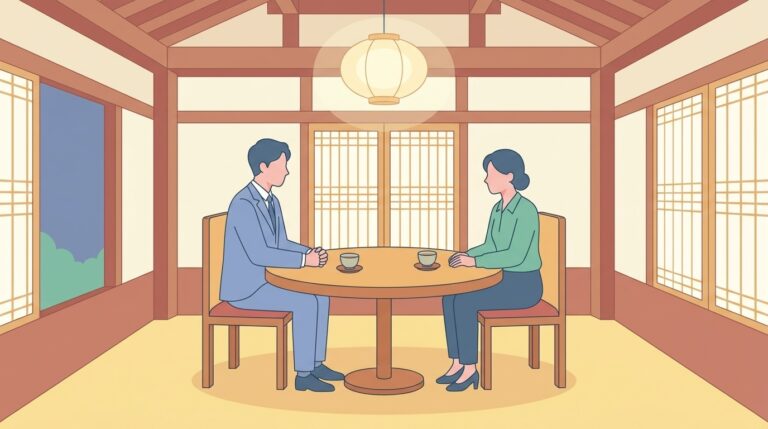
Picture this: You are seated across from Team Leader Park at a tranquil Hanok-style restaurant in Seoul. The delicate smell of grilled short ribs fills the air, fine ceramic tableware sits pristine on the table, and your upcoming partnership contract rests safely in your briefcase. Then, the inevitable happens. The waiter bows out, slides the wooden door shut, and an echoing silence settles across the room. You want to break the tension, but your mind races through standard textbook lines. Should you ask about his weekend? Will that sound intrusive? Should you say “식사하셨습니까?” (Did you eat?) even though dinner is being served right in front of you?
Navigating business hospitality (비즈니스 접대) in Korea is notorious for sending even confident intermediate learners into a state of panic. You know the vocabulary, but you fear crossing invisible boundaries between professional respect and friendly small talk. Over the past decade coaching foreign professionals living and working in Korea, I have seen brilliant executives freeze up right at this crossroads.
Here is the secret: in Korea, business relationships are fundamentally human relationships. Smooth small talk (스몰토크) is not about reciting stiff honorifics; it is about showing subtle consideration (배려, baeryeo) for the other person’s comfort. This guide is crafted directly from field feedback to give you the practical phrasing, non-verbal cues, and cultural confidence to break the ice effortlessly before the real business begins.
Phase 2: Core Expressions Deep Dive
Here are three B2-level small talk keystones designed to warm up any corporate gathering.
1. 오늘 오시는 길은 편안하셨어요? (Oneul osineun gileun pyeon-an-hasyeosseoyo?)
- Pronunciation: Oh-neul oh-she-neun gee-leun pyun-ahn-hah-shyut-suh-yo? (Think of pyeon-an like a sigh of relief—soft and round, without sharp consonant stops).
- Meaning: Literal: “Was the road you came on comfortable?” | Actual Nuance: “Did you have a smooth journey getting here?”
- K-Culture Moment: You will hear this constantly in workplace K-Dramas like Misaeng or King the Land the moment an external partner steps into the meeting room or private dining suite.
- Editor’s Insight: Seoul traffic is notoriously chaotic. Inquiring about someone’s transit expresses empathy for their physical exertion before jumping into business topics.
- Situation Spectrum: Casual 🚫 | Semi-formal ✅ | Formal ✅
- 🤔 Think About It: In many Western contexts, asking about a drive can lead to complaints about gridlock. In Korea, this phrase is primarily a gentle vehicle for courtesy. Does your native language open meetings with logistics or personal inquiries?
2. 요즘 날씨가 갑자기 쌀쌀해졌죠? (Yojeum nalssiga gapjagi ssalssalhaejyeottjyo?)
- Pronunciation: Yoh-jeum nahl-she-gah gahp-jah-gee ssahl-ssahl-hae-jyut-jyo? (The double ss in ssalssal sounds like a sharp intake of brisk autumn air, mimicking the cold breeze).
- Meaning: Literal: “Lately the weather has suddenly become chilly, hasn’t it?” | Actual Nuance: “It feels like autumn came overnight, don’t you think?”
- K-Culture Moment: Seen frequently in scenes where colleagues break away for a warm canned coffee outside convenience stores or rooftop terraces.
- Editor’s Insight: Notice the ending -죠? (-jyo). Instead of asking a dry question (날씨가 쌀쌀합니까?), the tag ending invites immediate agreement, building a shared emotional baseline.
- Situation Spectrum: Casual ✅ | Semi-formal ✅ | Formal ⚠️ (Prefer 쌀쌀해졌지요? in strictly hierarchical settings)
- 🤔 Think About It: Weather is universally safe, but the Korean ending creates mutual camaraderie. How do tag questions function in your culture to establish consensus?
3. 여기 분위기가 정말 좋네요. 자주 오시나요? (Yeogi bunwigiga jeongmal jonne-yo. Jaju osinayo?)
- Pronunciation: Yuh-gee boon-wee-gee-gah jung-mahl jon-neh-yoh. Jah-joo oh-she-nah-yoh? (Jonne-yo carries a smooth nasal transition from the silent ‘h’ in 좋다).
- Meaning: Literal: “The atmosphere here is really nice. Do you come often?” | Actual Nuance: “This venue is fantastic. Is this one of your regular spots?”
- K-Culture Moment: A host beaming with quiet pride when a foreign guest compliments their choice of a traditional tea house or contemporary galbi restaurant.
- Editor’s Insight: Complimenting the venue acknowledges your host’s thoughtfulness in selecting it. It validates their hosting effort (접대 감각) while naturally steering the chat toward culinary tastes.
- Situation Spectrum: Casual ✅ | Semi-formal ✅ | Formal ✅
- 🤔 Think About It: Acknowledging the setting highlights communal ambiance rather than individual taste. Why is venue selection considered a primary business skill in East Asia?
Phase 3: Textbook Korean vs. Real Korean
Situation 1: Asking how the partner arrived at the venue
- 📖 교과서 한국어 (Textbook): 어떻게 오셨습니까? (Eotteoke osyeotseumnikka? – “How did you come here?”)
- 🗣️ 진짜 한국어 (Real-life): 오시는 데 차 많이 안 막히셨어요? (Osineun de cha mani an mak-hisyeosseoyo? – “I hope you didn’t run into heavy traffic on your way here?”)
- 💡 왜 다를까? (Why the difference?): While grammatically correct, “어떻게 오셨습니까?” is the exact phrase used by receptionists or bank tellers to ask “What is the purpose of your visit?” In a business dinner setting, asking about traffic conditions shows real consideration for their travel comfort.
Situation 2: Asking about dietary restrictions or food preferences
- 📖 교과서 한국어 (Textbook): 무엇을 먹고 싶습니까? (Mueoseul meokgo sipseumnikka? – “What do you want to eat?”)
- 🗣️ 진짜 한국어 (Real-life): 혹시 가리는 음식이나 못 드시는 것 있으세요? (Hoksi garineun eumsigina mot deusineun geot isseuseyo? – “By any chance, do you have any dietary restrictions or foods you can’t eat?”)
- 💡 왜 다를까? (Why the difference?): Open-ended questions like “What do you want to eat?” put awkward pressure on the guest to guess what the host wants to spend. Asking softly with “혹시” (by any chance) allows them to politely mention allergies or aversions without sounding demanding.
Phase 4: K-Culture Deep Dive & Non-Verbal Etiquette
4-1. 눈치 (Nunchi) & Gestures: The Art of the Unspoken
In Korean business small talk, what your hands and eyes do is just as important as what your mouth says. Small talk is the calibration phase for 눈치 (Nunchi)—reading the room’s temperature.
* The Two-Handed Anchor: When water, tea, or side dishes are brought to the table, never receive or adjust them with one limp hand. Place your left hand gently near your right wrist or under your chest while gesturing with your right hand. This non-verbal physical reflex communicates deference.
* The Soft Head Nod (고개 끄덕임): Maintain gentle eye contact when your partner answers small talk questions, but soften your gaze by nodding rhythmically. Staring directly into a senior partner’s eyes without blinking can feel confrontational.
4-2. Cultural Code: The Rhythm of “접대 (Business Hospitality)”
In Western business cultures, dinner often follows a signed deal as a celebration. In Korea, business hospitality (접대) frequently happens before or during high-stakes negotiations. The dinner is not recreation; it is the arena where character, reliability, and emotional resonance (정, Jeong) are evaluated. Initiating light, respectful small talk signals that you are someone who understands communal harmony and is easy to collaborate with.
Phase 5: Real-Life Roleplay Scenario
Setting: A private dining room at a modern Hanok restaurant near Gwanghwamun. Team Leader Park (박 팀장, a seasoned 40-something corporate manager) has just sat down opposite you.
- 박 팀장: 오늘 퇴근 시간에 이동하셔서 오시느라 고생 많으셨죠? (Oneul toegeun sigane idonghasyeoseo osineura gosaeng maneusyeottjyo? – “You must have had a tough time getting here during rush hour?”)
🎭 행동 지문: 양손으로 물잔을 채워주며 따뜻한 미소를 짓는다. (Pours water with both hands and offers a warm smile.) -
You: 아녜요, 팀장님. 지하철로 왔더니 생각보다 금방 도착했어요. (Anyeyo, timjangnim. Jihaecheollo watdeoni saenggakboda geumbang dochakhaesseoyo. – “Not at all, Team Leader. I took the subway, so I actually arrived faster than expected.”)
🎭 행동 지문: 두 손으로 물잔을 받아 살짝 목례한다. (Receives the water cup with both hands and gives a subtle head bow.) -
박 팀장: 다행이네요. 여기 한옥 인테리어가 차분해서 가끔 손님 모시고 오거든요. (Dahaeng-ineyo. Yeogi han-ok interi-eoga chabunhaeseo gakkeum sonnim mosigo ogeodeunyo. – “That’s a relief. The Hanok interior here is peaceful, so I bring guests here from time to time.”)
🎭 행동 지문: 방 안의 서까래와 조명을 둘러보며 고개를 끄덕인다. (Looks around at the wooden rafters and soft lighting, nodding.) -
You: 어쩐지 분위기가 정말 아늑하네요. 좋은 곳으로 예약해 주셔서 감사합니다. (Eojjeonji bunwigiga jeongmal aneuk-hane-yo. Joeun goseuro yeyak-hae jusyeoseo gamsahamnida. – “No wonder! The ambiance is truly cozy. Thank you very much for reserving such a wonderful place.”)
🎭 행동 지문: 식당 내부를 감탄 어린 눈빛으로 바라본다. (Glances around the room with appreciative eyes.) -
박 팀장: 입맛에 맞으셔야 할 텐데, 혹시 가리는 음식이나 매운 것 못 드시나요? (Immate majeusyeoya hal tende, hoksi garineun eumsigina maeun geot mot deusinayo? – “I hope it suits your palate. By any chance, do you have any food restrictions or trouble with spicy food?”)
🎭 행동 지문: 메뉴판을 조심스럽게 건네며 상대방을 살핀다. (Gently slides the menu forward, checking your reaction.) -
You: 저는 다 잘 먹습니다! 특히 한국 찌개류나 고기는 정말 좋아해요. (Jeoneun da jal meokseumnida! Teukhi hanguk jjigaeryuna gogineun jeongmal joahaeyo. – “I eat everything well! In particular, I really love Korean stews and grilled meat.”)
🎭 행동 지문: 밝은 표정으로 손을 살짝 흔들며 안심시킨다. (Waves hand lightly with a bright expression to put him at ease.) -
박 팀장: 하하, 다행이네요! 그럼 여기 시그니처 갈비찜으로 주문하겠습니다. (Haha, dahaeng-ineyo! Geureom yeogi sigeunicheo galbijjimeuro jumunhagetseumnida. – “Haha, what a relief! Then I’ll order their signature braised short ribs for us.”)
🎭 행동 지문: 가벼운 웃음을 터뜨리며 벨을 누른다. (Laughs lightly and presses the call bell.) -
You: 네, 기대됩니다. 팀장님 덕분에 오늘 제대로 된 맛집을 알게 되었네요. (Ne, gidaedoemnida. Timjangnim deokbune oneul jedaero doen matjibeul alge doe-eonne-yo. – “Sounds wonderful, I’m looking forward to it. Thanks to you, I’ve discovered an authentic food gem today.”)
🎭 행동 지문: 정중하게 미소를 지으며 앞접시를 정리한다. (Smiles politely while tidying the side plate.)
🔀 Interactive Decision Point
When Team Leader Park asks about your weekend plans during a momentary pause, what is your best conversational move?
* Option A: “주말에 푹 쉬면서 다음 주 회의 안건이나 다시 확인하려고요.” (“I’ll just rest and double-check next week’s meeting agenda.”)
* Option B: “요즘 날씨가 너무 좋아서 북한산 등산이나 가볼까 해요. 팀장님도 등산 좋아하세요?” (“The weather has been so nice lately that I’m thinking of hiking Bukhansan. Do you enjoy hiking as well, Team Leader?”)
* Option C: “한국 주말은 너무 바빠서 집에서 개인적인 비밀 프로젝트만 합니다.” (“Korean weekends are too busy, so I just work on a private secret project at home.”)
Feedback:
* Option A (Risk): Too robotic! Bringing the conversation straight back to work can make the host feel that their hospitality effort is being rebuffed.
* Option B (Best ✅): Outstanding. Mentioning seasonal outdoor activities like hiking (등산) is an instant Korean cultural classic. It invites your counterpart to share their own hobby without prying into private family matters.
* Option C (Bad): Creates unnecessary distance and comes across as slightly secretive or defensive.
Phase 6: 10-Second Emotion Shadowing Drill
Practice matching natural cadence, breathing pauses (/), and emotional warmth.
- [😊 Warm & Appreciative]
- “오늘 오시는 길은 / 편안하셨어요? / 날씨가 갑자기 쌀쌀해졌죠?”
- Oneul osineun gileun / pyeon-an-hasyeosseoyo? / Nalssiga gapjagi ssalssalhaejyeottjyo?
- [🤝 Attentive & Reassuring]
- “좋은 곳으로 예약해 주셔서 / 정말 감사합니다. / 저는 매운 음식도 / 아주 좋아합니다.”
- Joeun goseuro yeyak-hae jusyeoseo / jeongmal gamsahamnida. / Jeoneun maeun eumsikdo / aju joahamnida.
- [✨ Enthusiastic & Respectful]
- “팀장님 덕분에 / 오늘 제대로 된 맛집을 / 알게 되었네요!”
- Timjangnim deokbune / oneul jedaero doen matjibeul / alge doe-eonne-yo!
Phase 7: K-Culture Mini Dictionary
- 접대 (Jeopdae): Business hospitality or client entertainment. It refers to meals, drinks, or cultural outings designed to build long-term trust and rapport before contractual agreements.
- 배려 (Baeryeo): Thoughtful consideration. In Korean culture, preemptively attending to someone else’s comfort (such as refilling tea or choosing an accessible location) without being asked.
- 아이스브레이킹 (A-i-seu-beu-re-i-king): The Koreanized loanword for “icebreaking.” Regularly used in corporate settings to describe warm-up small talk at the beginning of meetings.
- 티키타카 (Tiki-taka): Originally from soccer passing, this slang describes rapid, witty, and harmonious conversational chemistry between two people.
Phase 8: Survival Kit for Business Visitors
Top 3 Survival Expressions
- 차 안 막히셨어요? (Cha an mak-hisyeosseoyo?)
- Pro Tip: Use this within 30 seconds of meeting your partner in the lobby or dining room. It immediately breaks the silence.
- 추천해 주시는 메뉴로 하겠습니다. (Chucheonhae jusineun menyuro hagetseumnida.)
- Pro Tip: If you are unsure what to pick from an authentic Korean menu, deferring to your host flatters their judgment.
- 덕분에 아주 편안하게 대화 나누었습니다. (Deokbune aju pyeon-anhage daehwa nanueotseumnida.)
- Pro Tip: Use this as your exit line. It thanks them for the pleasant atmosphere rather than just the meal.
Editor’s Travel & Hospitality Note
When heading to a business venue, avoid estimating your arrival using international mapping tools, which frequently miscalculate Seoul transit times. Always plan your route through the official Naver Map app on Google Play or iOS App Store for real-time subway congestion and taxi estimates. If your host insists on paying the entire bill at the register, do not stage an aggressive wrestling match over the card. Step slightly behind them, bow your head, and say: “정말 잘 먹었습니다. 다음엔 제가 모시겠습니다.” (Thank you for the wonderful meal. Next time, it will be my treat.)
Phase 9: One Step Deeper (Reflective Essay)
Korean business dinner talk often surprises professionals from low-context, transactional cultures. In many Western boardrooms, diving straight into slide decks is viewed as respect for another person’s time. In Korea, however, transactions follow relationship building. Small talk over seasonal weather, transit convenience, and shared meals creates an invisible web of 정 (Jeong) and mutual responsibility. When a partner shares where they like to hike or how they take their stew, they are not merely killing time; they are inviting you to demonstrate emotional alignment. Success in Korean business negotiations is rarely won by the sharpest contract clause alone; it is cultivated over shared laughter, hot soup, and mindful conversation.
💬 Your Turn: Have you ever experienced an awkward pause during a business meeting in another country? How did you bridge the cultural gap? Share your story in the comments below!
Phase 10: FAQ & Avoiding Misunderstandings
Q: Can I ask about marital status or family during Korean business small talk?
A: For B2 learners, it is safest to avoid personal family inquiries (e.g., “Are you married?” or “Do you have children?”) during an initial dinner unless the partner brings it up first. Keep initial topics centered on the venue, weather, commuting, food, and public hobbies like hiking or sports.
Q: What is the right speech level for business small talk?
A: Stick strictly to polite honorifics using the 해요체 with the honorific marker -(으)시- (e.g., 오셨어요?, 좋아하세요?). The high-formal 하십시오체 (오셨습니까?) can feel overly rigid for small talk, while casual 반말 is strictly prohibited.
Q: Should I refuse a drink if my business host offers one?
A: Outright blunt refusal can break the mood. If you do not drink alcohol for health or personal reasons, simply accept the first glass with two hands, set it down, and say politely: “죄송하지만 건강상의 이유로 술을 못 합니다. 물이나 음료수로 대신해도 괜찮을까요?” (I apologize, but for health reasons I cannot drink alcohol. May I join you with water or a soft drink instead?).
🚨 Common Mistakes Warning Board
- Mistake: Asking “몇 살이에요?” (How old are you?) right away.
- Correct Action: While age determines Korean social hierarchy, asking directly in a business greeting feels tactless. Wait for senior members to establish team titles.
- Mistake: Using textbook greetings like “식사하셨습니까?” (Did you eat?) when sitting down for dinner.
- Correct Action: Say “좋은 자리 마련해 주셔서 감사합니다” (Thank you for arranging this wonderful gathering).
- Mistake: Rejecting side dishes with a blunt “저 이거 안 먹어요” (I don’t eat this).
- Correct Action: Soften your aversion: “제가 아직 이건 익숙하지 않아서요” (I am not quite accustomed to this yet).
Phase 11: Action Missions
- 🥉 Bronze Mission (Solo Practice): Stand before a mirror. Practice asking “오늘 오시는 길은 편안하셨어요?” three times with a gentle head nod and a relaxed half-smile.
- 🥈 Silver Mission (Community Connect): Head to your language exchange app or social media. Leave a polite Korean comment asking about the weather using the -죠? structure: “오늘 그곳 날씨는 쌀쌀하지 않나요?”
- 🥇 Gold Mission (Real-world Challenge): Next time you meet a Korean tutor, client, or colleague, do not say 안녕하세요 and wait. Immediately follow up with “오시는 데 차 안 막히셨어요?” and observe how quickly the room warms up!
- 🎮 K-Culture Mission: Watch Episode 1 of the K-Drama Misaeng (Incomplete Life). Take note of how younger employees greet visiting clients in meeting rooms.
Phase 12: Interactive Quiz Challenge
Test your situational instincts with these three quick questions.
- Situational Judgment: Your client remarks that it suddenly rained on their way to the restaurant. Which response displays the best 배려 (consideration)?
- A) “비가 오면 길이 미끄럽습니다.” (Grammatically factual)
- B) “우산은 챙겨 오셨어요? 옷은 안 젖으셨는지 모르겠네요.” (Empathetic & conversational)
- C) “저는 지하철을 타서 비를 안 맞았습니다.” (Self-centered)
- Fill in the Blank: Complete this polite small-talk tag question about the venue:
- “여기 인테리어가 정말 아늑하____?”
- True or False: In Korean business dinners, asking open-ended questions like “What do you want to eat?” (무엇을 먹고 싶습니까?) is considered polite because it gives maximum freedom to your guest.
👉 Click here to check answers and explanations!
- Correct Answer: B. Inquiring whether they had an umbrella or got their clothes wet shows deep empathy for their comfort.
- Correct Answer: -네요 / -죠 (아늑하네요? / 아늑하죠?). Using -네요 expresses warm surprise, while -죠 invites mutual agreement.
- Correct Answer: False. Open-ended questions often place unnecessary burden on Korean dining guests. It is far more considerate to suggest categories or ask gently if they have foods they avoid (가리는 음식).







