

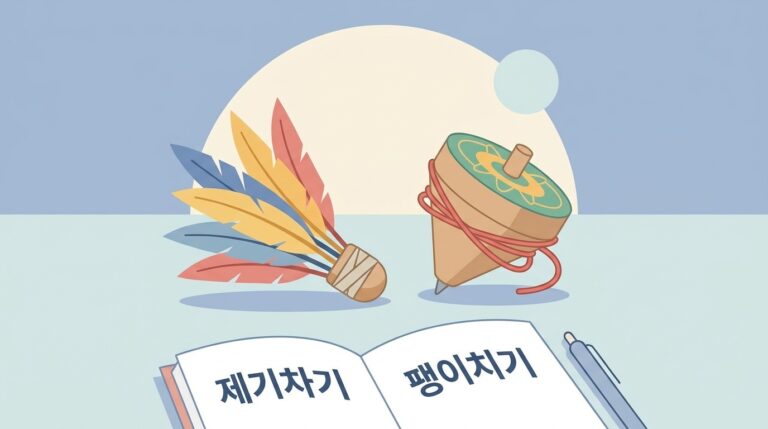
Master the Art of Korean Play: Level Up Your Jegichagi and Paeng-ichigi Game Banter
Phase 1: 공감 (Story-Immersive Opening)
안녕하세요! 매일한글 에디터입니다. (Hello! I’m your Daily Hangul editor.)
If you have ever tuned into legendary Korean variety shows like Running Man or 2 Days & 1 Night during a holiday special, you know the scene: world-famous actors and K-pop idols dressed in pristine Hanbok, suddenly rolling on the dirt floor, screaming their lungs out over a stray feathered shuttlecock or a stubbornly wobbling wooden top. It looks effortlessly hilarious on screen—until you find yourself standing in the courtyard of Bukchon Hanok Village during Chuseok. A friendly local grandfather hands you a handcrafted jegi (제기), smiles warmly, and says, “젊은이, 한판 해봐!” (Young friend, give it a shot!).
You step up with athletic confidence, kick once, miss on the second touch, and watch the jegi plummet into the gravel while everyone chuckles gently. In that split second, you realize textbook phrases like “저는 한국 전통 놀이를 좋아합니다” (I like Korean traditional games) leave you completely stranded. You want to playfully contest the wind, accuse your friend of distracting you, or dramatically declare a comeback! Based on real classroom feedback from hundreds of advanced learners who froze during festive gatherings, this guide bridges the gap between passive vocabulary and authentic, razor-sharp game banter. By mastering these C1-level expressions, you will not just participate—you will command the room with native-level wit and poise.
Phase 2: 핵심 표현 3선 심층 분석 (Deep Dive into 3 Essential Expressions)
1. 판을 뒤집다 (Pan-eul dwijipda)
- Pronunciation: Pan-eul dwi-jip-da (Sounds like “pahn-eul dwee-jeep-dah”, rhyming with a swift “pan” and an upward “flip-that”)
- Meaning: Literal: “To overturn the game board” | Actual Nuance: “To turn the tables / To engineer a dramatic comeback”
- K-Culture Moment: Used constantly in variety shows when an underdog player trails by a massive deficit in jegichagi and pulls off an acrobatic 25-kick streak to win the match.
- Editor’s Insight: At the C1 level, notice how pan (판) refers to the arena, context, or social board. You will hear corporate strategists and political commentators say “선거 판을 뒤집다” (turn the tables on the election). In casual games, shouting this right before your turn shows supreme swagger.
- Situation Spectrum: Casual ✅ / Semi-formal ✅ / Formal ⚠️
- 🤔 Think About It: In English, we often say “turn the tables” or “level the playing field.” Why do you think Korean uses the visceral physical verb 뒤집다 (to flip over), evoking an entire mat being upended?
2. 내기 한판 할래요? (Naegi hanpan hallaeyo?)
- Pronunciation: Nae-gi han-pan hal-lae-yo? (Sounds like “nay-ghee hahn-pahn hahl-lay-yo”)
- Meaning: Literal: “Shall we do one round of betting?” | Actual Nuance: “Up for a friendly wager? / Winner takes all?”
- K-Culture Moment: Coworkers on lunch break outside a traditional tea house picking up wooden tops (paeng-i) and immediately wagering an iced Americano on who spins the longest.
- Editor’s Insight: Do not confuse 내기 (naegi) with illicit gambling (도박 – dobak). Naegi in everyday Korean culture is social glue; wagering small stakes—like buying coffee, carrying bags, or enduring a forehead flick (ttakbam)—fuels connection and excitement.
- Situation Spectrum: Casual ✅ / Semi-formal ✅ / Formal 🚫
- 🤔 Think About It: How does wagering minor daily items alter the emotional temperature of social interactions in your culture compared to Korea’s lighthearted bet culture?
3. 아슬아슬하게 살았다! (Aseul-aseulhage saratda!)
- Pronunciation: A-seul-a-seul-ha-ge sa-rat-da! (Sounds like “ah-seul-ah-seul-hah-geh sah-raht-dah”)
- Meaning: Literal: “It survived by a razor’s edge!” | Actual Nuance: “That was a nail-biter! / Saved it in the nick of time!”
- K-Culture Moment: The collective gasp when a spinning top lurches sideways, grazes an opponent’s top, and miraculously rights itself, or when an off-balance jegi kick hits an ankle and stays airborne.
- Editor’s Insight: Notice the verb 살았다 (survived). Korean speakers frequently personify game tools (jegi, paeng-i, game tokens) as living beings fighting for survival. Using this personification shows true linguistic naturalness.
- Situation Spectrum: Casual ✅ / Semi-formal ✅ / Formal 🚫
- 🤔 Think About It: Why does Korean frequently attribute animate life and struggle (죽다/살다) to inanimate objects in sports and games?
Phase 3: 교과서 한국어 vs 진짜 한국어 (Textbook vs. Real Korean)
Situation 1: Botching a Jegi Kick
- 📖 교과서 한국어: “제기를 발로 제대로 차지 못했습니다.” (Je-gi-reul bal-lo je-dae-ro cha-ji mot-haet-seum-ni-da. / I was unable to kick the jegi properly with my foot.)
- 🗣️ 진짜 한국어: “아, 발에 안 맞고 완전히 빗맞았네! 삑사리 났어.” (A, bal-e an mat-go wan-jeon-hi bit-ma-jat-ne! Bbik-sa-ri nat-eo. / Ah, completely missed the sweet spot! It totally skidded off my shoe!)
- 💡 왜 다를까?: Native speakers rarely describe technical failure using formal negation (못했습니다). Instead, they deploy visceral sensory verbs like 빗맞다 (to strike off-center) and playful, expressive slang like 삑사리 (an accidental slip or voice crack).
Situation 2: Praising a Flawlessly Balanced Spinning Top
- 📖 교과서 한국어: “팽이가 균형을 잡고 오랫동안 회전하고 있습니다.” (Paeng-i-ga gyun-hyeong-eul jap-go o-raet-dong-an hoe-jeon-ha-go it-seum-ni-da. / The top is maintaining balance and rotating for a long time.)
- 🗣️ 진짜 한국어: “와, 팽이가 미동도 없이 쌩쌩 도네! 완전히 칼각이다.” (Wa, paeng-i-ga mi-dong-do eop-si ssaeng-ssaeng do-ne! Wan-jeon-hi kal-gak-i-da. / Whoa, that top is whirring without a flinch! Laser precision!)
- 💡 왜 다를까?: Modern native speech blends traditional sound-symbolic adverbs like 쌩쌩 (sound of smooth, rapid spinning) with trendy idioms like 칼각 (sharp, knife-like angle precision) to convey admiration dynamically.
Phase 4: K-Culture 딥다이브 & 비언어적 매너 (Deep Dive & Non-Verbal Etiquette)
4-1. 눈치 (Nunchi) & Gestures
- The Physical Perimeter: During jegichagi, players move unpredictably. Good manners require watching the kicker’s peripheral field (nunchi). Never crowd too close to inspect their count, as encroaching on their landing foot is considered poor sportsmanship.
- The Whip Arc in Paeng-ichigi: When spinning traditional tops with a cord (팽이채 – paeng-ichae), the flick of the wrist must snap downwards toward the ground, never horizontally across the circle where the string might hit an onlooker’s shins.
- Turn-Taking Humility: When playing with elders or in-laws during holidays, enthusiastic leaning forward and vocal admiration (“이야, 솜씨가 여전하시네요!” – Wow, your skills are as sharp as ever!) is expected. If you defeat an elder, never celebrate boisterously; lower your posture slightly, smile, and frame it as pure beginner’s luck (소 뒷걸음질 치다 쥐 잡았네요).
4-2. Cultural Code Analysis: The Psychology of “벌칙” (Penalty Culture)
Korean play culture is fundamentally collective and ritualistic. In Western contexts, friendly backyard games are often played casually for personal scorekeeping. In Korea, games exist to create drama (서사 – seosa) and mutual vulnerability. This is why every traditional game on variety shows and family gatherings ends in a 벌칙 (beol-chik – game penalty): from buying hot red-bean buns to wearing silly hats or receiving a harmless forearm tap. Embracing the stakes willingly proves your sociability (인싸 기질).
Phase 5: 실전 롤플레이 시나리오 (Interactive Roleplay Scenario)
Setting: An outdoor courtyard festival in Insa-dong. Autumn breeze, sound of wooden tops clacking against granite tiles.
Character: Min-seok (민석), your relentlessly competitive Korean friend who treats traditional folk games like the Olympic finals.
- Min-seok: “오늘 한옥마을 전통 놀이 대회, 그냥 갈 순 없지. 커피 내기 한판 콜?” (O-neul han-ok-ma-eul jeon-tong no-ri dae-hoe, geu-nyang gal sun eop-ji. Keo-pi nae-gi han-pan kol? / “We can’t just pass by the Hanok Village traditional game booth. Coffee bet on one round, deal?”)
🎭 눈을 반짝이며 제기를 허공에 가볍게 튕긴다 - You: “좋아요, 제가 요즘 발목 스냅 연습 좀 했거든요. 후회하지 마세요!” (Jo-a-yo, je-ga yo-jeum bal-mok seu-naep yeon-seup jom haet-geo-deun-yo. Hu-hoe-ha-ji ma-se-yo! / “Deal! I’ve been practicing my ankle snap lately. Don’t regret this!”)
🎭 겉옷 소매를 걷어 올리며 의기양양하게 웃는다 - Min-seok: “오, 자신감 보소? 먼저 제기차기 20개 넘기기부터 가시죠!” (O, ja-sin-gam bo-so? Meon-jeo je-gi-cha-gi i-sip-gae neom-gi-gi-bu-teo ga-si-jyo! / “Ooh, look at the confidence! Let’s see you clear 20 jegi kicks first!”)
🎭 팔짱을 끼고 의심 가득한 미소를 짓는다 - You: “하나, 둘, 셋… 앗, 열아홉 개에서 빗맞았네! 아깝다!” (Ha-na, dul, set… At, yeol-a-hop gae-e-seo bit-ma-jat-ne! A-kkap-da! / “One, two, three… Argh, completely botched the 19th! So close!”)
🎭 머리를 감싸 쥐며 탄식하는 시늉을 한다 - Min-seok: “크하하, 19개면 인정! 이제 내 차례, 팽이치기로 판을 뒤집어 볼까?” (Keu-ha-ha, sip-gu-gae-myeon in-jeong! I-je nae cha-rye, paeng-i-chi-gi-ro pan-eul dwi-ji-beo bol-kka? / “Bwahaha, 19 is respectable! My turn, shall I flip the tables with the spinning top?”)
🎭 팽이채 줄을 팽팽하게 감으며 자세를 낮춘다 - You: “어림없죠! 제 팽이는 지금 미동도 없이 칼각으로 쌩쌩 돌고 있거든요?” (Eo-rim-eop-jyo! Je paeng-i-neun ji-geum mi-dong-do eop-si kal-gak-eu-ro ssaeng-ssaeng dol-go it-geo-deun-yo? / “Not a chance! My top is spinning like a razor right now without even a tremor!”)
🎭 바닥에서 맹렬히 회전하는 팽이를 가리킨다 - Min-seok: “어라? 저거 봐라, 중심 흔들린다! 아슬아슬하게 버티는데?” (Eo-ra? Jeo-geo bwa-ra, jung-sim heun-deul-lin-da! A-seul-a-seul-ha-ge beo-tin-eun-de? / “Wait, look at that wobble! It’s barely clinging to life!”)
🎭 바짝 다가와 입바람을 불려는 시늉을 한다 - You: “휴! 간신히 살았다! 승자는 저니까 시원한 아바라 부탁해요!” (Hyu! Gan-sin-hi sa-rat-da! Seung-ja-neun jeo-ni-kka si-won-han a-ba-ra bu-tak-hae-yo! / “Phew! Survived in the nick of time! I’m the winner, so an iced vanilla latte please!”)
🎭 두 손으로 승리의 V자를 그리며 환호한다
🔀 Interactive Branching Point
Min-seok challenges you to a tie-breaker round. How do you respond?
* Option A: “콜! 대신 이번엔 진 사람이 붕어빵까지 쏘는 걸로 판 키우시죠?” (Deal! But let’s raise the stakes: loser buys bungeoppang too?)
* Outcome (Best): High charisma, perfectly matches Korean playful escalation culture. Builds instant rapport.
* Option B: “아니요, 규칙상 제가 이겼으니 게임은 여기서 끝입니다.” (No, by the rules I won, so the game ends here.)
* Outcome (Bad): Overly rigid, snaps the friendly conversational atmosphere instantly.
* Option C: “진짜요? 당신은 실력이 너무 형편없어서 제가 무조건 이겨요.” (Really? Your skills are so awful that I’ll definitely win.)
* Outcome (Risk): Borderline aggressive. In Korean humor, playful banter requires warmth, not blunt insults.
Phase 6: 10초 감정 섀도잉 드릴 (10-Second Emotion Shadowing Drill)
Read aloud matching the rhythm slashes (/) and emotional tone indicators:
[🔥 승부욕에 불타며 도발하듯]
“커피 내기 / 한판 콜? / 이번엔 진짜 / 안 봐줍니다!”
(Keo-pi nae-gi / han-pan kol? / I-beon-en jin-jja / an bwa-jum-ni-da! / Bet a coffee / one round, deal? / This time I’m really / not going easy on you!)-
[😱 아쉬움에 발을 동동 구르며]
“아, / 거의 다 잡았는데 / 마지막에 / 빗맞아서 / 삑사리 났네!”
(A, / geo-ui da ja-bat-neun-de / ma-ji-mak-e / bit-ma-ja-seo / bbik-sa-ri nat-ne! / Ah, / had it right in the bag / but at the very end / struck it off-center / and totally botched it!) -
[😎 능청스럽고 여유 넘치게]
“봤죠? / 제 팽이 / 칼각으로 / 쌩쌩 도는 거? / 판은 이미 끝났어요.”
(Bwat-jyo? / Je paeng-i / kal-gak-eu-ro / ssaeng-ssaeng do-neun geo? / Pan-eun i-mi kkeut-nat-eo-yo. / You saw that, right? / My top / whirring with laser precision? / The game is already over.)
Phase 7: K-Culture 미니 사전 (Mini Cultural Dictionary)
- 팽이돌리기 (Paeng-i-dol-li-gi) | Lit: Top spinning | Everyday Usage: Aside from the folk game, idiomatically used in workplace and social contexts to mean giving someone the runaround or deflecting direct questions in circles (사람을 팽이돌리듯 뱅뱅 돌리네).
- 밑장빼기 (Mit-jang-ppae-gi) | Lit: Pulling a card from the bottom of the deck | Everyday Usage: Slang popularized by gambling thrillers like Tazza; refers to any subtle cheating, shady rule modification, or sneaky maneuvering during a match.
- 승부사 (Seung-bu-sa) | Lit: Master match-player | Everyday Usage: Describes a competitor with ice in their veins who thrives under high pressure and seizes decisive victory at critical moments.
- 벌칙 (Beol-chik) | Lit: Penalty / Forfeit | Everyday Usage: The playful punishment assigned to the loser of a game. Essential in university drinking games, family holidays, and variety media.
Phase 8: 여행자를 위한 생존 키트 (Traveler’s Survival Kit)
Top 3 On-Site Survival Lines
- “제기 차는 요령 좀 알려주실 수 있나요?” (Je-gi cha-neun yo-ryeong jom al-lyeo-ju-sil su it-na-yo?)
- Pro Tip: Use this with folk village volunteers. 요령 (knack/trick) sounds far more natural than 방법 (method).
- “팽이채는 어떻게 감아야 잘 돌아요?” (Paeng-i-chae-neun eo-tteo-ke gam-a-ya jal do-ra-yo?)
- Pro Tip: Shows you respect the technical craft of top spinning.
- “한 번만 연습 게임으로 봐주세요!” (Han beon-man yeon-seup ge-im-eu-ro bwa-ju-se-yo!)
- Pro Tip: Use when you fail your first try. Asking for a mulligan with aegyo immediately softens the mood.
Editor’s Travel Note
When hunting for authentic traditional game hubs in Seoul, head straight to the courtyard experiences at Namsangol Hanok Village or the National Folk Museum inside Gyeongbokgung Palace. Rather than relying on generic international maps that often misplace courtyard entrances, be sure to utilize the Naver Map navigation application to pinpoint exact cultural event pavilions. Most heritage experiences are free to participate in, but having cash (1,000 KRW bills) is handy if you choose to purchase an artisanal wooden top or feathered jegi from local craftsmen onsite.
Phase 9: “한 발 더 깊이” (Reflective Cultural Inquiry)
Traditional Korean folk games are fundamentally communal architectures of shared joy (흥 – heung) and mutual solidarity (정 – jeong). Unlike modern digital gaming which tends toward solitary hyper-competition, games like jegichagi and paeng-ichigi were designed around the agrarian winter rhythms, turning bitter cold village plazas into hotbeds of communal laughter where hierarchical boundaries temporarily collapsed. Winning matters less than the collective rhythm of cheering, teasing, and sharing snacks after the showdown.
💬 Your Turn: In your native culture, what traditional street or holiday game brings people of all generations together, and how does the banter differ when someone makes a mistake? Share your story in the comments below!
Phase 10: FAQ & 오해 방지 (FAQ Schema)
Q: Can women and children participate in Jegichagi and Paeng-ichigi historically?
A: Absolutely! While Paeng-ichigi was historically popular among boys on frozen ponds during winter, modern festival play is universally enjoyed across all genders and ages throughout Seollal (Lunar New Year) and Chuseok.
Q: Does shouting “삑사리” (bbiksari) sound too vulgar for polite company?
A: 삑사리 is informal slang. It is perfect when bantering with peers, friends, or younger companions during games. However, avoid using it in formal corporate meetings or with elders you have just met for the first time; stick to 실수 (sil-su) or 빗맞았습니다 (bit-ma-jat-seum-ni-da) in formal settings.
Q: How do you determine the winner in traditional Paeng-ichigi?
A: There are two main rules: 지구력 싸움 (endurance contest: who spins the longest) and 팽이 싸움 (collision duel: knocking the opponent’s top out of the chalk circle or toppling it over).
🚨 Common Mistakes Warning Board
- Mistake: Saying “제기를 던지다” (to throw the jegi) instead of “제기를 차다” (to kick the jegi).
- Correct Action: Always use the verb 차다 (to kick) since the defining mechanic of the game is foot strikes.
- Mistake: Demanding a cash payout after offering a “내기” (naegi) to casual acquaintances.
- Correct Action: Keep stakes strictly experiential or culinary (coffee, ice cream, roasted chestnuts, snack penalty).
- Mistake: Celebrating a victory by trash-talking an elder in the group.
- Correct Action: Deflect credit to luck: “운이 좋았습니다!” (I was just lucky!).
Phase 11: 액션 미션 & 참여 유도 (Action Missions)
- 🥉 Bronze Mission (Solo Mastery): Stand in front of a mirror and practice shadowing the Phase 6 emotional sentences three times, focusing on exaggerating your facial expressions.
- 🥈 Silver Mission (Social Connection): Leave a comment below using the phrase “판을 뒤집다” in an original sentence about your Korean learning journey.
- 🥇 Gold Mission (Real-World Application): Next time you watch a Korean variety show or visit an offline cultural center, spot a traditional game and post a short audio or video clip in your study group reacting with “아슬아슬하게 살았다!”.
- 🎮 K-Culture Mission: Watch an episode of Running Man (런닝맨) during a Chuseok or Lunar New Year holiday special, and transcribe at least two game-betting slang expressions shouted by the cast members.
Phase 12: 인터랙티브 퀴즈 챌린지 (Interactive Quiz Challenge)
1. Situational Judgment
You are playing a friendly game of paeng-ichigi with your Korean project manager during a company retreat. Your top barely clips the edge of the stone, wobbles, and continues spinning to secure victory. What is the most culturally savvy and engaging phrase to say?
* A) “제가 완벽한 기술로 이겼습니다. 돈 내놓으세요.” (I won with perfect technique. Hand over the money.)
* B) “와, 마지막에 아슬아슬하게 살았네요! 정말 운이 좋았습니다.” (Whoa, it barely survived at the end! I was truly lucky.)
* C) “팀장님은 팽이를 전혀 칠 줄 모르시는군요.” (Team lead, you really have no clue how to spin a top.)
2. Fill-in-the-Blank
Fill in the missing idiom that means “to flip the script / turn the tables”:
“이번 라운드에서 점수를 왕창 따서 반드시 (판 / 상 / 길)을 뒤집겠어!”
3. True / False Cultural Check
True or False? In Korean folk culture, using the word 내기 (naegi) implies severe, high-stakes casino gambling and should be strictly avoided in social gatherings.
👉 Click to reveal answers & explanations!
- Answer: B
- Explanation: Option B demonstrates C1 mastery: it acknowledges the dramatic tension with authentic idiom (아슬아슬하게 살았다) while maintaining respectful social etiquette (운이 좋았습니다) with a senior colleague.
- Answer: 판
- Explanation: The complete idiom is 판을 뒤집다 (to turn the tables / overturn the game).
- Answer: False
- Explanation: Naegi is a healthy, ubiquitous social icebreaker for friendly wagers such as coffee, snacks, or playful penalties (벌칙).
- Explanation: Naegi is a healthy, ubiquitous social icebreaker for friendly wagers such as coffee, snacks, or playful penalties (벌칙).







