

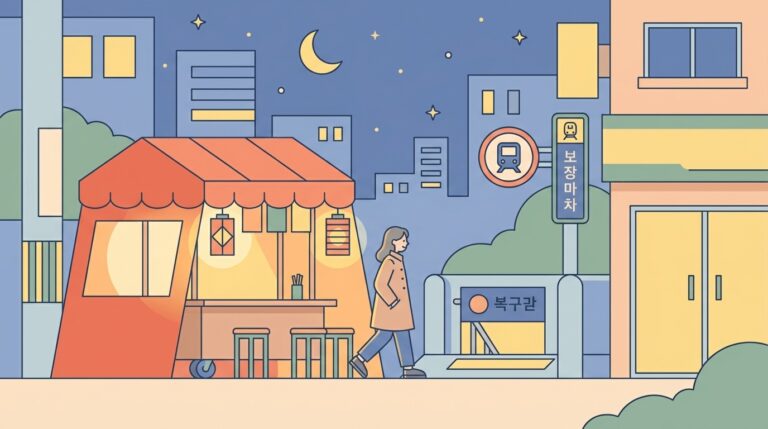
The Art of the Korean Hoesik Escape: How to Politely Leave After-Work Drinks
Phase 1: Empathy (Story-Driven Opening)
안녕하세요! 매일한글 에디터입니다. (Hello! This is your Daily Hangul editor.)
Have you ever found yourself sitting at a noisy Korean BBQ restaurant, the clock ticking past 10:30 PM, soju glasses endlessly clinking, wondering: “Can I actually leave now without causing an office scandal?”
If you have ever watched the K-Drama Work Later, Drink Now (술꾼도시여자들) or the iconic office series Misaeng (미생), you already know that an after-work dinner (hoesik, 회식) is not just dinner; it is an unscripted cultural drama. In Korea, dining together builds camaraderie (jeong, 정), but staying until round 3 (sam-cha, 3차) at 1:00 AM on a Tuesday can leave you utterly drained. Many of our international learners tell us their biggest pain point is the fear of being seen as rude or antisocial when they simply want to go home and sleep.
Do not worry! Leaving early does not make you a bad team player if you execute the exit strategy correctly. Based on real feedback from expats and corporate culture veterans in Seoul, this guide gives you the exact phrases, physical cues, and tactical timing you need to slip away smoothly—leaving your boss smiling and your social score intact.
Phase 2: 3 Key Expressions Deep Dive
1. 저 먼저 들어가 보겠습니다 (Jeo meonjeo deureogabogesseumnida)
- Pronunciation: [Jeo meon-jeo deu-reo-ga-bo-get-seum-ni-da] (Sounds like “Juh mun-juh dew-ruh-gah-bo-get-soom-nee-dah”)
- Meaning: Literal: “I will go in first.” / Nuance: “I will be heading home now.”
- K-Culture Moment: The classic respectful phrase spoken quietly to a team manager while standing with hands folded, just as another round of beer arrives.
- Editor’s Insight: Koreans rarely say “I am leaving” (Jeo gamnida); instead, they say “I will enter [my home] first.” Framing your exit as entering your private sanctuary softens the departure.
- Situation Spectrum: Casual ⚠️ | Semi-formal ✅ | Formal ✅
- 🤔 Think About It: In your culture, do you announce that you are leaving, or do you explain where you are heading? Notice how Korean focuses on returning safely to one’s home base.
2. 오늘 몸이 좀 안 좋아서요 (Oneul mom-i jom an joaseoyo)
- Pronunciation: [Oh-neul mom-ee jom an jo-ah-seo-yo] (Think of ‘mom’ like English ‘mome’, ‘jom’ as a soft ‘chom’)
- Meaning: Literal: “Because my condition is not good today.” / Nuance: “I am feeling a bit under the weather today.”
- K-Culture Moment: A junior colleague rubs their neck, speaking softly to their immediate senior (seonbae) so the entire table does not hear.
- Editor’s Insight: The magic word here is jom (좀, a little). In Korean communication, minimizing negative assertions prevents the listener from feeling burdened. It offers an airtight reason nobody will contest.
- Situation Spectrum: Casual ✅ | Semi-formal ✅ | Formal ✅
- 🤔 Think About It: Why do you think polite excuses in Korea often center on physical health rather than personal plans?
3. 막차 끊기기 전에 가야 해요 (Makcha kkeunkigi jeone gaya haeyo)
- Pronunciation: [Mak-cha kkeun-ki-gi jeo-ne ga-ya hae-yo] (Roughly “Mahk-chah kkoon-kee-ghee juh-neh gah-yah heh-yo”)
- Meaning: Literal: “I must go before the last train is cut off.” / Nuance: “I need to run before the last subway stops running!”
- K-Culture Moment: Checking the subway app at 11:15 PM and pointing at the phone screen to show your peers with an apologetic smile.
- Editor’s Insight: Makcha (막차) is the undisputed golden ticket. Nobody—not even the most demanding boss—wants to pay for your expensive late-night taxi fare or keep you stranded.
- Situation Spectrum: Casual ✅ | Semi-formal ✅ | Formal ⚠️
- 🤔 Think About It: How does public transport infrastructure shape cultural curfews and social excuses in different countries?
Phase 3: Textbook Korean vs. Real Korean
Situation 1: Announcing your departure to the table
- 📖 교과서 한국어: 저는 지금 집에 가겠습니다. (Jeoneun jigeum jib-e gagesseumnida. / “I will now go to house.”)
- 🗣️ 진짜 한국어: 저 슬슬 일어나 볼게요. (Jeo seulseul ireona bolgeyo. / “I think I will slowly get up now.”)
- 💡 왜 다를까? Saying “I will go home” sounds blunt, like a military status report. Using seulseul (슬슬, gradually/slowly) creates a soft buffer that makes your departure feel gentle and unforced.
Situation 2: Saying goodbye without interrupting the room
- 📖 교과서 한국어: 안녕히 계십시오, 여러분! (Annyeonghi gyesipsio, yeoreobun! / “Goodbye, everyone!”)
- 🗣️ 진짜 한국어: 먼저 일어날게요, 끝까지 못 있어서 죄송해요! (Meonjeo ireonalgeyo, kkeutkkaji mot isseoseo joesonghaeyo! / “I will take off first, so sorry I could not stay till the end!”)
- 💡 왜 다를까? Calling everyone’s attention disrupts the group harmony (bunwigi, 분위기). Quietly letting your immediate neighbor know with an apology for missing the finale shows considerate social etiquette.
Phase 4: K-Culture Deep Dive & Non-Verbal Manners
4-1. 눈치 (Nunchi) & Tactical Body Language
- The Coat Strategy: When you first arrive at the dinner, hang your coat and bag near the restaurant entrance or tuck your essentials discreetly into your bag. If you pack up your bag at the table, everyone notices you are planning your escape.
- The Break Point: The prime window to leave is during transition periods—when people step outside for fresh air, when the bill is being processed between 1차 (Round 1) and 2차 (Round 2), or when your manager heads to the restroom.
- The Two-Hand Bow: When saying goodbye to seniors, bow at about 30 degrees with both hands clasped neatly in front of your lower torso. Avoid sudden, loud farewells.
4-2. The Dynamics of Multi-Round Nights (1차 to 3차)
In Korean drinking culture, social gatherings usually progress across multiple venues: barbecue (1차), draft beer or dried snacks (2차), and karaoke or spicy soup (3차). The unwritten golden rule: Never leave in the middle of 1차 unless it is an emergency. Staying through Round 1 fulfills your collective duty. When the group moves to the street to walk toward Round 2, that street corner is your perfect exit ramp.
Phase 5: Real-Life Roleplay Scenario
Setting: A smoky samgyeopsal pub in Euljiro, Seoul. It is 10:40 PM. Round 1 is wrapping up, and Manager Kim (Kim Bujangnim) is rallying the group for fried chicken and beer (chimaek).
- Characters:
- Manager Kim (김 부장님): Generous but passionate team leader who loves long speeches.
- Minji (민지 대리): Astute senior colleague who knows how the office works.
- Sam (샘): An expat employee with an early morning presentation.
Dialogue:
1. Manager Kim: 자, 1차 끝났으니 2차는 맥주 한잔하러 가자고! 다들 갈 거지? (Ja, il-cha kkeutnasseuni i-cha-neun maekju hanjan-hareo gajago! Dadeul gal geoji?)
🎭 Clapping loudly while waving toward the street.
2. Minji: 부장님, 오늘 다들 너무 달렸는데요! (Bujangnim, oneul dadeul neomu dallyeonneundeyo!)
🎭 Laughing politely while glancing over at Sam to gauge his energy.
3. Sam: 부장님, 오늘 정말 즐거웠습니다! (Bujangnim, oneul jeongmal jeulgeowosseumnida!)
🎭 Standing up politely, holding both hands together.
4. Manager Kim: 어, 그래! 샘 씨도 오늘 고기 많이 먹었어? 2차 가서 감자튀김에 한잔 더 해야지? (Eo, geurae! Saem ssido oneul gogi mani meogeosseo? I-cha gaseo gamjatwigim-e hanjan deo haeyaji?)
🎭 Smiling warmly, patting Sam’s shoulder.
5. Sam: 정말 가고 싶은데, 제가 내일 아침 본사 미팅이 있어서요… (Jeongmal gago sipeunde, jega naeil achim bonsa miting-i isseoseoyo…)
🎭 Looking genuinely disappointed with a gentle head tilt.
6. Manager Kim: 아, 내일 본사 화상 회의 있지? 그거 중요하지. (A, naeil bonsa hwasang hoe-ui itji? Geugeo jungyohaji.)
🎭 Nodding thoughtfully, remembering the schedule.
7. Sam: 네, 끝까지 함께하지 못해 정말 죄송합니다. 저 먼저 들어가 보겠습니다! (Ne, kkeutkkaji hamkkehaji mothae jeongmal joesonghaeyo. Jeo meonjeo deureogabogesseumnida!)
🎭 Giving a respectful 30-degree bow.
8. Minji: 샘 씨, 얼른 들어가서 쉬어요! 조심히 가요! (Saem ssi, eolleun deureogaseo swieoyo! Josimhi gayo!)
🎭 Waving discreetly with a knowing wink.
🔀 Interactive Branch: What should Sam say if Manager Kim insists on “Just one more quick drink”?
- Option A: “싫어요, 너무 피곤해요.” (Sireoyo, neomu pigonhaeyo. / “No, I am too tired.”)
➡️ Outcome: [Bad] Bluntly rejecting a senior’s offer causes sudden awkwardness and damages group harmony. - Option B: “죄송합니다, 부장님! 제가 오늘 막차 놓치면 택시 잡기가 너무 힘들어서요.” (Joesonghamnida, bujangnim! Jega oneul makcha notchimyeon taeksi japgiga neomu himdeureoseoyo. / “I am so sorry, Manager! If I miss the last train, catching a taxi is almost impossible.”)
➡️ Outcome: [Best] Highly practical, relatable reason in Seoul. Nobody wants you stranded outside. - Option C: Say nothing, sneak out into the restroom, and take a cab home quietly without telling anyone.
➡️ Outcome: [Risk] Known as *ninjatwigeun (ninja exit). If colleagues search for you, they might worry you got lost or fell ill.*
Phase 6: 10-Second Emotion Shadowing Drill
Practice these natural rhythm pauses (/) and adopt the indicated facial expressions!
[🥺 Regretful and polite]
정말 가고 싶은데요… / 오늘 몸이 좀 안 좋아서요. / 죄송합니다.
(Jeongmal gago sipeundeyo… / oneul mom-i jom an joaseoyo. / joesonghamnida.)-
[🏃 Urgent yet friendly]
벌써 시간이 이렇게 됐네요! / 저 막차 끊기기 전에 / 먼저 일어나 볼게요!
(Beolsseo sigani ireoke dwaenneyo! / jeo makcha kkeunkigi jeone / meonjeo ireona bolgeyo!) -
[😊 Grateful and warm]
오늘 너무 맛있게 잘 먹었습니다! / 내일 사무실에서 뵙겠습니다!
(Oneul neomu mas-itge jal meogeosseumnida! / naeil samusireseo boepgesseumnida!)
Phase 7: K-Culture Mini Dictionary
- 회식 (Hoe-sik): Company dinner gathering. Historically seen as mandatory team bonding, it is now shifting toward shorter, optional dinners among younger generations.
- 1차 / 2차 (Il-cha / I-cha): Round 1 / Round 2. 1차 is typically centered on food and alcohol, while 2차 shifts to lighter snacks, pubs, or karaoke (noraebang).
- 막차 (Mak-cha): The final scheduled subway or city bus of the night, usually running around 11:30 PM to 12:30 AM in the Seoul metropolitan area.
- 눈치 (Nun-chi): Social intuition and situational awareness. Having good nunchi allows you to read subtle atmospheric cues and pick the exact right moment to exit.
Phase 8: Traveler & Expat Survival Kit
Top 3 Survival Phrases
- 먼저 가볼게요! (Meonjeo gabolgeyo!) — “I will get going first!”
💡 Pro Tip: Perfect for casual peer gatherings with friends or language exchange buddies. - 택시가 잡혀서 먼저 가보겠습니다. (Taeksiga japhyeoseo meonjeo gabogesseumnida.) — “My taxi just got assigned, so I will take off.”
💡 Pro Tip: Hail your taxi via app first; once assigned, you have a solid 3-minute hard deadline to leave. - 내일 일찍 일정이 있어서요. (Naeil iljjik iljeongi isseoseoyo.) — “I have an early schedule tomorrow.”
💡 Pro Tip: The most universally respected professional boundary.
Editor’s Travel Note
- Transport App: Seoul taxis become notoriously difficult to hail past 11:00 PM near Hongdae, Gangnam, and Jongno. Download the Kakao T mobile app in advance so you can hail certified rides directly.
- Subway Tracking: Use the Naver Map application to check live countdown timers for your route’s makcha (last train). Never rely on rough estimates!
Phase 9: A Step Deeper (Reflective Essay)
In traditional Korean society, eating and drinking together from the same pot symbolized a shared destiny, turning coworkers into sikgu (식구, family members who eat together). For decades, leaving early was seen as rejecting the team’s shared spirit. Today, Korea is rapidly balancing collective respect with personal boundaries (worabal, work-life balance). Leaving a dinner early is no longer forbidden; it simply requires emotional consideration. By framing your exit around logistical facts (the last train) or physical limits (health), you demonstrate that you respect the group while taking care of yourself.
💬 Your Turn: In your home country, how do people usually leave long social dinners? Do you say goodbye to each person, or do you prefer an “Irish exit”? Let us know in the comments below!
Phase 10: FAQ & Avoiding Misunderstandings
Q: Do I need to split the bill before sneaking out of a hoesik?
A: Usually, no! In standard corporate hoesik, the company card or the most senior leader pays for the entire gathering. However, in casual gatherings (moim), always send your portion via bank transfer or leave cash with the organizer immediately after stepping out.
Q: Is it rude to leave during Round 1?
A: Generally, yes. Leaving during Round 1 can make you seem detached unless you give prior notice before the dinner starts (e.g., informing your manager at 4 PM that you have a doctor’s appointment).
Q: Can I just leave without saying anything?
A: Only do this at massive, noisy parties with 30+ people. In typical team sizes (5–12 people), a silent exit (ninjatwigeun) will cause worry, prompting calls asking if you got home safely.
🚨 Common Mistakes Warning Board
- Mistake: Announcing to the entire table: “I am exhausted, I am going home.”
- Correct Action: Quietly inform your direct senior and the table host one-on-one before slipping away.
- Mistake: Staying until 2 AM out of politeness, then coming late to work the next morning.
- Correct Action: Prioritize your morning performance. Leaving early with a polite excuse is far better than showing up late to the office.
- Mistake: Telling obvious lies that can be contradicted later on social media.
- Correct Action: Stick to standard, indisputable reasons: early morning tasks, family duties, or the last train curfew.
Phase 11: Action Missions
- 🥉 Bronze Mission: Stand in front of your mirror and practice saying: “저 먼저 들어가 보겠습니다!” with a polite 30-degree bow.
- 🥈 Silver Mission: Open your favorite transit app (like Naver Map) and locate the exact departure time of the makcha (last train) from your favorite station.
- 🥇 Gold Mission: Use the phrase “오늘 몸이 좀 안 좋아서요, 먼저 일어나 볼게요” in your next language exchange or dinner meetup when you are ready to head home.
- 🎮 K-Culture Mission: Watch an episode of an office drama (like Misaeng) and spot the exact moment an employee slips away from their team dinner!
Phase 12: Interactive Quiz Challenge
Test your situational nunchi with three quick questions!
1. Situational Judgment: You are at a team dinner. It is 10:50 PM. Round 1 has just wrapped up, and your team is standing outside choosing a karaoke bar. What is your best move?
* A) Run to the subway station without speaking to anyone.
* B) Tell the boss that karaoke is boring and leave.
* C) Approach your manager, thank them for the delicious dinner, mention your early morning meeting, bow politely, and head to the station.
2. Fill in the Blank:
“내일 일찍 회의가 있어서 저 (_________) 일어나 볼게요!”
(Hint: The Korean adverb meaning ‘slowly’ or ‘gradually’)
3. True or False: In Korea, mentioning that you will miss the makcha (last subway/bus) is considered an offensive reason to leave a company dinner.
👉 Click to reveal answers & explanations
- Answer: C
Explanation: The transition between Round 1 and Round 2 is the ideal exit window. Thanking the host before leaving maintains high social rapport. - Answer: 슬슬 (seulseul)
Explanation: “저 슬슬 일어나 볼게요” (I think I will slowly get up now) is the natural native way to soften your departure. - Answer: False
Explanation: Makcha is one of the most universally respected, polite, and uncontested excuses in Korean urban culture!







