

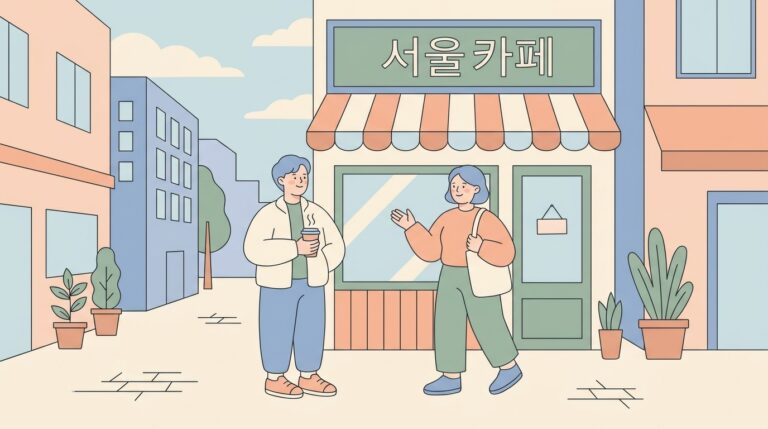
Master the Art of the Polite “No” in Korean: “다음에 할게요” (Daeume halgeyo)
Phase 1: 공감 (The Art of Saying “Later” Without Hurting Feelings)
안녕하세요! This is your Daily Hangul editor, your trusted local culture navigator!
Picture this classic Seoul scene: You are strolling through the vibrant, neon-lit alleys of Hongdae. The aroma of sweet grilled hotteok fills the air, and enthusiastic cosmetic shop promoters step outside, offering you free face masks while inviting you in: “Come take a look! (들어와서 구경하세요! / Deureowaseo gugyeonghaseyo!)”
Your heart rate spikes. In English, you might casually wave your hand and say, “No thanks, I’m good!” But your textbook only taught you “아니요 (Aniyo – No)” or “싫어요 (Sireoyo – I hate it/I don’t want to).” If you blurt out “싫어요!” with wide eyes, the friendly promoter looks startled, and suddenly, the whole sidewalk feels awkward.
Here is the secret: In Korea, a flat-out “No” hits like a verbal slap. Direct refusals break the invisible social cushion called Jeong (정) and harmony. Instead, locals lean into a magical, graceful social buffer phrase: “다음에 할게요 (Daeume halgeyo – I’ll do it next time).”
Over the past decade tutoring hundreds of beginners, I have watched this single phrase transform anxious travelers into confident, culturally savvy communicators. Once you master it, you will decline street vendors, say no to a second drink, and gracefully dodge pushy sales pitches—all while keeping everyone smiling.
Phase 2: 핵심 표현 3선 심층 분석 (Top 3 Polite Refusal Expressions)
1. 다음에 할게요 (Daeume halgeyo)
- Pronunciation: [Dae-um-e hal-ge-yo] (Sounds like “Die-oom-eh hahl-geh-yo”)
- Meaning: Literal: “I will do it next time.” | Actual Nuance: “I’m flattered/I hear you, but no thank you for now.”
- K-Culture Moment: You will hear this constantly in K-dramas when a character tries to sell insurance or when a colleague asks someone to join an unexpected team dinner (Hoesik).
- Editor’s Insight: You do not actually have to set an appointment for “next time.” It is a socially accepted white lie that protects both your boundaries and the other person’s pride (Che-myeon).
- Situation Spectrum: Casual: ✅ | Semi-formal: ✅ | Formal: ⚠️ (In strict business, pair it with an apology)
- 🤔 Think About It: In your native language, do you offer a future promise even if you don’t mean it, or do you prefer a firm “No”?
2. 괜찮아요 (Gwaenchanayo)
- Pronunciation: [Gwaen-chan-a-yo] (Sounds like “Gwen-chahn-ah-yo”—think of the singer Gwen Stefani!)
- Meaning: Literal: “It is okay.” | Actual Nuance: “I am fine as I am / No thank you.”
- K-Culture Moment: Seen in convenience store scenes whenever the cashier asks if the customer wants a receipt (Yeongsujeung) or a plastic bag (Bongtu).
- Editor’s Insight: Tone is everything here! A bright, melodic “괜찮아요~” means a polite “No thank you.” A flat, downward tone can sound cold.
- Situation Spectrum: Casual: ✅ | Semi-formal: ✅ | Formal: ✅
- 🤔 Think About It: Why does saying “I’m already okay” function as a polite refusal instead of stating what you don’t want?
3. 다음에 또 올게요 (Daeume tto olgeyo)
- Pronunciation: [Dae-um-e tto ol-ge-yo] (Sounds like “Die-oom-eh toh ohl-geh-yo”)
- Meaning: Literal: “I will come again next time.” | Actual Nuance: “Thanks for letting me browse, I’m leaving without buying anything!”
- K-Culture Moment: Used by characters shopping at boutique stores in Garosu-gil or traditional markets when escaping attentive shop owners without guilt.
- Editor’s Insight: Adding “또 (tto – again)” shows goodwill. It guarantees you leave the shop with warmth rather than tension.
- Situation Spectrum: Casual: ✅ | Semi-formal: ✅ | Formal: 🚫
- 🤔 Think About It: Notice how Korean shop etiquette treats leaving a store as a warm social farewell rather than an abrupt exit.
Phase 3: 교과서 한국어 vs 진짜 한국어 (Textbook vs. Real Korean)
Situation 1: Browsing a boutique store and deciding not to buy anything
- 📖 교과서 한국어: 사고 싶지 않습니다. (Sago sipji anseumnida.) — “I do not desire to purchase this.”
- 🗣️ 진짜 한국어: 구경 잘했어요, 다음에 올게요! (Gugyeong jalhaesseoyo, daeume olgeyo!) — “I enjoyed looking around, I’ll come next time!”
- 💡 왜 다를까?: Declaring that you don’t want to buy makes the merchant feel rejected. Complimenting their store before promising a vague future visit leaves everyone happy.
Situation 2: When an elderly vendor offers extra samples you don’t want
- 📖 교과서 한국어: 싫습니다. 주지 마세요. (Silseumnida. Juji maseyo.) — “I dislike it. Do not give it to me.”
- 🗣️ 진짜 한국어: 배불러서 괜찮아요, 감사합니다! (Baebulleoseo gwaenchanayo, gamsahamnida!) — “I’m so full, so I’m okay, thank you!”
- 💡 왜 다를까?: Direct negation sounds aggressive in Korean food culture. Blaming your own full stomach (배불러서) takes the fault off the generous host.
Phase 4: K-Culture 딥다이브 & 비언어적 매너 (Nunchi & Body Language)
4-1. 눈치 (Nunchi) & Body Language: The Subtle Shield
In Korea, words only do half the work; your body does the rest!
* The Gentle Hand Fan: When saying “괜찮아요 (Gwaenchanayo),” bring one hand to chest height and wave it gently from left to right twice (palm facing outward). Keep it small—don’t wave like you’re swatting a mosquito!
* The Micro-Bowing Head Tilt: Accompany “다음에 할게요 (Daeume halgeyo)” with a slight 15-degree head tilt and an apologetic smile. This demonstrates that you value their offer.
* Soft Eye Contact: Avoid intense, unblinking eye contact when saying no. Glance down slightly to signal humility.
4-2. Cultural Code: The Art of Che-myeon (체면 – Saving Face)
Why do Koreans rarely say a blunt “아니요 (No)”? It boils down to Che-myeon (social face). A direct rejection exposes both parties: the asker feels rejected, and the refuser feels rude. By suggesting “Next time (다음에),” you build an invisible bridge where nobody loses face.
Phase 5: 실전 롤플레이 시나리오 (Real Role-Play Scenario)
Setting: A hip vintage clothing store near Hongik University Station. The energetic store owner, Min-su, spots you admiring an oversized leather jacket.
- 민수 (Min-su): 손님, 이 재킷 오늘 들어온 신상이에요! 한번 입어보실래요?
(Sonnim, i jaekit oneul deureoon sinsang-ieyo! Hanbeon ibeobosillaeyo?)
“Customer, this jacket is a fresh arrival today! Would you like to try it on?”
🎭 Eyes sparkling with sales enthusiasm, holding the hanger toward you. -
You (Alex): 와, 예쁘네요. 그런데 가격이 조금 비싸요.
(Wa, yeppeuneyo. Geureonde gageogi jogeum bissayo.)
“Wow, it is pretty. But the price is a bit high.”
🎭 Touching the sleeve while checking the price tag with a curious smile. -
민수 (Min-su): 오늘 현금으로 하시면 제가 10% 깎아드릴게요! 입어만 보세요!
(Oneul hyeongeumeuro hasimyeon jega sip-peosenteu kkakka-deurilgeyo! Ibeoman boseyo!)
“If you pay with cash today, I’ll give you 10% off! Just try it on!”
🎭 Stepping forward encouragingly, gesturing toward the fitting mirror. -
You (Alex): 정말 감사해요. 그런데 오늘은 그냥 구경하는 중이에요.
(Jeongmal gamsahaeyo. Geureonde oneureun geunyang gugyeonghaneun jung-ieyo.)
“Thank you so much. But today I am just looking around.”
🎭 Raising one hand with a polite, small waving gesture. -
민수 (Min-su): 편하게 입어보셔도 되는데… 진짜 잘 어울리실 것 같아요!
(Pyeonhage ibeobosyeodo doeneunde… Jinjja jal eoullisil geot gat-ayo!)
“You really don’t have to feel pressured… I think it will look great on you!”
🎭 Making one final warm attempt, smiling warmly. -
You (Alex): 감사합니다. 오늘은 괜찮고, 다음에 할게요!
(Gamsahamnida. Oneureun gwaenchanko, daeume halgeyo!)
“Thank you. Today I’m okay, I will do it next time!”
🎭 Nodding politely with a warm, apologetic 15-degree head bow. -
민수 (Min-su): 아, 그래요? 알겠습니다! 천천히 더 구경하세요~
(A, geuraeyo? Algesseumnida! Cheoncheonhi deo gugyeonghaseyo~)
“Ah, is that so? Understood! Feel free to look around at your own pace~”
🎭 Stepping back peacefully, relieved by the smooth communication. -
You (Alex): 네, 감사합니다! 구경 잘하고 다음에 또 올게요!
(Ne, gamsahamnida! Gugyeong jalhago daeume tto olgeyo!)
“Yes, thank you! I enjoyed browsing, I will come back next time!”
🎭 Exiting the shop smoothly with a relaxed wave.
🔀 Interactive Decision Point: Min-su insists you try on a jacket
What is your best response?
* Option A: “싫어요. 절대 안 사요! (Sireoyo. Jeoldae an sayo! – I hate it. I will never buy it!)”
* Feedback (Bad): Too harsh! Min-su will freeze in shock, and the atmosphere in the tiny boutique turns ice-cold.
* Option B: “죄송하지만, 다음에 할게요! (Joesonghajiman, daeume halgeyo! – I am sorry, but I’ll do it next time!)”
* Feedback (Best): Perfect! Flawless polite refusal. You acknowledge his kindness and step back with total social grace.
* Option C: (Say nothing, make awkward eye contact, and sprint out the door)
* Feedback (Risk): The owner might wonder if you felt offended or misunderstood. Silence feels heavier than a gentle verbal boundary.
Phase 6: 10초 감정 섀도잉 드릴 (10-Second Emotion Shadowing Drill)
Practice reading these out loud, observing the breath marks (/) and feeling the emotional vibe:
[🥺 아쉽고 공손하게 - Apologetic & polite]
“죄송해요, / 오늘은 / 다음에 할게요.”
(Joesonghaeyo, / oneureun / daeume halgeyo.)
Translation: “I’m sorry, / today / I’ll pass for next time.”-
[😊 산뜻하고 밝게 - Crisp & cheerful]
“감사합니다! / 구경 잘하고 / 다음에 또 올게요~”
(Gamsahamnida! / Gugyeong jalhago / daeume tto olgeyo~)
Translation: “Thank you! / I loved looking around, / I’ll visit again next time~” -
[✋ 차분하고 부드럽게 - Calm & gentle]
“아, / 저는 / 괜찮아요!”
(A, / jeoneun / gwaenchanayo!)
Translation: “Ah, / as for me, / I am all good!”
Phase 7: K-Culture 미니 사전 (Essential Mini Dictionary)
- 다음 (Dae-um) | Next / The following
Everyday usage: The ultimate starter block for future planning. Combine it with ju (week) for Daeum-ju (next week) or dal (month) for Daeum-dal (next month). - 거절 (Geo-jeol) | Refusal / Rejection
Everyday usage: Commonly heard in daily conversations like “거절하기 힘들어요 (Geojeolhagi himdeureoyo – It is hard to say no).” - 눈치 (Nun-chi) | Social intuition / Reading the room
Everyday usage: If you master polite refusals, locals will compliment you: “눈치 빠르시네요! (Nunchi ppareusineyo! – You’ve got quick social wits!)” - 서비스 (Seo-bi-seu) | Free perk / Complimentary gift
Everyday usage: In Korean restaurants, side dishes or extra drinks given on the house are called “서비스.” If you can’t eat it, decline politely with “감사하지만 괜찮아요!”
Phase 8: 여행자를 위한 생존 키트 (Traveler’s Survival Kit)
Top 3 Survival Phrases
- 1. “영수증은 괜찮아요.” (Yeongsujeungeun gwaenchanayo.)
Pro Tip: Say this at 7-Eleven or CU convenience stores when the cashier taps the receipt machine. It means “I don’t need a receipt.” - 2. “봉투는 괜찮아요.” (Bongtuneun gwaenchanayo.)
Pro Tip: Plastic bags cost 50 to 100 KRW in Korea. Use this if you have your own tote bag. - 3. “생각해 보고 올게요.” (Saenggakhae bogo olgeyo.)
Pro Tip: Means “I will think about it and come back.” The golden escape phrase when street market merchants offer persistent deals.
Editor’s Travel Note
When wandering dynamic spots like Myeongdong Night Market or Namdaemun, street hawkers will address you in five languages! If you feel overwhelmed, don’t freeze up. A soft smile paired with “다음에 올게요!” works like a protective cloak.
To help navigate local shops without wandering into tourist traps, make sure to read our curated walkthrough on the Naver Map app installation and navigation guide. Remember that credit cards and T-Money transport cards are accepted almost everywhere in Seoul, but having 1,000 KRW bills handy for street snacks is always smart!
Phase 9: “한 발 더 깊이” (A Step Deeper)
In Western communication, clarity and directness are often viewed as the highest forms of respect: “Be honest so we don’t waste time.” But in Korea’s historically collectivist culture, social comfort takes priority over raw honesty. By softening a rejection into “next time,” you offer the other person a safe landing cushion. You aren’t lying; you are practicing communal empathy.
💬 Your Turn: Have you ever felt guilty or awkward saying “No” in another country? How does the concept of “다음에 할게요” feel compared to how you decline offers at home? Drop your story in the comments below!
Phase 10: FAQ & 오해 방지 (FAQ & Common Mistakes)
Q: Does saying “다음에 할게요” obligate me to actually go back?
A: Not at all! In 95% of casual commercial encounters (shops, street stalls, promotions), both you and the speaker understand it as a polite, final refusal for that moment. No one will hold you to a contract!
Q: Can I use “다음에 할게요” with my boss or professor?
A: Be careful! To people of much higher status, it can sound a bit casual. In formal environments, say: “죄송하지만 이번에는 어렵겠습니다 (Joesonghajiman ibeoneneun eoryeopgetseumnida – I am sorry, but it will be difficult this time).”
Q: What is the difference between “아니요 (Aniyo)” and “괜찮아요 (Gwaenchanayo)”?
A: “아니요” is a logical denial (“No, that is not the case”). “괜찮아요” means “I am content / No thank you.” When declining offers, food, or assistance, “괜찮아요” is far more natural.
🚨 흔한 실수 (Common Mistakes Top 3)
- Shouting “싫어요! (Sireoyo!)” to shopkeepers
Correction: Replace it with “다음에 올게요! (Daeume olgeyo!)”. - Vigorously waving both hands over your head
Correction: Keep hand gestures small and level with your chest. Big hand gestures signal emergency or panic. - Walking away in stone-cold silence
Correction: Even a gentle one-second head nod with “괜찮아요 (Gwaenchanayo)” shows respect and leaves a glowing impression.
Phase 11: 액션 미션 & 참여 유도 (Action Missions)
- 🥉 Bronze Mission: Stand in front of your mirror. Look at yourself, give a gentle 15-degree nod, raise one hand slightly, and say “다음에 할게요 (Daeume halgeyo)” 3 times.
- 🥈 Silver Mission: When ordering a coffee or shopping today, practice declining a receipt or bag in your mind (or aloud!) using “괜찮아요 (Gwaenchanayo).”
- 🥇 Gold Mission: On your next trip to Korea (or at a local K-mart), smoothly decline a sample offering using “감사합니다, 다음에 할게요!”
- 🎮 K-Culture Mission: Watch an episode of a modern K-drama (like Business Proposal or Hospital Playlist) and listen for when someone says “다음에.” Write down the context in your study journal!
Phase 12: 인터랙티브 퀴즈 챌린지 (Interactive Quiz Challenge)
1. Situation Quiz
You are browsing a cosmetic shop in Myeongdong. The clerk hands you a basket and recommends three lipsticks you don’t want. What is the most culturally polite way to decline?
– A) 안 사요! (An sayo! – I won’t buy it!)
– B) 싫습니다. (Silseumnida. – I dislike it.)
– C) 구경하고 다음에 할게요. 감사합니다! (Gugyeonghago daeume halgeyo. Gamsahamnida!)
👉 Click here to reveal the answer and explanation!
Correct Answer: C
Explanation: Option C acknowledges the browsing experience, places the refusal gently into the future (“다음에 할게요”), and ends with sincere gratitude. Options A and B sound aggressively confrontational.
2. Fill-in-the-Blank
Complete the natural refusal when someone offers you more food, but your stomach is bursting:
* “배불러서 __________, 감사합니다!” (I’m full, so I’m okay, thank you!)
👉 Click here to reveal the answer and explanation!
Correct Answer: 괜찮아요 (Gwaenchanayo)
Explanation: “배불러서 괜찮아요 (Baebulleoseo gwaenchanayo)” is the textbook-perfect natural way to tell hosts you have enjoyed enough food without sounding ungrateful.
3. True / False Cultural Check
Statement: When you say “다음에 또 올게요 (I’ll come again next time)” to a street food vendor, they will expect you to return tomorrow and might get mad if you don’t.
👉 Click here to reveal the answer and explanation!
Correct Answer: False!
Explanation: Koreans understand “다음 (next time)” in shopping and service encounters as a friendly linguistic ritual that maintains warmth. No one keeps attendance!







