

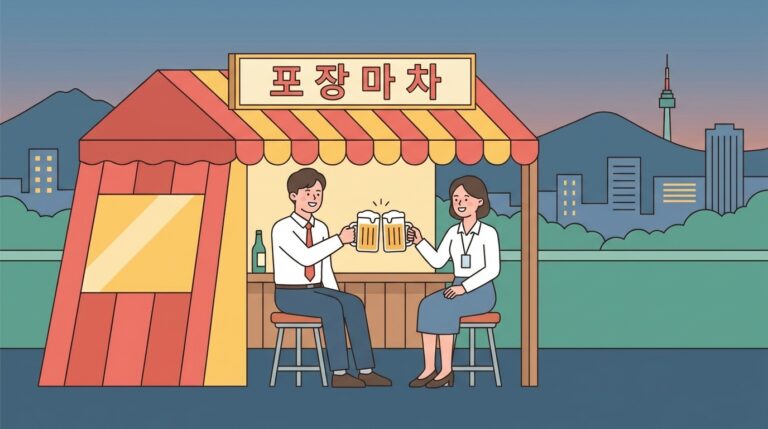
안녕하세요! 매일한글 에디터입니다. (Hello! I’m your Daily Hangul editor.)
Phase 1: The 5:58 PM Clock Freeze
Picture this scene straight out of an office K-Drama like Misaeng or Business Proposal: It is 5:58 PM on a brisk Thursday evening in a modern Gangnam office tower. The repetitive clatter of mechanical keyboards begins to slow down. Your monitors glow warmly, and your coworker sitting right across from you lets out a quiet, exhausted sigh while massaging their shoulders. You survived a brutal week of back-to-back quarterly reviews together, and you are craving a crisp, ice-cold draft beer with some crispy fried chicken. You want to ask them: “Hey, want to grab a beer before heading home?”
Yet, your throat freezes. What if it sounds like an unwanted, mandatory company dinner (hoesik)? What if your phrase is too stiff, making you sound like a robotic corporate textbook, or way too casual, disrespecting their personal boundary? Many intermediate learners tell me: “I know the vocabulary words for beer and company, but I don’t know how to pop the question naturally without making it awkward.”
Don’t worry! After mentoring hundreds of global professionals working in Korean companies, I’ve refined this stress-free guide. Today, you will learn the exact intermediate (B1) Korean expressions, physical nunchi gestures, and cultural etiquette to invite your teammates out for an effortless, stress-relieving brew. Let’s dive right in!
Phase 2: Core Expressions Deep Dive
1. 오늘 퇴근하고 맥주 한잔 어때요? (Oneul toe-geun-ha-go maek-ju han-jan eo-ttae-yo?)
- Pronunciation: oh-neul toe-geun-hah-goh maek-joo hahn-jahn uh-ttae-yoh? (Think of “toe” + “gun” for 퇴근, and “uh-ttae” like the surprise sound “Uh?” followed by “tae”).
- Meaning: Literal: “How about one glass of beer after leaving work today?” | Real Nuance: “Fancy a quick beer after work today?”
- K-Culture Moment: Frequently heard between friendly peers of similar rank wrapping up a tough sprint, just before grabbing their coats.
- Editor’s Insight: 한잔 (han-jan) literally means “one glass,” but culturally it implies an easygoing, low-pressure gathering. It promises the other person that you aren’t planning an exhausting, four-round all-night drinking session.
- Situation Spectrum: Casual ✅ | Semi-formal ✅ | Formal ⚠️
- 🤔 Think About It: In your home culture, do you usually specify the exact beverage or time when inviting someone, or do you use a symbolic phrase like “grab a cup/glass”?
2. 가볍게 치맥이나 하러 가요. (Ga-byeop-ge chi-maek-i-na ha-reo ga-yo.)
- Pronunciation: gah-byeop-geh chee-maek-ee-nah hah-ruh gah-yoh. (The particle 이나 flows seamlessly from the ‘k’ sound in 치맥 as chee-mae-gi-na).
- Meaning: Literal: “Let’s go do something like chimaek lightly.” | Real Nuance: “Let’s just grab a quick chicken and beer.”
- K-Culture Moment: Seen in romantic comedies when two colleagues turn a stressful overtime day into a comforting, shared comfort-food date.
- Editor’s Insight: The particle (이)나 here is pure magic! It lowers the stakes by implying “or something similar,” showing you are flexible and not demanding a heavy commitment.
- Situation Spectrum: Casual ✅ | Semi-formal ✅ | Formal 🚫
- 🤔 Think About It: Notice how the adverb 가볍게 (lightly) softens direct invitations in Korean culture. How does your language soften proposals?
3. 시간 괜찮으시면 같이 가실래요? (Si-gan gwaen-chan-eu-si-myeon gat-i ga-sil-rae-yo?)
- Pronunciation: shee-gahn gwaen-chahn-oo-she-myeon gah-chee gah-sheel-lae-yoh? (Notice 같이 is pronounced like gah-chee due to Korean palatalization).
- Meaning: Literal: “If time is okay, would you like to go together?” | Real Nuance: “If you have time and feel up for it, care to join me?”
- K-Culture Moment: The polite bridge phrase used when inviting a slightly senior colleague (선배) or someone you haven’t spoken with casually yet.
- Editor’s Insight: This incorporates the honorific marker -(으)시-. It is immensely respectful because it prioritizes the other person’s schedule and agency first.
- Situation Spectrum: Casual ⚠️ | Semi-formal ✅ | Formal ✅
- 🤔 Think About It: Why is giving a coworker an “easy exit” considered peak politeness in collective workplaces?
Phase 3: Textbook Korean vs. Real Korean
Situation A: Asking out a coworker right before 6:00 PM
- 📖 교과서 한국어: 오늘 저녁에 저와 함께 술을 마시겠습니까? (Oneul jeonyeoge jeowa hamkke sureul masigesseumnikka?) — “Will you drink alcohol together with me this evening?”
- 🗣️ 진짜 한국어: 오늘 퇴근하고 간단하게 한잔할래요? (Oneul toegeunhago gandanhage hanjanhallaeyo?) — “Wanna grab a quick drink after clocking out?”
- 💡 Why the difference? Textbook phrases sound like an official business interview or a contract proposal. Native speakers use 간단하게 (simply/lightly) and 한잔하다 (to have a drink) to keep the interaction warm, safe, and casual.
Situation B: Enthusiastically accepting an after-work invite
- 📖 교과서 한국어: 네, 좋습니다. 맥주를 마시러 갑시다. (Ne, joseumnida. Maekjureul masireo gapsida.) — “Yes, it is good. Let us go drink beer.”
- 🗣️ 진짜 한국어: 오, 완전 좋죠! 오늘 딱 땡겼는데! (O, wanjeon jotjyo! Oneul ttak ttaenggyeonneunde!) — “Oh, absolutely! I was craving that exact thing today!”
- 💡 Why the difference? 땡기다 (ttaenggida) is expressive conversational slang meaning to strongly crave a specific food or drink. It signals instant enthusiasm and camaraderie!
Phase 4: K-Culture Deep Dive & Non-Verbal Manners
4-1. 눈치 (Nunchi) & Office Body Language
- Desk Scan Strategy: Never invite someone when their fingers are furiously typing or their phone is pressed to their ear. The sweet spot is around 5:50 PM when they begin closing tabs, stretching their neck, or shutting down their laptop.
- The Soft Tilt & Distance: Don’t march up directly behind their chair. Approach diagonally, maintain a respectful two-foot boundary, tilt your head slightly with a friendly smile, and lower your vocal volume.
- The Secret Sign: If you catch their eye across the desk partitions, mimic holding a tiny cup between your fingers and giving a gentle toast nod. If they smile and nod back, you’re clear to speak!
4-2. The Evolution of Korean After-Work Gatherings
Forget the 1990s K-Drama trope where the stern boss drags everyone through three exhausting rounds of soju until 2:00 AM. Today’s Korean workplace—especially among MZ-generation workers—values boundaries, personal time (워라밸 – Work-Life Balance), and casual self-care. Asking a peer for a beer is no longer an obligation; it’s a voluntary debriefing session to unpack daily stress over hot fried chicken. Respecting a decline without pressing further is the ultimate sign of good manners.
Phase 5: Real-World Roleplay Scenario
Setting: 6:02 PM. The open-plan office of a bustling tech company in Pangyo. Your peer, Assistant Manager Min-woo (대리 민우), is rubbing his eyes while organizing paperwork on his desk.
- You: 민우 대리님, 오늘 야근 안 하시죠? (Min-woo daerinim, oneul yageun an hasijyo?)
🎭 Leaning slightly over the partition divider with a gentle smile.
(Min-woo, you’re not working overtime today, right?) - Min-woo: 네! 오늘 맡은 보고서는 다 끝냈어요. 왜요? (Ne! Oneul mateun bogoseoneun da kkeunnaesseoyo. Woyo?)
🎭 Turning his office chair toward you, looking curious.
(Nope! I finished all my assigned reports for today. Why?) - You: 오늘 프로젝트 때문에 진짜 고생 많으셨잖아요. (Oneul peurojekteu ttaemune jinjja gosaeng maneusyeotjanhayo.)
🎭 Shaking your head slightly in shared sympathy.
(You worked so hard today on that project.) - Min-woo: 아, 말도 마세요. 머리가 다 지끈거리네요. (A, maldo maseyo. Meoriga da jikkeungeorineyo.)
🎭 Laughing tiredly while rolling his shoulders.
(Ah, don’t even get me started. My head is throbbing.) - You: 그러니까요! 퇴근하고 가볍게 맥주 한잔 어때요? (Geureonikkayo! Toegeunhago gabyeopge maekju hanjan eottaeyo?)
🎭 Miming holding a chilled glass with a cheerful twinkle in your eye.
(Exactly! How about a light beer after we clock out?) - Min-woo: 오, 진짜요? 안 그래도 시원한 맥주 생각나긴 했는데. (O, jinjjoyo? An geuraedo siwonhan maekju saenggangnagin haenneunde.)
🎭 Brightening up, his posture perking up instantly.
(Oh, really? Honestly, I was just thinking about a cold beer.) - You: 회사 앞 치킨집에서 딱 한 시간만 치맥 하고 가요! (Hoesa ap chikin-jib-eseo ttak han sigan-man chi-maek hago gayo!)
🎭 Giving a reassuring thumbs-up.
(Let’s grab chimaek for just one hour at the pub in front of the office!) - Min-woo: 좋습니다! 가방만 챙기고 바로 로비에서 봬요! (Joseumnida! Gabang-man chaenggigo baro robi-eseo bwaeyo!)
🎭 Rapidly powering down his monitor with renewed energy.
(Sounds awesome! Let me grab my bag and meet you right in the lobby!)
🔀 Interactive Decision Fork
Imagine Min-woo hesitates for two seconds. What do you say?
- Option A: “오늘 무조건 마셔야 해요! 빼지 마세요!” (Oneul mujogeon masyeoya haeyo! Ppaeji maseyo! – You must drink today! Don’t chicken out!)
- Feedback (Bad): High social risk! Pressuring colleagues ruins trust and feels like toxic old-school corporate culture.
- Option B: “혹시 오늘 약속 있으세요? 부담 갖지 마시고 편하게 말씀해 주세요!” (Hoksi oneul yaksok isseuseyo? Budam gatji masigo pyeonhage malsseumhae juseyo! – Do you happen to have plans? Please don’t feel burdened at all!
- Feedback (Best): Spot-on! Gives them a dignified way out if they are drained, guaranteeing they’ll gladly say yes next time.
- Option C: “술 못 드시면 그냥 집으로 가세요.” (Sul mot deusimyeon geunyang jibeuro gaseyo. – If you can’t drink, just go home.)
- Feedback (Risk): Sounds passive-aggressive and cold. You might turn a helpful ally into a distant stranger.
Phase 6: 10-Second Emotional Shadowing Drill
Practice reading these out loud, observing the breath stops marked with /:
[😊 Inviting & lighthearted]- 오늘 퇴근하고 / 가볍게 맥주 한잔 / 어때요?
- Oneul toe-geun-ha-go / ga-byeop-ge maek-ju han-jan / eo-ttae-yo?
[🤝 Empathetic & stress-relieving]- 오늘 고생 많으셨는데 / 시원하게 치맥이나 / 하러 가요!
- Oneul go-saeng man-eu-syeon-neun-de / si-won-ha-ge chi-maek-i-na / ha-reo ga-yo!
[😌 Respectful & considerate]- 혹시 피곤하시면 / 다음에 가도 되니까 / 편하게 말씀하세요.
- Hok-si pi-gon-ha-si-myeon / da-eum-e ga-do doe-ni-kka / pyeon-ha-ge mal-sseum-ha-se-yo.
Phase 7: K-Culture Mini Dictionary
- 칼퇴 (Kal-toe) | Noun (Slang)
- Literal: “Knife-clock-out.” Leaving work the exact second office hours end (e.g., at 6:00:00 PM sharp).
- Usage: “오늘 칼퇴하고 맥주 마시러 가요!” (Let’s knife-clock-out and go grab a beer!)
- 치맥 (Chi-maek) | Compound Noun
- The quintessential pairing of Korean fried chicken (치킨) and draft beer (맥주).
- Usage: The gold-standard bonding meal for coworkers and friends across South Korea.
- 불금 (Bul-geum) | Noun (Slang)
- Literal: “Fire Friday.” The equivalent of “TGIF,” celebrating freedom ahead of the weekend.
- Usage: “드디어 불금인데 시원하게 한잔해야죠!” (It’s finally Fire Friday, we have to celebrate with a cold one!)
- 1차 (Il-cha) | Noun
- The first round or venue of an evening out. A great boundary phrase when you want to avoid late rounds.
- Usage: “저 오늘은 1차만 하고 들어갈게요.” (I’ll just participate in round one today and head home.)
Phase 8: Expat & Traveler Survival Kit
Top 3 Survival Phrases for Coworker Gatherings
- 생맥주 두 잔 주세요! (Saeng-maek-ju du jan ju-se-yo!)
- “Two draft beers, please!”
- Pro Tip: Korean draft beer on tap is termed 생맥주 (saeng-maek-ju) or simply 생맥 (saeng-maek).
- 건배할까요? (Geon-bae-hal-kka-yo?)
- “Shall we make a toast?”
- Pro Tip: Tap your glass slightly lower than your coworker’s rim if they are older or higher in seniority!
- 제가 살게요! (Je-ga sal-ge-yo!)
- “It’s on me! / I’ll pay!”
- Pro Tip: If you initiated the impromptu one-on-one invite, offering to pay creates huge warmth.
Editor’s Travel Note
When heading out with coworkers in metropolitan hubs like Seoul or Pangyo, ditch international mapping tools. Instead, utilize the Naver Map application download to uncover hidden craft beer spots with real-time seating and local reviews. If splitting costs, remember the phrase N분의 1 (N-bun-ui-il)—modern colleagues routinely split casual lunch and after-work bills via mobile transfers!
Phase 9: 한 발 더 깊이 (One Step Deeper)
In Korean corporate life, after-work drinks are not merely about alcohol; they are an emotional valve known as building 정 (Jeong – shared empathy and connection). Inside meeting rooms, Korean language strictly maintains hierarchical sentence endings (-sumnida), maintaining professional decorum. Sharing a side of pickled radishes and draft beer allows people to safely drop rigid facades, vent shared pressures, and bond as human equals.
💬 Your Turn: How does your home culture navigate bonding after work? Would you feel comfortable asking a coworker for a beer on a weekday? Share your thoughts below!
Phase 10: FAQ & Avoiding Misunderstandings
Q: What should I do if my coworker says no to my beer invitation?
A: Smile warmly and say: “네! 오늘 푹 쉬세요! 다음에 시간 맞을 때 가요!” (Got it! Rest well today! Let’s go next time when schedules align!). Never ask “Why?” or push further. Declining is often due to introversion, family duties, or simple exhaustion—not a rejection of your friendship.
Q: Is it rude if I don’t drink alcohol when going to a pub?
A: Not at all! The culture has changed immensely. You can happily order a zero-alcohol beer (무알콜 맥주) or soda (사이다 or 콜라). Your presence and company are what matter, not the alcohol percentage in your cup.
Q: How do I clarify that this isn’t an all-night marathon?
A: Use the magical qualifier 딱 한잔 (ttak han-jan – literally, ‘just strictly one glass’) or state upfront: “저 내일 일찍 일정이 있어서 가볍게 한 시간만 마셔요!” (I have an early schedule tomorrow, so let’s just do a light one hour!).
🚨 Common Mistakes Warning Board
- Mistake: Using casual imperative “술 마셔!” with someone senior.
- Correct Action: Stick to soft interrogative endings like “~어때요?” or “~가실래요?”.
- Mistake: Clinking glasses higher than your senior colleague’s cup.
- Correct Action: Keep your glass rim slightly below theirs as a subtle sign of mutual courtesy.
- Mistake: Pouring only your own drink while their glass sits empty.
- Correct Action: Notice when their glass is near empty and gently offer: “한잔 더 채워드릴까요?” (Shall I refill your glass?).
Phase 11: Action Missions
- 🥉 Bronze Mission (Solo Vocalizer): Stand in front of your mirror and practice saying: “오늘 퇴근하고 가볍게 맥주 한잔 어때요?” three times with a bright, welcoming smile.
- 🥈 Silver Mission (Social Share): Snap your next evening drink, post it to your Instagram story, and caption it with: #오늘퇴근하고 #치맥 #DailyHangul.
- 🥇 Gold Mission (Real Life Execution): Next time 5:50 PM arrives at your study group or workplace, invite a peer for a quick coffee or draft beer using our Phase 5 roleplay script!
- 🎮 K-Culture Mission: Watch an episode of an office K-Drama (Misaeng, Gaus Electronics, or Agency) and spot how many times colleagues invite each other out using 한잔!
Phase 12: Interactive Quiz Challenge
1. Which phrase makes an after-work beer invitation sound low-pressure and polite?
* (A) 오늘 무조건 술 먹으러 가자. (Oneul mujogeon sul meogeureo gaja.)
* (B) 오늘 퇴근하고 가볍게 맥주 한잔 어때요? (Oneul toegeunhago gabyeopge maekju hanjan eottaeyo?)
* (C) 왜 저랑 술을 안 마십니까? (Wae jeorang sureul an masimnikka?)
2. Fill in the blank with the natural everyday slang:
* “오늘 진짜 피곤했는데 시원한 치맥 완전 ________!” (I was so tired today, I’m completely craving cold chimaek!)
3. [True / False] In contemporary Korean office culture, you must always stay out until round 3 (3차) if invited.
🔍 Click to Reveal Answers & Explanations!
- Answer: (B)
- Why: (B) uses 가볍게 (lightly) and the soft suggestion 어때요 (how about?). (A) is an aggressive order, while (C) sounds like an accusatory confrontation!
- Answer: 땡겨요 (ttaeng-gyeo-yo) or 땡겼어요 (ttaeng-gyeoss-eo-yo)
- Why: 땡기다 is the most authentic conversational Korean term for craving food or drink when tired.
- Answer: False
- Why: Work-life balance is highly cherished now. Leaving gracefully after round 1 (1차) with a bright “오늘 고생하셨습니다!” is completely normal and respected.
- Why: Work-life balance is highly cherished now. Leaving gracefully after round 1 (1차) with a bright “오늘 고생하셨습니다!” is completely normal and respected.







