

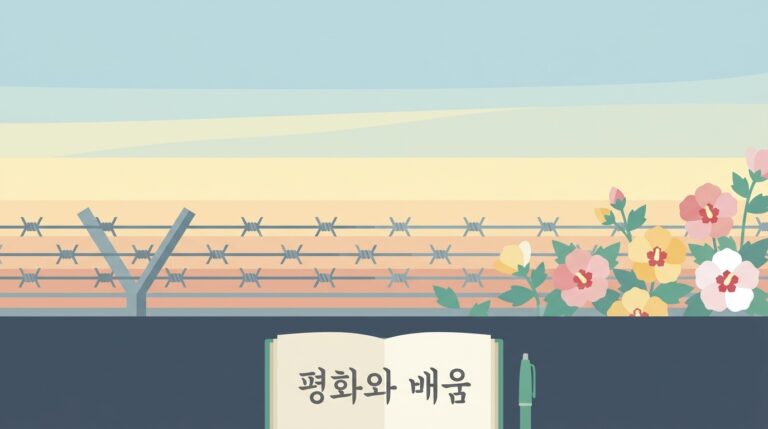
Phase 1: Empathy (Story Immersion Opening)
안녕하세요! 매일한글 에디터입니다. (Hello! I am your Daily Hangul editor.)
Have you ever found yourself sitting in a Seoul cinema watching a film like Ode to My Father (국제시장) or binge-watching Crash Landing on You (사랑의 불시착), watching families tearfully embrace across a military demarcation line, only to realize that your textbook Korean feels painfully inadequate to describe what you are witnessing? Or perhaps during a trip to Imjingak or the War Memorial of Korea in Yongsan, an elderly Korean person started sharing their childhood memories of the 1950s, and all you could muster was a stiff “안타깝습니다” (Antakkapseumnida / That is unfortunate)?
You are not alone. Many C1-level advanced learners excel at debating economic trends or analyzing academic essays, yet stumble into linguistic paralysis when touching upon Korea’s modern history—specifically the Korean War (6.25 전쟁) and the lingering trauma of national division (분단의 아픔). These topics carry a profound socio-cultural sentiment known as Han (한)—an accumulated sorrow mixed with resilience. Without the right emotional lexicon and contextual sensitivity, your words can accidentally sound detached, textbook-cold, or inadvertently insensitive.
This guide was forged from direct classroom field notes and deep feedback from advanced learners who wanted to bridge that exact chasm. By mastering these nuanced expressions, you will not just speak Korean; you will connect with the heartbeat of Korean modern history, unlocking conversations with older generations and understanding modern Korean cinema on an authentic, soul-to-soul level.
Phase 2: Core 3 Expressions In-Depth
1. 분단의 아픔 (Bundan-ui apeum)
- Pronunciation: [Boon-dan-ui ah-peum] (Think of boon as in “boon companion”, dahn rhyming with “dawn”, and ah-peum sounding like a softened “ah-poem”)
- Meaning: Literal: “The pain of division.” | Real Nuance: The enduring generational, emotional, and social wound of a divided nation that still shapes everyday Korean psyche.
- K-Culture Moment: Frequently heard in historical documentaries, serious KBS news commentary, or introspective dialogues in dramas like Crash Landing on You when characters reflect on why they cannot simply visit their loved ones across the 38th parallel.
- Editor’s Insight: 아픔 (apeum) is not merely physical ache; in modern history, it represents collective generational trauma. You use this expression when discussing the philosophical and structural tragedy of the peninsula, rather than petty political disputes.
- Situation Spectrum: Casual: ⚠️ (Can sound overly dramatic in light banter) | Semi-formal: ✅ | Formal: ✅
- 🤔 Think About It: Does your native culture have a singular compound noun that embodies both territorial division and enduring emotional sorrow? How does naming a historical state as “pain” shape collective empathy?
2. 이산가족 상봉 (Isangajok sangbong)
- Pronunciation: [Ee-sahn-gah-jok sahng-bong] (Sounds like ee-sahn + gah-johk + sahng-bong with a gentle, rounded nasal finish)
- Meaning: Literal: “Separated family reunion.” | Real Nuance: The poignant, politically fragile, and heart-wrenching temporary reunions between relatives separated by the Korean War.
- K-Culture Moment: The iconic real-life live broadcast scenes in the movie Ode to My Father (국제시장), where thousands held signs looking for siblings lost during the Hungnam Evacuation.
- Editor’s Insight: 이산 (isan) means dispersed/scattered due to external calamity, not voluntary migration. 상봉 (sangbong) is a high-register term reserved for momentous, tearful reunions after decades of separation.
- Situation Spectrum: Casual: ⚠️ | Semi-formal: ✅ | Formal: ✅
- 🤔 Think About It: Why does Korean retain an entirely distinct, elevated term (상봉) for reunions caused by tragedy instead of using everyday words like 만남 (meeting)?
3. 피난길에 오르다 (Pinangil-e oreuda)
- Pronunciation: [Pee-nahn-gheel-eh oh-reu-dah] (Pronounce pee-nahn crisply, followed by gheel-eh and a smooth oh-reu-dah)
- Meaning: Literal: “To step onto the refugee/evacuation road.” | Real Nuance: To embark on a desperate, perilous journey fleeing wartime violence, leaving everything behind.
- K-Culture Moment: Classic war films like The Front Line (고지전) or historical retrospectives where grandparents recount walking hundreds of kilometers south during the dead of winter in 1950.
- Editor’s Insight: The verb 오르다 (to climb/embark) elevates the act of fleeing from mere panic into a historic, heavy journey of survival. In C1 Korean, using this collocation displays profound respect for the hardships of wartime elders.
- Situation Spectrum: Casual: 🚫 | Semi-formal: ✅ | Formal: ✅
- 🤔 Think About It: Notice how English says “to flee as a refugee” (passive or urgent), whereas Korean treats it as “stepping onto a road” (길에 오르다). How does this spatial framing emphasize the shared communal trek?
Phase 3: Textbook Korean vs. Real Korean
Situation 1: Talking about an elder’s war trauma
- 📖 교과서 한국어 (Textbook): “전쟁 때문에 가족들과 헤어져서 슬펐습니다.” (Jeonjaeng ttaemune gajokdeulgwa heeojyeoseo seulppeosseumnida. / They were sad because they were separated from family due to war.)
- 🗣️ 진짜 한국어 (Real Native C1): “6.25 전쟁 당시 생이별을 겪으신 분들의 한은 이루 말할 수 없죠.” (Yug-i-o jeonjaeng dangsi saeng-ibyeor-eul gyeokkeusin bundeur-ui han-eun iru malhal su eopjyo. / The sorrow of those who suffered living separation during the Korean War is beyond words.)
- 💡 왜 다를까? Standard textbooks rely on basic verbs like 헤어지다 (to break up) and 슬프다 (to be sad). Native speakers choose 생이별 (living separation while both are alive) and 한 (unresolved communal sorrow), which honor the gravity of the experience.
Situation 2: Discussing the current armistice status
- 📖 교과서 한국어 (Textbook): “한국은 남한과 북한으로 나누어져 있습니다.” (Hangugeun namhangwa bukhaneuro nanueojyeo itseumnida. / Korea is divided into South Korea and North Korea.)
- 🗣️ 진짜 한국어 (Real Native C1): “사실상 종전이 아니라 휴전 상태라 분단의 현실이 여전히 피부로 와닿아요.” (Sasilsang jongjeon-i anira hyujeon sangtaera bundan-ui hyeonsir-i yeojeonhi piburo wadah-ayo. / In reality, it’s an armistice, not an end to the war, so the reality of division is still palpably felt.)
- 💡 왜 다를까? C1 native speakers articulate precise legal-historical terms (종전 vs. 휴전) paired with somatic idiomatic phrasing (피부로 와닿다 – to feel deeply/tangibly).
Phase 4: K-Culture Deep Dive & Non-Verbal Manners
4-1. 눈치 (Nunchi) & Somber Non-Verbal Etiquette
When visiting sites like the War Memorial of Korea, the DMZ, or speaking with elders who lived through the era:
* Lowered Pitch & Measured Pauses: Never speak in an upbeat, high-pitched “K-pop variety show tone.” Moderate your voice to a lower register. Allow a 1-2 second silence before responding to a tragic story.
* The Slow, Reverent Nod (고개 끄덕임): When an elder recounts wartime memories, do not interrupt with “진짜요?” (Really?). Instead, maintain soft eye contact, tilt your head slightly downward, and offer a somber nod while uttering subtle backchannel signals like “그러셨군요…” (Geureosyeotgunyo… / I can only imagine…).
* DMZ Tourism Sensibility: Avoid taking lighthearted “peace sign” selfies in front of military guard posts or monuments honoring fallen soldiers. Koreans view the DMZ not as an amusement park, but as an open scar of national tragedy.
4-2. Cultural Code Analysis: The Aesthetic of Han (한) and Cold-War Memory
Modern Korean cinema rarely glorifies war as mere patriotic action. Works like Taegukgi: The Brotherhood of War (태극기 휘날리며) or Joint Security Area (공동경비구역 JSA) treat the conflict as an existential tragedy where ordinary brothers, neighbors, and friends were forced to aim rifles at one another. The emotional core is not “winning the battle,” but the profound sorrow (한) of brotherhood shattered by foreign geopolitics. Understanding this code will help you realize why South Koreans often feel grief rather than hatred when speaking of separated northern compatriots.
Phase 5: Real-Life Roleplay Scenario
Setting: A quiet afternoon at the War Memorial of Korea in Yongsan (용산 전쟁기념관). You are examining a bronze statue of two brothers embracing on the battlefield (형제의 상). An elderly volunteer docent, Mr. Kim (김 할아버지, 82), steps up beside you.
Dialogue:
1. Mr. Kim: “학생, 이 동상이 뭔지 알고 보고 있는 건가?”
(Haksaeng, i dongsang-i mwonji algo bogo inneun geon-ga?)
“Young scholar, do you know what this statue represents as you look at it?”
🎭 [Hands clasped behind his back, looking up with a weathered, solemn gaze]
- Learner: “네, 어르신. 국군 형과 인민군 동생이 전쟁터에서 마주한 실화를 바탕으로 만든 ‘형제의 상’이라고 들었습니다.”
(Ne, eoreusin. Gukgun hyeonggwa inmingun dongsaeng-i jeonjaengteoeseo majuhan silhwareul batangeuro mandeun ‘hyeongje-ui sang’-irago deureotseumnida.)
“Yes, sir. I learned that it is the ‘Statue of Brothers’, based on a true story of an elder brother in the South Korean army and a younger brother in the North Korean army meeting on the battlefield.”
🎭 [Bowing head slightly with polite posture and calm demeanor] -
Mr. Kim: “맞아. 우리 민족의 비극이지… 내 형님도 그때 피난길에서 헤어진 뒤로 소식을 통 몰라.”
(Maja. Uri minjok-ui bigeugiji… Nae hyeongnimdo geuttae pinangill-eseo heeojin dwiro sosig-eul tong molla.)
“That’s right. It is our national tragedy… I, too, haven’t heard a single word from my older brother since we were separated on the refugee road.”
🎭 [Sighs gently, eyes trembling as he stares at the bronze figures] -
Learner: “아… 아직까지 생사를 확인하지 못하셨군요. 그 긴 세월 동안 분단의 아픔을 홀로 견디셨을 생각을 하니 가슴이 먹먹해집니다.”
(A… ajikkkaji saengsareul hwaginhaji mothasyeotgunyo. Geu gin sewol dongan bundan-ui apeum-eul hollo gyeondisyeosseul saenggak-eul hani gaseum-i meongmeokhaejimnida.)
“Ah… You haven’t even been able to confirm if he is alive or dead. Thinking of how you endured the ache of division alone all these long years makes my heart ache.”
🎭 [Placing a hand gently over chest, tone subdued and genuinely respectful] -
Mr. Kim: “외국인이 그 마음을 알아주니 고맙구먼. 명절 때마다 임진각에 가서 망배단에 제사만 올리고 와.”
(Oegugini geu ma-eum-eul arajuni gomapgumeon. Myeongjeol ttaemada imjingag-e gaseo mangbaedan-e jesaman olligo wa.)
“I’m grateful a foreigner understands that feeling. Every holiday, I just go to the Mangbaedan altar at Imjingak to hold ancestral rites toward the north.”
🎭 [A faint, bitter smile forms on his lips as he pats your shoulder] -
Learner: “고향 땅을 바로 눈앞에 두고도 가지 못하는 실향민들의 애환이 하루빨리 치유되었으면 좋겠습니다.”
(Gohyang ttang-eul baro nun-ape dugodo gaji mothaneun silhyangmindeur-ui aehwan-i haruppalli chiyudwoe-eosseumyeon jokesseumnida.)
“I sincerely hope the sorrow of displaced people, who cannot visit their hometown even with it right before their eyes, will be healed soon.”
🎭 [Maintaining reverent eye contact with a sincere, earnest expression] -
Mr. Kim: “그래, 통일이든 평화든 어서 와서 살아생전에 소식이라도 듣는 게 내 마지막 소원이야.”
(Geurae, tong-irideun pyeonghwadeun eoseo waseo sarasaengjeon-e sosig-irado deunneun ge nae majimak sowon-iya.)
“Indeed. Whether it’s unification or peaceful coexistence, hearing any news while I am still alive is my final wish.”
🎭 [Nodding slowly, gazing into the distance] -
Learner: “어르신의 간절한 바람이 꼭 이루어지기를 저도 진심으로 기도하겠습니다. 오늘 귀한 말씀 나누어 주셔서 감사합니다.”
(Eoreusin-ui ganjeolhan baram-i kkok irueojigireul jeodo jinsim-euro gidohagessumnida. Oneul gwihan malsseum nanueo jusyeoseo gamsahamnida.)
“I will truly pray that your earnest wish comes true, sir. Thank you deeply for sharing such precious memories today.”
🎭 [Offering a deep, polite 45-degree bow]
🔀 Interactive Choice Point
After Mr. Kim shares his story about missing his brother (Turn 3), how do you respond?
- Option A: “북한에 편지나 이메일이라도 한 번 보내보시지 그러셨어요?” (Why didn’t you try sending a letter or email to North Korea?)
- Option B: “가족을 잃은 슬픔이 얼마나 크셨을지 감히 헤아리기 어렵습니다. 하루빨리 이산가족 상봉의 기회가 다시 열리길 바랍니다.” (I can hardly fathom the depth of your grief over losing family. I truly hope separated family reunion opportunities reopen soon.)
- Option C: “전쟁은 옛날이야기인데 이제는 잊고 남은 인생을 즐기시는 게 건강에 좋아요!” (The war is ancient history; forgetting it and enjoying the rest of your life would be better for your health!)
Feedback:
* Option A [Risk]: Shows serious ignorance of the geopolitical reality. Civilians cannot exchange letters or internet communications across the DMZ due to strict security laws.
* Option B [Best]: Demonstrates exemplary C1 cultural empathy, utilizing sophisticated vocabulary (감히 헤아리기 어렵다, 이산가족 상봉) that comforts the elder.
* Option C [Bad]: Highly offensive and dismissive of lifelong trauma, violating all foundational rules of Korean filial deference (효) and social empathy.
Phase 6: 10-Second Emotional Shadowing Drill
Practice these high-frequency, emotionally charged historical sentences. Notice the / indicating deliberate micro-pauses for impact.
[🥺 가슴 아프고 숙연하게 - Heartbroken & Solemn]
“전쟁의 포화 속에서 / 가족과 생이별을 겪어야 했던 / 실향민들의 고통은 / 상상조차 하기 힘듭니다.”
(Jeonjaeng-ui pohwa sog-eseo / gajokgwa saeng-ibyeor-eul gyeokkeoya haetdeon / silhyangmindeur-ui gotong-eun / sangsangjocha hagi himdeumnida.)
“In the crossfire of war / the agony of displaced people / who had to endure living separation from their families / is difficult to even imagine.”-
[🕊️ 평화를 염원하며 진중하게 - Earnest & Peace-Yearning]
“철조망으로 가로막힌 분단의 벽을 넘어 / 남북이 자유롭게 왕래하는 날이 / 하루빨리 오기를 염원합니다.”
(Cheoljomang-euro garomakhin bundan-ui byeog-eul neomeo / nambug-i jayuropge wangraehaneun nar-i / haruppalli ogireul yeomwonhamnida.)
“Transcending the wall of division blocked by barbed wire / I earnestly yearn for the day / when North and South can freely travel back and forth.” -
[🤝 공감과 위로를 담아 - Warmly Empathetic & Comforting]
“평생을 그리움 속에서 살아오신 어르신의 세월 앞에 / 절로 고개가 숙여집니다.”
(Pyeongsaeng-eul geurium sog-eseo saraosin eoreusin-ui sewol ap-e / jeollo gogaega sugyeojimnida.)
“Before the decades you spent living in a lifetime of longing / my head bows in natural reverence.”
Phase 7: K-Culture Mini Dictionary (4 Key Terms)
-
실향민 (Silhyangmin – Displaced Persons/War Refugees)
- Meaning: People who lost their hometowns in the North during the Korean War and could never return.
- Usage: Essential when visiting northern border towns like Sokcho’s Abai Village (속초 아바이마을) or reading post-war modern Korean literature.
- 휴전협정 (Hujeonhyeopjeong – Armistice Agreement)
- Meaning: The military armistice signed on July 27, 1953, halting active combat without a formal peace treaty.
- Usage: Used in socio-political discussions to remind listeners that technically, the peninsula remains in an active cease-fire state.
- 망향의 동산 (Manghyang-ui Dongsan – Hills of Longing for Hometown)
- Meaning: Memorial hills, altars, or cemeteries established for those who passed away longing for northern hometowns.
- Usage: Frequently referenced during Chuseok or Seollal news broadcasts when displaced elders bow northward at Imjingak.
- 통일 (Tong-il – Peaceful Reunification)
- Meaning: The reunification of North and South Korea.
- Usage: Beyond politics, it functions as a generational cultural concept symbolizing reconciliation, national healing, and peaceful coexistence.
Phase 8: Traveler’s Survival Kit
Survival Expressions TOP 3
- “여기서 사진 촬영이 가능한가요?” (Yeogiseo sajin chwaryeong-i ganeunghangayo? / Is photography permitted here?)
- Pro Tip: Military zones along the DMZ, Imjingak, or border lookouts heavily restrict photography facing north. Always ask first.
- “전쟁 당시 상황에 대한 해설을 들을 수 있을까요?” (Jeonjaeng dangsi sanghwang-e daehan haeseor-eul deureul su isseulkkayo? / Could I listen to a docent commentary about the wartime conditions?)
- Pro Tip: Memorial museums often provide deeply moving, specialized docent tours given by descendants of veterans.
- “참전용사분들의 희생에 감사드립니다.” (Chamjeonyongsabundeur-ui huisaeng-e gamsadeurimnida. / I am grateful for the sacrifices of the war veterans.)
- Pro Tip: Write this in guestbooks at memorial halls. It resonates far more deeply than a generic “Thank you.”
Editor’s Travel Note
- Navigation & Exploration: When traveling to northern border areas like Paju or Cheorwon, do not rely on standard international map apps, as military mapping restrictions degrade their accuracy. Complete your Naver Map app download to search public transit routes and memorial operating hours seamlessly.
- DMZ Border Visits: You must carry your physical original passport when embarking on the DMZ Peace Train or local civilian border tours (민통선 투어); digital photo copies are strictly rejected at military checkpoints.
Phase 9: “One Step Deeper” (Philosophical Essay)
South Korea’s dazzling hyper-modernity—its gleaming glass skyscrapers in Gangnam, high-speed KTX trains, and global cultural exports—is often analyzed through the lens of economic policy. Yet, beneath the surface of the “Miracle on the Han River” lies the burning survival instinct born out of the ash of the 1950s. The collective determination that “we must never starve again, we must never be powerless again” was forged by the war generation who built modern Korea with their bare hands. Understanding the trauma of division is therefore not an exercise in outdated history; it is the master key to decoding modern Korean work ethic, family bonds, and the fierce urgency that drives contemporary society.
💬 Your Turn: Does your country carry a historical event that continues to subconsciously shape its modern pop culture, architecture, and conversational etiquette? Share your thoughts in the comments below!
Phase 10: FAQ & Common Mistakes
Q: Why do South Koreans use “6.25 전쟁” instead of “한국전쟁” in conversation?
A: While “한국전쟁” (The Korean War) is common in international academia, native South Koreans instinctively refer to it by the date it began: 6.25 전쟁 (Yug-i-o Jeonjaeng) or simply 6.25 (Yug-i-o). Naming the war by its sudden outbreak date captures the sudden shock and communal memory of the surprise invasion on Sunday dawn, June 25, 1950.
Q: Is it considered rude to ask young South Koreans their opinion on reunification?
A: It is not strictly taboo, but opinions vary drastically by generation. While elderly Koreans often prioritize emotional and familial reconciliation, younger Koreans (the MZ generation) frequently weigh the economic burdens, tax implications, and social friction of reunification. Approach the conversation neutrally by asking: “요즘 젊은 세대는 통일에 대해 어떻게 생각하는 편인가요?” (How does the younger generation tend to view reunification these days?)
Q: Can I use the term “실향민” for modern international refugees?
A: Technically, refugees from modern global conflicts are called 난민 (nanmin). 실향민 specifically denotes people who lost access to their historical hometowns within the divided Korean peninsula. Mixing these up sounds unnatural in formal discussions.
🚨 Common Mistakes Alert (흔한 실수 TOP 3)
- Calling the DMZ a “fun tourist spot” (관광지)
- Wrong Action: Saying “DMZ는 정말 재미있는 관광지예요!” (The DMZ is a really fun tourist attraction!)
- Correct Action: Rephrase as “분단의 현실을 체감할 수 있는 뜻깊은 장소예요.” (It is a meaningful place where you can feel the reality of division.)
- Confusing ‘종전’ (End of War) with ‘휴전’ (Ceasefire)
- Wrong Action: Stating that the Korean War ended in 1953.
- Correct Action: Clarify that 1953 was an armistice (휴전협정), meaning the peninsula remains officially in an ongoing armistice state (휴전 상태).
- Using basic breakup verbs for war separation
- Wrong Action: “그 할아버지는 전쟁 때 가족이랑 헤어졌어요.” (Casual breakup tone)
- Correct Action: “전쟁의 소용돌이 속에서 가족과 생이별하셨습니다.” (Honorific and historically appropriate register)
Phase 11: Action Mission & Engagement
Action Mission 3-Step Challenge
- 🥉 Bronze Level: Read the Phase 6 Shadowing Drill out loud 3 times, paying strict attention to pausing at
/and matching the solemn facial expressions in the mirror. - 🥈 Silver Level: Choose one K-movie related to modern Korean history (Ode to My Father, Taegukgi, or JSA). Post a short 2-sentence review in Korean on your social media using the expression 분단의 아픔.
- 🥇 Gold Level: Visit the War Memorial of Korea in Yongsan or a local historical museum, locate an exhibition piece, and write a heartfelt entry in the memorial guestbook utilizing: “참전용사분들의 숭고한 희생을 잊지 않겠습니다.” (We will not forget the noble sacrifices of the war veterans.)
🎮 K-Culture Discovery Mission
Next time you watch a historical K-Drama or cinema classic, keep your ears tuned for how elders refer to North Korea. Do they call it simply 북한 (North Korea), or do they use nostalgic, emotional phrases like 북녘땅 (the northern lands) or 이북 고향 (my northern hometown)? Note the emotional tone attached to each term!
Phase 12: Interactive Quiz Challenge
Test your grasp of advanced Korean socio-historical vocabulary!
1. Situation Judgment Quiz:
You are conversing with an elderly volunteer at an exhibition about war veterans. Which of the following expressions is the most culturally respectful and natural C1 Korean?
* A) “전쟁이 참 재미없었겠네요.” (War must have been quite uninteresting.)
* B) “전쟁의 상흔 속에서도 삶의 터전을 일궈내신 노고에 깊이 감사드립니다.” (I am deeply grateful for your hard work in building a livelihood amidst the scars of war.)
* C) “옛날일이니까 이제 신경 쓰지 마세요.” (It’s in the past, so don’t care about it anymore.)
🔍 Click to view answer & explanation
Correct Answer: B
Explanation: Option B makes use of advanced literary vocabulary (상흔 – scars/wounds, 삶의 터전 – base of livelihood, 노고 – toil/hard work), displaying the highest degree of respect and empathetic C1 fluency. Options A and C are deeply disrespectful and trivializing.
2. Fill-in-the-Blank:
Complete the sentence using the correct C1 historical idiom:
“남북 간의 정치적 대립을 넘어, 명절마다 가족을 만나지 못하는 ( )들의 슬픔은 아직도 계속되고 있다.”
(Beyond political conflict between North and South, the sorrow of [ separated families ] who cannot meet during holidays still continues.)
🔍 Click to view answer & explanation
Correct Answer: 이산가족 (Isangajok)
Explanation: 이산가족 (separated families) specifically describes relatives split across borders due to the Korean War.
3. True or False Cultural Quiz:
True or False: Because an armistice was signed in 1953, South Koreans consider the Korean War to be completely ended (종전).
🔍 Click to view answer & explanation
Correct Answer: False
Explanation: The agreement signed in 1953 was a ceasefire/armistice (휴전), not a definitive peace treaty (종전). Both Koreas remain technically in a state of paused conflict, which is why mandatory military conscription continues in South Korea today.







