

Introducing Your Children in Korean: The Warm and Natural Guide for Beginners
Phase 1: 공감 (Story-driven Opening)
안녕하세요! 매일한글 에디터입니다.
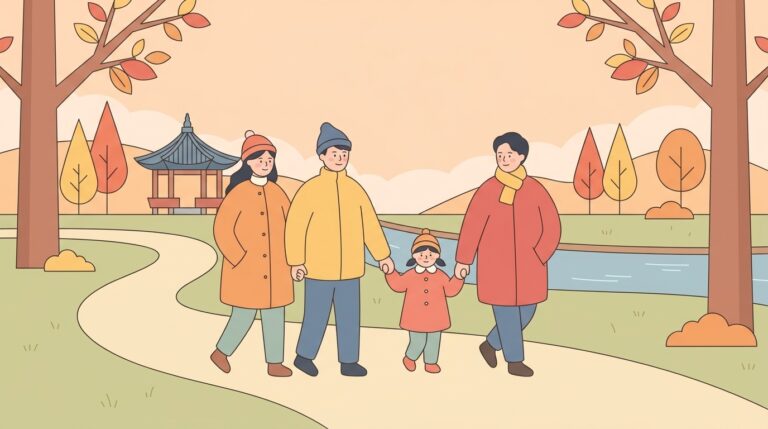
Picture this: You are taking a peaceful afternoon stroll through the sunlit pathways of Seoul Forest or sitting at an open-air cafe in Yeonnam-dong. Your little one is giggling, happily munching on a strawberry waffle. Suddenly, a kind-hearted elderly Korean lady stops her brisk walk, clasps her hands together, looks at your child, and beams: “아이구, 세상에! 아이가 너무 예뻐요. 아들이에요?” (Oh my goodness! The child is so pretty. Is it a son?)
Your mind goes completely blank. You know the textbook words for family, but you suddenly freeze. Do you say “내 아들” (nae adeul)? Do you need ultra-stiff formal grammar like “저의 아들입니다”? And what if your child is actually a little girl sporting a trendy pixie cut, and you need to warmly correct her without sounding offended?
Introducing your children in a foreign country is one of the most tender, heartwarming moments you can experience. At Daily Hangul, our beginner students frequently tell us: “I know how to say ‘This is an apple,’ but I want to introduce my own child with warmth, pride, and cultural grace.” This guide is built directly from real-life interactions to give you the exact conversational confidence you need as an A1 beginner.
Phase 2: 핵심 표현 3선 심층 분석 (3 Core Expressions)
1. 우리 아들이에요. (Uri adeul-ieyo.)
- Pronunciation: [Uri adeul-ieyo] (Sounds like Oo-ree ah-deul-ee-ye-yo — ‘adeul’ rhymes with ‘ah’ + ‘dull’)
- Meaning: Literal: “He is our son.” | Nuance: “This is my son.”
- K-Culture Moment: In neighborhood slice-of-life K-Dramas like Reply 1988 or When the Camellia Blooms, mothers proudly show off their boys to local shopkeepers with an affectionate grin.
- Editor’s Insight: In Korea, using “우리” (our) instead of “내” (my) is essential. If you say “내 아들” (my son), it can sound surprisingly cold or possessive, as if you are separating yourself from the community!
- Situation Spectrum: Casual ⚠️ | Semi-formal ✅ | Formal ⚠️
- 🤔 Think About It: Why do you think Korean society naturally favors “we/our” over “I/my” when referring to immediate family?
2. 우리 딸이에요. (Uri ttal-ieyo.)
- Pronunciation: [Uri ttal-ieyo] (Sounds like Oo-ree tal-ee-ye-yo — pronounce ‘ttal’ with a crisp, tightened ‘t’ sound like the ‘t’ in ‘stop’)
- Meaning: Literal: “She is our daughter.” | Nuance: “This is my daughter.”
- K-Culture Moment: On popular variety shows like The Return of Superman, celebrity dads introduce their baby girls to viewers while their eyes turn into pure hearts.
- Editor’s Insight: The double consonant ‘ㄸ’ (tt) requires tension in your vocal cords without releasing a puff of air. Keep your voice bright and proud!
- Situation Spectrum: Casual ⚠️ | Semi-formal ✅ | Formal ⚠️
- 🤔 Think About It: How do pet names and introductions for daughters in your native language compare to the simple pride of “우리 딸”?
3. 다섯 살이에요. (Daseot sal-ieyo.)
- Pronunciation: [Daseot sal-ieyo] (Sounds like Dah-sut sahl-ee-ye-yo)
- Meaning: Literal: “[Child] is five years old.” | Nuance: “He/She is five.”
- K-Culture Moment: At any playground in Korea, the very first question after learning a child’s gender is age: “몇 살이에요?” (How old is he/she?).
- Editor’s Insight: Notice that native Koreans omit pronouns like “He” or “She” completely! As long as the child is standing in front of you, just state the age followed by “-이에요/예요”.
- Situation Spectrum: Casual ⚠️ | Semi-formal ✅ | Formal ⚠️
- 🤔 Think About It: Why is age often the foundational piece of information in Korean relationships, even among young children?
Phase 3: 교과서 한국어 vs 진짜 한국어 (Textbook vs. Real Korean)
Situation 1: Introducing your child to a neighbor
- 📖 교과서 한국어: 저의 아들입니다. (Jeoui adeul-imnida.)
- 🗣️ 진짜 한국어: 우리 아들이에요. (Uri adeul-ieyo.)
- 💡 왜 다를까?: “저의” (my humble) and “-입니다” (formal ending) sound like an official military report or a courtroom deposition. Real Korean parents use the cozy, communal “우리” (our) and the warm polite ending “-이에요”.
Situation 2: Stating your child’s age
- 📖 교과서 한국어: 그는 다섯 살입니다. (Geuneun daseot sal-imnida.)
- 🗣️ 진짜 한국어: 다섯 살이에요. (Daseot sal-ieyo.)
- 💡 왜 다를까?: Pronouns like “그” (he) or “그녀” (she) exist mainly in written translations and translated novels. Spoken Korean naturally drops the subject when the context is visible.
Phase 4: K-Culture 딥다이브 & 비언어적 매너 (Deep Dive & Manners)
4-1. 눈치(Nunchi) & Gestures
- Open-Palm Introduction: When introducing your son or daughter, never point at them with an index finger. Instead, gesture toward them with an open hand, palm turned slightly upward, or place a warm, protective hand on their back.
- The Gentle Bow: When introducing your child to an elder (어르신), gently touch your child’s shoulders and prompt a slight bow. Even if your child is shy, bowing your own head politely on their behalf displays wonderful etiquette.
4-2. Cultural Code: The Power of “우리” (Woori)
In Korea, children are culturally perceived not just as the private possession of a single nuclear family, but as the precious future of the whole neighborhood community (the traditional 품앗이 spirit). Calling your child 우리 아들 (our son) or 우리 딸 (our daughter) signals that you are including the person you are talking to in your circle of trust and care.
Phase 5: 실전 롤플레이 시나리오 (Real-Life Roleplay)
Setting: A sunny afternoon bench next to the sandbox at Seoul Forest. You are resting while your child plays safely nearby. Next to you sits Sora’s Mom (소라 엄마), wearing an apron from the bakery around the corner.
- 소라 엄마 (Sora’s Mom): 어머, 아이가 너무 귀여워요! 몇 살이에요? (Eomeo, aiga neomu gwiyeowoyo! Myeot sarieyo? / “Oh my, the child is so adorable! How old are they?”) 🎭 Smiling warmly while handing you an extra wet wipe.
- You: 감사합니다! 다섯 살이에요. (Gamsahamnida! Daseot sal-ieyo. / “Thank you! He is five years old.”) 🎭 Giving a polite head nod and smiling.
- 소라 엄마 (Sora’s Mom): 그렇군요! 이름이 뭐예요? (Geureokunyo! Ireumi mwoyeyo? / “I see! What is their name?”) 🎭 Leaning forward with friendly curiosity.
- You: 민우예요. 우리 아들이에요. (Minu-yeyo. Uri adeul-ieyo. / “His name is Minwoo. He is our son.”) 🎭 Gesturing toward Minwoo with an open palm.
- 소라 엄마 (Sora’s Mom): 민우구나! 눈이 엄마를 쏙 빼닮았네요. (Minuguna! Nuni eommareul ssok bpaedalmatneyo. / “Minwoo! His eyes look just like his mother’s!”) 🎭 Nodding with an affectionate laugh.
- You: 아, 그래요? 다들 아빠 닮았다고 해요. (A, geuraeyo? Dadeul appa dalmatdago haeyo. / “Oh, really? Everyone usually says he looks like his dad.”) 🎭 Chuckling modestly.
- 소라 엄마 (Sora’s Mom): 둘 다 닮았겠죠! 소라야, 민우한테 인사해야지. (Dul da dalmatgetjyo! Soraya, Minuhante insahaeyaji. / “Probably both! Sora, come say hello to Minwoo.”) 🎭 Calling over her young daughter.
- You: 안녕 소라야, 반가워요! (Annyeong Soraya, bangawoyo! / “Hello Sora, nice to meet you!”) 🎭 Waving gently at the little girl.
🔀 Interactive Branching Choice
A passerby smiles at your daughter and asks: “아들이에요? 딸이에요?” (Is it a son or a daughter?)
* Choice A: 내 딸이야. (Nae ttariya.)
* Choice B: 우리 딸이에요. (Uri ttal-ieyo.)
* Choice C: 그녀는 나의 아이입니다. (Geunyeoneun naui ai-imnida.)
Feedback:
* Choice A (⚠️ Risk): “내 딸이야” is informal banmal (반말). Using this with someone you just met will sound blunt or rude!
* Choice B (✅ Best): Perfect! “우리 딸이에요” is warm, polite, culturally authentic, and grammatically spot on.
* Choice C (🚫 Bad): “그녀는 나의 아이입니다” sounds like a direct literal translation from an old English novel. Native speakers will be quite startled!
Phase 6: 10초 감정 섀도잉 드릴 (10-Second Shadowing Drill)
Practice saying these out loud with natural rhythm and emotion. Use the slashes / as your natural breathing pauses!
[😊 Proud & Warm]
우리 / 아들이에요. (Uri / adeul-ieyo.)
This / is our son.-
[🌸 Bright & Affectionate]
우리 / 딸이에요. (Uri / ttal-ieyo.)
This / is our daughter. -
[👋 Friendly & Polite]
다섯 / 살이에요. (Daseot / sal-ieyo.)
He’s / five years old.
Phase 7: K-Culture 미니 사전 (Mini Dictionary)
- 아들 (Adeul) | Son | The standard noun for son. In daily life, Korean parents often lovingly shout “아들~!” across the house as a term of endearment instead of using their boy’s name.
- 딸 (Ttal) | Daughter | The standard noun for daughter. Frequently paired with sweet adjectives like “우리 예쁜 딸” (our pretty daughter) or “우리 착한 딸” (our good daughter).
- 우리 (Uri) | We / Us / Our | The cornerstone of Korean social philosophy. It replaces the isolated “my” to express communal bonding with family, schools, and friends.
- 막내 (Maknae) | The Youngest Child / Member | Used to describe the youngest member in any family, workplace, or K-Pop group (such as Jungkook in BTS).
Phase 8: 여행자를 위한 생존 키트 (Traveler’s Survival Kit)
Top 3 Survival Phrases for Parents
- 아기 의자 있어요? (Agi uija isseoyo?)
- Meaning: “Do you have a baby/high chair?”
- Pro Tip: Ask this at restaurants right as you enter so the staff can set up a booster seat.
- 유아차 들어갈 수 있어요? (Yuacha deureogal su isseoyo?)
- Meaning: “Can a stroller enter?”
- Pro Tip: ‘유아차’ (yuacha) is modern gender-neutral Korean for stroller, though ‘유모차’ (yumocha) is also widely understood.
- 아이 화장실이 어디예요? (Ai hwajangsil-i eodiyeyo?)
- Meaning: “Where is the family/children’s restroom?”
- Pro Tip: Major department stores and train stations in Korea have luxury nursery lounges called 수유실 (suyusil).
Editor’s Travel Note
When navigating the Seoul subway system with young kids and strollers, make sure to use the [Naver Map transit guide for mobile] to quickly locate stations equipped with street-to-platform elevators. Wheelchair and stroller gates are highlighted clearly on station maps!
Phase 9: “한 발 더 깊이” (Food for Thought)
In Western languages, if someone refers to “our husband” or “our child,” it might sound like an unconventional shared custody arrangement! But in Korean, 우리 embodies a profound collective identity where neighbors, teachers, and communities hold joint responsibility for nurturing the next generation. Calling your child 우리 딸 invites the listener into a warm, shared circle of care.
💬 Your Turn: Does your native culture emphasize individual possession (“my child”) or community belonging (“our child”)? Leave a comment below and share your thoughts!
Phase 10: FAQ & 흔한 실수 (FAQ & Common Mistakes)
Q: Can I say “제 아들” instead of “우리 아들”?
A: Yes! “제 아들” (Je adeul) is grammatically correct and uses the humble pronoun 제 (my). However, in informal neighborhood chats, “우리 아들” sounds infinitely warmer and far more natural.
Q: What if an elderly neighbor mistakenly calls my daughter a boy?
A: Don’t feel offended! With toddlers dressed in neutral colors, it happens every single day. Just smile gently and say: “딸이에요~” (She’s a daughter~) with a soft, cheerful intonation.
Q: How do I say my child’s age if I forget Korean native numbers?
A: If you forget numbers like 하나 (1), 둘 (2), 셋 (3), 넷 (4), or 다섯 (5), don’t stress! Simply hold up your fingers and say: “[Number] 살이에요!” People in Korea love kids and will appreciate your effort.
🚨 흔한 실수 (Common Mistakes) Warning Board
- Mistake: Saying “내 아들입니다” to an older stranger.
- Correct Action: Replace 내 with 우리 and use the conversational polite ending: “우리 아들이에요.”
- Mistake: Pointing your index finger directly at your child when naming them.
- Correct Action: Direct attention gently using an open palm or a soft hand on their back.
- Mistake: Translating word-for-word like “그는 나의 아들이다”.
- Correct Action: Drop the robotic third-person pronouns completely and rely on natural context.
Phase 11: 액션 미션 & 참여 유도 (Action Missions)
- 🥉 Bronze Mission (Solo Drill): Stand in front of your mirror, smile warmly, and say “우리 아들이에요” or “우리 딸이에요” out loud 5 times.
- 🥈 Silver Mission (Community Drill): Share a photo of your child (or your beloved pet!) in our Daily Hangul study group with the Korean caption: #우리아들이에요 or #우리딸이에요.
- 🥇 Gold Mission (Real-World Test): Next time you visit a Korean bakery, grocery store, or speak with a Korean neighbor, introduce your child in Korean!
🎮 K-Culture Mission: Watch a short clip of KBS’s The Return of Superman (슈퍼맨이 돌아왔다) on YouTube and listen closely for how many times the parents refer to their children as 우리!
Phase 12: 인터랙티브 퀴즈 챌린지 (Quiz Challenge)
1. Situation Judgment: You are talking to a warm neighbor at a cafe. How should you introduce your son?
* (A) 내 아들이다.
* (B) 우리 아들이에요.
* (C) 그는 나의 아들입니다.
2. Fill in the Blank: Complete the sentence to say “She is our daughter”:
* 우리 [______]이에요.
3. True or False: Saying “우리 아들” implies that the listener is biologically related to your child.
* (True / False)
Click to reveal answers & explanations!
- Answer: (B) 우리 아들이에요. (Natural, polite, and culturally warm!)
- Answer: 딸 (ttal). (우리 딸이에요 = She is our daughter.)
- Answer: False. (The word “우리” reflects social warmth and collective community belonging, not literal shared paternity!)







