

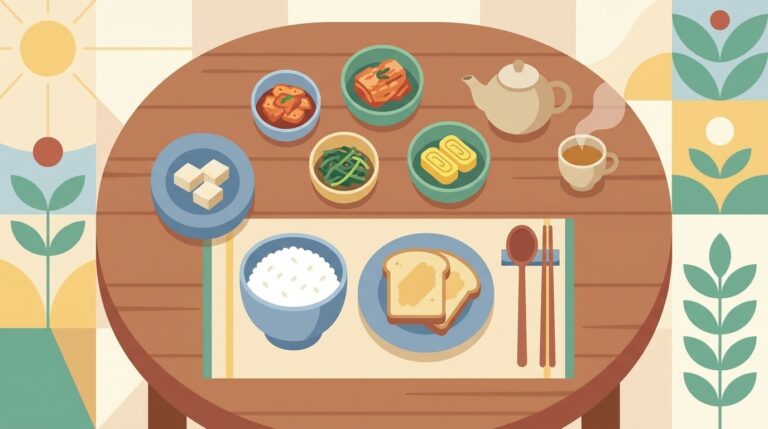
Phase 1: 공감 (Story Immersion Opening)
안녕하세요! 매일한글 에디터입니다. (Hello! I’m your Daily Hangul editor!)
Picture this: You are waking up in a warm, sunlight-drenched guesthouse in Mangwon-dong, Seoul. The aroma of roasted sesame oil and freshly brewed coffee floats through the hallway. As you shuffle into the kitchen in your comfy socks, your friendly Korean host smiles brightly and asks with genuine warmth: “좋은 아침이에요! 오늘 아침 뭐 먹었어요?” (Joeun achimieyo! Oneul achim mwo meogeosseoyo? – Good morning! What did you eat for breakfast?)
Suddenly, your mind races. You learned the word for “apple” (sagwa) and “bread” (ppang), but your tongue ties into a knot. Do you say “I ate” with meogeosseoyo? Should you mention that you only drank a quick iced Americano because you were running late? In standard Korean textbooks, morning routines often sound like rigid military timetables: “I consume boiled rice and fermented bean soup at precisely 7:00 AM.” But in real Korean life, morning conversation is casual, caring, and full of cozy everyday phrases.
Over the past ten years coaching hundreds of beginner learners at Daily Hangul, I have discovered that mastering how to talk about your breakfast is the single fastest way to break the ice with Korean colleagues, homestay families, and new friends. In Korea, asking about someone’s meal is not an interrogation—it is an affectionate greeting that says “I care about your well-being today.” By the end of this guide, you will breeze through any morning conversation with natural flair, zero awkward pauses, and true native confidence.
Phase 2: 핵심 표현 3선 심층 분석 (Deep-Dive Core Expressions)
Here are the three essential phrases you need to conquer your morning breakfast chat at the A2 level:
1. 아침에 토스트 먹었어요. (Achime toseuteu meogeosseoyo.)
- Pronunciation: [Achime toseuteu meogeosseoyo] (Think: Ah-chee-meh toh-seu-teu muh-guh-ssuh-yoh—glide smoothly through to-seu-teu without heavy English stress)
- Meaning: Literal: “In the morning, I ate toast.” | Real Nuance: “I had toast for breakfast.”
- K-Culture Moment: You will hear this in almost every lifestyle K-Drama, like Crash Landing on You or Hospital Playlist, when colleagues catch up over morning coffee in the pantry.
- Editor’s Insight: Notice that Korean speakers often drop the direct object marker (-eul) in everyday spoken conversation. Instead of saying to-seu-teu-reul, simply pairing the food with meogeosseoyo sounds far more natural.
- Situation Spectrum: Casual: ✅ | Semi-formal: ✅ | Formal: ⚠️ (In formal meetings, use “아침 식사로 토스트를 먹었습니다.”)
- 🤔 Think About It: In English, we say “had toast.” In Korean, the verb is explicitly 먹었어요 (meogeosseoyo – ate). Why do you think Korean separates eating and drinking so distinctly compared to the broad English “had”?
2. 저는 아침을 꼭 챙겨 먹어요. (Jeoneun achimeul kkok chaenggyeo meogeoyo.)
- Pronunciation: [Jeoneun achimeul kkok chaenggyeo meogeoyo] (Sounds like: Juh-neun ah-chee-meul kkoke cheng-gyuh muh-guh-yoh—crisp double ‘kk’ sound like clicking a pen)
- Meaning: Literal: “I make sure to pack and eat breakfast.” | Real Nuance: “I never skip breakfast / I always make sure to eat breakfast.”
- K-Culture Moment: In Korean variety shows like I Live Alone (나 혼자 산다), cast members praise disciplined celebrities who cook a healthy breakfast by saying, “와, 아침을 잘 챙겨 드시네요!”
- Editor’s Insight: The compound verb 챙겨 먹다 (chaenggyeo meokda) embodies a deep cultural philosophy: eating is an act of self-care and responsibility. It signals that you value your health.
- Situation Spectrum: Casual: ✅ | Semi-formal: ✅ | Formal: ✅
- 🤔 Think About It: Does your native language have a specific compound verb that connects “taking care” directly with “eating”?
3. 간단하게 사과랑 커피 마셨어요. (Gandan-hage sagwarang keopi masyeosseoyo.)
- Pronunciation: [Gandan-hage sagwarang keopi masyeosseoyo] (Sounds like: Gahn-dahn-hah-geh sah-gwa-rahng kuh-pee mah-shuh-ssuh-yoh)
- Meaning: Literal: “Simply, with an apple, I drank coffee.” | Real Nuance: “I just had a quick apple and coffee.”
- K-Culture Moment: Frequently heard among busy university students and young professionals in Gangnam grabbing an iced Americano on their way to the subway.
- Editor’s Insight: The connector -(i)rang (-랑/이랑) means “and” or “with” in warm, colloquial speech. 간단하게 (gandan-hage) sets expectations that it wasn’t a feast, just a light bite.
- Situation Spectrum: Casual: ✅ | Semi-formal: ✅ | Formal: ⚠️
- 🤔 Think About It: Modern city life in Seoul moves at dizzying speed (ppalli-ppalli). How does the word 간단하게 (lightly/simply) reflect the morning lifestyle of busy Koreans?
Phase 3: 교과서 한국어 vs 진짜 한국어 (Textbook vs. Real-Life Korean)
Situation 1: Asking if someone ate breakfast
- 📖 교과서 한국어 (Textbook Korean): 당신은 오늘 아침 식사를 하였습니까? (Dangsin-eun oneul achim siksareul hayeosseumnikka? – “Did you perform morning dining today?”)
- 🗣️ 진짜 한국어 (Real-Life Korean): 오늘 아침 먹었어요? (Oneul achim meogeosseoyo? – “Did you eat breakfast today?”)
- 💡 왜 다를까? (Why is it different?): Native Koreans rarely use the second-person pronoun 당신 (dangsin) in direct conversation because it feels confrontational or archaic. Dropping the subject entirely makes you sound friendly and authentic.
Situation 2: Saying you skipped breakfast
- 📖 교과서 한국어 (Textbook Korean): 저는 오늘 조식을 섭취하지 않았습니다. (Jeoneun oneul josigeul seopchwihaji anasseumnida. – “I did not ingest morning sustenance.”)
- 🗣️ 진짜 한국어 (Real-Life Korean): 오늘 아침 걸렀어요. (Oneul achim geolleosseoyo. – “I skipped breakfast today.”)
- 💡 왜 다를까? (Why is it different?): The verb 거르다 (georeuda – to skip a turn or meal) is the exact natural idiom Koreans use. 섭취하다 (seopchwihada) belongs in a clinical medical paper, not in your everyday morning chit-chat!
Phase 4: K-Culture 딥다이브 & 비언어적 매너 (Culture Deep-Dive & Non-Verbal Manners)
4-1. 눈치 (Nunchi) & Gestures
When someone in Korea asks what you had for breakfast, pay close attention to your body language:
* The Head Tilt of Reflection: When recalling your meal, Koreans often tilt their head slightly and tap their chin lightly while saying “음… 토스트 먹었어요.” It shows modesty and conversational presence.
* The Rebound Courtesy: Never stop at answering about yourself! Always volley the question back with a gentle two-hand gesture toward them: “OO 씨는요? 아침 드셨어요?” (And what about you, OO? Did you eat?). Failing to ask back feels like an emotional dead-end in Korean interaction.
4-2. Cultural Code Analysis: The Breakfast Metamorphosis
Korean breakfast culture has undergone an incredible evolution. Traditionally, breakfast was a hearty, savory affair identical to dinner: steaming white rice (bap), piping hot soup (guk), and half a dozen fermented side dishes (banchan). Generations grew up hearing grandmothers insist, “한국인은 밥심이지!” (Koreans run on rice power!).
Today, you will see a dynamic mix across Seoul. Older generations and traditional families still relish their comforting bowl of doenjang jjigae or haejang-guk. Meanwhile, Generation MZ lines up at trendy bakeries in Seongsu-dong for salt bread (sogeum-ppang) or grabs a triangle kimbap (samgak-gimbap) and banana milk from a local CU or GS25 convenience store. Being able to explain your preferred style—traditional rice versus light pastry—is a delightful conversation starter!
Phase 5: 실전 롤플레이 시나리오 (Interactive Roleplay Scenario)
Setting: It’s 8:40 AM in the shared lounge of an Airbnb in Hongdae. Sunlight streams through the blinds. Your local roommate, Min-ji (민지), is brewing fresh pour-over coffee while buttering bread.
- 민지 (Min-ji): 좋은 아침이에요! 잠은 잘 잤어요?
(Joeun achimieyo! Jameun jal jasseoyo?)
“Good morning! Did you sleep well?”
🎭 Hands you a glass of warm water with a friendly smile. -
나 (You): 네, 푹 잤어요. 민지 씨도 잘 잤어요?
(Ne, puk jasseoyo. Minji ssido jal jasseoyo?)
“Yes, I slept deeply. Did you sleep well too, Min-ji?”
🎭 Nodding politely while accepting the glass with both hands. -
민지 (Min-ji): 저도요! 오늘 아침 뭐 먹었어요?
(Jeodoyo! Oneul achim mwo meogeosseoyo?)
“Me too! What did you eat for breakfast today?”
🎭 Leaning against the counter, genuinely curious. -
나 (You): 저는 간단하게 바나나랑 요거트 먹었어요.
(Jeoneun gandan-hage banana-rang yogeoteu meogeosseoyo.)
“I just had a banana and yogurt simply.”
🎭 Smiling and making a small peeling gesture with your hands. -
민지 (Min-ji): 에이, 그걸로 배가 차요? 든든하게 먹어야죠!
(Ei, geu-geol-ro baega chayo? Deundeun-hage meogeoyajyo!)
“Aw, does that fill you up? You should eat a hearty meal!”
🎭 Teasing gently with affectionate maternal worry. -
나 (You): 하하, 원래 아침을 무겁게 안 먹어서 괜찮아요.
(Haha, wonrae achimeul mugeopge an meogeoseo gwaenchanayo.)
“Haha, I don’t usually eat heavy breakfasts, so I’m fine!”
🎭 Chuckling softly and waving your hand gently in reassurance. -
민지 (Min-ji): 그래도 커피는 마실 거죠? 제가 내린 드립 커피 한잔 줄까요?
(Geuraedo keopineun masil geojyo? Jega naerin deurip keopi hanjan julkkayo?)
“Still, you’ll drink coffee, right? Can I pour you a cup of drip coffee I made?”
🎭 Lifting the glass carafe with steam rising from it. -
나 (You): 와, 너무 좋아요! 정말 고마워요.
(Wa, neomu joayo! Jeongmal gomawoyo.)
“Wow, I’d love that! Thank you so much.”
🎭 Brightening up and bowing your head slightly in gratitude.
🔀 Interactive Branching Point
Imagine Min-ji asks: “오늘 아침 걸렀어요? 배 안 고파요?” (Did you skip breakfast today? Aren’t you hungry?). How do you respond?
- Choice A (Best): “네, 늦잠 자서 걸렀어요. 점심을 일찍 챙겨 먹으려고요! 민지 씨는 아침 드셨어요?”
Feedback: Best! You explained why you skipped (overslept), shared your plan for an early lunch, and politely rebounded the question back to Min-ji. Native Korean 100% unlocked! - Choice B (Risk): “네, 밥 안 먹었어요. 안녕히 가세요.”
Feedback: Risk. Grammatically understandable, but abruptly saying “Goodbye” cuts the friendly lounge rapport short. It sounds cold and dismissive. - Choice C (Bad): “식사를 거절했습니다. 싫어요.”
Feedback: Bad. “I rejected dining. I dislike it.” This sounds hostile, like an anime villain declining a banquet. Min-ji might wonder if she offended you!
Phase 6: 10초 감정 섀도잉 드릴 (10-Second Emotional Shadowing Drill)
Practice these lines out loud! Follow the rhythm pauses (/) and embody the emotion tags:
[😊 Bright & energetic]
“오늘 아침에 / 토스트랑 계란 프라이 / 먹었어요!”
(Oneul achime / toseuteurang gyeran peurayi / meogeosseoyo!)
Pause naturally after ‘achime’ to create comfortable conversational cadence.-
[😴 Sleepy but cheerful]
“시간이 없어서 / 편의점에서 삼각김밥 / 간단하게 먹었어요.”
(Sigani eopseoseo / pyeon-uijeom-eseo samgakgimbap / gandan-hage meogeosseoyo.)
Slightly lower your tone on ‘sigani eopseoseo’ (running out of time) then brighten up on ‘meogeosseoyo’. -
[🥺 Regretful & cute]
“늦잠 자서 / 아침 건너뛰었어요… / 지금 너무 배고파요!”
(Neutjam jaseo / achim geonneottwieosseoyo… / jigeum neomu baegopayo!)
Drop your pitch slightly on ‘geonneottwieosseoyo’ and drag out the final vowel playfully.
Phase 7: K-Culture 미니 사전 (Mini Culture Dictionary)
-
조식 (Josik)
Translation: Hotel / Official Breakfast
Usage: Used when booking accommodations, flights, or business hotels (e.g., “호텔 조식 포함이에요?” – Is hotel breakfast included?). Rarely used for a piece of toast eaten in your kitchen. -
아점 (A-jeom)
Translation: Brunch (Portmanteau of 아침 + 점심)
Usage: Extremely popular among weekend café-goers. “우리 주말에 늦잠 자고 아점 먹으러 가자!” (Let’s sleep in this weekend and grab brunch!). -
해장국 (Haejang-guk)
Translation: Morning Hangover Soup
Usage: A hearty, steaming soup (like bean sprout soup or beef bone broth) eaten early in the morning to soothe the stomach after a night out with friends or colleagues. -
챙겨 먹다 (Chaenggyeo meokda)
Translation: To make sure to eat / Not skip meals
Usage: The gold standard phrase used by family, partners, and close friends to show caring devotion. “바빠도 밥 잘 챙겨 먹어!” (Even if you’re busy, make sure you eat well!).
Phase 8: 여행자를 위한 생존 키트 (Traveler Survival Kit)
TOP 3 Survival Phrases for Morning Wanderers
-
“아침 식사 되나요?” (Achim siksa doenayo?)
Meaning: “Are you serving breakfast right now?”
Pro Tip: Perfect when you step into a neighborhood diner (bunsik-jip) early in the morning before regular lunch hours. -
“제일 인기 있는 메뉴가 뭐예요?” (Jeil ingi inneun menyuga mwoyeyo?)
Meaning: “What is your most popular menu item?”
Pro Tip: Use this when staring blankly at a Korean street food kiosk selling egg toast in Euljiro. -
“따뜻한 아메리카노 한잔 테이크아웃이요.” (Ttatteut-han amerikano hanjan teikeu-ausiyo.)
Meaning: “One hot Americano for takeout, please.”
Pro Tip: While Koreans love Eol-juk-a (freezing to death for iced Americano), chilly autumn and winter mornings call for a warm cup!
Editor’s Travel Note
- Map Navigation: Google Maps struggles with real-time walking and transit routes inside South Korea. Always use the search and navigation features on Naver Map app download for Korean travel to locate charming neighborhood breakfast diners and cafes open before 9:00 AM.
- Early Morning Transit: If you are catching an early morning KTX train from Seoul Station to Busan, book your ride quickly using Kakao T app download for Seoul taxi booking rather than hoping to hail a cab on the street at 6:00 AM.
Phase 9: “한 발 더 깊이” (Cultural Essay & Thought Question)
In Western cultures, the standard morning greeting is “Good morning” or “Did you sleep well?” But in Korea, the most sacred everyday greeting has long been “밥 먹었어요?” (Bap meogeosseoyo? – Did you eat?). Throughout history, enduring harsh winters, wars, and poverty, ensuring that your community member had a bowl of warm rice was the ultimate affirmation of life and solidarity. Today, even in high-tech modern Seoul, asking what you had for breakfast is never small talk about carbohydrates—it is an affectionate emotional blanket wrapped around your morning.
💬 Your Turn: What did you eat this morning? Drop your answer in Korean in the comments below using the pattern “저는 오늘 아침에 [Menu] 먹었어요!” I will personally review your sentence and reply with native tips!
Phase 10: FAQ & 흔한 실수 방지 (FAQ & Common Mistakes)
Q: Can I use “아침” (Achim) to mean both “morning” and “breakfast”?
A: Yes, absolutely! Context decides the meaning. In the sentence “아침에 일어났어요” (Achime ireonasseoyo), it means “I woke up in the morning.” But in “아침 먹었어요” (Achim meogeosseoyo), it directly translates to “I ate breakfast.” Koreans use this convenient dual-meaning every single day!
Q: What is the difference between “마시다” (masida) and “먹다” (meokda) for morning soup?
A: In English, you “drink” soup or “eat” soup. In Korean, even though soup is liquid, if it is part of a meal containing solid ingredients (like vegetables and tofu), Koreans overwhelmingly use the verb 먹다 (meokda – to eat). Reserve 마시다 (masida) exclusively for water, juice, milk, and coffee!
Q: How do I politely tell my homestay host that I don’t eat breakfast at all?
A: Simply say with a warm smile: “감사합니다! 그런데 제가 원래 아침을 잘 안 먹어요.” (Gamsahamnida! Geureonde jega wonrae achimeul jal an meogeoyo – Thank you! But I usually don’t eat breakfast). They will understand completely and won’t feel rejected.
🚨 Common Mistakes Warning Board
- Mistake: Saying “저는 아침을 마셨어요” when talking about a smoothie bowl or soup.
Correct Action: Use 먹었어요 (meogeosseoyo) for anything eaten with a spoon or fork, and reserve 마셨어요 (masyeosseoyo) only for beverages in cups. - Mistake: Using the ultra-formal 진지 잡수셨습니까? with a casual young friend or coworker.
Correct Action: This honorific form is strictly reserved for your grandparents or elderly elders! With peers and colleagues, stick to 아침 드셨어요? or 아침 먹었어요?. - Mistake: Forgetting to rebound the question back to the speaker.
Correct Action: Always follow your answer with: “[Name] 씨는 아침 드셨어요?” to keep the warmth flowing.
Phase 11: 액션 미션 & 참여 유도 (Action Missions)
Take your Korean from the screen into the real world with this step-by-step challenge:
- 🥉 Bronze Mission (Solo Vocal Drill): Stand in front of your bathroom mirror tomorrow morning. Smile and say out loud three times: “오늘 아침에 토스트 먹었어요!” (Oneul achime toseuteu meogeosseoyo!).
- 🥈 Silver Mission (Social Connection): Take a photo of your breakfast plate or coffee mug. Post it to your Instagram story or language exchange app with the caption: “오늘 나의 아침 메뉴! 여러분은 아침 드셨어요?” (Today’s breakfast menu! Did everyone eat breakfast?).
- 🥇 Gold Mission (Real-World Execution): Next time you walk into a Korean bakery or café, order your food in full Korean, and if the cashier or barista asks if you’ve eaten yet, respond with your new phrase: “네, 아침 먹었어요!”
- 🎮 K-Culture Mission: Watch the first 15 minutes of any modern K-Drama episode on Netflix. Listen carefully for characters gathering around the kitchen table. Can you catch the word 아침 (achim) or 밥 (bap)?
Phase 12: 인터랙티브 퀴즈 챌린지 (Interactive Quiz Challenge)
Test your breakfast mastery before you go! Review the questions, then expand the toggle below to verify your answers.
- Scenario Judgment: Your Korean language exchange partner asks you over KakaoTalk at 9:00 AM: “아침 먹었어요?” You woke up late and ran straight to your desk without eating. Which response sounds the most natural and friendly?
- (A) 거절했습니다. (Geojeolhaesseumnida.)
- (B) 아니요, 늦잠 자서 걸렀어요! (Aniyo, neutjam jaseo geolleosseoyo!)
- (C) 저는 아침을 사망했습니다. (Jeoneun achimeul samanghaesseumnida.)
- Fill-in-the-Blank: Complete the sentence with the correct particle meaning “and”:
“오늘 아침에 사과______ 커피 마셨어요.” (I had an apple and coffee this morning.)- (A) 랑 (-rang)
- (B) 에 (-e)
- (C) 에서 (-eseo)
- True or False Cultural Quiz: In Korea, asking someone “밥 먹었어요?” (Did you eat?) always means they want to immediately take you to a restaurant and pay for your meal. (True / False)
👉 Click here to check the answers and explanations!
Answers & Explanations:
-
Correct Answer: (B)
Explanation: 걸렀어요 (geolleosseoyo) is the native, colloquial verb for skipping a routine meal. Choice (A) means “I refused/rejected,” which makes no sense, and Choice (C) accidentally uses the medical verb for “passed away/died”! -
Correct Answer: (A) 랑 (-rang)
Explanation: 사과 ends in a vowel, so it takes the conversational connector -랑 (sagwarang = apple and). If the noun ended in a consonant (like 밥), it would take -이랑 (bab-irang). -
Correct Answer: False
Explanation: While it can lead to sharing food, “밥 먹었어요?” functions primarily as a caring social greeting equivalent to “How are you doing today?” in Korean culture!







