

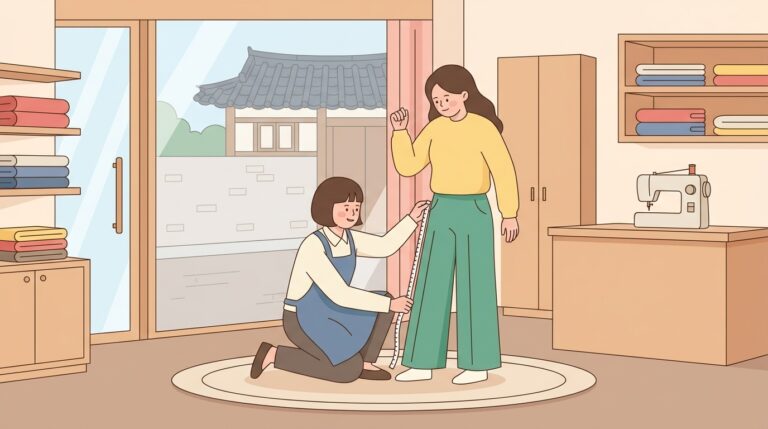
Phase 1: 공감 (Story-Immersive Opening)
안녕하세요! 매일한글 에디터입니다.
Picture this: You are exploring the ultra-hip streets of Seongsu-dong or Hongdae. After browsing through chic boutiques and vintage racks, you finally spot it—that dreamy, high-waisted wide-leg denim trousers or crisp structured blazer you saw your favorite K-drama lead wearing. Your heart races. You run to the fitting room, pull them on, look in the full-length mirror, and… oops. The waist has a two-inch gap in the back, or the pant legs are so gloriously long they are sweeping the floor like a broom!
In Korea, this is completely normal. In fact, most Koreans buy clothes knowing they will head straight to a local alterations shop (suseon-so, 수선소) to customize the garment to their exact body silhouette. But for intermediate learners, walking into a cozy neighborhood alteration shop run by an experienced sajangnim (master tailor) with measuring tape around their neck can feel intimidating. When they abruptly ask, “어디 줄여줄까?” (What should I take in?), your mind goes blank. How do you distinguish between pant length, leg width, and waist without awkwardly miming?
Don’t let a fear of tailoring vocab ruin your K-fashion haul. Drawing from over a decade of navigating local Korean neighborhood spots and helping hundreds of intermediate students, I have crafted this master guide. Mastering these alteration expressions won’t just save your wardrobe—it will elevate your Korean fluency to a confident, authentic B2 level.
Phase 2: 핵심 표현 3선 심층 분석 (Core Expressions)
1. 바지 기장 좀 줄여주세요. (Baji gijang jom juryeojuseyo.)
- Pronunciation: [Baji gijang jom juryeojuseyo] (Tip: ‘Gijang’ sounds like the ‘gi’ in ‘gift’ plus ‘jang’ like ‘jungle’ with an ‘ah’ sound: GEE-jahng)
- Meaning: Literal: “Please reduce the pants length a bit.” / Actual Nuance: “Could you hem these pants for me?”
- K-Culture Moment: Seen in everyday lifestyle vlogs or dramas like Record of Youth, where models and stylists quickly pin pants before a runway or shoot.
- Editor’s Insight: Notice the word 기장 (gijang). While beginners often say 길이 (giri – length), fashion-savvy Koreans and tailors strictly use 기장 to denote garment length (sleeves, pant legs, skirt hems). Using 기장 instantly signals to the tailor that you know your fashion terminology.
- Situation Spectrum: Casual: ✅ | Semi-formal: ✅ | Formal: ✅
- 🤔 Think About It: In English, we use distinct verbs like “hem,” “shorten,” or “crop.” Korean relies on the specific noun 기장 combined with the versatile causative verb 줄이다 (to reduce/shrink). How does focusing on the specific part rather than the tool change how you visualize clothing?
2. 허리통을 1인치만 줄여주실 수 있으세요? (Heoritong-eul il-inchi-man juryeojusil su isseuseyo?)
- Pronunciation: [Heori-tong-eul il-inchi-man juryeojusil su isseuseyo] (Tip: ‘Tong’ rhymes with ‘song’, referring to circumference or cylinder width)
- Meaning: Literal: “Could you reduce the waist cylinder by 1 inch?” / Actual Nuance: “Could you take the waist in by just one inch?”
- K-Culture Moment: In K-pop styling rooms where stage outfits must fit idol performers down to the millimeter so costumes do not slip during sharp choreography.
- Editor’s Insight: The suffix 통 (tong) denotes girth, circumference, or width of cylindrical parts of clothing (e.g., 허리통 for waist width, 바지통 for pant leg width). If you just say 허리 줄여주세요, they will do it, but adding 통 and an exact measurement (인치 – inch, or 센티 – cm) proves you have intermediate precision.
- Situation Spectrum: Casual: ⚠️ | Semi-formal: ✅ | Formal: ✅
- 🤔 Think About It: While Korea uses the metric system for almost everything, tailors still frequently use 인치 (inches) alongside centimeters due to historical garment crafting standards. Is measuring hybridity common in your country?
3. 원래 밑단 살려서 수선해 주세요. (Wonrae mitdan sallyeoseo suseonhae juseyo.)
- Pronunciation: [Wonrae mitdan sallyeoseo suseonhae juseyo] (Tip: ‘Mit-dan’ sounds like ‘meet-dahn’; ‘sal-lyeo’ sounds like ‘sahl-yuh’)
- Meaning: Literal: “Please alter it while keeping the original bottom hem alive.” / Actual Nuance: “Please hem these while preserving the original distressed/stitched hemline.”
- K-Culture Moment: Anyone who buys designer raw denim or vintage jeans in Hongdae knows this magical phrase. If the tailor cuts off the stone-washed hem, the jeans lose their vintage soul!
- Editor’s Insight: The verb 살리다 literally means “to save/revive/keep alive.” When applied to fashion alteration, 단 살리기 (dan-salligi) means cutting the garment, reattaching the original factory edge with its unique wash and stitch, and pressing it flat. It is a hallmark intermediate/advanced phrase.
- Situation Spectrum: Casual: ✅ | Semi-formal: ✅ | Formal: ✅
- 🤔 Think About It: Why does Korean use a vitalistic word like “keeping alive” (살리다) for an inanimate seam? It reflects how Koreans view aesthetic details as having their own distinct character.
Phase 3: 교과서 한국어 vs 진짜 한국어 (Textbook vs. Real Native Korean)
Situation 1: Specifying the exact pant length
- 📖 교과서 한국어: “바지의 길이를 짧게 해 주십시오.” (Please make the length of the pants short.)
- 🗣️ 진짜 한국어: “복사뼈 살짝 덮는 기장으로 똑 떨어지게 줄여주세요.” (Please hem them cleanly so they just slightly cover my ankle bone.)
- 💡 왜 다를까? Textbook Korean sounds like an instruction manual robot. Native Koreans define fit relative to anatomical landmarks (복사뼈 – ankle bone, 발등 – top of the foot) and sensory adverbs like 똑 떨어지게 (clean-falling drape).
Situation 2: Slimming down wide pant legs
- 📖 교과서 한국어: “바지의 폭을 좁게 고쳐 주세요.” (Please repair the width of the pants narrow.)
- 🗣️ 진짜 한국어: “바지통만 슬림하게 살짝 쳐주세요.” (Please taper the leg opening just slightly.)
- 💡 왜 다를까? In actual tailoring jargon, native speakers use the action verb 치다 (to trim/cut off sharply) instead of generic 고치다 or 줄이다 when slimming excess silhouette width.
Phase 4: K-Culture 딥다이브 & 비언어적 매너 (Deep Dive & Non-Verbal Manners)
4-1. 눈치 (Nunchi) & Alteration Shop Gestures
When you step into a neighborhood suseon-so (수선소), the atmosphere is often brisk and focused. Don’t wait to be formally seated!
* The Fitting Stance: If you need pants hemmed, bring the shoes you intend to wear with them (sneakers, boots, or loafers). Put the pants on inside their fitting stall, step onto the wooden inspection box in front of the mirror, and stand upright with shoulders back. Crucial Nunchi Tip: Do not look down at your feet while the tailor folds the fabric! Looking down alters your spine’s angle and raises the hem by 1-2 centimeters. Look straight ahead into the mirror.
* The Pinch Gesture: Use your thumb and index finger to pinch the excess fabric at the waist or thigh while saying, “요 정도만 잡고 싶어요” (I’d like to take in just about this much).
4-2. The Cultural Code of ‘Fit’ (핏) in Korean Fashion
In Seoul, people care deeply about ‘핏’ (Pit – Silhouette/Fit). Whether it’s the relaxed “dandyguy” look in Gangnam or the cropped “street minimalist” look in Seongsu, clothes are rarely worn straight off the rack if they don’t complement personal proportions. Master tailors in Korean neighborhoods often have 30 to 40 years of experience—having honed their craft since the booming Dongdaemun textile markets of the 1980s. When you speak to them using respectful yet precise terminology, their eyes light up, and they treat your clothes like customized couture.
Phase 5: 실전 롤플레이 시나리오 (Real-World Roleplay Scenario)
Setting: A cozy, legendary alteration shop near Mapo. Sajangnim (Master Tailor Kim, late 60s, tape measure around neck, chalk in hand) looks up from an industrial sewing machine as Minho (an intermediate exchange student) steps onto the wooden fitting platform wearing newly purchased raw denim trousers.
- 사장님: “어디 한번 볼까? 바지가 좀 길어 보이네. 기장만 볼 거유?”
(Eodi hanbeon bolkka? Bajiga jom gireo boine. Gijangman bol geoyu?)
“Let’s take a look. The pants look a bit long. Just looking at the hem length?”
🎭 친절하면서도 날카로운 눈빛으로 바지 밑단을 스캔하며 핀을 집어 든다. -
민호: “네, 사장님! 바지 기장 줄이려고요. 신발 신었을 때 발등에 살짝 닿았으면 좋겠어요.”
(Ne, sajangnim! Baji gijang juriryeogoyo. Sinbal sineosseul ttae baldeung-e saljjak dah-asseumyeon jokesseoyo.)
“Yes, Boss! I want to hem the pants. When wearing shoes, I’d like it to just lightly touch the top of my foot.”
🎭 거울을 정면으로 바라보며 허리를 곧게 펴고 선다. -
사장님: “그럼 요렇게 접으면 딱 예쁘겠네. 자, 거울 한번 봐봐요. 이 정도?”
(Geureom yoreoke jeobeumyeon ttak yeppeugenne. Ja, geoul hanbeon bwabwayo. I jeongdo?)
“Then folding it like this will look great. Now, check the mirror. Around this much?”
🎭 능숙한 손놀림으로 밑단을 안으로 접어 시침핀으로 딱 고정한다. -
민호: “네, 딱 좋아요! 아, 사장님, 혹시 밑단 워싱 살려서 수선 가능한가요?”
(Ne, ttak jo-ayo! A, sajangnim, hoksi mitdan wosing sallyeoseo suseon ganeunghangayo?)
“Yes, that’s perfect! Ah, Boss, by any chance, is it possible to alter it while keeping the bottom wash detail alive?”
🎭 바지 밑단의 빈티지 스티치를 손가락으로 살짝 가리킨다. -
사장님: “당연하지! 청바지는 단 안 살리면 멋이 안 나. 단 살리기는 3천 원 추가야.”
(Dang-yeonhaji! Cheongbajineun dan an sallimyeon meosi an na. Dan salligineun samcheon-won chugaya.)
“Of course! Jeans don’t look stylish if you don’t preserve the hem. Hem preservation is an extra 3,000 KRW.”
🎭 당연하다는 듯 고개를 끄덕이며 초크로 초크 선을 긋는다. -
민호: “네, 그렇게 해주세요. 그리고 허리통도 반 인치만 줄일 수 있을까요?”
(Ne, geureoke haejuseyo. Geurigo heoritongdo ban inchi-man juril su isseulkkayo?)
“Yes, please do that. And could we also take in the waist girth by half an inch?”
🎭 바지 허리 뒷부분을 두 손가락으로 살짝 집어 보여준다. -
사장님: “뒤쪽에서 자연스럽게 잡아줄 테니까 걱정 마. 내일 저녁 6시쯤 찾으러 와요.”
(Dwijjok-eseo jayeonseureopge jabajul tenikka geokjeong ma. Naeil jeonyeok yeoseot-sijjeum chajeureo wayo.)
“I’ll taper it naturally from the back seam, so don’t worry. Come pick it up tomorrow around 6 PM.”
🎭 손등을 털며 장부에 분홍색 분필로 픽업 시간을 적는다. -
민호: “감사합니다, 사장님! 내일 올게요!”
(Gamsahamnida, sajangnim! Naeil olgeyo!)
“Thank you, Boss! See you tomorrow!”
🎭 가볍게 목례를 하고 탈의실로 들어간다.
🔀 인터랙티브 분기점 (Interactive Branching Point)
Imagine the tailor asks: “허리통 줄이면 엉덩이 쪽 핏이 약간 달라질 수 있는데, 그래도 해줘요?” (If I take in the waist, the fit around the hips might change slightly, do you still want me to do it?)
- Choice A: “네, 상관없어요. 그냥 허리만 엄청 꽉 조여주세요.” (Yes, doesn’t matter. Just tighten the waist super tight.)
- Feedback [Bad]: Over-tightening without considering hip balance will cause horizontal creasing and ruin the drape.
- Choice B: “그럼 엉덩이 라인 어색하지 않게 자연스럽게만 잡아주세요.” (In that case, please just take it in naturally so the hip line doesn’t look awkward.)
- Feedback [Best!]: Excellent choice! You acknowledge the tailor’s craft and trust their judgment to balance the silhouette.
- Choice C: “어… 그럼 그냥 수선하지 말까요? 고민되네요…” (Uh… then should I just not alter it? I’m debating…)
- Feedback [Risk]: Shows hesitation, which can stall the tailor during busy rush hours. It’s better to ask for their recommendation: “사장님이 보시기에 어때요?” (What do you think, Boss?).
Phase 6: 10초 감정 섀도잉 드릴 (10-Second Emotional Shadowing Drill)
Practice these with the rhythm pauses (marked with /) and internalize native speed and feeling!
[😊 정중하고 확신에 찬 목소리로]
“바지 기장 좀 / 발등에 살짝 닿게 / 줄여주세요.”
(Baji gijang jom / baldeung-e saljjak dah-ge / juryeojuseyo.)-
[✨ 스타일을 아는 똑 부러진 어조로]
“청바지 밑단 워싱 / 그대로 살려서 / 수선 부탁드려요.”
(Cheongbaji mitdan wosing / geudaero sallyeoseo / suseon butakdeuryeoyo.) -
[🤝 전문가에게 조언을 구하듯 부드럽게]
“허리통을 줄이면 / 핏이 이상할까요? / 사장님 추천대로 해 주세요.”
(Heoritong-eul jurimyeon / pisi isanghalkkayo? / Sajangnim chucheondaero hae juseyo.)
Phase 7: K-Culture 미니 사전 (Key Alteration Terms)
- 기장 (Gijang) | Garment Length
- Essential fashion noun for hem lengths (총기장 = total length, 소매기장 = sleeve length).
- 바지통 / 허리통 (Bajitong / Heoritong) | Width/Circumference of Pant Legs or Waist
- Used when asking to taper legs or take in/let out waists (통 줄이기 / 통 늘리기).
- 단 살리기 (Dan-salligi) | Original Hem Preservation
- The gold-standard technique for denim tailoring where the original stitch and hem distressing remain intact.
- 핏 (Pit) | Fit & Silhouette
- Borrowed from English “fit,” but used extensively to evaluate overall proportion (e.g., 루즈핏 – loose fit, 오버핏 – oversized fit, 슬림핏 – slim fit).
Phase 8: 여행자를 위한 생존 키트 (Traveler’s Survival Kit)
Top 3 Survival Expressions
- 이거 오늘 바로 돼요? (Igeo oneul baro dwaeyo?)
- Pro Tip: If you are traveling and leaving Seoul soon, ask this first! Simple hems take 15–30 minutes; complex waist/shoulder alterations take 1–2 days.
- 입어보고 다시 맞춰볼 수 있나요? (Ibeobogo dasi matchwobol su innayo?)
- Pro Tip: Useful when trying on the altered garment at pickup to ensure the fit meets your expectations before leaving.
- 계좌이체나 현금만 되나요? (Gyejwa-ichena hyeon-geumman doenayo?)
- Pro Tip: Many small independent neighborhood alteration shops prefer cash or local bank transfer (계좌이체). Always carry 10,000–20,000 KRW in cash.
Editor’s Travel Note
Need to find a reputable alteration shop near your Airbnb or hotel? Open your smartphone and use 네이버 지도 앱 다운로드 to search for ‘옷 수선’ (clothing alteration) or ‘수선실’. Look for shops inside local commercial arcades (상가) or apartment basements—these hidden spots are often where neighborhood grandmasters with unrivaled skills operate at half department store prices!
Phase 9: “한 발 더 깊이” (Cultural Reflection)
In many Western cultures, having everyday off-the-rack garments custom-altered is considered a luxury or reserved for expensive formal wear. In Korea, however, alteration culture is an accessible, community-rooted staple of daily life. This stems from a dynamic intersection of Korea’s legendary textile manufacturing heritage and modern street fashion aesthetics: Koreans prioritize looking impeccably put-together over wearing a brand-name item that fits awkwardly. It is a quiet philosophy that clothes should adapt to human bodies, not the other way around.
💬 Your Turn: Have you ever bought an outfit while traveling that needed tailoring? What was the hardest part about explaining how you wanted it altered? Share your stories below!
Phase 10: FAQ & 오해 방지 (FAQ Schema)
Q: Can I get my clothes altered inside large shopping malls or department stores?
A: Yes! Large department stores (Hyundai, Lotte, Shinsegae) and fast-fashion flagships in Myeongdong or Gangnam often house an in-house 수선실 (alteration room) on an upper floor. They accept international credit cards, though rates are slightly higher than neighborhood street shops.
Q: How do I express wanting to lengthen a garment instead of shortening it?
A: Use the verb 늘리다 (neullida – to lengthen/widen). You can say: “기장 좀 늘릴 수 있나요?” (Can you lengthen the hem?). Note that lengthening is only possible if there is spare fabric folded inside the hem (여유 시접).
Q: How much does basic alterations cost in Korea?
A: As of 2024–2026, standard pants hemming (기장 수선) costs around 4,000–6,000 KRW. Preserving denim hems (밑단 살리기) costs 7,000–10,000 KRW. Waist reductions (허리 수선) typically range between 10,000–15,000 KRW depending on construction complexity.
🚨 Common Mistakes Alert (흔한 실수 TOP 3)
- Mistake: Using “길이 (giri)” instead of “기장 (gijang)”.
- Correct Action: Say 바지 기장 or 소매 기장 for an authentic tailor-ready vocabulary.
- Mistake: Looking down at your feet while the tailor is marking the pins.
- Correct Action: Keep eyes forward on the mirror to keep the spine straight and prevent uneven hem heights.
- Mistake: Forgetting to bring the right shoes.
- Correct Action: Wear or bring the exact heels or sneakers you plan to pair with the pants.
Phase 11: 액션 미션 & 참여 유도 (Action Missions)
- 🥉 Bronze Level: Stand in front of your bedroom mirror wearing your favorite pants. Say aloud: “바지 기장 복사뼈 위로 똑 떨어지게 줄여주세요!” three times with crisp pronunciation.
- 🥈 Silver Level: Snap a photo of a clothing tag or outfit you love and share it on Instagram or our community board with the caption using the word #핏 (Fit) and #기장수선.
- 🥇 Gold Level: During your next trip to Korea, find a local 수선소, try on a piece of clothing, and successfully complete an alteration request entirely in Korean without using English or translation apps!
🎮 K-Culture Mission: Watch an episode of a fashion-centric K-drama or K-pop stylist behind-the-scenes vlog. Listen closely and spot whenever someone says 기장, 핏, or 수선!
Phase 12: 인터랙티브 퀴즈 챌린지 (Interactive Quiz Challenge)
Test your fashion tailoring instincts!
- Situation Judgment: You bought expensive vintage jeans with beautiful faded stitching at the hem. You need them hemmed 5cm shorter. What must you ask the tailor?
- A) 기장을 자르고 버려주세요.
- B) 원래 밑단 살려서 수선해 주세요.
- C) 허리통을 최대로 좁혀주세요.
- Fill in the Blank: “바지가 너무 길어서 신발을 다 덮어요. 바지 ( ) 좀 줄여주실 수 있나요?”
- A) 단추 (Button)
- B) 기장 (Garment length)
- C) 주머니 (Pocket)
- True / False Culture Quiz: When the tailor is pinning your pants hem in front of the mirror, you should bend your head down to check whether you like the pin location.
- (True / False)
👉 Click here to reveal answers & explanations!
- Answer: B) 원래 밑단 살려서 수선해 주세요.
- Explanation: Choice B asks the tailor to preserve the original hem wash and stitching (단 살리기), preventing your jeans from looking like plain cheap cuts.
- Answer: B) 기장 (Gijang)
- Explanation: 기장 specifically means garment length. 단추 is button, and 주머니 is pocket.
- Answer: False!
- Explanation: If you bend down, your posture shifts, lifting the fabric hem higher than it actually falls when walking normally. Always look straight ahead into the mirror!
- Explanation: If you bend down, your posture shifts, lifting the fabric hem higher than it actually falls when walking normally. Always look straight ahead into the mirror!







