

Master Korean Unmanned Convenience Stores Like a Local
Phase 1: 공감 (Story-driven Opening)
안녕하세요! 매일한글 에디터입니다.
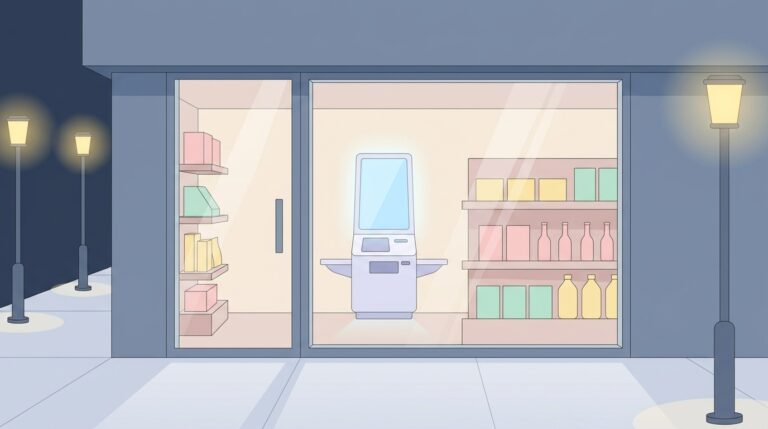
Picture this: It is 1:30 AM in a quiet alley of Mapo-gu, Seoul. After a long flight or an exhilarating night out singing your heart out at a noraebang, your stomach starts growling for that iconic late-night Korean ramyun. You spot the bright, neon-lit logo of a convenience store—CU, GS25, or E-Mart 24. But as you push the glass door, it doesn’t budge. An electronic chime rings, and a sleek card reader flashes by the handle: 출입 인증 (Access Authentication). You’ve stumbled upon Korea’s modern marvel: the 무인 편의점 (Muin pyeon-uijeom – unmanned convenience store).
Inside, there’s no friendly clerk calling out “어서오세요!” (Eoseo oseyo! / Welcome!). It’s just you, aisles of glistening treats, high-tech CCTV cameras, and an intimidating touchscreen self-checkout terminal speaking rapid Korean. If you’ve ever frozen in front of a Korean kiosk while an impatient local queued behind you, you are far from alone. Over my 10 years of mentoring advanced Korean language learners, the transition from textbook conversations to real-world automated interactions is where even C1 speakers experience sudden friction. Automated prompts use specific lexical patterns, administrative abbreviations, and socio-cultural cues that standard grammar books simply bypass.
Today, we’re unpacking everything you need to navigate these automated spaces seamlessly—from the linguistic nuances of kiosk prompts to the unwritten rules of nunchi (눈치) in Korea’s high-trust, fast-paced society. By the time you finish this guide, you’ll stroll into any unmanned storefront in Seoul with total swagger and zero hesitation.
Phase 2: 핵심 표현 3선 심층 분석 (3 In-Depth Core Expressions)
Here are three high-frequency, pragmatic expressions you will encounter on screens and audio prompts across Korean self-checkout systems.
1. 바코드 찍고 결제하기만 하면 돼요. (Bakodeu jjikgo gyeoljehagi-man hamyeon dwaeyo.)
- Pronunciation: [Bah-koh-deu jjeek-goh gyeol-je-hah-gee-mahn hahm-yeon dweh-yoh] (Think of jjik like the English word “chick” but with a punchier, tense ‘jj’ sound, like clicking an antique camera shutter).
- Meaning: Literal: “All you have to do is scan the barcode and pay.” | Actual Nuance: “It’s completely hassle-free; just scan your items and tap your card.”
- K-Culture Moment: You’ll hear this casual reassurance in modern web dramas like Work Later, Drink Now when a street-smart local walks an overwhelmed friend through their very first automated snack run.
- Editor’s Insight: The grammatical construction -기만 하면 되다 expresses minimal effort required to achieve a result. In unmanned retail contexts, native speakers drop formal passive verbs (스캔하여 주십시오) in favor of this active, breezy phrase to emphasize convenience.
- Situation Spectrum: Casual ✅ | Semi-formal ✅ | Formal ⚠️
- 🤔 Think About It: In English, we often say “Just scan and go.” How does Korean’s explicit inclusion of -기만 하면 되다 reflect the culture’s obsession with efficiency and reassuring the customer against user error?
2. 카드 투입구에 끝까지 밀어 넣어 주세요. (Kadeu tu-ip-gue kkeutkkaji mireo neo-eo juseyo.)
- Pronunciation: [Kah-deu too-eep-goo-eh kkeut-kkah-jee mee-raw nuh-aw joo-seh-yoh] (Tu-ip-gu flows like “two-eep-goo”, and kkeut hits sharply like the English exclamation “cut!”).
- Meaning: Literal: “Please push the card into the slot until the end.” | Actual Nuance: “Make sure your IC chip clicks firmly into the reader; otherwise, the machine won’t read it!”
- K-Culture Moment: A staple voice-guided kiosk prompt heard echoing inside self-checkout booths in variety shows like Hangout with Yoo during unexpected solo survival challenges.
- Editor’s Insight: The Sino-Korean compound 투입구 (投入口 – tu-ip-gu) refers to an insertion slot. Notice the compound verb 밀어 넣다 (to push in) reinforced with 끝까지 (all the way). Advanced learners should note how procedural Korean pairs spatial adverbs with directional compound verbs for precise instructions.
- Situation Spectrum: Casual 🚫 | Semi-formal ✅ | Formal ✅
- 🤔 Think About It: Why do Korean automated interfaces use polite imperative endings like -(으)세요 even when speaking to an anonymous customer through a speaker?
3. 봉투 결제 여부를 선택해 주세요. (Bongtu gyeolje yeobureul seontaekhae juseyo.)
- Pronunciation: [Bohng-too gyeol-jeh yaw-boo-reul suhn-taek-heh joo-seh-yoh] (Yeobu sounds similar to the word for spouse yeobo, but with a crisp, neutral ending).
- Meaning: Literal: “Please select whether or not you will pay for a plastic bag.” | Actual Nuance: “Do you need a bag? Tap Yes or No on the screen.”
- K-Culture Moment: Frequently spotted in K-Vlogs by creators touring 24-hour unmanned convenience stores or ramyeon bars near the Han River.
- Editor’s Insight: The noun 여부 (與否 – yeobu) represents “whether or not / yes or no.” In spoken conversational Korean, someone might ask: 봉투 필요하세요? (Bongtu piryohaseyo?), but automated kiosk UIs favor nominalized administrative phrasing like 결제 여부 (payment status/choice).
- Situation Spectrum: Casual 🚫 | Semi-formal ✅ | Formal ✅
- 🤔 Think About It: Korea strictly enforces environmental laws regarding single-use plastics. How does the prominence of this prompt demonstrate legal policy shaping everyday digital UI?
Phase 3: 교과서 한국어 vs 진짜 한국어 (Textbook vs. Real-Life Korean)
Situation 1: Entering an Unmanned Store Locked with Credit Card Entry
- 📖 교과서 한국어 (Textbook): 출입 인증을 위해 단말기에 신용카드를 삽입하여 주십시오. (Churip injeung-eul wihae danmalgie sinyongkadeureul sabiphayeo jusipsio. / Please insert your credit card into the terminal for entry verification.)
- 🗣️ 진짜 한국어 (Real-Life): 카드 꽂거나 태그해야 문 열려요. (Kadeu kkot-geona taegeu-haeya mun yeollyeoyo. / You gotta insert or tap your card to open the door.)
- 💡 왜 다를까? Kiosk door plaques display dense Sino-Korean administrative jargon (출입 인증, 삽입), but native speakers standing outside simplify the action down to raw sensory verbs: 꽂다 (to plug/insert) and the loanword 태그하다 (to tap/tag RFID).
Situation 2: Asking an Attendant or Neighbor if an Item is 1+1 (Buy One, Get One)
- 📖 교과서 한국어 (Textbook): 이 상품은 증정 행사가 적용되는 제품입니까? (I sangpum-eun jeungjeong haengsaga jeokyongdoeneun jepum-imnikka? / Is this a product to which promotional gift conditions apply?)
- 🗣️ 진짜 한국어 (Real-Life): 이거 원플러스원(1+1) 맞죠? 결제할 때 알아서 찍혀요? (Igeo won-peulleoseu-won matjyo? Gyeoljehal ttae araseo jjikhyeoyo? / This is 1+1, right? Does it apply automatically at the checkout?)
- 💡 왜 다를까? Commercial policy words like 증정 행사 (promotional gift event) are completely replaced in colloquial discourse by Konglish terms like 원플러스원 (1+1), and locals use the reflexive phrase 알아서 찍히다 (to register automatically on screen).
Phase 4: K-Culture 딥다이브 & 비언어적 매너 (Deep Dive & Non-Verbal Manners)
4-1. 눈치 (Nunchi) & Self-Checkout Etiquette
In Korea’s hyper-fast retail environment, nunchi (the art of gauging social moods and surroundings) is paramount at the self-checkout counter:
1. Pre-sorting Your Barcodes: When stepping up to the scanner, don’t fumble through your basket slowly. Notice how Koreans rotate all item barcodes outward beforehand. This subtle habit speeds up scanning and respects the person waiting behind you.
2. The Space Buffer: If someone is scanning at the machine, do not stand right beside them inspecting the screen. Maintain a respectful 1.5-meter step-back distance. Hovering too close violates personal boundaries and triggers theft anxiety in unattended spaces.
3. Post-Purchase Cleanliness: Unmanned ramyeon counters and convenience stores operate strictly on mutual civic trust. Leaving an empty broth cup on the counter or failing to separate food waste (음식물 쓰레기) from paper packaging is considered a severe social taboo.
4-2. The Cultural Phenomenon of the “High-Trust Society” (양심 문화)
Why are unmanned ramen joints (무인 라면 카페) and unattended convenience stores thriving across South Korea without getting ransacked? It boils down to a blend of dense urban surveillance (CCTV) and an ingrained collective ethos known as 양심 (Yangsim – Conscience).
In Korean society, shared public property and convenience stores are treated as extensions of community infrastructure. When late-night drama characters in shows like My Liberation Notes seek refuge in brightly lit 24-hour spaces, the store is presented not just as a retail stop, but as a safe, clean sanctuary. When you use an unmanned kiosk in Korea, scanning every single small item—even a 50-won plastic bag—is seen as your personal contribution to preserving this societal trust.
Phase 5: 실전 롤플레이 시나리오 (Real-World Roleplay Scenario)
Setting: It is 2:15 AM at an unmanned convenience store near Sinchon Station. You have selected a cup of buldak ramyun, a triangle gimbap (samgak gimbap), and an iced pouch beverage. The kiosk screen turns red with a warning chime. A friendly Korean university student, Ji-hoon, is preparing hot water nearby.
Ji-hoon (NPC):
어, 화면에 빨간 불 들어왔네요. 바코드 인식 안 됐나 봐요. 🎭 Pointing gently toward your scanner screen while holding his instant noodles.
(Eo, hwamyeone ppalgan bul deureowatneyo. Bakodeu insik an dwaenna bwayo. / Oh, a red light came on the screen. Looks like the barcode didn’t register.)
You:
아, 그런가요? 삼각김밥 바코드가 잘 안 읽히네요. 🎭 Tilting the triangular gimbap back and forth under the red laser.
(A, geureon-gayo? Samgak-gimbap bakodeuga jal an ilkhineyo. / Ah, is that so? The triangle gimbap barcode isn’t scanning properly.)
Ji-hoon:
그거 비닐 접힌 부분 쫙 펴서 스캐너 정면에 대보세요. 🎭 Demonstrating by flattening his own snack wrapper with both thumbs.
(Geugeo binil jeophin bubun jjwag pyeoseo seukaeneo jeongmyeone daeboseyo. / Flatten out the creased plastic and hold it right in front of the scanner.)
You:
아, 이제 인식됐어요! 감사합니다. 🎭 Smiling with relief as the terminal emits a sharp beep.
(A, ije insik-dwaesseoyo! Gamsahamnida. / Ah, it registered now! Thank you.)
Ji-hoon:
다행이네요! 이제 화면 맨 밑에 있는 ‘결제하기’ 누르시면 돼요. 🎭 Nodding encouragingly while stirring his ramyun bowl.
(Dahaeng-ineyo! Ije hwamyeon maen mite inneun ‘gyeolje-hagi’ nureusimyeon dwaeyo. / What a relief! Now you just have to press ‘Checkout’ at the bottom of the screen.)
You:
혹시 봉투도 결제해야 하나요? 가방이 없어서요. 🎭 Looking around for a plastic bag dispenser near the counter.
(Hoksi bongtudo gyeoljehaeya hanayo? Gabang-i eopseoseoyo. / Do I also need to pay for a bag? I don’t have my backpack with me.)
Ji-hoon:
네, 화면에 ‘봉투 추가’ 팝업 뜨면 100원짜리 선택하시면 옆에서 나와요. 🎭 Gesturing toward the slot beneath the payment terminal.
(Ne, hwamyeone ‘bongtu chuga’ pabeop tteumyeon baeg-won-jjari seontaekhasimyeon yeop-eseo nawayo. / Yes, when the ‘Add Bag’ pop-up shows on screen, select the 100-won option and it dispenses from the side.)
You:
친절하게 알려주셔서 정말 감사해요! 좋은 밤 되세요. 🎭 Bowing slightly at a 15-degree angle while inserting your travel payment card.
(Chinjeolhage allyeojusyeoseo jeongmal gamsahaeyo! Joeun bam doeseyo. / Thank you so much for explaining kindly! Have a good night.)
🔀 Interactive Branching Moment
The kiosk screen suddenly flashes: “포인트 적립 혹은 통신사 할인을 적용하시겠습니까?” (Would you like to apply membership points or telecom carrier discount?)
- Option A: Press “건너뛰기 / 건너뜀” (Skip).
- Option B: Frantically wave your foreign passport at the barcode scanner.
- Option C: Press “통신사 할인” (Telecom Discount) and scan your hotel room keycard.
Branch Feedback:
* Choice A [BEST]: Perfect execution! Unless you possess an active Korean resident registration number or a domestic Korean mobile telecom account (SKT, KT, LGU+), foreign tourists cannot redeem these carrier discounts. Pressing 건너뛰기 (Skip) keeps the line moving smoothly.
* Choice B [BAD]: The optical barcode scanner only reads Korean carrier barcodes and registered loyalty apps. Waving your passport triggers an invalid scanning loop error.
* Choice C [RISK]: Hotel keycards use unrelated RFID frequencies. Doing this freezes the kiosk session, forcing a 30-second system timeout while the counter chime alerts anyone in earshot.
Phase 6: 10초 감정 섀도잉 드릴 (10-Second Emotional Shadowing Drill)
Master the natural cadences and intonation micro-pauses of kiosk problem-solving:
[🤔 Perplexed & seeking clarity]- 영수증 출력을 / 깜빡했는데 / 재발행 버튼이 / 어디 있죠?
- (Yeongsujeung chullyeog-eul / kkamppakhaenneunde / jaebalhaeng beoteun-i / eodi itjyo?)
- “I totally forgot / to print the receipt / where is / the reprint button?”
[😊 Relieved & briskly polite]- 아, 카드 꽂아두고 / 그냥 갈 뻔했네요! / 큰일 날 뻔했어요.
- (A, kadeu kkoj-adugo / geunyang gal ppeonhaenneyo! / Keun-il nal ppeonhaesseoyo.)
- “Ah, I almost walked away / leaving my card plugged in! / That was close.”
[😌 Confident & self-directed]- 바코드 찍고 / 결제하기만 하면 되니까 / 생각보다 훨씬 편하네요.
- (Bakodeu jjikgo / gyeoljehagi-man hamyeon doenikka / saeng-gakboda hwolssin pyeonhaneoyo.)
- “Since all you do is scan the barcode / and pay / this is way more convenient than I thought.”
Phase 7: K-Culture 미니 사전 (4 Essential Keywords)
- 무인 단말기 (Muin danmalgi)
- Translation: Unattended automated terminal (Kiosk).
- Real-world Usage: When asking customer support or discussing store formats: 무인 단말기가 먹통이에요 (The self-service terminal is frozen).
- 결제 취소 (Gyeolje chwiso)
- Translation: Payment cancellation / refund.
- Real-world Usage: Used if you accidentally scan an item twice: 중복 결제되어서 결제 취소해야 돼요 (It scanned twice, so I need to void the transaction).
- 행사 상품 (Haengsa sangpum)
- Translation: Promotional items (1+1, 2+1, discounts).
- Real-world Usage: Refers to items with bundled tags on the shelves: 행사 상품은 바코드 둘 다 찍으셔야 해요 (For promotional combo deals, you must scan both individual items).
- 현금 결제 불가 (Hyeongeum gyeolje bulga)
- Translation: Cash payments not accepted (Card/Digital only).
- Real-world Usage: Ubiquitous label on modern Korean self-checkouts: 여기는 현금 결제 불가 매장입니다 (This store is completely cashless).
Phase 8: 여행자를 위한 생존 키트 (Traveler’s Survival Kit)
Survival Expressions TOP 3
- 이거 바코드 인식이 안 돼요. (Igeo bakodeu insig-i an dwaeyo.)
- Romanization: [Ee-guh bah-koh-deu een-sheeg-ee ahn dweh-yoh.]
- Pro Tip: Use this when turning to another customer in the store for assistance with stubborn packaging.
- IC 카드를 끝까지 넣어주세요. (IC kadeureul kkeutkkaji neoeojuseyo.)
- Romanization: [Eye-see kah-deu-reul kkeut-kkah-jee nuh-aw-joo-seh-yoh.]
- Pro Tip: If the kiosk keeps beeping at payment, don’t tap—leave your physical card inserted until the receipt prints!
- 문이 안 열려요! (Mun-i an yeollyeoyo!)
- Romanization: [Moon-ee ahn yuhl-lyuh-yoh!]
- Pro Tip: Use if the smart door latch doesn’t release during entry or exit.
Editor’s Travel Note
- Navigation & Access: Download the Naver Map app download to search for nearby 무인 편의점 or 24시 편의점. Naver Map accurately indicates whether a branch switches to unmanned mode after midnight.
- Payment Verification Methods: When entering an unmanned store late at night, the door requires an IC card tap. Foreign Visa/Mastercards with contactless chips usually work, but carrying a physical WOWPASS or Korean transit card (T-Money) guarantees instant door unlocks.
Phase 9: “한 발 더 깊이” (Cultural Insight)
The rise of unmanned retail in South Korea is not solely a triumph of robotics; it is a mirror reflecting the country’s high level of mutual social responsibility. In a culture shaped by collective consciousness, unattended storefronts can only endure because individuals understand that mutual convenience relies upon unpoliced civic discipline. When a Korean leaves the kiosk counter spotless and responsibly sorts their recyclables into designated bins, they are preserving an invisible covenant between stranger and merchant.
💬 Your Turn: Have you ever seen unattended stores operating successfully in your home country? What social or psychological factors make self-checkout feel natural or stressful in your culture compared to Korea? Let’s discuss below!
Phase 10: FAQ & 오해 방지 (FAQ Schema)
Q: Can foreign credit cards be used to unlock the door at night?
A: Yes, most modern unmanned door scanners accept international credit cards equipped with EMV contactless chips. Simply tap your physical card on the terminal outside the entrance. If your foreign card does not register, you can tap a domestic transit card (T-Money) or standard domestic prepaid tourist card like WOWPASS.
Q: If an item is listed as 1+1, do I scan one item or both?
A: You must physically grab both items from the shelf and scan each barcode individually. The kiosk’s automated billing software will automatically discount the second item to 0 KRW upon calculation before final payment.
Q: What should I do if the kiosk freezes after I swipe my card?
A: Check the wall directly beside or above the self-checkout counter for a sign labeled 비상 연락처 (Emergency Contact). Dial the mobile or interphone number displayed. Convenience store managers can remotely reset the terminal or verify your transaction within minutes.
🚨 흔한 실수 (Common Mistakes) TOP 3
- Mistake: Yanking your payment card out immediately after hearing the first beep.
- Correct Action: Keep the card inserted until the on-screen animation completes and the receipt slot dispenses paper.
- Mistake: Forgetting to scan the barcode on paid plastic or paper bags.
- Correct Action: Tap 봉투 구매 (Purchase Bag) on screen, then scan the specific barcode printed directly across the plastic bag.
- Mistake: Dumping unfinished ramen broth directly into the standard dry waste bin.
- Correct Action: Pour liquid contents into the designated sink labeled 국물 버리는 곳 (Broth Disposal), and dispose of the paper bowl separately.
Phase 11: 액션 미션 & 참여 유도 (Action Missions)
- 🥉 Bronze Mission (Solo Practice): Read the Phase 6 Shadowing drills aloud three times, emphasizing natural pauses at each slash mark (
/). - 🥈 Silver Mission (Interactive Observation): The next time you watch a modern K-Drama or Seoul walking vlog, identify at least one self-checkout terminal or automated kiosk notice board.
- 🥇 Gold Mission (Real-World Execution): Walk into an unmanned convenience store or self-service cafe in Korea, complete your snack purchase without changing the UI to English, and snap your receipt!
- 🎮 K-Culture Mission: Watch an episode of tvN’s variety show Unexpected Business (어쩌다 사장) to observe how traditional interpersonal grocery cashier culture humorously contrasts with modern automated urban kiosks.
Phase 12: 인터랙티브 퀴즈 챌린지 (Interactive Quiz Challenge)
Test your situational readiness with these 3 questions!
- Situational Judgment: You want to buy a 2+1 coffee deal at an unmanned convenience store. You have placed all 3 cans on the counter. What is the correct step at the checkout?
- A) Scan one can three times to save time.
- B) Scan each of the three cans individually to ensure promotional application.
- C) Scan only two cans and take the third can out without scanning.
- Fill-in-the-Blank: Complete the following standard kiosk screen instruction:
- “카드를 투입구에 ________ 밀어 넣어 주세요.” (Please push your card all the way into the slot.)
- A) 대충 (Daechung)
- B) 끝까지 (Kkeutkkaji)
- C) 천천히만 (Cheoncheonhiman)
- True or False Culture Check: Unmanned convenience stores in Korea generally accept both paper cash bills and coins directly into the kiosk.
- True or False?
👉 Click here to check your answers and explanations!
- Answer: B
- Explanation: At Korean self-checkouts, promotional bundling requires inventory tracking for each unit. You should scan each individual can. Scanning one barcode multiple times can occasionally trigger inventory mismatch alerts.
- Answer: B (끝까지)
- Explanation: 끝까지 means “to the end / all the way.” Kiosks require the IC chip to seat firmly in the receiver slot.
- Answer: False
- Explanation: The vast majority of Korean unmanned convenience stores are 현금 없는 매장 (Cashless Stores) designed to deter theft and eliminate mechanical bill-jam maintenance. Always carry a card or mobile payment!
- Explanation: The vast majority of Korean unmanned convenience stores are 현금 없는 매장 (Cashless Stores) designed to deter theft and eliminate mechanical bill-jam maintenance. Always carry a card or mobile payment!







