

Phase 1: Empathy (A Road Trip Turned Mini-Panic)
안녕하세요! 매일한글 에디터입니다. (Hello! I’m your Daily Hangul editor.)
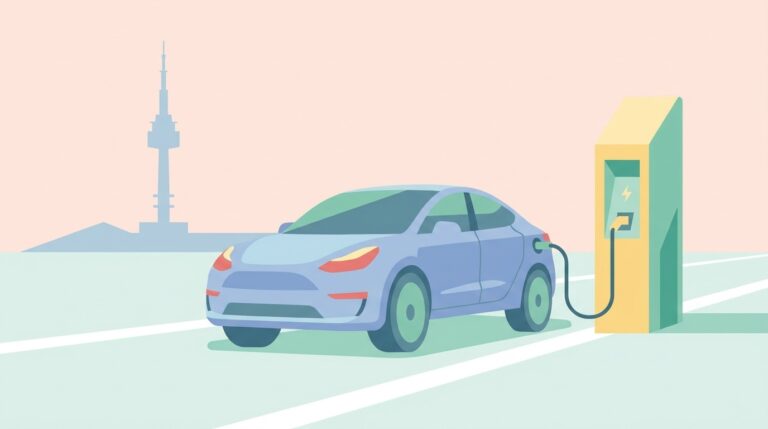
Picture this: You’ve rented a sleek Ioniq 5 to cruise down the breathtaking coastal roads of Jeju Island or navigate the neon-lit highways of Gangnam. K-Pop is playing on the radio, the ocean breeze is crisp, and you’re feeling like the main character in a healing drama. Suddenly, a high-pitched chime interrupts your favorite playlist. The dashboard flashes bright orange: Battery: 8%. You pull into an expansive rest area (휴게소), only to find four charging bays surrounded by a maze of touchscreen kiosks, unfamiliar connector types, and local drivers waiting in their cars.
Navigating EV infrastructure in South Korea can feel intimidating even for experienced drivers, especially when tech jargon clashes with fast-paced local etiquette. Through hundreds of tutoring sessions at Daily Hangul, our learners consistently tell us: “I know how to ask where the bathroom is, but how do I ask if someone is almost done charging without sounding rude?” That’s why we built this B2-level field guide. By the end of this article, you’ll not only find the right charger effortlessly, but you’ll also speak with the natural fluency, nuance, and politeness of a seasoned local motorist. Let’s hit the road!
Phase 2: Core Expressions Deep Dive
Here are the three foundational expressions you need at any Korean EV charging station.
1. 혹시 여기 근처에 급속 충전기 어디에 있어요?
- Romanization & Sound Metaphor: Hoksi yeogi geuncheoe geupsok chungjeongi eodie isseoyo? (Start with a soft, inquiring Hok-shee—like you’re gently tapping someone on the shoulder before speaking.)
- Meaning: Literal: “By any chance, where is a rapid charger near here?” | Nuance: A very polite, natural inquiry that cushions the question so you don’t sound abrupt or demanding.
- K-Culture Moment: Heard frequently in road-trip variety shows like Unexpected Business (어쩌다 사장) when the cast drives into rural towns looking for power stations before sunset.
- Editor’s Insight: Always specify 급속 (geupsok, fast/DC fast) versus 완속 (wansok, slow/AC). If your battery is dying, accidentally booking an 8-hour trickle charger will ruin your itinerary!
- Situation Spectrum: Casual (⚠️ with strangers) / Semi-formal (✅ Best: with shop clerks or attendants) / Formal (✅ Appropriate)
- 🤔 Think About It: Why does Korean rely so heavily on softener words like 혹시 (hoksi – by chance) compared to the direct English “Where is the fast charger?”
2. 완충될 때까지 얼마나 걸려요?
- Romanization & Sound Metaphor: Wanchungdoel ttaekkaji eolmana geollyeoyo? (Wan-choong sounds punchy, like “one chunk” of solid battery power.)
- Meaning: Literal: “Until full charge occurs, how much time takes?” | Nuance: “How long until it’s fully charged?”
- K-Culture Moment: When you pull up next to another EV driver at a highway service area and need to calculate whether you have time to grab walnut pastries (호두과자) or if you must wait by the wheel.
- Editor’s Insight: 완충 (wanchung) is a classic Korean portmanteau of 완전 (complete) and 충전 (charging). Using this abbreviation signals immediate natural fluency.
- Situation Spectrum: Casual (✅ with close friends: 완충까지 얼마나 걸려?) / Semi-formal (✅ Standard: 완충될 때까지 얼마나 걸려요?) / Formal (✅)
- 🤔 Think About It: Notice how Korean contracts formal terms into two-syllable acronyms (완충, 급속). How does this reflect Korea’s fast-paced, efficiency-driven lifestyle?
3. 충전 끝나셨으면 차 좀 빼주시겠어요?
- Romanization & Sound Metaphor: Chungjeon kkeunnasyeosseumyeon cha jom bbaejusigesseoyo? (Bbae has a sharp, tense popping sound—keep the following ju-si-ge-sseo-yo melodic and gentle.)
- Meaning: Literal: “If charging has ended for you, could you please remove the car a little?” | Nuance: “If you’re done charging, would you mind moving your car out of the bay?”
- K-Culture Moment: Seen in community slice-of-life dramas like My Liberation Notes, capturing the everyday tension of high-density apartment parking dynamics.
- Editor’s Insight: The verb 빼다 (bbaeda) literally means “to pull out/remove.” Adding 좀 (jom, a little) and the polite honorific -시겠어요 softens a potentially confrontational request into an indisputably respectful one.
- Situation Spectrum: Casual (🚫 Don’t use casually with strangers) / Semi-formal (✅ Ideal balance of firmness and politeness) / Formal (✅)
- 🤔 Think About It: Why is adding the humble word 좀 (jom) so vital in public confrontations in Korea?
Phase 3: Textbook Korean vs. Real Korean
Situation 1: Checking if a charging slot is occupied
- 📖 교과서 한국어 (Textbook): “현재 전기차 충전 설비를 이용 가능한 상태입니까?” (Hyeonjae jeongicha chungjeon seolbireul iyong ganeunghan sangtae-imnikka? – Is the electric vehicle charging facility currently in an available state?)
- 🗣️ 진짜 한국어 (Real-life): “지금 충전기 자리 있어요? 다 차 있나요?” (Jigeum chungjeongi jari isseoyo? Da cha innayo? – Is there an open charging spot right now? Are they all taken?)
- 💡 Why the difference?: Locals rarely use dry administrative terminology like 설비 (facility/equipment). Instead, they ask about 자리 (spot/seat) and whether it is 차 있다 (filled up).
Situation 2: Warning a fellow driver about parking overtime
- 📖 교과서 한국어 (Textbook): “충전 완료 후 지속적인 주차는 관련 법규령에 의거하여 과태료가 부과됩니다.” (Chungjeon wanryo hu jisokjeogin juchaneun gwanryeon beopgyuryeonge uigeohayeo gwataeryoga bugwadoemnida. – Continuous parking post-charge will incur a statutory penalty fine.)
- 🗣️ 진짜 한국어 (Real-life): “충전 다 됐으면 바로 빼야 돼요. 안 그러면 과태료 나와요!” (Chungjeon da dwaesseumyeon baro bbaeya dwaeyo. An geureomyeon gwataeryo nawayo! – Once it’s done charging, you have to move it right away. Otherwise, you’ll get slapped with a fine!)
- 💡 Why the difference?: Native speakers use active, conversational idioms such as 과태료(가) 나오다 (a fine comes out/is issued) rather than the passive, legalistic 과태료가 부과되다.
Phase 4: K-Culture Deep Dive & Non-Verbal Manners
4-1. 눈치 (Nunchi) & Gestures: The Charging Bay Dance
- The Courtesy Blink (비상깜빡이): When pulling up behind a vehicle currently charging to claim next-in-line priority, flash your hazard lights (bisang kkamppagi) 2 to 3 times. It signals: “I see you, I’m waiting for this stall, but take your time.”
- The Windshield Glance: Korean EV owners display their phone numbers on the dashboard. If an idle car blocks a stall, never aggressively rap on their window or honk. Gently check the contact card on the windshield, send a polite text, or call with a warm tone.
- Two-Handed Cable Etiquette: When replacing an EV heavy-duty DC cable back into its holster, handle it with both hands. Leaving cables sprawled across the asphalt is seen as poor civic etiquette (민폐, minpye).
4-2. The 100,000 KRW Reality: 친환경자동차법 (Eco-Car Law)
In Korea, charging etiquette isn’t just good manners; it’s strictly codified by law. Under the Eco-Friendly Automobile Act, blocking a rapid charging stall or parking an internal combustion engine vehicle in an EV bay triggers an automatic 100,000 KRW fine (around $75 USD). Furthermore, remaining parked at a rapid charger (급속) beyond 40 minutes can trigger severe municipal penalties. The mantra here is fast, efficient, and considerate—traits deeply rooted in Korea’s modern Ppallli-Ppalli (빨리빨리, fast-paced) culture.
Phase 5: Real-World Roleplay Scenario
Setting: A busy highway rest stop (휴게소) along the Yeongdong Expressway on a rainy Saturday. You pull your rental EV up to an outdoor kiosk.
Characters:
* You: An intermediate learner on a road trip to Gangneung.
* Mr. Park (박 기사님): An experienced, silver-haired electric taxi driver wiping rain off his windshield.
Dialogue (8 Turns):
1. You: 저기요, 기사님! 혹시 여기 급속 충전기 맞나요?
(Jeogiyo, gisanim! Hoksi yeogi geupsok chungjeongi mannayo?)
“Excuse me, sir! By any chance, is this a rapid charger?”
🎭 Hands politely clasped, stepping slightly forward with a gentle head tilt.
- Mr. Park: 네, 맞아요. 100킬로와트짜리 급속이에요. 금방 들어가요.
(Ne, majayo. Baek-killowateu-jjari geupsok-ieyo. Geumbang deureogayo.)
“Yes, that’s right. It’s a 100kW rapid charger. Charges up in no time.” -
You: 다행이네요. 제 차 배터리가 10%밖에 안 남아서 정말 당황했거든요.
(Dahaeng-ineyo. Je cha baeteori-ga sip peosenteu-bakke an namaseo jeongmal danghwang-haetgeodeunyo.)
“What a relief. My battery had only 10% left, so I was really panicking.”
🎭 Letting out an audible sigh of relief and smiling gratefully. -
Mr. Park: 아이고, 고속도로에서 그러면 큰일 나지! 결제 카드는 있어요?
(Aigo, gosokdoro-eseo geureomyeon keunil naji! Gyeolje kadeuneun isseoyo?)
“Oh dear, running out on a highway is serious trouble! Do you have a payment card?” -
You: 렌터카 전용 카드가 있는데, 리더기에 그냥 태그하면 되나요?
(Renteoka jeonyong kadeuga inneunde, rideogie geunyang taegeuhamyeon doenayo?)
“I have a rental car dedicated card. Do I just tap it on the RFID reader?” -
Mr. Park: 화면에서 ‘회원 카드’ 누르고 여기 화면 밑에 대면 돼요. 내가 도와줄게요.
(Hwamyeon-eseo ‘hoewon kadeu’ nureugo yeogi hwamyeon mite daemyeon dwaeyo. Naega dowajulgeyo.)
“Press ‘Member Card’ on screen and tap it right below here. Let me help you out.” -
You: 정말 감사합니다! 완충될 때까지 얼마나 걸릴까요?
(Jeongmal gamsahamnida! Wanchungdoel ttaekkaji eolmana geollilkkayo?)
“Thank you so much! How long will it take until it reaches full charge?” -
Mr. Park: 급속이니까 80% 채우는 데 한 30분이면 충분해요. 호두과자 하나 사 먹고 와요!
(Geupsog-inikka palsip peosenteu chaeuneunde han samsipbun-imyeon chungbunhaeyo. Hodu-gwaja hana sa meokgo wayo!)
“Since it’s fast charging, about 30 minutes is enough to get to 80%. Go grab some walnut cakes and come back!”
🔀 Interactive Choice Point
You see another car waiting behind you with its blinkers on as your battery reaches 80%:
* Choice A: “기사님, 제 차 충전 거의 다 됐는데 먼저 대실래요?” (Sir, mine is almost done, do you want to back in first?)
* Choice B: Keep sitting inside watching YouTube until 100% hits, ignoring the queue.
* Choice C: Unplug immediately without stopping the session on screen, pulling the heavy cable abruptly.
- Choice A (Best): Exceptional Nunchi! Offering your spot once you hit the 80% taper curve saves time for others and earns heartfelt praise.
- Choice B (Bad): A major social blunder! Charging above 80% at highway rapid chargers slows down drastically and obstructs drivers with genuine emergencies.
- Choice C (Risk): Danger! Pulling cables without completing the interface software lock can freeze the kiosk terminal or damage the vehicle port.
Phase 6: 10-Second Emotional Shadowing Drill
Practice these lines out loud with the matching emotional tempo. Slashes (/) indicate natural breath and rhythm pauses.
[⚡ 급하고 초조하게 / Urgent & Panicked]
“저기요! / 배터리가 3%밖에 안 남았는데 / 혹시 먼저 충전해도 될까요?”
(Jeogiyo! / Baeteori-ga sam-peosenteu-bakke an namanneunde / hoksi meonjeo chungjeonhaedo doelkkayo?)
“Excuse me! / I only have 3% battery left / could I possibly charge first?”-
[🙏 정중하고 공손하게 / Warm & Polite Request]
“충전 끝나셨으면 / 뒤에 기다리는 분 계셔서 / 차 좀 빼주실 수 있을까요?”
(Chungjeon kkeunnasyeosseumyeon / dwie gidarineun bun gyesyeoseo / cha jom bbaejusil su isseulkkayo?)
“If you are finished charging / someone is waiting behind / could you please move your car?” -
[😊 안도하고 밝게 / Relieved & Cheerful]
“친절하게 도와주셔서 감사합니다! / 덕분에 안전하게 갈 수 있겠어요.”
(Chinjeolhage dowajusyeoseo gamsahamnida! / Deokbune anjeonhage gal su itgesseoyo.)
“Thank you for kindly helping me! / Thanks to you, I can drive safely.”
Phase 7: K-Culture Mini Dictionary
- 급속 충전 (Geupsok Chungjeon): Rapid/DC Fast Charging. Charges most EVs to 80% within 20–40 minutes. Essential for highway travel.
- 완속 충전 (Wansok Chungjeon): Slow/AC Trickle Charging. Commonly found in hotel and apartment basements; typically requires 6 to 10 hours for a full charge.
- 완충 (Wanchung): Full Charge (Slang/Colloquial abbreviation). Frequently used in daily conversations: 완충했어? (“Did you charge it all the way?”).
- 얌체 주차 (Yamche Jucha): Selfish/Hogging Parking. Refers to non-EVs parking in charging bays or EV drivers who park long after their charging session has finished.
Phase 8: Traveler’s Survival Kit
Survival Expressions Top 3
- 결제가 계속 오류 나요.
(Gyeoljega gyesok oryu nayo.)
“The payment keeps returning an error.”
Pro Tip: Korean charging stations sometimes reject foreign master/visa credit cards without 3D-secure authentication. Knowing this phrase alerts on-site staff instantly. - 커넥터가 안 빠져요.
(Keonekteoga an bbajyeoyo.)
“The connector won’t unlock/unplug.”
Pro Tip: EV plugs remain electronically locked while the car doors are locked. Unlock the car doors with your key fob first! - 충전 방해 금지 구역이에요.
(Chungjeon banghae geumji guyeog-ieyo.)
“This is an EV charging obstruction prevention zone.”
Pro Tip: Useful when reminding an internal combustion engine driver politely not to block the stall.
Editor’s Travel Note
- Essential Navigation: Standard Google Maps cannot provide real-time updates for Korea. Make sure you install the Naver Map app navigation or KakaoMap app real-time EV guide prior to hitting the highway. Filter by charger type (DC 콤보 / CCS1).
- Emergency KEPCO Help: If a machine eats your card or locks your car port, look for the 24-hour customer hotline sticker displayed right beside the LCD screen.
Phase 9: “한 발 더 깊이” (One Step Deeper)
In South Korea, where over 60% of the population resides in high-density multi-family apartment complexes (아파트), an EV charging stall is not merely a piece of utility equipment; it is shared social real estate. The friction between private vehicle ownership and communal living has fostered a culture where punctuality and 배려 (consideration for others) are scrutinized. Leaving your car plugged in overnight at a rapid stall is not just seen as a minor oversight—it is viewed as a breach of communal trust. By mastering the language of consideration (차 좀 빼주실 수 있을까요?), you show native drivers that you value the harmony of the shared space.
💬 Your Turn: Have you ever encountered unexpected parking or driving etiquette rules while traveling abroad? How would you handle a fellow driver taking up a spot in your hometown? Drop your thoughts below!
Phase 10: FAQ & Avoiding Misunderstandings
Q: Can I use foreign credit cards directly at public EV charging kiosks in Korea?
A: Many public kiosks managed by local municipalities or small private vendors only accept domestic Korean credit cards or local RFID roam cards (such as HappyCharger or KEPCO cards). At highway service plazas, newer high-speed networks like Hyundai E-Pit often accept international credit cards. Always carry a secondary domestic T-Money card enabled for payments or rent an EV with a pre-registered billing RFID card from agencies like Lotte Rent-a-Car or SK Rent-a-Car.
Q: What is the difference between DC 콤bo and 차데모 in Korea?
A: DC 콤보 (CCS1) is the official national standard for fast charging in South Korea, used by modern Hyundai, Kia, Genesis, and most imported vehicles. 차데모 (CHAdeMO) is older and rarely found at newly built chargers. Tesla vehicles require their proprietary NACS adapter or a CCS1 DC Combo combo adapter.
Q: Is it illegal to charge an EV to 100% at a highway rest station?
A: While technically not illegal to reach 100%, most rapid chargers automatically shut off after 40 minutes under the Eco-Friendly Automobile Act (친환경자동차법). If your car remains plugged in without active charging, you can be reported via the safety app and fined 100,000 KRW.
🚨 Common Mistakes Noticeboard
- Mistake: Calling every charger a 주유소 (gas station).
- Correct Action: Say 충전소 (chungjeonso, charging station). A 주유소 strictly sells petroleum fuel.
- Mistake: Pulling the plug forcefully while the dashboard status indicator light is pulsing blue/green.
- Correct Action: Press “충전 중지” (Stop Charge) on the kiosk screen first, unlock your vehicle doors, and wait for the tactile click of the solenoid release.
- Mistake: Leaving your hazard lights off when waiting in line behind another EV.
- Correct Action: Always turn on your hazard lights (비상깜빡이) to indicate to others that you are officially queuing for the charging bay.
Phase 11: Action Missions
- 🥉 Bronze Mission (Solo Practice): Record yourself on your smartphone pronouncing: “혹시 여기 근처에 급속 충전기 어디에 있어요?” Ensure your 혹시 sounds gentle and melodic.
- 🥈 Silver Mission (Community Engagement): Check a Korean map app (Naver Map), locate the nearest EV charging station in Seoul, screenshot it, and label the terms 급속 and 완속 in an Instagram story or community study group.
- 🥇 Gold Mission (Real-world Simulation): Next time you speak to your Korean tutor, conversation partner, or a local attendant, practice roleplaying Phase 5 with spontaneous responses!
- 🎮 K-Culture Mission: Watch an episode of a recent modern K-Drama (like King the Land or Crash Course in Romance). Spot a scene featuring an electric vehicle and listen for words like 충전, 배터리, or 주차!
Phase 12: Interactive Quiz Challenge
Test your real-world comprehension below!
1. Situational Judgment: You arrive at a rest stop with 5% battery remaining. There is only one rapid charger, and a car has been sitting at 100% full charge for 15 minutes with no driver in sight. What is the most culturally appropriate and effective first step?
(A) Honk loudly until the driver comes running out from the food court.
(B) Unplug their cable by force and connect it to your car.
(C) Check the driver’s phone number on the dashboard and send a polite text: “안녕하세요, 충전 완료되셔서 차 좀 이동 부탁드립니다.”
2. Fill-in-the-Blank: Complete the sentence to make it sound like a natural Korean speaker asking how long it takes to charge to 100%:
“( )될 때까지 얼마나 걸려요?”
3. True or False: In South Korea, parking a conventional gasoline or diesel car in an electric vehicle charging space can result in a 100,000 KRW administrative fine.
(True / False)
Click to view answers and explanations!
-
Answer: (C)
Explanation: Honking or pulling cables creates public conflict (민폐). Contacting the number placed on the front windshield with a respectful message is standard and accepted etiquette throughout South Korea. -
Answer: 완충
Explanation: 완충 (Wanchung) is the native portmanteau for “full charge” (완전 충전). The full phrase is 완충될 때까지 얼마나 걸려요? -
Answer: True
Explanation: Under the Eco-Friendly Automobile Act, blocking or parking an unauthorized vehicle in designated green spaces carries a 100,000 KRW municipal fine.







