

안녕하세요! 매일한글 에디터입니다.
Picture this: You are walking through the buzzing underground passage of Hongdae Station on a rainy Friday evening. The rhythm of street musicians mingles with the clinking glasses of nearby restaurants. Suddenly, an elderly gentleman right in front of you stumbles and collapses to the polished tile floor. A crowd gathers, murmuring anxiously in Korean. Someone gasps, but people hesitate, unsure of what step to take next. In high-stakes moments like this, textbook phrases like “I am sick” or “Where is the clinic?” will not cut it. You need clear, decisive words to direct bystanders, administer emergency first aid, and summon Korea’s 119 rescue teams.
Many of our intermediate learners share that when an unexpected emergency strikes in Korea, their minds freeze because medical terminology feels intimidating. But here is the comforting truth: you do not need a medical license or C2-level fluency to make an immediate, life-saving impact. Over the past decade, we have guided hundreds of expats and travelers to communicate confidently during critical moments. In this guide, you will master essential first aid expressions, discover the non-verbal cultural rules of Korean emergency etiquette, and learn how to act with confidence when seconds truly matter.
Phase 2: Core Expressions Deep Dive
1. 심폐소생술을 할 줄 아세요? (Simpyesosaengsuleul hal jul aseyo?)
- Pronunciation: [Sim-pye-so-saeng-sul-eul hal jul a-se-yo?] (Think: “Seem-pyeh-so-sang-sool”)
- Meaning: “Do you know how to perform CPR?” (Literal: “Do you know the method of cardiopulmonary resuscitation?”)
- K-Culture Moment: Seen in nearly every high-tension emergency K-drama like Hospital Playlist or Dr. Romantic, where a paramedic or doctor urgently scans the room to identify anyone capable of keeping chest compressions going.
- Editor’s Insight: “심폐소생술” (CPR) sounds like a mouthful, but Koreans frequently abbreviate it as CPR (씨피알, Ssipiar) in casual speech. However, using the full term “심폐소생술” ensures immediate clarity across all age groups, especially older bystanders who might not instantly catch the English acronym.
- Situation Spectrum: Casual ⚠️ | Semi-formal ✅ | Formal ✅
- 🤔 Think About It: In many Western contexts, people might ask “Can anybody do CPR?” into the void. In Korean culture, speaking directly with respectful honorific endings (
-세요) commands focused responsibility rather than leaving the question open-ended.
2. 피가 많이 나요. 지혈해 주세요. (Piga mani nayo. Jihyeolhae juseyo.)
- Pronunciation: [Pi-ga ma-ni na-yo. Ji-hyeol-hae ju-se-yo.] (Sounds like: “Pee-gah mah-nee nah-yo. Jee-hyol-hae joo-seh-yo”)
- Meaning: “It’s bleeding heavily. Please apply pressure to stop the bleeding.”
- K-Culture Moment: Common in action thrillers or workplace dramas when a character gets a deep cut from broken glass or machinery and needs an urgent tourniquet or direct pressure.
- Editor’s Insight: “지혈” (jihyeol) is a Hanja-based compound meaning “stopping blood” (止血). While beginners might say “피 멈춰 주세요” (Pi meomchwo juseyo), using “지혈” immediately marks your language as precise and calm, signaling that serious first aid action is required.
- Situation Spectrum: Casual ⚠️ | Semi-formal ✅ | Formal ✅
- 🤔 Think About It: Why use the request ending
~해 주세요even in an emergency? In Korean social dynamics, imperative honorifics balance urgency with respect, encouraging cooperation from bystanders without sounding aggressive.
3. 구급상자나 제세동기 있어요? (Gugeupsangjana jesedonggi isseoyo?)
- Pronunciation: [Gu-geup-sang-ja-na je-se-dong-gi it-seo-yo?] (Sounds like: “Goo-goop-sahng-jah-nah jeh-seh-dong-gee eet-soh-yo?”)
- Meaning: “Do you have a first aid kit or an AED?”
- K-Culture Moment: Frequently heard at subway stations, train terminals, or community centers when someone alerts the station master during a medical crisis.
- Editor’s Insight: “제세동기” (Defibrillator/AED) is also officially labeled as “자동심장충격기” (Automated External Defibrillator) on public emergency cabinets. Both terms are recognized, but “제세동기” is shorter and faster to say in a rush.
- Situation Spectrum: Casual ✅ | Semi-formal ✅ | Formal ✅
- 🤔 Think About It: South Korea legally mandates AED installations in all public transport hubs, apartment complexes with over 500 units, and public facilities. Knowing this word turns any Korean public space into an accessible emergency safety net.
Phase 3: Textbook Korean vs. Real Korean
Situation 1: Checking if the patient is conscious and breathing
- 📖 교과서 한국어: “환자분의 의식이 있습니까?” (Hwanjabun-ui uisigi itsseumnikka? / Does the patient possess consciousness?)
- 🗣️ 진짜 한국어: “저기요, 제 말 들리세요? 눈 좀 떠보세요!” (Jeogiyo, je mal deulliseyo? Nun jom tteoboseyo! / Excuse me, can you hear me? Open your eyes!)
- 💡 왜 다를까?: In real-life emergencies, bystanders talk directly to the injured person rather than describing clinical symptoms abstractly. Calling out sensory prompts like “눈 좀 떠보세요” (Try to open your eyes) is the natural standard first step taught in Korean public first aid drills.
Situation 2: Directing someone to summon 119
- 📖 교과서 한국어: “구급차를 신속하게 호출해 주시기 바랍니다.” (Gugeupchareul sinsokhage hochulhae jusigi baramnida. / Please call an ambulance promptly.)
- 🗣️ 진짜 한국어: “빨간 옷 입으신 분, 119에 전화해서 여기로 와달라고 해주세요!” (Ppalgan ot ibeusin bun, il-il-gu-e jeonhwahaeseo yeogiro wadallago haejuseyo! / You in the red shirt, please call 119 and tell them to come here!)
- 💡 왜 다를까?: Passive, overly formal textbook statements cause the “bystander effect.” In Korean society, pinpointing someone’s visible attribute (e.g., clothing color) followed by the direct number
119creates immediate personal accountability.
Phase 4: K-Culture Deep Dive & Non-Verbal Manners
4-1. 눈치 (Nunchi) & Gestures in Emergency Aid
In Korea, shouting ambiguously into a crowd often results in everyone staring blankly because people fear making a mistake or intruding into someone else’s space without clear permission. To break this bystander paralysis, apply dynamic Nunchi (situational awareness) combined with precise body language:
* Point with an Open Hand or Direct Gaze: Pointing aggressively with a single index finger can feel confrontational. Instead, lock direct eye contact, nod firmly, and point distinctly toward an individual while specifying what they are wearing: “안경 쓰신 분!” (You with glasses!).
* Clear Vocal Modulation: Keep your pitch grounded. A panicked, shrill scream can disorient older bystanders. Speak with a deep, steady, downward-falling inflection to project competence and calm.
4-2. Cultural Code: Golden Time & The Good Samaritan Act
In Korea, you will frequently hear the phrase “골든타임” (Golden Time) on the news. This refers to the critical 4-minute window during cardiac arrest or severe trauma before irreversible brain damage occurs. Because quick intervention is critical, South Korea enacted Article 5-2 of the Emergency Medical Service Act (응급의료에 관한 법률)—commonly referred to as the Korean Good Samaritan clause. It protects ordinary citizens who step forward to perform CPR or first aid in good faith from civil or criminal liability if complications arise. Knowing this allows you to act with courage and without fear of legal reprisal.
Phase 5: Real-World Roleplay Scenario
- Setting: A platform bench at Express Bus Terminal Station (고속터미널역). An office worker suddenly slumps over unconscious.
- Characters:
- You (민지/Alex): An alert bystander who knows basic first aid.
- Station Staff NPC (김 대리/Manager Kim): A metro officer carrying an emergency radio.
- Dialogue:
- You: 🎭 (Approaching the collapsed person and tapping their shoulders firmly) “저기요! 제 목소리 들리세요?” (Jeogiyo! Je moksori deulliseyo? / “Excuse me! Can you hear my voice?”)
- Manager Kim: 🎭 (Rushing over with a startled expression) “무슨 일인가요? 쓰러지셨나요?” (Museun iringayo? Sseureojisyeonnayo? / “What happened? Did he collapse?”)
- You: 🎭 (Checking for chest movements and breathing) “의식이 없고 숨을 안 쉬어요. 심정지 같아요!” (Uisigi eopgo sumeul an swieoyo. Simjeongji gatayo! / “He is unconscious and not breathing. It looks like cardiac arrest!”)
- Manager Kim: 🎭 (Looking distressed, fumbling for his walkie-talkie) “어떡하지… 어떻게 해야 하죠?” (Eotteokhaji… eotteoke haeya hajyo? / “What should we do… how do we handle this?”)
- You: 🎭 (Maintaining clear eye contact and pointing at him) “역무원님, 지금 바로 119 부르시고 역사 안 제세동기 가져다주세요!” (Yeongmuwonnim, jigeum baro il-il-gu bureusigo yeoksa an jesedonggi gajyeodajuseyo! / “Officer, please call 119 right now and bring the AED from the station!”)
- Manager Kim: 🎭 (Nodding determinedly and speaking into his radio) “네, 알겠습니다! 바로 119 신고하고 제세동기 가져오겠습니다!” (Ne, algetseumnida! Baro il-il-gu singohago jesedonggi gajyeo-ogetseumnida! / “Yes, understood! I will call 119 immediately and fetch the AED!”)
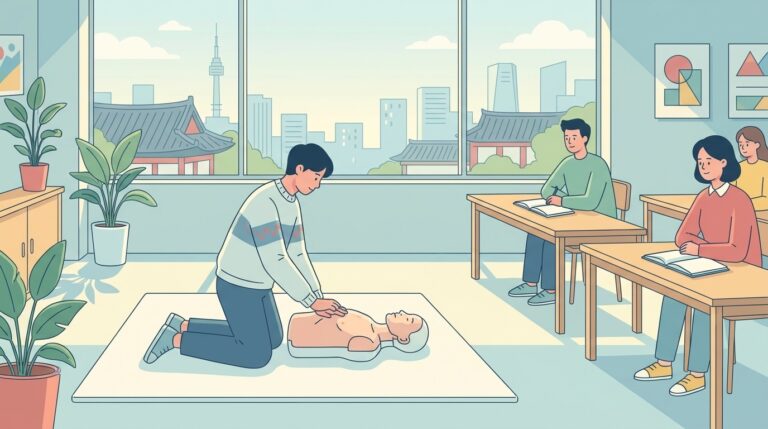
- You: 🎭 (Kneeling down, intermeshing hands over the center of the chest) “제가 구급대 올 때까지 심폐소생술 하고 있을게요!” (Jega gugeupdae ol ttaekkaji simpyesosaengsul hago isseulgeyo! / “I will perform CPR until the paramedics arrive!”)
- Manager Kim: 🎭 (Sprinting toward the emergency box) “네, 1분 안에 제세동기 들고 오겠습니다! 버텨주세요!” (Ne, il-bun ane jesedonggi deulgo ogetseumnida! Beotyeojuseyo! / “Yes, I will be back with the AED within one minute! Please hold on!”)
🔀 Interactive Choice Point
The patient suddenly begins gasping irregularly (agonal breathing) while you prepare compressions. How do you instruct the crowd gathering nearby?
- Option A: “다들 멀리 비켜 서 계세요! 구경하지 마세요!” (Everyone step far back! Stop watching!)
- Option B: “파란 셔츠 입으신 분, 환자 머리 살짝 젖혀서 기도 확보 좀 도와주세요!” (You in the blue shirt, please gently tilt the patient’s head back to help open the airway!)
- Option C: “누가 그냥 편의점 가서 따뜻한 물 한 잔만 사다 주실래요?” (Can someone just go to the convenience store and buy a cup of warm water?)
Feedback:
- Option A (Risk): While clearing space is good, yelling “stop watching” without giving specific functional instructions can create defensive tension among spectators.
- Option B (Best): Excellent! You addressed a specific person calmly and gave a precise, actionable first aid instruction that protects the airway.
- Option C (Bad): Never administer oral fluids to an unconscious or seizing individual, as it risks fatal aspiration into the lungs.
Phase 6: 10-Second Emotion Shadowing Drill
Practice these high-urgency rhythm patterns out loud. Pay close attention to the pause markers (/) and emotional tone!
[🚨 긴박하고 단호하게 - Urgent & Resolute]
“숨 안 쉬어요! / 빨리 119에 전화해 주세요!”
(Sum an swieoyo! / Ppal-li il-il-gu-e jeonhwahae juseyo!)
“He’s not breathing! / Please call 119 immediately!”-
[🩺 차분하고 전문적이게 - Calm & Competent]
“깨끗한 수건으로 / 상처 부위를 / 세게 눌러주세요.”
(Kkaekkeutan sugeoneuro / sangcheo buwireul / sege nulleojuseyo.)
“With a clean towel / press firmly / on the wound area.” -
[🤝 안심시키며 다정하게 - Reassuring & Gentle]
“괜찮아요, / 구급차 지금 오고 있어요. / 심호흡하세요.”
(Gwaenchanayo, / gugeupcha jigeum ogo isseoyo. / Simhoheubhaseyo.)
“It’s okay, / the ambulance is on its way right now. / Take deep breaths.”
Phase 7: K-Culture Mini Dictionary
- 자동심장충격기 (Jadong simjang chunggyeokgi) | Automated External Defibrillator (AED)
- Everyday context: Seen in red or green glass wall-mounted boxes in all Seoul Metro stations, KTX terminals, and public gymnasiums. Often printed alongside voice-prompt instructions in Korean and English.
- 골든타임 (Goldeuntaim) | Golden Time (Window of Opportunity)
- Everyday context: Widely used beyond healthcare into business and daily life to denote the irreversible critical period required to solve a major crisis.
- 지혈 (Jihyeol) | Hemostasis / Bleeding Control
- Everyday context: Essential word at construction sites, kitchens, or pharmacies (약국) when requesting specialized compression bandages or blood-clotting powders.
- 119 (Il-il-gu) | Korea’s Emergency Dispatch Number
- Everyday context: Combines ambulance, fire department, and rescue services into one universal line. Free translation services in multiple languages (English, Chinese, Japanese) are connected on-demand when an overseas caller connects.
Phase 8: Traveler’s Survival Kit
Survival Expressions TOP 3
- “구급차 불러주세요!” (Gugeupcha bulleojuseyo! / “Please call an ambulance!”)
- Pro Tip: When your phone battery is dead, shout this directly toward store clerks or station agents.
- “여기 사람이 쓰러졌어요!” (Yeogi sarami sseureojyeosseoyo! / “Someone collapsed here!”)
- Pro Tip: Use this clear, unambiguous sentence to immediately draw the attention of nearby citizens.
- “알레르기 약 있어요?” (Allereugi yak isseoyo? / “Do you have allergy medication?”)
- Pro Tip: Vital if an acute anaphylactic reaction occurs at a restaurant or food stall.
Editor’s Travel Note
- Essential Lifesaving App: Download the official Emergency Medical Information App (응급의료정보제공) prior to your trip. It shows real-time locations of operating nighttime emergency rooms (응급실), nearby AED stations, and holiday pharmacies based on your live GPS coordinates.
- Smart Navigation Filter: In the Naver Map Application, typing “야간약국” (night pharmacy) or “응급실” (ER) instantly flags 24-hour medical resources across Seoul and Busan.
- Subway Help Booths: Every platform has red SOS telephone boxes mounted on station pillars. Pressing the button connects you directly to station control without dialing.
Phase 9: “A Step Deeper”
In South Korea, public safety is deeply intertwined with “우리의식” (Uri-uishik / We-consciousness)—the shared belief that members of a society share collective responsibility for one another’s well-being. When an accident occurs on a busy Korean street, you will rarely see people simply shrug and walk away. Citizens actively hold umbrellas over injured pedestrians, distribute bottled water, and coordinate traffic until police and paramedics arrive. Learning first aid phrases in Korean is not just about memorizing technical vocabulary; it is your gateway into participating in this profound web of communal care.
💬 Your Turn: Have you ever encountered a medical scare or emergency while traveling abroad? How do you think you would handle communicating with locals in Korea? Share your thoughts in the comments below!
Phase 10: FAQ & Avoiding Misunderstandings
Q: Can I speak English when dialing 119 in Korea?
A: Yes! When you dial 119, state clearly: “English, please” or “영어 통역 부탁합니다” (Yeongeo tong-yeok butakhamnida). Korea’s National Fire Agency collaborates with 24-hour interpretation services (BBB Korea) that connect an English translator directly into a three-way call within seconds.
Q: Do I have to pay out-of-pocket for an ambulance ride in South Korea?
A: No. Public emergency transport provided by the 119 Fire and Disaster Headquarters is completely free of charge for both Korean citizens and foreign visitors. Private transport vans between hospitals do charge fees, but 911-style emergency dispatches do not.
Q: Where are public AEDs usually located if there is no subway nearby?
A: Check the ground-floor security lobby of any large apartment complex (아파트 관리사무소), local community service centers (주민센터), and public police boxes (지구대 / 파출소).
🚨 Common Mistakes Alert!
- Mistake: Dialing 112 instead of 119 for medical emergencies.
- Correct Action: Remember: 112 is strictly for Police (경찰); 119 is for Fire, Paramedics, and First Aid (구급/소방).
- Mistake: Offering food or water to someone who just regained consciousness.
- Correct Action: Keep them seated or lying in recovery position. Never offer liquids, as impaired swallowing reflexes can cause choking.
- Mistake: Using honorific verb endings when directing CPR chest compressions rhythm.
- Correct Action: Count out loud simply and rhythmically: “하나, 둘, 셋, 넷!” (Hana, dul, set, net! – 1, 2, 3, 4!) without formal affixes.
Phase 11: Action Mission & Engagement
- 🥉 Bronze Mission (Solo Mastery): Practice saying “제세동기 어디 있어요?” 5 times while standing in front of your mirror until it rolls off your tongue in under 3 seconds.
- 🥈 Silver Mission (Social Connection): Screenshot Phase 7’s Mini Dictionary, share it on your Instagram Stories, and tag your study buddy with the hashtag
#DailyHangulEmergencyKit. - 🥇 Gold Mission (Real-World Scouting): On your next walk around your neighborhood (or virtually on street view in Seoul), spot and photograph one public AED cabinet and identify its Korean label!
- 🎮 K-Culture Media Mission: Watch an episode of a Korean medical drama (like Hospital Playlist Season 1, Episode 1) and listen carefully for when a character screams “119 불러!” or “심폐소생술”.
Phase 12: Interactive Quiz Challenge
1. Situational Judgment
You are at Seoul Station and someone next to you experiences severe heat exhaustion and faints. A crowd gathers, but no one is calling emergency services. What is the most effective Korean sentence to say?
* (A) “누가 병원에 전화해 주시기 바랍니다.”
* (B) “거기 회색 코트 입으신 분, 지금 119에 전화해 주세요!”
* (C) “한국말 하실 줄 아는 분 손들어 보세요.”
2. Fill-in-the-Blank
Complete the first-aid instruction:
* “피가 너무 많이 나요. 수건으로 상처를 꽉 눌러서 ________ 해 주세요!”
* (Clue: The two-syllable Sino-Korean word for stopping bleeding)
3. True or False Cultural Quiz
- Statement: Under the Korean Good Samaritan Law, a bystander who performs non-negligent, good-faith CPR on an unconscious stranger is legally shielded from civil and criminal liability if minor injuries occur.
👉 Click here to check the answers & explanations!
- Answer: (B)
- Explanation: Directing a specific person by identifying their visible clothing (“회색 코트 입으신 분”) cuts through bystander apathy immediately.
- Answer: 지혈 (Jihyeol)
- Explanation: Direct pressure to stop blood loss is called 지혈 (hemostasis).
- Answer: TRUE
- Explanation: Under Korea’s Emergency Medical Service Act (응급의료에 관한 법률), civil and criminal exemption is granted to protect willing first-responders acting in good faith.
- Explanation: Under Korea’s Emergency Medical Service Act (응급의료에 관한 법률), civil and criminal exemption is granted to protect willing first-responders acting in good faith.







