

Phase 1: Empathy (Story-Driven Opening)
안녕하세요! 매일한글 에디터입니다.
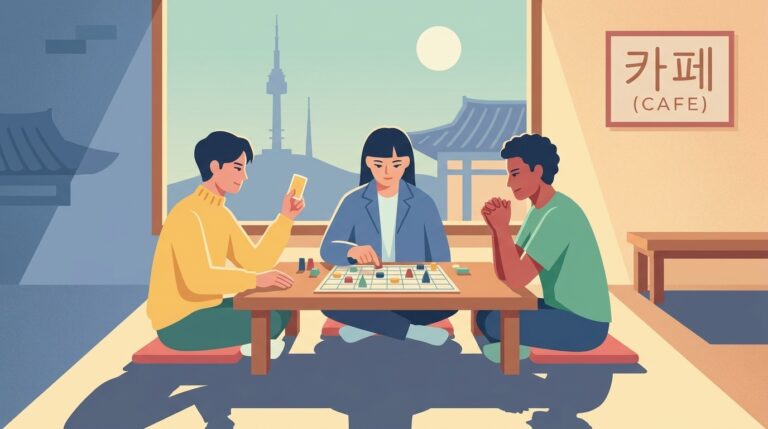
Picture this: You are sitting around a dimly lit wooden table at a buzzing board game cafe in Hongdae with your Korean friends. The moderator clears their throat and declares, “밤이 되었습니다. 마피아는 고개를 들어 서로를 확인해 주세요.” (Night has fallen. Mafia members, please raise your heads and identify each other.) Your heart races. You draw the Mafia card. When morning arrives, someone suddenly points directly at your face and shouts, “저 사람 눈빛 흔들린다! 마피아 맞네!” (Look at their eyes shaking! They’re definitely the Mafia!)
Suddenly, your mind goes completely blank. You know you’re innocent—or maybe you are frantically trying to bluff your way out—but standard textbook Korean fails you. Saying “저는 마피아가 아닙니다” sounds robotic, stiff, and ironically guilty. In high-stakes Korean psychological games, victory doesn’t hinge on grammar accuracy; it hinges on mastering nuance, vocal pitch, and the art of social deflection. Having coached hundreds of advanced learners navigating real-world K-variety show games and university retreat (MT) culture, I created this masterclass to turn your nervous stutter into sharp, persuasive C1-level banter. Let’s make sure you never get unjustly voted out again!
Phase 2: Top 3 Core Strategic Expressions
1. 몰아가다 (Moragada)
- Pronunciation: [Mo-ra-ga-da] (Think of mora as in ‘moral’ + ga-da as in ‘got-the’)
- Meaning: Literal: To herd cattle in a direction | Actual: To gang up on someone, frame someone, or steer public suspicion against a target.
- K-Culture Moment: Seen perpetually in SEVENTEEN’s variety show Going Seventeen: Don’t Lie, whenever members instinctively herd collective suspicion onto Mingyu or Hoshi without concrete evidence.
- Editor’s Insight: This verb encapsulates collective momentum. In Korean group dynamics, consensus builds rapidly. When you say, “왜 나로 몰아가?” (Why are you framing/ganging up on me?), you expose their tactic as an unfair emotional bandwagon rather than logical proof.
- Situation Spectrum: Casual ✅ | Semi-formal ⚠️ | Formal 🚫
- 🤔 Think About It: Does your native culture have a single verb that means “to socially engineer suspicion against someone in a collective group setting”?
2. 발뺌하다 (Balppaemhada)
- Pronunciation: [Bal-ppaem-ha-da] (Sounds like bal in ‘ball’ + ppaem like ‘femme’ with a crisp popping p + ha-da)
- Meaning: Literal: To pull one’s foot back out | Actual: To feign innocence, dodge accountability, or flatly deny involvement despite lingering suspicions.
- K-Culture Moment: Frequently featured on Running Man during detective specials, when Yoo Jae-suk catches Lee Kwang-soo red-handed stealing clues, yet Kwang-soo continues to feign utter ignorance.
- Editor’s Insight: Often used as “발뺌할 생각 하지 마” (Don’t even dream of denying it). It carries a punchy, confrontational bite that implies you see right through their shallow bluff.
- Situation Spectrum: Casual ✅ | Semi-formal ⚠️ | Formal 🚫
- 🤔 Think About It: How does shifting physical metaphors (pulling a foot back) into psychological evasion reveal Korea’s tactile linguistic heritage?
3. 판을 흔들다 (Paneul heundeulda)
- Pronunciation: [Pa-neul heun-deul-da] (Pan like ‘pan’ + eul + heun like ‘honey’ without ‘y’ + deul-da)
- Meaning: Literal: To shake the game board | Actual: To disrupt the status quo, intentionally stir up chaos, or dismantle an established narrative.
- K-Culture Moment: Master tacticians in brain-survival shows like The Genius or Bloody Game execute this when an alliance gets too comfortable, dropping unexpected accusations to fracture the majority.
- Editor’s Insight: This is sophisticated C1 strategic vocabulary. You don’t merely survive; you assert dominance over the game’s flow. You can accuse a player: “지금 판 흔들려고 억지 부리는 거죠?” (You’re just making far-fetched claims to shake up the board, aren’t you?).
- Situation Spectrum: Casual ✅ | Semi-formal ✅ | Formal ⚠️
- 🤔 Think About It: Why does Korean prioritize spatial metaphors like ‘판’ (the board/arena of life) when discussing psychological strategies?
Phase 3: Textbook Korean vs. Real Korean
Situation 1: Defending Yourself from an Unfair Accusation
- 📖 교과서 한국어 (Textbook): “저는 결백합니다. 다른 사람을 의심하십시오.” (Jeoneun gyeolbaekhamnida. Dareun sarameul uisimhasipsio. / I am innocent. Please suspect someone else.)
- 🗣️ 진짜 한국어 (Real-World): “지금 저한테 프레임 씌우시는 거예요? 근거가 너무 빈약하잖아요!” (Jigeum jeohante peureim ssiiusineun geoyeyo? Geungeoga neomu binyakhajanhayo! / Are you really trying to frame me right now? Your evidence is ridiculously flimsy!)
- 💡 왜 다를까? Textbook Korean sounds like a courtroom transcript from 1950. Real native speakers use modern loanwords like 프레임 (frame) combined with rhetorical indignation to turn the psychological pressure back onto the accuser.
Situation 2: Exposing Someone’s Nervous Poker Face
- 📖 교과서 한국어 (Textbook): “당신의 표정이 긴장되어 보여서 수상합니다.” (Dangsinui pyojeongi ginjangdoeeo boyeoseo susanghamnida. / Your facial expression looks nervous, so you are suspicious.)
- 🗣️ 진짜 한국어 (Real-World): “말끝 흐리는 거 보니까 찔리는 구석이 있나 보네?” (Malkkeut heurineun geo bonikka jjillineun guseogi inna bone? / Seeing your voice trail off like that, you must have a guilty conscience, huh?)
- 💡 왜 다를까? Koreans hone in on microscopic behavioral shifts using expressive idioms like ‘찔리다’ (to feel a prick of guilt) and ‘말끝을 흐리다’ (to trail off one’s words), rendering textbook observations lifeless.
Phase 4: K-Culture Deep Dive & Non-Verbal Etiquette
4-1. 눈치 (Nunchi) & Micro-Gestures in Mind Games
In a Korean psychological showdown, silence speaks louder than screams. To project innocence, maintain relaxed, unblinking eye contact while resting your palms open on the table. In contrast, pointing your index finger directly at someone’s face is considered overly aggressive—even in games—so native players point with an open hand or tilt their chin toward the suspect.
Watch out for 동공 지진 (pupil earthquakes: rapid eye movements). If someone asks you a question and you look upward-left while clearing your throat, any Korean player with average nunchi will immediately lock in on you. Counteract this by leaning forward slightly, smiling faintly, and responding with amused skepticism rather than defensive panic.
4-2. The MT Mafia Tradition & Media Craze
Whether it’s an annual university MT (Membership Training) at Daeseong-ri or an evening hangout at a themed board game cafe, the Mafia game is Korea’s ultimate social icebreaker. Korean society is historically collectivist and polite; social hierarchy (Kkondae etiquette and age dynamics) governs daily interactions. The Mafia game offers a unique, culturally sanctioned “free pass” where juniors (whoobae) can legally interrogate and overthrow their seniors (sunbae). This explains why Korean reality shows obsess over psychological deduction formats—it is emotional catharsis wrapped in a board game.
Phase 5: Real-World Roleplay Scenario
Setting: 11:30 PM at ‘Dice & Story’ board game cafe in Hongdae. Neon light reflections, clattering plastic chips, and iced Americano glasses sweating on coasters. You are sitting between Min-su (an aggressive instigator) and Ji-won (a cool-headed, analytical player).
- Min-su: “야, 솔직히 이번 판 범인 너무 뻔하지 않냐? 아까부터 아무 말도 안 하고 가만히 있는 거 봐.”
(Ya, soljikhi ibeon pan beomin neomu ppeonhaji anya? Kkabuteo amu maldo an hago gamanhi inneun geo bwa. / Hey, honestly isn’t the culprit totally obvious this round? Look at them sitting quietly without saying a word.)
🎭 Leans both elbows onto the table, aggressively pointing an open palm toward you while smirking. -
You: “조용히 판세를 읽고 있었을 뿐인데요? 말 많은 사람이 먼저 꼬리 잡히는 법이잖아요.”
(Joyonghi pansereul ilgo isseosseul ppuninde-yo? Mal maneun sarami meonjeo kkori japhineun beobijanhayo. / I was merely reading the board dynamics. You know the loudest person is always the first to get their tail caught.)
🎭 Calmly taking a sip of your iced tea, holding steady eye contact without flinching. -
Ji-won: “듣고 보니까 일리 있네. 민수 너 지금 여론 몰이해서 물타기하려는 거 아니야?”
(Deutgo bonikka illi inne. Minsu neo jigeum yeoron morihaeseo multagiharyeoneun geo aniya? / That actually makes sense. Min-su, aren’t you just stirring up public opinion right now to distract us?)
🎭 Taps her chin thoughtfully with the tip of her pen, narrowing her eyes at Min-su. -
Min-su: “내가 왜 물타기를 해? 난 시민팀 승리밖에 관심 없어! 얘 표정 변하는 거 다들 못 봤어?”
(Naega wae multagireul hae? Nan simintim seungribakke gwansim eopseo! Yae pyojeong byeonhaneun geo dadeul mot bwasseo? / Why would I deflect? I only care about the citizen team’s victory! Did nobody else catch their facial expression shift?)
🎭 Voice goes up half an octave, waving both hands emphatically in mock disbelief. -
You: “제 표정이 아니라 민수 씨 논리가 흔들리고 있는데요. 억지 부리지 마세요.”
(Je pyojeongi anira Minsu ssi nonriga heundeulligo inneundeyo. Eokji buriji maseyo. / It’s not my expression, but your logic that’s shaking, Min-su. Stop forcing such an illogical narrative.)
🎭 Chuckles softly, projecting relaxed confidence. -
Ji-won: “맞아. 민수가 저렇게 혼자 흥분할 때는 백 프로 마피아였어. 투표 가자.”
(Maja. Minsuga jeoreohke honja heungbunhal ttaeneun baek peuro mapiayeosseo. Tupyo gaja. / Agreed. Whenever Min-su gets overly excited like this, he’s a hundred percent the Mafia. Let’s go to a vote.)
🎭 Pushes her voting token straight into the center of the table. -
Min-su: “아, 진짜 억울하네! 나 죽으면 니들 진짜 후회한다? 마피아 지금 웃고 있어!”
(A, jinjja eogulhane! Na jukmyeon nideul jinjja huhoehanda? Mapia jigeum utgo isseo! / Ah, this is so unfair! If I die, you guys will seriously regret it! The Mafia is laughing right now!)
🎭 Ruffles his hair in dramatic frustration. -
You: “다음 밤에 마피아가 누구를 잡는지 보면 진실이 밝혀지겠죠. 투표하시죠.”
(Daeum bame mapiaga nugureul jamneunji bomyeon jinsiri balkhyeojigetjyo. Tupyohasijyo. / We’ll uncover the truth when we see who the Mafia eliminates tonight. Let’s vote.)
🎭 Places voting chip resolutely, sealing the round.
🔀 Interactive Choice Point: Min-su corners you again! What’s your play?
If Min-su suddenly shouts: “너 아까 밤 단계에서 살짝 부스럭거리는 소리 냈잖아!” (You made that rustling sound during the night phase!)
- Choice A: “전 아무 소리도 안 냈는데요… 진짜 억울해요…” (I didn’t make any sound… I’m really innocent…)
Feedback: ❌ Bad. Passive whining screams guilt. In Korean deduction games, acting fragile when accused makes the entire table vote against you immediately. - Choice B: “그 소리 제 쪽 아니라 민수 씨 오른쪽에서 났는데, 왜 방향을 속이세요?” (That sound came from your right side, not mine—why are you lying about the direction?)
Feedback: 🏆 Best! You flip the observation into counter-surveillance. It proves you were alert, objective, and catches him attempting sensory deception. - Choice C: “너 마피아지? 그냥 너 찍을래!” (You’re the Mafia, right? I’m just voting for you!)
Feedback: ⚠️ Risk. High emotional volatility. If the table values logic (like Ji-won), this petulant outburst makes you look cornered and reckless.
Phase 6: 10-Second Emotional Shadowing Drill
Master the cadence, pauses (/), and tonal shifts of psychological warfare:
- [🤨 억울하고 단호하게 – Indignantly Defending]
“아니, / 지금 저로 몰아가는 거 / 너무 억지 아니에요? / 근거를 대보세요!”
(Ani, / jigeum jeoro moraganeun geo / neomu eokji anieyo? / Geungeoreul daeboseyo!) -
[😏 능청스럽게 상대 떠보며 – Sarcastic Counter-Investigation]
“말끝 흐리는 거 보니까… / 슬슬 찔리는 구석이 / 드러나나 보네?”
(Malkkeut heurineun geo bonikka… / seulseul jjillineun guseogi / deureonana bone?) -
[🤫 냉정하게 상황 정리 – Cold Rational Takedown]
“지금 판 흔들어봤자 / 본인 무덤 파는 거예요. / 차분하게 가시죠.”
(Jigeum pan heundeureobwatja / bonin mudeom paneun geoyeyo. / Chabunhage gasijyo.)
Phase 7: K-Culture Mini Dictionary
-
심리전 (Simrijeon) | Psychological warfare / Mind games
Refers to covert mental friction, bluffing, and emotional manipulation. Outside games, it’s used in corporate negotiations: “이번 연봉 협상은 완전 치열한 심리전이었어.” (This salary negotiation was intense psychological warfare.) -
촉 (Chok) | Intuitive gut feeling / sixth sense
Derives from sensory touch. Native Koreans rely heavily on this: “내 촉으로는 쟤 마피아 백 퍼센트야.” (According to my gut instinct, that guy is 100% the Mafia.) -
자폭 (Japok) | Self-destruction / Committing a strategic suicide
Making a verbal slip or an accusation so outrageously flawed that it exposes your own deceit: “방금 그 발언은 완전 자폭인데?” (That remark just now was complete self-destruction.) -
쉴드 치다 (Swildeu chida) | To defend / shield someone aggressively
Combining English “shield” with the Korean verb “치다”. Used when someone suspiciously over-protects another player: “왜 쟤를 그렇게 온몸으로 쉴드 쳐 줘?” (Why are you shielding him so desperately with your whole body?)
Phase 8: Survival Kit for Travelers
Top 3 Board Game Cafe Survival Expressions
-
“인원수에 맞춰서 블러핑 게임 추천해 주실 수 있나요?”
(Inwonsue matchwoseo beulleoping geim chucheonhae jusil su innayo?)
Pro Tip: Korean cafes have extensive libraries. Asking for ‘bluffing games’ tailored to headcounts ensures you get gems like Avalon or Coup immediately. -
“설명서 영상 태블릿에 재생이 안 되는데 확인해 주세요.”
(Seolmyeongseo yeongsang taebleur-e jaesaengi an doeneunde hwaginhae juseyo.)
Pro Tip: Most modern Korean cafes (e.g., Red Button) use customized iPad apps at each booth to provide animated game rule videos! -
“저희 한 시간만 더 연장하고 음료 추가할게요!”
(Jeohui han siganman deo yeonjanghago eumryo chugahalgeyo!)
Pro Tip: Time flies. Use this to effortlessly extend your booth stay while ordering another round of snacks.
Editor’s Travel Note
When hunting for board game hubs in Seoul, avoid wandering blindly in the cold. Open your phone and use the 네이버 지도 앱 다운로드 to search for 보드게임카페 in Hongdae (홍대), Gangnam (강남), or Hyehwa (혜화). The gold standard chain is Red Button (레드버튼), featuring private loft cubbies, ambient lighting, and digital ordering kiosks.
Phase 9: A Step Deeper (Reflective Insight)
Playing games like Mafia in Korea reveals the intricate balance between Jeong (deep relational affection) and high-context consensus building. In a culture where interpersonal friction is politely suppressed in daylight hours, the Mafia table acts as an exhilarating pressure valve. It strips away societal hierarchies, allowing friends to test each other’s poker faces, decode hidden subtexts, and engage in guilt-free intellectual sparring.
💬 Your Turn: Have you ever played the Mafia game with Korean speakers or watched Korean celebrity deduction shows? What is your personal go-to phrase when you need to convince someone you are telling the truth? Drop your thoughts in the comments below!
Phase 10: FAQ & Avoiding Misunderstandings
Q: Can I use the phrase “몰아가다” in professional office situations?
A: Use it carefully! In a peer brainstorming or casual meeting, saying “너무 한쪽 의견으로 몰아가지 맙시다” (Let’s not railroad everything into one direction) is acceptable. However, telling your team leader “왜 저로 몰아가세요?” will sound combative and insubordinate.
Q: What is the exact difference between “물타기” and “발뺌”?
A: 발뺌 is denial of your own action (“I didn’t do it!”). 물타기 is muddying the waters by changing the topic, introducing irrelevant facts, or deflecting blame onto another issue to weaken the original accusation.
Q: How do native Koreans express that someone is terrible at lying in games?
A: They use the colorful colloquialism: “너 거짓말할 때 티 너무 많이 나!” (You show way too many obvious tells when you lie!) or “얼굴에 다 쓰여 있어!” (It’s written all over your face!).
🚨 Common Mistakes Warning Board
- Mistake: Using stiff textbook honorifics when defending yourself against friends (“저는 시민입니다!”).
Correct Action: Speak colloquially with emotional conviction: “진짜 억울해! 나 시민이라니까?” - Mistake: Flat out pointing an index finger at people’s foreheads while accusing them.
Correct Action: Use open-palm gestures (손바닥 펴기) to maintain game etiquette without offending peers. - Mistake: Staying completely silent because you don’t know the vocabulary.
Correct Action: Silence in Korean deduction games equals death. Even uttering “아니, 진짜 아닌데…” keeps you in play.
Phase 11: Action Mission & Engagement
- 🥉 Bronze Mission (Solo): Stand in front of your mirror. Practice the Shadowing Drill line: “아니, 지금 저로 몰아가는 거 너무 억지 아니에요?” with the correct indignant pitch 5 times.
- 🥈 Silver Mission (Social): Leave a comment below utilizing either 몰아가다, 발뺌하다, or 판을 흔들다 in an original sentence.
- 🥇 Gold Mission (Real Life): Visit a board game cafe or jump into an online Korean voice chat (e.g., Among Us / Goose Goose Duck on Korean servers) and successfully deflect an accusation using today’s C1 strategies.
- 🎮 K-Culture Mission: Watch Episode 1 of Going Seventeen: Don’t Lie or Running Man Episode 500. Spot how many times the members use 몰아가기 or accuse each other of 발뺌!
Phase 12: Interactive Quiz Challenge
1. Situational Judgment: Min-su is falsely framing you during round 2. Which response demonstrates the most natural C1-level counter-strategy?
* (A) “저는 마피아가 아니므로 경찰이 저를 조사해야 합니다.”
* (B) “지금 증거도 없이 여론 몰아가시는 것 같은데, 본인이 마피아라서 그러시죠?”
* (C) “화내지 마십시오. 저는 착한 시민입니다.”
👉 Click to reveal Answer & Explanation
Correct Answer: (B)
Explanation: Option (B) brilliantly integrates advanced vocabulary (여론 몰아가다 – steering public consensus) with rhetorical psychological deflection. Options (A) and (C) sound unnatural and overly formal for an intense social game.
2. Fill-in-the-Blank: Complete the strategic phrase:
“아무리 그렇게 발뺌을 해봤자, 이미 네 논리는 완전 [______] 수준이야!” (No matter how much you feign innocence, your logic is practically on the level of self-destruction!)
* (A) 자폭 (Japok)
* (B) 촉 (Chok)
* (C) 쉴드 (Swildeu)
👉 Click to reveal Answer & Explanation
Correct Answer: (A) 자폭 (Japok)
Explanation: Self-sabotage or making a disastrous verbal contradiction is called 자폭 (self-destruction).
3. True or False Cultural Quiz: In Korean board game cafes and variety shows, being completely silent and composed without arguing back is universally respected as the hallmark of an innocent player.
* [True / False]
👉 Click to reveal Answer & Explanation
Correct Answer: False
Explanation: In Korean psychological deduction culture, passivity and total silence (병풍 모드 / folding-screen mode) are viewed as suspicious evasion. Innocent citizens are expected to proactively voice opinions and defend their integrity!







