

Phase 1: 공감 (Story-Driven Opening)
안녕하세요! 매일한글 에디터입니다.
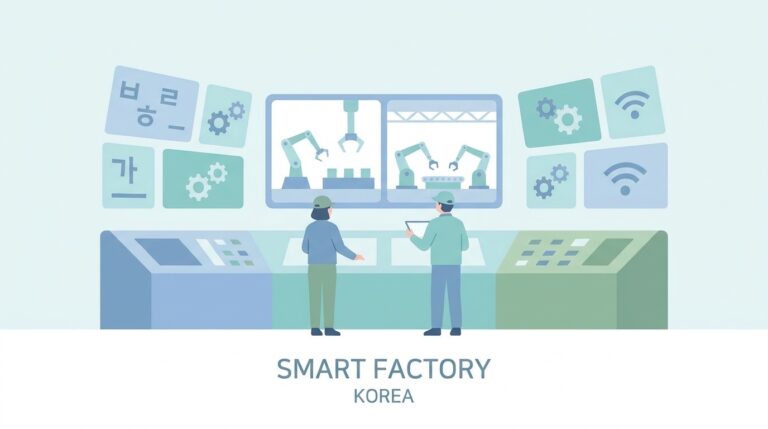
Imagine stepping onto the immaculate floor of an advanced manufacturing facility in Hwaseong or an electric vehicle battery plant in Ochang. Automated Guided Vehicles (AGVs) hum quietly along magnetic paths, real-time sensor dashboards illuminate glass control booths with live telemetry, and robotic arms assemble micro-components with millimeter accuracy. Suddenly, the plant manager turns to you, pointing at a spiking latency alert on the central SCADA terminal, and asks: “선임님, 라인 3번 병목 현상 원인 규명하셨습니까?”
If your mind instantly scrambles to recall elementary vocabulary like “기계가 멈췄어요” (The machine stopped), you know that sinking feeling. In high-stakes industrial ecosystems where the Internet of Things (IoT) and cyber-physical systems dictate production schedules, standard textbook Korean simply will not cut it. At the C1 level, fluency isn’t merely about getting your point across; it is about projecting technical authority, aligning cross-functional teams, and grasping the implicit hierarchy and high-context communication unique to Korean corporate engineering.
This guide was forged from direct debriefs with foreign systems engineers and production managers who survived the trenches of Korean industrial automation. By mastering the exact phrasings, nuances, and strategic silence required on an automated production line, you will transform from an outsider relying on translation apps into a trusted technical peer who can orchestrate complex IoT deployments seamlessly.
Phase 2: 핵심 표현 3선 심층 분석 (Top 3 Core Expressions)
1. 공정 이상 징후를 선제적으로 감지하다 (Gongjeong isang jinghureul seonjejeogeuro gamjihada)
- Pronunciation: [Gong-jeong ee-sang jing-hoo-reul seon-jeh-jeok-eu-ro gahm-jee-hah-da] (Sounds like “Gong-jung” as in a gong mallet, “Ee-sang” matching the English letter ‘E’ + ‘song’)
- Meaning: Literally “To preemptively sense symptoms of process abnormalities.” Nuance: Identifying micro-deviations before they turn into costly yield losses.
- K-Culture Moment: Picture an intense boardroom sequence from a high-tech corporate drama like Misaeng (Incomplete Life) or Agency, where an engineer presents predictive maintenance data that rescues an entire export shipment.
- Editor’s Insight: The key term here is 선제적 (preemptive). Korean manufacturers pride themselves on zero-defect manufacturing (무결점 생산). Using 선제적으로 signals that you don’t merely put out fires; you prevent them.
- Situation Spectrum:
- Casual: 🚫 (Unnatural with friends)
- Semi-formal: ⚠️ (Only in technical technical exchanges)
- Formal: ✅ (Standard for technical reports, scrums, and client updates)
- 🤔 Think About It: Western engineering often celebrates reactive agility (“move fast and fix bugs”), whereas Korean manufacturing culture places immense honor on flawless foresight (예방). How does your native language reflect the balance between rapid iteration and absolute prevention?
2. 병목 현상을 해소하기 위해 실시간 데이터 피드백을 반영하다 (Byeongmok hyeonsangeul haesohagi wihae silsigan deiteo pideubaekeul banyeonghada)
- Pronunciation: [Byung-mok hyun-sahng-eul hae-so-hah-gee wee-hae seel-she-gahn day-ee-tuh pee-deu-baek-eul bahn-young-hah-da] (Think of “Byeong” rhyming with “young”, “mok” like choking sound on a mock)
- Meaning: Literally “To reflect real-time data feedback to resolve bottleneck phenomena.” Nuance: Dynamically load-balancing automated cells using live IoT edge data.
- K-Culture Moment: In automotive or battery tech documentaries covering Hyundai or Samsung SDI, chief architects frequently use 병목 현상 해소 when explaining automated cycle time optimizations.
- Editor’s Insight: 해소하다 (resolve/dispel) is a sophisticated alternative to 해결하다 (solve). It implies not just eliminating an obstacle, but dissolving operational stress across the whole assembly system.
- Situation Spectrum:
- Casual: 🚫
- Semi-formal: ⚠️
- Formal: ✅
- 🤔 Think About It: 병목 (bottleneck; literally “bottle’s neck”) shares the same visual metaphor in English and Korean, but pairing it with 해소 (alleviating tension) highlights a systemic, holistic worldview.
3. 설비 가동률을 극대화하려면 원격 모니터링이 필수적입니다 (Seolbi gadongryureul geukdaehwaharyeomeon won-gyeok monitoring-i pilsujeogimnida)
- Pronunciation: [Sul-bee gah-dong-ryool-eul geuk-dae-hwah-hah-ryuh-myun won-gyuk moh-nee-tuh-ring-ee peel-soo-juhk-eem-nee-dah] (“Seol” sounds like “Seoul”; “Geuk-dae” sounds like “cook” + “day”)
- Meaning: Literally “If we intend to maximize equipment utilization rates, remote monitoring is essential.” Nuance: Making an indisputable business case for IoT sensor telemetry infrastructure.
- K-Culture Moment: Seen in executive pitch meetings in industrial tech thrillers where an architect convinces the board that smart factory conversion isn’t an option, but an existential imperative.
- Editor’s Insight: 가동률 (OEE / Operation rate) is the holy metric in Korean manufacturing. Adding 극대화하다 (maximize) demonstrates that your technical proposals directly serve operational profitability.
- Situation Spectrum:
- Casual: 🚫
- Semi-formal: ⚠️
- Formal: ✅
- 🤔 Think About It: Stating a condition with ~하려면 … 필수적입니다 allows you to present a firm technical assertion while remaining deferential to collective decision-making.
Phase 3: 교과서 한국어 vs 진짜 한국어 (Textbook vs. Real Korean)
Situation A: Addressing an emergency stoppage on an automated packing line
- 📖 교과서 한국어: “기계에 문제가 생겨서 작동이 멈췄습니다. 센서를 확인해야 합니다.” (There is a problem with the machine so it stopped running. We must check the sensor.)
- 🗣️ 진짜 한국어: “센서 통신 지연으로 인터록(Interlock)이 걸렸는데, 로그 분석 후 즉각 조치하겠습니다.” (Sensors had a comms delay which triggered an interlock; I’ll analyze the log and rectify it immediately.)
- 💡 왜 다를까? Textbook Korean sounds like an outside observer describing an accident. In an actual automated factory, Korean engineers use domain-specific loanwords (인터록, 로그) and reassure managers by pairing the root cause with proactive ownership (즉각 조치하겠습니다).
Situation B: Reporting automated process synchronization
- 📖 교과서 한국어: “모든 기계들이 인터넷으로 연결되어 정보를 잘 주고받고 있습니다.” (All machines are connected to the Internet and exchange information well.)
- 🗣️ 진짜 한국어: “PLC와 엣지 디바이스 간 프로토콜 동기화가 완벽해서 데이터 유실 없이 트래킹 중입니다.” (Protocol synchronization between the PLC and edge devices is seamless, tracking without data loss.)
- 💡 왜 다를까? C1 professionals don’t say “give and receive information.” They pinpoint the hardware layer (PLC, 엣지 디바이스) and metrics (동기화, 데이터 유실), proving technical precision.
Phase 4: K-Culture 딥다이브 & 비언어적 매너 (Non-Verbal Etiquette)
4-1. 눈치 (Nunchi) & Plant Gestures
In an automated plant or monitoring control room (통제실), body language speaks louder than intercoms. When an operations lead (공장장님 or 팀장님) reviews real-time dashboards:
1. Two-Handed Device Holding: If you are holding an industrial tablet showing SCADA panels, always support the bottom with both hands when handing it over or showing it to a superior.
2. The Open-Palm Pointer: Never point at a specific robot actuator or warning screen with an index finger; sweep an open palm with your thumb folded inward toward the zone of concern.
3. De-escalation Posture: When production halts unexpectedly, maintain an alert, forward-leaning stance. Avoid crossing your arms or sighing audibly. In Korean plants, visible urgency (신속함) demonstrates shared responsibility (공동 책임).
4-2. 문화 코드: “빨리빨리” meets “초격차” (Hyper-Precision)
Korea’s legendary Ppalli-ppalli (hurry-hurry) culture has evolved in the Fourth Industrial Revolution into 초격차 (Super-gap)—maintaining an insurmountable technological lead through hyper-automated precision. Smart factories aren’t just cost-cutting tools; they are the pride of Korean export power. When discussing automation, framing IoT integration around yield (수율), downtime minimization (다운타임 최소화), and safety (안전 표준) resonates deeply with Korean corporate values.
Phase 5: 실전 롤플레이 시나리오 (Smart Factory Floor Simulation)
- Background: Smart Battery Cell Plant, Cheongju. Line 4 is experiencing intermittent cycle-time drops.
- Characters:
- Alex (알렉스): Lead IoT Systems Integration Specialist (Learner, C1).
- Manager Park (박 부장): Seasoned Plant Operations Director, results-driven but receptive to clear data.
박 부장: 알렉스 선임, 4번 라인 포장 공정에서 비전 센서 에러가 자꾸 발생하는데, 원인 파악됐어요?
(Alex seonim, 4-beon rain pojang gongjeong-eseo bijeon senseo ereoga jakku balsaenghaneunde, won-in pa-akdwaesseoyo?)
“Senior Engineer Alex, vision sensor errors keep recurring on the Line 4 packaging process. Have we identified the root cause?”
🎭 [이마를 짚으며 태블릿 화면의 에러 로그를 심각하게 들여다본다]
알렉스: 네, 부장님. IoT 게이트웨이 트래픽 로그를 분석해 보니 통신 병목으로 프레임 드롭이 생겼습니다.
(Ne, bujangnim. IoT geiteuwei teuraepik rogeureul bunseokhae boni tongsin byeongmogeuro peureim deurobi saenggyeotseumnida.)
“Yes, Director Park. Analyzing the IoT gateway traffic logs revealed that communication bottlenecks caused frame drops.”
🎭 [두 손으로 태블릿을 살짝 기울여 네트워크 지연 그래프를 가리킨다]
박 부장: 패킷 손실 문제였구만. 이러면 라인 전체 택트 타임(Tact Time)이 밀릴 텐데, 대책은 세웠습니까?
(Paekit sonsil munjeyeokguman. Ireomyeon rain jeonche taektu taim-i millil tende, daechaeg-eun sewosseumnikka?)
“So it was packet loss. This could push back the tact time of the whole line. Do you have a countermeasure?”
🎭 [팔짱을 풀고 알렉스의 눈을 직시하며 촉구하듯 묻는다]
알렉스: 엣지 컴퓨팅 노드에서 전처리를 수행하도록 알고리즘을 최적화하여 서버 부하를 분산시키겠습니다.
(Etji keompyuting nodeu-eseo jeoncheorireul suhaenghadorok algo-ribeum-eul choejeokhwahayeo seobeo buhareul bunsansikigesseumnida.)
“We will optimize the algorithm to run preprocessing directly on edge computing nodes, thereby distributing the server load.”
🎭 [차분하지만 확신에 찬 목소리로 고개를 끄덕인다]
박 부장: 실시간 데이터 전송 지연 시간은 얼마나 단축될 것으로 예상합니까?
(Silsigan deiteo jeonsong jiyeon siganeun eolmana danchukdoel geoseuro yesanghamnikka?)
“How much do you project real-time data transmission latency will be reduced?”
🎭 [안경을 고쳐 쓰며 흥미로운 표정으로 차트를 훑어본다]
알렉스: 지연 시간을 20밀리초 이내로 유지하여 공정 이상 징후를 선제적으로 감지할 수 있습니다.
(Jiyeon siganeul 20-millicho inaero yujihayeo gongjeong isang jinghureul seonjejeogeuro gamjihal su itsseumnida.)
“By keeping latency within 20 milliseconds, we can preemptively detect process anomalies.”
🎭 [오른손 손바닥을 펴서 안정화 시뮬레이션 지표를 정중히 가리킨다]
박 부장: 좋아요. 계획대로 패치를 적용하고, 교대조 투입 전까지 시운전 완료해 주세요.
(Joayo. Gyehoekdaero paechireul jeok-yonghago, gyodaejo tu-ip jeonkkaji siunjeon wanryohae juseyo.)
“Good. Deploy the patch as planned and complete the trial run before the shift changeover.”
🎭 [만족스러운 듯 알렉스의 어깨를 가볍게 툭 치며 미소 짓는다]
알렉스: 알겠습니다. 모니터링 대시보드 상태를 실시간으로 공유해 드리겠습니다.
(Algetseumnida. Monitoring daesibodeu sangtaereul silsigan-euro gong-yuhae deurigetseumnida.)
“Understood. I will share the real-time status of the monitoring dashboard with you.”
🎭 [상체를 15도 숙이며 단호하고 깍듯하게 인사한다]
🔀 인터랙티브 분기점 (Interactive Choice)
At the point where Manager Park asks if the trial run can be done before shift change, how should Alex reply if unexpected firmware errors arise?
- Option A: “시간이 너무 촉박해서 무리입니다. 내일 아침에 다시 하시죠.” (That’s impossible because time is too tight. Let’s do it tomorrow morning.)
- Feedback [Bad]: Defeatist and blunt. Violates workplace etiquette by unilaterally pushing deadlines without presenting an alternative solution.
- Option B: “최대한 빨리 해볼게요, 부장님. 어떻게든 되겠죠.” (I’ll try as fast as possible, Director. It’ll work out somehow.)
- Feedback [Risk]: Overly casual (해볼게요) and fatally vague (어떻게든). High-stakes engineering environments demand quantifiable assurances, not wishful thinking.
- Option C (Best): “현 시점 기준으로 펌웨어 정합성을 재검증해야 하므로, 30분만 더 확보해 주시면 무결점 상태로 검증 완료하겠습니다.” (Given that we must re-verify firmware compatibility, if you grant us just 30 more minutes, we will complete validation with zero defects.)
- Feedback [Best]: Pinpoints the precise technical justification (정합성 재검증), asks for an exact timeframe (30분), and reinforces quality (무결점 상태).
Phase 6: 10초 감정 섀도잉 드릴 (Emotional Shadowing Drill)
Read aloud along the designated pause slashes (/), feeling the industrial urgency:
[⚡ 단호하고 전문성 있게 / Decisive & Technical]
“IoT 게이트웨이 트래픽 로그를 분석해 보니 / 통신 병목으로 인해 / 데이터 손실이 발생했습니다.”
(IoT geiteuwei teuraepik rogeureul bunseokhae boni / tongsin byeongmogeuro inhae / deiteo sonsiri balsaenghaetseumnida.)-
[🤝 신뢰감 넘치고 명확하게 / Reassuring & Confident]
“공정 이상 징후를 / 선제적으로 감지할 수 있도록 / 실시간 알고리즘을 즉시 업데이트하겠습니다.”
(Gongjeong isang jinghureul / seonjejeogeuro gamjihal su itdorok / silsigan algoribeumeul jeuksi eopdeiteuhagetseumnida.) -
[💼 보고하듯 정중하고 간결하게 / Crisp Formal Reporting]
“설비 가동률을 극대화하기 위해 / 센서 동기화 작업을 / 교대조 투입 전까지 완수하겠습니다.”
(Seolbi gadongryureul geukdaehwahagi wihae / senseo donggihwa jageobeul / gyodaejo tu-ip jeonkkaji wansuhagetseumnida.)
Phase 7: K-Culture 미니 사전 (Core Vocabulary)
- 예지 보전 (Yeji bojeon) | Predictive Maintenance
- The industry holy grail. Rather than breakdown maintenance (사후 보전) or preventive calendar maintenance (예방 보전), IoT models analyze vibrations and heat to repair equipment just before failures occur.
- 수율 (Suyul) | Production Yield Rate
- The percentage of non-defective finished goods. When pitching automation or robotics to Korean leadership, highlighting yield improvements (수율 향상) will instantly win stakeholder support.
- 디지털 트윈 (Dijiteol teuwin) | Digital Twin
- Virtual software replicas of physical conveyor lines. Frequently mentioned in high-level government-backed smart factory initiatives in Korea.
- 현장감 (Hyeonjanggam) | Sense of the Production Floor / On-site Presence
- Even with complete cloud automation, Korean business culture deeply reveres the 현장 (physical plant floor). Engineers who only look at screens without walking the floor are criticized for lacking 현장감.
Phase 8: 여행자 & 출장자를 위한 생존 키트 (Business Visitor Kit)
TOP 3 Industrial Survival Phrases
- “시운전 일정 조율 가능할까요?” (Si-unjeon iljeong joyul ganeunghalkkayo?)
- “Could we coordinate the schedule for the equipment trial run?”
- Pro Tip: Use 조율 (tune/harmonize) instead of 변경 (change). It makes the scheduling adjustment feel collaborative rather than disruptive.
- “현장 안전 수칙 브리핑 먼저 부탁드립니다.” (Hyeonjang anjeon suchik beuriping meonjeo butakdeurimnida.)
- “Could you please brief us on the plant safety guidelines first?”
- Pro Tip: Emphasizing safety builds immediate trust before touring automated high-voltage or chemical robotics areas.
- “스펙 시트 및 통신 프로토콜 문서 송부 부탁드립니다.” (Seupek siteu mit tongsin peurotokol munseo songbu butakdeurimnida.)
- “Please send over the spec sheet and communication protocol documentation.”
- Pro Tip: Use 송부 (formal transmission of documents) rather than simply 보내주세요.
Editor’s Travel Note
- Industrial Hub Logistics: When visiting major automation hubs in Ulsan, Changwon, or Gumi, book your high-speed rail via the official 코레일 톡(KorailTalk) 앱 다운로드. Standard cabs in industrial clusters often require calling via the 카카오 T 앱 다운로드 rather than street hailing.
- Smart Factory Security Pass: Korean corporate plants (Samsung, LG, SK, Hyundai) enforce stringent hardware security. Prepare your passport, register your laptop serial number in advance, and expect stickers over your smartphone cameras upon entry.
Phase 9: “한 발 더 깊이” (Cultural Insight)
In Western manufacturing contexts, industrial automation is frequently described as the replacement of human fallibility with deterministic algorithmic logic. However, in Korean smart factories, automation is viewed as an extension of human ownership (주인의식).
Even when AI algorithms run cycle times autonomously, Korean operations teams operate under a strong ethic of collective stewardship (공동 책임). An algorithm’s miscalculation is never brushed off as “just a code glitch”; it is treated as a collective task to be resolved together on the factory floor. When engineers discuss automated IoT loops using phrases like “선제적 조치” (preemptive action) and “현장 소통” (floor communication), they embody the marriage between world-class engineering and human camaraderie.
💬 Your Turn: In your home country, is automation viewed as completely eliminating human error, or as a tool augmenting human expertise? How does this influence the way engineers communicate on duty? Share your thoughts below!
Phase 10: FAQ & 오해 방지 (FAQ Schema)
Q: Why do Korean smart factory engineers use so many English technical words mixed with Korean particles?
A: Korean industrial high-tech seamlessly blends international standards with native administrative structures. Terms like 인터록 (Interlock), 트래픽 (Traffic), 파라미터 (Parameter), and 택트 타임 (Tact time) are universal. Retaining these terms while wrapping them in precise Korean honorifics (~반영하겠습니다, ~확인 부탁드립니다) prevents costly technical misunderstandings across multinational supply chains.
Q: Can I use “야 (Hey)” or informal speech with line workers if we are working on the machines together?
A: Absolutely not. Even when sweating side-by-side during emergency maintenance, the factory floor requires utmost mutual respect. Always address operators as 반장님 (Banjangnim / Shift Supervisor), 기사님 (Gisanim / Technician), or peers by name followed by 선임님 (Seonimnim / Senior Engineer) or 엔지니어님.
Q: What is the single biggest verbal mistake foreign engineers make during plant downtime?
A: Saying “제 잘못이 아닙니다” (It is not my fault). In Korean manufacturing culture, immediate finger-pointing during an incident damages teamwork. Instead, say: “원인을 신속히 규명하여 라인 정상화를 최우선으로 조치하겠습니다” (I will promptly identify the root cause and make restoring the line our top priority).
🚨 Common Mistakes Alert Board
- Mistake: Using 고장 났어요 (It broke) for an automated sensor flag.
- Correct Action: Use 공정 이상 알람이 발생했습니다 (A process anomaly alarm was triggered).
- Mistake: Saying 더 빨리 돌릴 수 있어요 (We can spin it faster) regarding cycle times.
- Correct Action: Use 택트 타임을 단축하여 가동률을 극대화할 수 있습니다 (We can shorten tact time and maximize equipment utilization rates).
- Mistake: Leaving meetings with a casual 수고하세요 to older department heads.
- Correct Action: Bow and state “고생 많으셨습니다. 라인 현황 지속 모니터링하겠습니다” (Thank you for your hard work; I will continue monitoring line status).
Phase 11: 액션 미션 & 참여 유도 (Action Missions)
- 🥉 Bronze Level: Read Expression 1 out loud 3 times using the emotion cues in Phase 6. Record your voice on your phone to check that your intonation is firm, crisp, and professional.
- 🥈 Silver Level: Write a 2-sentence technical update in the comments below about an imaginary factory issue using both 선제적으로 and 병목 현상.
- 🥇 Gold Level: During your next engineering catch-up or language exchange, explain how IoT sensors optimize process workflows using “가동률을 극대화하기 위해…” without lapsing into textbook phrasing.
- 🎮 K-Culture Mission: Watch an episode of a modern Korean business drama (Start-Up, Misaeng, or Numbers). Identify at least one scene where characters discuss server traffic or hardware operations, and observe their posture and two-handed tablet etiquette.
Phase 12: 인터랙티브 퀴즈 챌린지 (Interactive Quiz Challenge)
1. 상황 판단 (Situational Judgment)
An automated solder-paste inspection (SPI) robot experiences recurring packet delays. Your plant manager asks what the immediate priority is. Which response establishes the best C1 technical posture?
* A) 기계가 인터넷을 못 잡으니 재부팅해 볼게요.
* B) 통신 병목 현상을 해소하기 위해 엣지 단에서 데이터를 전처리하도록 조치하겠습니다.
* C) 소프트웨어 개발팀에 전화해서 따져보겠습니다.
2. 빈칸 채우기 (Fill in the Blank)
- “설비 _______을 극대화하려면 정기적인 센서 보정과 예지 보전 알고리즘 도입이 필수적입니다.”
(To maximize equipment ________, regular sensor calibration and the introduction of predictive maintenance algorithms are essential.)
3. True / False 문화 퀴즈 (Cultural True/False)
- Q: In a Korean automated factory control center, pointing at warning monitors with your index finger while casually asking the shift supervisor to fix it is considered assertive and admirable leadership. (True / False)
👉 Click to reveal answers and detailed explanations!
- 정답: B
- 해설: Option B showcases advanced terminology (병목 현상 해소, 엣지 단, 전처리) and clear responsibility. Option A is too simplistic and amateurish, while Option C breaches teamwork etiquette by shifting blame aggressively.
- 정답: 가동률 (Equipment Utilization Rate / OEE)
- 해설: 설비 가동률 is the standard C1 business collocation for factory operating efficiency.
- 정답: False
- 해설: Pointing directly with an index finger is rude in Korean professional settings. Engineers use an open palm and approach the supervisor (반장님) with deference and shared problem-solving urgency.
- 해설: Pointing directly with an index finger is rude in Korean professional settings. Engineers use an open palm and approach the supervisor (반장님) with deference and shared problem-solving urgency.







