

Phase 1: 공감 (Story-Driven Opening)
안녕하세요! 매일한글 에디터입니다.
Imagine this scene straight out of a slice-of-life K-drama: It’s an icy, wind-whipped December evening in Seoul. The temperature has plummeted to minus eight degrees, your breath forms tiny white clouds, and your fingers are numb inside your coat pockets. Suddenly, a neon glow cuts through the frosty mist—the welcoming glass doors of a GS25 convenience store. As you step inside, the automatic chime rings, and you are immediately greeted by the rich, comforting aroma of dough and warm fillings.
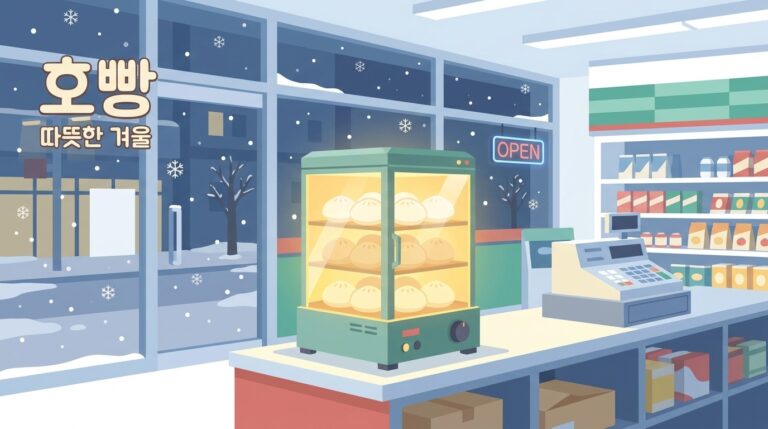
Right next to the register sits the holy grail of Korean winter comfort: a glowing, multi-tiered cylindrical glass steamer (찜기, jjimgi), swirling with gentle steam and loaded with plump, pillowy steamed buns known as 호빵 (Hoppang). You see rows of immaculate buns resting on colorful paper liners. But as you step closer to inspect the options, the cashier suddenly looks up, smiles politely, and asks:
“어떤 거 꺼내드릴까요?” (Eotteon geo kkeonaedeurilkkayo? / Which one can I take out for you?)
Panic sets in. Which one is the classic sweet red bean? Is the green liner vegetable or spicy buldak? Can you just open the steamer door yourself, or is that a major social faux pas? Should you take the bun from the top rack or the bottom? At Daily Hangul, hundreds of intermediate learners have shared this exact moment of freeze-up. Hoppang season is quintessential Korean culture, yet navigating convenience store ordering requires specific vocabulary and nuanced etiquette that standard textbooks simply skip.
By the end of this guide, you will be able to distinguish every flavor with confidence, ask natural questions like a Seoulite, and enjoy your piping-hot winter treat effortlessly. Let’s conquer the convenience store steamer together!
Phase 2: 핵심 표현 3선 심층 분석
Here are three essential expressions tailored for intermediate (B2) speakers to navigate any winter snack encounter like a seasoned local.
1. 단팥이랑 야채 중에 뭐가 더 잘 나가요? (Danpat-irang yachae jung-e mwo-ga deo jal nagayo?)
- Pronunciation: [Dan-pa-ti-rang ya-chae jung-e mwo-ga deo jal na-ga-yo?] (Think: “Dahn-paht-ee-rahng yah-cheh joong-eh mwo-gah duh jahl nah-gah-yo?”)
- Meaning: Literal: “Between sweet red bean and vegetable, which one goes out better?” | Real Nuance: “Which one is more popular / sells better, red bean or vegetable?”
- K-Culture Moment: Seen in romantic comedies and webtoons when an indecisive protagonist stands before street food or convenience food shelves, seeking the clerk’s insider recommendation without sounding clueless.
- Editor’s Insight: The verb 나가다 (to go out) is widely used in commercial contexts to mean “to sell” or “to move off shelves.” Saying 잘 나가요 sounds infinitely more native and colloquial than asking 어떤 것이 인기가 있습니까? (Which has popularity?).
- Situation Spectrum: Casual ✅ | Semi-formal ✅ | Formal ⚠️
- 🤔 Think About It: In English, we often ask “What do you recommend?” directly to the person. Why do you think Korean often refers to social consensus or market velocity (잘 나가다 – how well it moves to others) instead?
2. 이거 지금 바로 꺼내 먹어도 돼요? (Igeo jigeum baro kkeonae meogeodo dwaeyo?)
- Pronunciation: [I-geo ji-geum ba-ro kkeo-nae meo-geo-do dwae-yo?] (Think: “Ee-guh jee-geum bah-roh kkuh-neh muh-guh-doh dweh-yo?”)
- Meaning: Literal: “Can I take this out and eat it right now?” | Real Nuance: “Is this one fully heated and ready to eat right now?”
- K-Culture Moment: Frequently heard during winter late-night store visits when newly restocked buns have just been placed in the steamer and are still lukewarm inside.
- Editor’s Insight: Convenience store steamers take 20 to 30 minutes to warm up refrigerated buns thoroughly. If a bun was placed in the steamer recently, the red light might still be in heating mode (가열 중). Using this phrase politely checks if the bun is thoroughly steamed without making an awkward assumption.
- Situation Spectrum: Casual ✅ | Semi-formal ✅ | Formal ⚠️
- 🤔 Think About It: Notice the compound action 꺼내 먹다 (take out and eat). Intermediate Korean relies heavily on combining directional motion verbs with consumption verbs to express seamless actions.
3. 밑에 종이 떼고 드세요. (Mite jong-i ttego deuseyo.)
- Pronunciation: [Mi-te jong-i tte-go deu-se-yo.] (Think: “Mee-teh jong-ee tteh-goh deu-seh-yoh.”)
- Meaning: Literal: “Peel the paper on the bottom and eat it.” | Real Nuance: “Make sure to peel off the bottom paper wrapper before taking a bite!”
- K-Culture Moment: A quintessential caring phrase spoken by convenience store owners, grandmothers, or friends offering you a freshly steamed bun straight from the paper case.
- Editor’s Insight: Hoppang buns are steamed on wax-coated paper discs to keep them from sticking to the steamer rack. While native Koreans do this automatically, friendly cashiers often remind international visitors or kids because taking a huge bite of hot bun with the paper attached is a classic rite-of-passage blunder!
- Situation Spectrum: Casual ✅ | Semi-formal ✅ | Formal ✅
- 🤔 Think About It: 떼다 (to detach/peel off) vs. 벗기다 (to peel/strip). While fruit peel uses 벗기다, flat adhered objects like stickers, stamps, and bun papers use 떼다.
Phase 3: 교과서 한국어 vs 진짜 한국어
Level up from textbook robotic phrasing to the natural cadence of modern Seoul.
Situation 1: Asking if a specific Hoppang flavor is warmed up
- 📖 교과서 한국어: 피자 호빵은 따뜻하게 데워져 있습니까? (Pija hoppang-eun ttatteuthage dewojyeo itseumnikka? / Is the pizza steamed bun warmed up warmly?)
- 🗣️ 진짜 한국어: 피자호빵 지금 먹을 수 있어요? (Pijahoppang jigeum meogeul su isseoyo? / Can the pizza hoppang be eaten right now?)
- 💡 왜 다를까? Textbook Korean frequently overuses passive causative constructions like 데워져 있습니까 with stiff formal endings. Real native speakers cut straight to the functional intent (지금 먹을 수 있어요?), saving time and sounding warm yet polite.
Situation 2: Asking the cashier to grab a bun for you
- 📖 교과서 한국어: 저에게 단팥 찐빵 한 개를 주십시오. (Jeo-ege danpat jjinppang han gaereul jusipsio. / Please give me one sweet red bean steamed bun.)
- 🗣️ 진짜 한국어: 단팥 하나만 꺼내주시겠어요? (Danpat hanaman kkeonaejusigesseoyo? / Could you take out one red bean bun for me?)
- 💡 왜 다를까? In Korean retail reality, referring to yourself (저에게) is redundant and unnatural. Furthermore, specifying 단팥 already implies 단팥호빵, and using 꺼내주다 (to pull out for someone) accurately reflects the physical action of opening the steamer case.
Phase 4: K-Culture 딥다이브 & 비언어적 매너
4-1. 눈치(Nunchi) & 편의점 찜기 매너 (Steamer Etiquette)
When approaching the Hoppang steamer at a Korean convenience store (such as GS25, CU, 7-Eleven, or Emart24), keep these unspoken rules in mind:
* Look Before Touching: Some convenience stores allow self-service tongs (집게, jipge), while in others, the clerk prefers to retrieve the bun to prevent steam burns or hygiene issues. Look for a small sign saying “직원에게 말씀해 주세요” (Please ask the staff). When in doubt, make gentle eye contact with the cashier and point toward the steamer.
* The Indicator Light Check: Look at the small LED lights near the base of the machine. If the green light is on (보온, Bo-on / Keep Warm), the buns are hot and ready. If the red light (가열, Ga-yeol / Heating) is flashing with freshly added white dough, those buns might still have an icy core!
* Paper Bottom Color Code: Traditional Hoppang brands like Samlip color-code their bottom paper liners: Red/White paper usually indicates classic Red Bean (단팥), Green indicates Vegetable (야채), Orange/Yellow indicates Pizza (피자), and Black/Brown often indicates Spicy Buldak (불닭) or Meat (고기).
4-2. 문화 코드: 삼립호빵과 겨울의 추억 (The Cultural Resonance of Hoppang)
Invented in 1971 by Samlip General Foods, the name 호빵 (Hoppang) comes from the cheerful onomatopoeia “호호 불어 먹는다” (blowing hot air ‘ho-ho’ to cool down food) combined with “온 가족이 호호 웃으며 함께 먹는다” (the whole family laughing ‘ho-ho’ together). In cold Korean winters before modern central heating was universal, the glowing red neon signage and steaming glass cabinets outside neighborhood stores served as emotional beacons of warmth. Sharing a bun by splitting it right down the middle—releasing a plume of fragrant steam—is a sacred winter friendship ritual immortalized across K-dramas from Reply 1988 to Hospital Playlist.
Phase 5: 실전 롤플레이 시나리오
Setting: It is 11:30 PM on a snowy night. You (Alex) walk into a CU near Sinchon Station. The store is quiet with soft indie K-pop playing. Behind the counter stands a friendly college student part-timer, Minho.
- Turn 1 (Alex): 안녕하세요! 저기 혹시 호빵 지금 돼요?
(Annyeonghaseyo! Jeogi hoksi hoppang jigeum dwaeyo?)
“Hello! Excuse me, is the hoppang available right now?”
🎭 Hands tucked in coat pockets, gently gesturing toward the glass warmer. -
Turn 2 (Minho): 네, 지금 보온 중이라 바로 드실 수 있어요! 어떤 거 드릴까요?
(Ne, jigeum boon jung-ira baro deusil su isseoyo! Eotteon geo deurilkkayo?)
“Yes, it’s on warm mode now so you can eat right away! Which one would you like?”
🎭 Smiling warmly while picking up stainless-steel food tongs and a wax paper bag. -
Turn 3 (Alex): 단팥이랑 피자 중에 뭐가 더 잘 나가요?
(Danpat-irang pija jung-e mwo-ga deo jal nagayo?)
“Between red bean and pizza, which one sells better?”
🎭 Tilting head slightly with a thoughtful, curious expression. -
Turn 4 (Minho): 역시 오리지널은 단팥인데, 야식으로는 피자호빵이 진짜 인기 많아요.
(Yeoksi orijineor-eun danpat-inde, yasik-euro-neun pijahoppang-i jinjja ingi manayo.)
“Well, the original classic is red bean, but for late-night snacks, the pizza hoppang is crazy popular.”
🎭 Pointing with the tongs toward the orange-lined bun on the middle shelf. -
Turn 5 (Alex): 아, 그래요? 그럼 피자호빵 하나 꺼내주세요!
(A, geuraeyo? Geureom pijahoppang hana kkeonaejuseyo!)
“Oh really? In that case, could you take out one pizza hoppang for me please?”
🎭 Nodding affirmatively and stepping toward the register. -
Turn 6 (Minho): 네! 개별 포장 봉투에 넣어드릴게요. 밑에 종이 뜨거우니까 뗄 때 조심하세요.
(Ne! Gaebyeol pojang bongtu-e neoheodeurilgeyo. Mite jong-i tteugeounikka ttel ttae josimhaseyo.)
“Sure thing! I will put it into an individual sleeve bag. The paper on the bottom is hot, so be careful when peeling it.”
🎭 Carefully sliding the bun into a branded paper sleeve without crushing it. -
Turn 7 (Alex): 감사합니다! 계산은 카드로 할게요.
(Gamsahamnida! Gyesan-eun kadeu-ro halgeyo.)
“Thank you! I will pay by card.”
🎭 Holding card with both hands to insert into the card reader terminal. -
Turn 8 (Minho): 영수증 버려드릴까요? 맛있게 드세요!
(Yeongsujeung beoryeodeurilkkayo? Masitge deuseyo!)
“Shall I discard the receipt for you? Enjoy your snack!”
🎭 Handing over the warm bag while slightly bowing.
🔀 인터랙티브 분기점 (Interactive Choice Branching)
What would you do if you notice the flavor you want is inside the steamer, but there are no tongs outside?
- Option A: Reach your bare hand into the sliding door of the steamer to grab it.
- Feedback [BAD 🚫]: Extreme risk of burns from escaping steam! Convenience store steamers operate at high heat. Cashiers consider this a hygiene violation.
- Option B: Say: “저기요, 야채호빵 하나만 직접 꺼내도 되나요? 아니면 꺼내주시나요?” (Excuse me, may I take out a vegetable hoppang myself, or do you take it out?).
- Feedback [BEST ✅]: Flawless B2 communication! It demonstrates cultural awareness, respects the store’s hygiene protocol, and gets immediate assistance.
- Option C: Grab a multi-pack of cold hoppang from the refrigerated dairy aisle, take it to the register, and microwave it yourself without saying anything.
- Feedback [RISK ⚠️]: Edible, but microwave heating dries out the dough crust unless you wrap it in a damp paper towel or use a dedicated steaming pouch. The glass steamer produces a far superior texture!
Phase 6: 10초 감정 섀도잉 드릴
Practice these lines out loud. Respect the pause marks (/) and embody the indicated emotion for authentic rhythm.
[🤔 호기심 가득하고 친근하게 / Curious & Friendly]
저기요, / 혹시 피자호빵 / 지금 바로 먹을 수 있어요?
(Jeogiyo, / hoksi pijahoppang / jigeum baro meogeul su isseoyo?)-
[😋 기대감에 부풀어서 / Anticipating Deliciousness]
우와, / 방금 찐 거라 / 김이 모락모락 나네요!
(Uwa, / banggeum jjin geo-ra / gimi morakmorak naneyo! / Wow, because it was just steamed, the steam is billowing out!) -
[🥺 뜨거워서 호들갑 떨며 / Surprised by the Heat]
앗 뜨거워! / 밑에 종이 뗄 때 / 손 델 뻔했어요.
(At tteugeowo! / Mite jong-i ttel ttae / son del ppeonhaesseoyo! / Ouch, hot! I almost burned my hand peeling the paper on the bottom.)
Phase 7: K-Culture 미니 사전 (Key Vocabulary)
-
호빵 (Hoppang) vs 찐빵 (Jjinppang)
Literal/Translation: Commercial Steamed Bun vs. Traditional Steamed Bun
Usage: While 찐빵 refers broadly to any steamed bun (traditionally rustic, dense dough with coarse red bean sold at market stalls), 호빵 is technically the trademarked commercial product made with soft, cake-like dough specifically formulated for convenience store steamers. -
찜기 (Jjimgi)
Literal/Translation: Steamer cabinet / Food steamer
Usage: In winter convenience stores, 찜기 universally refers to the transparent hot display case sitting next to the cash register containing buns. -
모락모락 (Morak-morak)
Literal/Translation: Rising smoothly in clouds (smoke, steam)
Usage: The signature winter sensory word. Koreans describe appetizing winter food by saying 김이 모락모락 난다 (Steam is billowing out cozily). -
반반 (Banban)
Literal/Translation: Half and half
Usage: When buying multi-packs at supermarkets or splitting a bun with a companion: “단팥 하나 야채 하나 사서 반반 나눠 먹자!” (Let’s buy one red bean and one vegetable and share half-and-half!).
Phase 8: 여행자를 위한 생존 키트 (Traveler’s Survival Kit)
Top 3 Survival Phrases for Convenience Store Foodies
- “단팥 하나, 피자 하나 포장해 주세요.” (Danpat hana, pija hana pojanghae juseyo.)
“Please pack one red bean and one pizza bun to go.”
Pro Tip: Convenience stores have small single-bun paper sleeves. If you are taking them back to your hotel, ask for a plastic bag: “봉투도 한 장 주세요” (Please give me a bag too, which costs ~100 KRW). - “호빵 찜기에 있는 거 지금 따뜻해요?” (Hoppang jjimgi-e inneun geo jigeum ttatteuthaeyo?)
“Is the one inside the steamer warm right now?”
Pro Tip: Perfect question to verify if you spot newly stacked buns. - “전자레인지에 몇 초 돌려야 돼요?” (Jeonjareinji-e myeot cho dollyeoya dwaeyo?)
“How many seconds should I run this in the microwave?”
Pro Tip: If buying chilled packaged multi-packs from the refrigerated section, typical store microwaves (1000W) need exactly 30 seconds per bun.
Editor’s Travel Note
- Locate Winter Street Snacks: Use the Naver Map street navigation service to search for nearby 편의점 (convenience stores) or explore the community crowd-sourced app 가슴속 3천원 (3,000 Won in My Pocket) to locate nearby outdoor stalls selling 붕어빵 (bungeoppang) and 호떡 (hotteok).
- Payment Manners: Contactless mobile payment (Apple Pay, Samsung Pay) and T-Money transportation cards are accepted at all major Korean convenience store counters. Simply hold your card near the IC terminal.
Phase 9: “한 발 더 깊이” (Cultural Reflection)
In Korean culture, food is rarely an individualistic experience; it is fundamentally relational. The design of Hoppang itself—soft, rounded, and easily partitioned down the center seam—encourages tearing it into two unequal steaming halves to offer the larger piece to a companion. This everyday ritual encapsulates 정 (Jeong): the affectionate bond of silent caring that binds Korean society. When a companion instinctively blows on a scorching hot piece of Hoppang before handing it to you, they are offering more than calories—they are offering hospitality against the bitter cold.
💬 Your Turn: In your home country, is there a specific seasonal comfort food that people eat exclusively when the temperature drops? Have you ever shared food that requires two hands to break apart? Drop your stories in the comments below!
Phase 10: FAQ & Common Mistakes
Q: Can I grab the Hoppang directly with my bare hands if the steamer door is unlocked?
A: Absolutely not. The internal steam can reach over 80°C, causing sudden scalding. Moreover, touching shared food in Korean convenience stores is considered unsanitary. Always request the staff to assist or use the dedicated sanitized metal tongs provided on top of the warmer.
Q: What is the white paper stuck to the bottom of the Hoppang, and is it edible?
A: It is non-edible silicone-coated parchment paper (유산지). It prevents the moist yeast bun from sticking to the metal wire rack of the steamer. Always peel it off before eating. If a tiny piece of paper residue sticks to the dough, simply pinch away that small outer layer of dough.
Q: How do I know which flavor is which inside the glass warmer?
A: Look at the color print on the bottom paper disc or the small plastic label tabs stuck to the rack shelves. Alternatively, look at the bun’s top marking: classic red bean is pure smooth white, vegetable often has a faint green tint or a small indentation, and pizza frequently has a reddish-orange dot or distinct swirl on top.
🚨 Common Mistakes Alert!
- Mistake: Trying to microwave a chilled Hoppang without moisture.
Correct Action: Wet your fingers and flick water onto the bun surface, or cover it with a moist paper towel before microwaving for 30 seconds. Otherwise, the bread turns rock-hard like rubber! - Mistake: Biting immediately into a fresh Pizza Hoppang.
Correct Action: Break the bun open with your thumbs first! The molten tomato-cheese filling retains scalding heat much longer than the outer bread crust. - Mistake: Confusing 찐빵 (dense street-stall bun) with 호빵 (light convenience store bun).
Correct Action: Use 호빵 when speaking to convenience store staff, and 찐빵 when ordering at outdoor market steamers.
Phase 11: 액션 미션 & 참여 유도
Ready to activate your knowledge? Complete these three levels of mastery:
- 🥉 Bronze Level: Stand in front of your mirror and practice the phrase: “피자호빵 하나 꺼내주시겠어요?” three times with natural pronunciation and a slight bow.
- 🥈 Silver Level: Next time you watch a winter K-Drama or vlog, snap a photo when you spot a convenience store warmer or Hoppang package, tag @DailyHangul, and write the Korean name of the flavor you see.
- 🥇 Gold Level: Walk into an authentic Korean convenience store (or local H-Mart warmer), order your chosen Hoppang flavor completely in Korean, and successfully peel off the bottom paper like a true Seoulite!
🎮 K-Culture Mission: Watch Episode 4 of Reply 1988 or search YouTube for 편의점 호빵 먹방 (Convenience store hoppang mukbang). Notice how creators hold the bun with paper napkins around the base to protect their fingertips.
Phase 12: 인터랙티브 퀴즈 챌린지
Test your real-world readiness with these three practical questions!
Q1. Situational Judgment
You walk into a convenience store at 2:00 AM. The glass steamer has two vegetable buns inside, but the little indicator light says “가열 중” (Heating). What is the smartest thing to say?
* (A) “이거 지금 당장 주세요!”
* (B) “이거 다 쪄지려면 얼마나 걸려요?”
* (C) “빨리 꺼내 먹어도 아무 문제 없죠?”
Q2. Fill-in-the-Blank
Complete the sentence to politely ask which flavor is the bestselling item:
“단팥호빵이랑 야채호빵 중에 어떤 게 더 ( )?”
Q3. True or False
All steamed buns sold in Korea are called 호빵, and there is zero distinction between 호빵 and 찐빵 in traditional Korean markets. (T / F)
👉 Click to reveal answers & explanations!
- Q1 Answer: (B)
Explanation: 가열 중 means the buns are currently heating and may be cold in the center. Asking “이거 다 쪄지려면 얼마나 걸려요?” (How long until these are fully steamed?) allows the cashier to tell you the remaining minutes (usually 10–15 minutes). - Q2 Answer: 잘 나가요
Explanation: The natural idiomatic expression for “sells well / popular” is 잘 나가요. - Q3 Answer: False
Explanation: 찐빵 is the general category of traditional rustic steamed buns, while 호빵 is the iconic branded, commercial convenience store variant created by Samlip in 1971.







