

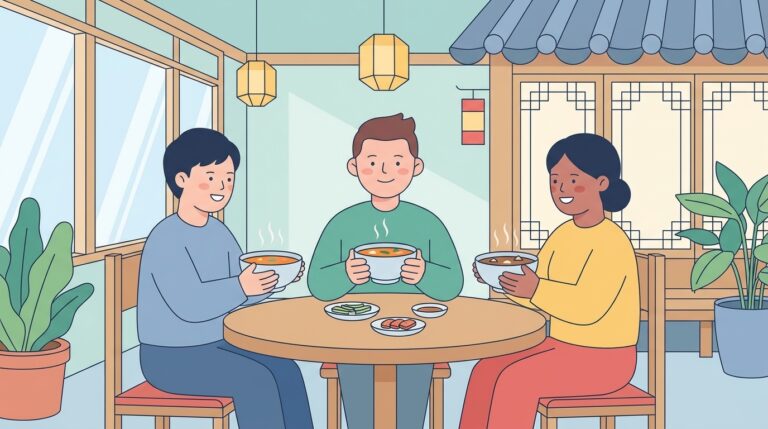
Recovering from Korean Drinking Blunders: The Ultimate Next-Day Survival Guide
안녕하세요! 매일한글 에디터입니다.
Picture this: You are at a bustling Pocha (street pub) in Hongdae. Neon signs are flickering, K-pop beats are pulsing, and the clinking of tiny green soju glasses surrounds you. You are having the time of your life shouting Geonbae! with your Korean colleagues or friends. But the next morning, reality hits. Your head is pounding, you check your KakaoTalk messages with one eye open, and a chilling thought strikes: “Wait… did I pour my manager’s drink with one hand? Did I speak informal Banmal to my senior? What on earth did I say last night?”
If you have ever woken up with the dreaded “drunken cringe” (what Koreans call Ibul-kick, kicking your blanket in embarrassment), take a deep breath. You are definitely not alone! Navigating Korean drinking culture (Sul-jari munhwa) is an exciting bonding ritual, but it comes with a minefield of unique etiquette rules. Based on hundreds of real coaching sessions with our B1 intermediate learners, we have built this foolproof recovery guide. By the end of this post, you won’t just know how to fix a drinking faux pas—you will turn an awkward blunder into a lifelong friendship.
Phase 2: Core 3 Expressions In-Depth
When things go slightly sideways after a few rounds of Somaek (soju + beer), having the right intermediate phrases will instantly restore harmony.
1. 어제 필름이 끊겼어요 (Eoje pillim-i kkeunkyeosseoyo)
- Pronunciation: [Uh-jeh peel-leem-ee kkeun-kyeo-ssuh-yo] (Think of an old-school movie camera film snapping with a crisp ‘snap’ sound!)
- Meaning:
- Literal: “My film snapped yesterday.”
- Actual Nuance: “I completely blacked out last night / I lost my memory.”
- K-Culture Moment: You will see this classic line in almost every workplace K-drama, like Business Proposal or Misaeng, when a character wakes up clutching their head, piecing together the wild chaos of the previous night’s company dinner.
- Editor’s Insight: While admitting you blacked out in Western cultures might sound irresponsible, in Korea, admitting your “film snapped” with genuine humility can actually serve as a polite buffer. It softens the blow of minor social slip-ups and invites friends to fill you in with laughter rather than judgment.
- Situation Spectrum: Casual ✅ | Semi-formal ✅ | Formal ⚠️ (Acceptable with close teammates, but avoid with executive board members!)
- 🤔 Think About It: Why do you think Korean uses a visual metaphor like “film snapping” to describe losing one’s memory? Does your native language view memory loss from alcohol as an accident or a personal fault?
2. 제가 술주정을 부렸나요? (Jega suljujeong-eul buryeonnayo?)
- Pronunciation: [Jeh-gah sool-joo-jeong-eul boo-ryeon-nah-yo?]
- Meaning:
- Literal: “Did I display drunken habits?”
- Actual Nuance: “Did I make a drunken fool of myself? / Was I acting out out of line?”
- K-Culture Moment: Seen in comedy-romance K-dramas when the protagonist timidly asks a friend over morning bean sprout soup whether they made a cringeworthy confession the night before.
- Editor’s Insight: Suljujeong (술주정) refers to behavioral quirks triggered by alcohol—whining, repeating the same story five times, suddenly crying, or getting overly affectionate. Asking this proactively shows Nunchi (tact and awareness). It signals: “I care about my social standing and respect your comfort.”
- Situation Spectrum: Casual ✅ | Semi-formal ✅ | Formal 🚫
- 🤔 Think About It: In many Western contexts, asking if you made a scene can sound defensive. In Korea, asking this first is seen as considerate and humble. How does self-reflection shape social responsibility in your culture?
3. 어제 분위기 깨서 죄송해요 (Eoje bun-wigi kkaeseo joesonghaeyo)
- Pronunciation: [Uh-jeh boon-wee-gee kkeh-suh jweh-song-heh-yo]
- Meaning:
- Literal: “I broke the atmosphere yesterday, so I’m sorry.”
- Actual Nuance: “I’m sorry for ruining the vibe / bringing down the mood last night.”
- K-Culture Moment: Used whenever someone accidentally spilled a drink, caused an argument, or left a vibrant karaoke (Noraebang) session abruptly.
- Editor’s Insight: The word Bun-wigi (분위기, atmosphere/vibe) is sacred in Korean collective gatherings. Admitting that you “shattered” (kkaeda) the group’s harmonious mood proves you are a cooperative team player who values the collective harmony over individual pride.
- Situation Spectrum: Casual ✅ | Semi-formal ✅ | Formal ✅
- 🤔 Think About It: In individualistic societies, apologies often focus on personal actions (“Sorry I shouted”). Why does the Korean apology center on the shared vibe of the group?
Phase 3: Textbook Korean vs. Real-world Korean
Textbooks teach you rigid, robotic sentences. Real life in Seoul demands natural, fluid expressions.
Situation 1: Saying you got too intoxicated
- 📖 교과서 한국어 (Textbook): 저는 어제 술을 너무 많이 마셔서 취했습니다. (Jeoneun eoje sureul neomu mani masyeoseo chwihaetseumnida. / “I drank too much alcohol yesterday and became inebriated.”)
- 🗣️ 진짜 한국어 (Real Korean): 어제 완전 만취해서 정신이 하나도 없었어요! (Eoje wanjeon manchwihaeseo jeongsini hanado eopseosseoyo! / “I was totally wasted yesterday, I completely lost my senses!”)
- 💡 왜 다를까? (Why is it different?): Textbook forms sound like a police report! Koreans use Manchwi (만취, heavily intoxicated) coupled with Jeongsin-i eopda (having no mind/sense left) to express harmless human vulnerability and build rapport.
Situation 2: Checking if everyone arrived home safely
- 📖 교과서 한국어 (Textbook): 당신은 어제 안전하게 귀가했습니까? (Dangsineun eoje anjeonhage gwigahaetseumnikka? / “Did you return home safely yesterday?”)
- 🗣️ 진짜 한국어 (Real Korean): 어제 다들 잘 들어갔어요? 속은 좀 괜찮아요? (Eoje dadeul jal deureogasseoyo? Sogeun jom gwaenchannayo? / “Did everyone get home safe yesterday? How’s your stomach holding up?”)
- 💡 왜 다를까? (Why is it different?): Natural Korean omits the awkward pronoun Dangsin. Asking about someone’s stomach (Sok) the next morning is the ultimate warm, caring gesture among friends and colleagues.
Phase 4: K-Culture Deep Dive & Non-verbal Manners
4-1. Nunchi & Gestures: The Body Language of Apology
If you committed a faux pas—like receiving a drink with just one hand from someone older—words are only half the battle. Non-verbal body language does the heavy lifting:
* The Two-Handed Morning Greeting: The next day, when greeting the person you made a mistake with, bow at a 30-degree angle with both hands gently clasped in front of your lower abdomen (or one hand resting across your chest).
* The Beverage Peace Offering: Never apologize empty-handed! Walk in with an iced Americano or a hangover drink (Condition or Morning Care) from the convenience store. Place it gently on their desk with both hands and smile sheepishly.
4-2. Cultural Code Analysis: The Magic of Haejang (해장)
In Korea, alcohol culture doesn’t end when the bar closes; it concludes with Haejang (hangover curing). Going out for Kongnamul Gukbap (bean sprout soup) or Sundae Gukbap (blood sausage soup) the next day is a sacred communal ritual. During this shared meal, funny mistakes are brought up, teased gently, and washed away with steaming hot broth. In Korean social dynamics, drinking together (Sul-jari) is not about alcohol consumption; it is about tearing down formal social barriers (Gyeok-sik) to build authentic Jeong (deep emotional affection).
Phase 5: Real-life Roleplay Scenario
Setting: A cozy café near your office at 11:45 AM. You are meeting Minho (민호 대리), your 30-year-old team senior who took care of you during last night’s rowdy company dinner.
- Turn 1 (Minho): 🎭 Approaching your table with a friendly grin, holding a warm can of honey-citron tea.
민호: OO 씨, 안색이 안 좋은데 속은 좀 괜찮아요?
(OO ssi, ansaegi an joeunde sogeun jom gwaenchannayo? / “OO, your complexion doesn’t look great, is your stomach feeling okay?”) -
Turn 2 (You): 🎭 Standing up slightly, bowing your head with an embarrassed expression.
나: 대리님, 어제 제가 술을 너무 많이 마셔서 정말 죄송해요.
(Daerinim, eoje jega sureul neomu mani masyeoseo jeongmal joesonghaeyo. / “Manager Minho, I’m so sorry I drank too much last night.”) -
Turn 3 (Minho): 🎭 Chuckles softly and waves his right hand dismissively in the air.
민호: 에이, 죄송하긴요! 신입사원 때 다 그런 거죠. 어제 기억은 다 나요?
(Ei, joesonghagin-yo! Sin-ipsawon ttae da geureon geojyo. Eoje gieog-eun da nayo? / “Hey, don’t mention it! Everyone does that when they’re new. Do you remember everything from yesterday?”) -
Turn 4 (You): 🎭 Scratching the back of your neck with both eyes wide open.
나: 솔직히 노래방부터는 필름이 살짝 끊겼어요. 제가 술주정을 부렸나요?
(Soljiki noraebangbuteoneun pillim-i saljjak kkeunkyeosseoyo. Jega suljujeong-eul buryeonnayo? / “Honestly, my film snapped a bit starting from the karaoke. Did I make a scene?”) -
Turn 5 (Minho): 🎭 Laughs out loud, tapping your shoulder lightly.
민호: 별거 없었어요. 그냥 팀장님 손잡고 인생 상담을 30분 동안 했을 뿐이에요!
(Byeolgeo eopseosseoyo. Geunyang timjangnim sonjapgo insaeng sangdam-eul samsipbun dongan haesseul ppunieyo! / “Nothing major! You just held the team leader’s hands and asked for life advice for 30 minutes straight!”) -
Turn 6 (You): 🎭 Covering your face with both hands in utter disbelief.
나: 세상에… 제가 정말 분위기 깨서 어떡해요. 팀장님께 사과드려야겠죠?
(Sesang-e… jega jeongmal bun-wigi kkaeseo eotteokhaeyo. Timjangnimkke sagwadwimyeogetjyo? / “Oh my goodness… I ruined the mood, what should I do? Should I apologize to the team leader?”) -
Turn 7 (Minho): 🎭 Handing you the warm citron tea with a reassuring wink.
민호: 팀장님이 오히려 OO 씨가 귀엽다고 칭찬하셨어요. 너무 걱정 마요.
(Timjangnimi ohiryeo OO ssiga gwiyeopdago chingchanhasyeosseoyo. Neomu geokjeong mayo. / “The team leader actually complimented you, saying you were adorable. Don’t worry so much.”) -
Turn 8 (You): 🎭 Accepting the drink with two hands, letting out a deep sigh of relief.
나: 다행이에요! 대리님, 오늘 점심에 해장국은 제가 꼭 살게요!
(Dahaeng-ieyo! Daerinim, oneul jeomsime haejanggug-eun jega kkok salgeyo! / “What a relief! Minho, I’m definitely treating you to hangover soup for lunch today!”)
🔀 Interactive Choice Point: How do you react to the Team Leader?
What would you say when you run into the Team Leader right after this conversation?
- Option A: 팀장님, 어제 기억이 안 나는데 제가 무슨 말 했어요? (Timjangnim, eoje gieogi an nande jega museun mal haesseoyo? / “Team leader, I don’t remember yesterday, what did I say to you?”)
- 👉 Feedback [RISK]: A bit too blunt! Demanding that a superior recap your drunken conversation borders on disrespectful Banmal attitudes.
- Option B: 팀장님! 어제 제 진심을 들어주셔서 감사했습니다! (Timjangnim! Eoje je jinsimeul deureojusyeoseo gamsahaetseumnida! / “Team leader! Thank you for listening to my honest thoughts yesterday!”)
- 👉 Feedback [BAD]: Dangerous! You don’t even remember what you said; confirming it as your “deep sincere truth” might backfire if you complained about work.
- Option C: 팀장님, 어제 제가 너무 취해서 결례를 범했습니다. 너그럽게 봐주셔서 감사합니다. (Timjangnim, eoje jega neomu chwihaeseo gyeollyereul beomhaetseumnida. Neogeureopge bwajusyeoseo gamsahamnida. / “Team leader, I was overly intoxicated and acted impolitely yesterday. Thank you for your generous understanding.”)
- 👉 Feedback [BEST]: Perfect balance of professionalism, humility, and gratitude. This will earn you maximum respect in Korean corporate culture!
Phase 6: 10-Second Emotional Shadowing Drill
Master your rhythm, pauses (/), and natural emotion!
[🥺 민망하고 미안한 감정 / Embarrassed & apologetic]- 어제 / 제가 / 실수를 한 건 아닌지 / 너무 걱정돼요.
(Eoje / jega / silsureul han geon aninji / neomu geokjeongdwaeyo.)
- 어제 / 제가 / 실수를 한 건 아닌지 / 너무 걱정돼요.
[😅 쑥스럽지만 고마운 뉘앙스 / Sheepish yet genuinely thankful]- 챙겨주셔서 감사해요, / 다음엔 / 제가 진짜 조심할게요!
(Chaenggyeojusyeoseo gamsahaeyo, / daeumen / jega jinjja josimhalgeyo!)
- 챙겨주셔서 감사해요, / 다음엔 / 제가 진짜 조심할게요!
[🤝 쾌활하고 씩씩한 다짐 / Bright, energized offer]- 오늘은 / 제가 쏠 테니까 / 시원하게 해장하러 가요!
(Oneureun / jega ssol tenikka / siwonhage haejanghareo gayo!)
- 오늘은 / 제가 쏠 테니까 / 시원하게 해장하러 가요!
Phase 7: K-Culture Mini Dictionary
- 흑역사 (Heuk-yeoksa) | “Dark History”
- Meaning: Highly embarrassing past moments you wish you could erase from history.
- Usage: Essential slang among young Koreans. “어제 완전 내 흑역사 생성했어!” (I created a complete dark history yesterday!).
- 2차 (I-cha) | “Second Round”
- Meaning: Moving from the initial restaurant to another location (like a pub, beer hall, or Noraebang).
- Usage: Drinking mistakes almost always happen at 2차 or 3차. If your tolerance is low, knowing how to politely slip away before 2차 is the ultimate survival skill.
- 해장 (Haejang) | “Stomach-soothing / Hangover Recovery”
- Meaning: Relieving physical after-effects with spicy, warm broth or cool beverages.
- Usage: Beyond food, Koreans now use terms like Haejang Coffee (iced Americano) or Haejang Ice Cream.
- 주량 (Juryang) | “Alcohol Tolerance”
- Meaning: The exact number of soju bottles/glasses you can consume before losing control.
- Usage: A staple icebreaker question. “주량이 어떻게 되세요?” (What is your alcohol limit?). Always state half your actual limit to stay safe!
Phase 8: Traveler’s Survival Kit
Top 3 Survival Expressions
- 술 잘 못 마셔요. (Sul jal mot masyeoyo.)
- Romanization: [Sool jal mot mah-syuh-yo]
- Pro Tip: Say this smilingly before anyone pours your first drink. It instantly sets expectations and frees you from peer pressure.
- 물 한 잔만 주세요. (Mul han janman juseyo.)
- Romanization: [Mool han jan-man joo-seh-yo]
- Pro Tip: Alcohol dehydrates you fast under intense soju games. Keep a water glass full and sip discreetly between shots.
- 저 먼저 일어나 볼게요. (Jeo meonjeo ireona bolgeyo.)
- Romanization: [Juh mohn-juh ee-ruh-nah bohl-geh-yo]
- Pro Tip: The smoothest way to leave early without breaking the social vibe: “I will get going first!”
Editor’s Travel Note
- Safe Transit: Never take unlicensed street taxis when tipsy. Prepare in advance by completing the Kakao T Taxi Calling App download on your phone. It tracks your exact route, links your payment, and sends your vehicle number to friends.
- Locate Haejang Places: Find 24-hour hangover soup spots nearby via the Naver Map Navigation App download by searching for keywords like “24시 해장국” (24-hour hangover soup) or “콩나물국밥” (bean sprout soup).
Phase 9: One Step Deeper (Thinking Question)
In traditional Korean culture, there has long existed an unwritten cultural rule known as Sul-jari Myeon-joe-bu (술자리 면죄부, a pardon granted for drinking mistakes). Because Korean society operates under strict social hierarchies and politeness codes throughout the day, the drinking gathering is viewed as a pressure-release valve where raw humanity can breathe. Consequently, minor slips in etiquette are forgiven generously with a warm laugh the next day. However, this forgiveness is contingent upon one crucial condition: acknowledging your slip with humility rather than pretending nothing happened.
💬 Your Turn: Has an awkward drinking moment ever unexpectedly brought you closer to someone? How does your culture treat social blunders made while drinking? Share your funniest recovery stories in the comments below!
Phase 10: FAQ & Avoiding Misunderstandings (FAQ Schema)
Q: What should I do if I accidentally used informal Banmal to my boss or older acquaintance?
A: Do not panic or try to cover it up with long excuses! Approach them early the next morning, bow respectfully, and say: “어제 제가 취해서 반말을 쓴 것 같아요. 정말 죄송합니다!” (I think I used informal speech because I was tipsy yesterday. I am truly sorry!). Acknowledging your slip before they bring it up turns an awkward insult into an endearing moment of cultural sincerity.
Q: Is it considered rude to turn down a drink offered by an elder or senior?
A: Flatly saying “No” can indeed dampen the mood. Instead, accept the glass with two hands, touch the rim to your lips as a token of respect, and then place it down on the table. You can follow up with: “제가 건강상 술을 못 마셔서 아쉽습니다” (I regret that I cannot drink due to health reasons).
Q: What if I accidentally broke a glass or spilled a drink on someone’s clothes at a pocha?
A: Immediately grab napkins, assist without invading their personal space, and insist on offering dry-cleaning fees: “세탁비 꼭 물어드릴게요!” (Please let me cover the dry cleaning!). Even if they refuse, buying them a replacement round or coffee demonstrates superior etiquette.
🚨 Common Mistakes Warning Board
- Ghosting the next morning: Disappearing out of embarrassment causes people to think you are cold. Correct Action: Send a quick KakaoTalk asking if they got home safely.
- Pouring your own drink repeatedly: Pouring your own alcohol (Jajak) can inadvertently make your companions look neglectful. Correct Action: Watch other glasses and pour for them; they will quickly return the favor.
- Drinking face-to-face with elders: Swallowing a shot directly looking at someone senior is perceived as confrontational. Correct Action: Turn your head and upper body slightly to the side while covering your mouth with your other hand.
Phase 11: Action Missions & Engagement
- 🥉 Bronze Mission (Self Practice): Stand in front of your mirror and practice saying “어제 필름이 끊겼어요!” with a sheepish smile three times.
- 🥈 Silver Mission (Social Share): Save this article and share your favorite Korean hangover cure food on Instagram stories, tagging
@DailyHangul! - 🥇 Gold Mission (Real Life Application): At your next gathering, make a polite toast, pour a drink using two hands, and send a morning-after check-in text using “속은 좀 괜찮아요?”.
- 🎮 K-Culture Media Mission: Watch Episode 1 of any slice-of-life K-drama (like Hospital Playlist or Work Later, Drink Now). Spot the exact moment someone turns their head away to drink and notice how drinks are poured with two hands!
Phase 12: Interactive Quiz Challenge
Quiz 1. Situational Judgment
You wake up and realize you fell asleep on the subway and missed your stop after drinking with Korean colleagues. What message should you send in the team group chat the next morning?
* A) 어제 다들 먼저 가서 서운했어요. (I was sad everyone left first.)
* B) 어제 덕분에 정말 즐거웠습니다! 다들 속은 괜찮으신가요? (Thanks to you, I had so much fun yesterday! Is everyone’s stomach feeling okay?)
* C) 저는 술이 너무 세서 하나도 안 취했습니다. (My tolerance is so strong that I didn’t get drunk at all.)
🔍 Click to check the Answer & Explanation
- Correct Answer: B
- Explanation: Option B displays warm empathy (Jeong) and good vibes. Option A blames others, while Option C sounds boastful and untrue!
Quiz 2. Fill-in-the-Blank
Complete the sentence to apologize for ruining the party vibe:
* “어제 술을 너무 많이 마셔서 _________ 깨서 죄송합니다.”
🔍 Click to check the Answer & Explanation
- Correct Answer: 분위기 (Bun-wigi)
- Explanation: Bun-wigi kkaeda means “to kill the vibe / break the group atmosphere.”
Quiz 3. True or False Cultural Etiquette
- “In Korea, if your senior pours you a drink, you should hold your glass firmly with one hand while looking them dead in the eye to show confidence.” (True / False)
🔍 Click to check the Answer & Explanation
- Correct Answer: False
- Explanation: You must hold the glass with both hands (or support your right wrist/forearm with your left hand) and turn your head away as you drink. Looking an elder straight in the eye while swallowing alcohol is considered disrespectful.







