

Phase 1: 공감 (Story-Driven Opening)
안녕하세요! 매일한글 에디터입니다.
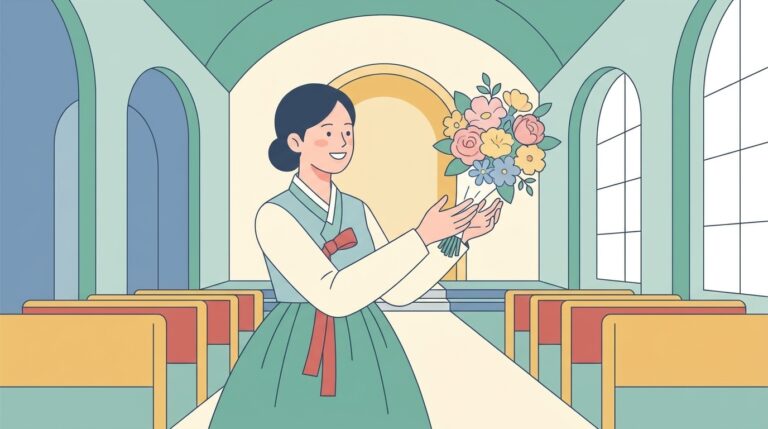
Imagine this classic K-drama scene: the wedding ceremony wraps up, romantic violin music swells, and the radiant bride prepares to toss her gorgeous floral bouquet. In many Western countries, every single woman gathers behind the bride in a friendly (or slightly competitive!) scrum to catch the flying flowers. But when you step into a stylish wedding hall in Seoul, something unexpected happens: only one person is called up to the stage by name, standing completely alone under the spotlight.
If that designated catcher is you, your heart might skip a beat. “Why is everyone staring at me? Do I have to get married now? What if I drop the flowers on camera?!”
Take a deep breath! In Korea, catching the bouquet isn’t a random scramble—it’s a pre-arranged, intimate honor reserved for the bride’s closest confidante. Over the past decade tutoring learners from all over the world, I’ve seen countless international friends panic when asked to take on this role. With this guide, tailored specifically to elementary (A2) learners, you will discover the exact natural phrases, etiquette rules, and photo-ready tips you need to shine on stage without any awkwardness.
Phase 2: 핵심 표현 3선 심층 분석 (Core Expressions)
1. 잘 던져 줘! (Jal deonjyeo jwo!)
- Pronunciation: [Jal deon-jyeo jwo] (Think of ‘Jal’ sounding like the start of ‘jalapeño’, ‘deon’ like English ‘done’, and ‘jwo’ like ‘j-wah’)
- Meaning: Literal: “Throw it well!” | Nuance: “Toss it gently right into my hands so I don’t drop it on camera!”
- K-Culture Moment: You will hear this friendly plead in rom-com dramas right before the photographer counts to three, spoken between childhood best friends.
- Editor’s Insight: The ending ~해 줘 (~hae jwo) is a warm, casual request among peers. If you are speaking with someone older or slightly formal, you would soften it to 잘 던져 주세요 (Jal deonjyeo juseyo).
- Situation Spectrum: Casual ✅ | Semi-formal ⚠️ | Formal 🚫
- 🤔 Think About It: In your home culture, do people treat the bouquet toss as a casual game of chance or an arranged photo-op between close friends?
2. 나 아직 결혼 계획 없는데! (Na ajik gyeolhon gyehoek eomneunde!)
- Pronunciation: [Na a-jik gyeol-hon gye-hoek eom-neun-de] (Say ‘ajik’ quickly like ‘ah-jeek’, and ‘eomneunde’ with a soft nasal ‘m-neun-de’)
- Meaning: Literal: “I don’t have wedding plans yet!” | Nuance: “Wait, why me? I’m not even dating anyone right now!”
- K-Culture Moment: In Korea, superstition says that if you catch a bouquet and do not marry within 6 months (or 3 years), you won’t marry for a very long time! This line is the quintessential self-deprecating joke you make when friends tease you.
- Editor’s Insight: ~는데 (~neunde) at the end of a sentence leaves your thought slightly open-ended, conveying cute shyness or humorous hesitation.
- Situation Spectrum: Casual ✅ | Semi-formal ✅ | Formal ⚠️
- 🤔 Think About It: Does your language use sentence-ending softeners to express playful worry without sounding genuinely upset?
3. 부케 꼭 잘 말려 줄게. (Buke kkok jal mallyeo julge.)
- Pronunciation: [Bu-ke kkok jal mal-lyeo jul-ge] (Pronounce ‘kkok’ with a tight, crisp ‘k’ sound, like ‘coke’ without the puff of air)
- Meaning: Literal: “I will definitely dry the bouquet well for you.” | Nuance: “I promise to dry and preserve these flowers beautifully and gift them back to you!”
- K-Culture Moment: Modern Korean brides love the thoughtful trend where the catcher dries the flowers for 100 days, places them in a glass dome or candle, and returns them as a token of lasting happiness.
- Editor’s Insight: The word 꼭 (kkok) adds sincerity and affection to your promise, meaning “without fail” or “cross my heart.”
- Situation Spectrum: Casual ✅ | Semi-formal ✅ | Formal 🚫
- 🤔 Think About It: What special after-wedding traditions or keepsakes exist between close friends in your country?
Phase 3: 교과서 한국어 vs 진짜 한국어 (Textbook vs. Real-Life)
Situation 1: Agreeing to catch the bouquet
- 📖 교과서 한국어: 제가 신부님의 부케를 받겠습니다. (Jega sinbunim-ui buke-reul batgesseumnida. – I shall receive the bride’s bouquet.)
- 🗣️ 진짜 한국어: 내가 예쁘게 잘 받을게! (Naega yeppeuge jal badeulge! – I’ll catch it nicely and look pretty doing it!)
- 💡 왜 다를까?: Textbook forms are overly robotic for a bond between friends. Real Korean friends use enthusiastic, affectionate casual language (반말) emphasizing how happy they are to help make the photos look great.
Situation 2: Playfully reacting to marriage pressure
- 📖 교과서 한국어: 저는 6개월 안에 결혼할 수 없습니다. (Jeoneun yukgaewol ane gyeolhonhal su eopseumnida. – I cannot get married within six months.)
- 🗣️ 진짜 한국어: 6개월 안에 누구라도 찾아볼게! (Yukgaewol ane nugurado chajabolge! – I’ll try my best to find someone in six months!)
- 💡 왜 다를까?: Stiff grammar misses the playful Korean joke about the six-month bouquet curse. Turning the superstition into a lighthearted self-deprecating punchline keeps the mood sparkling.
Phase 4: K-Culture 딥다이브 & 비언어적 매너 (Deep Dive & Non-Verbal Manners)
4-1. 눈치 (Nunchi) & Stage Manners
- The Staged Toss: Do not anticipate catching the bouquet on the first try and walking away! The photographer will usually stage the toss 2 to 4 times to capture the perfect cinematic arc. Stay in position, maintain your warm smile, and keep your hands ready.
- Two-Handed Receive: Catch the flowers securely with both hands. Diving or tumbling across the carpet like a goalkeeper will ruin your dress and startle the elders. Catch it gently, pull it toward your chest, and look straight into the camera lens with a joyful grin.
4-2. 문화 코드: 부케순이 (Buke-suni) & The 100-Day Gift
In Korean wedding vernacular, the designated bouquet catcher is nicknamed 부케순이 (Buke-suni). While older generations worried that an unmarried catcher might get “bad luck” if she didn’t marry soon, today’s young Koreans turn it into a celebration of friendship. The catcher takes the bouquet home, carefully dries the petals for 100 days (100일 말리기), and crafts them into a glass bell jar lamp or scented wax tablet to gift back to the newlyweds. It symbolizes wishing the couple 100 years of bright love.
Phase 5: 실전 롤플레이 시나리오 (Real-Life Roleplay Scenario)
Setting: The glamorous photo-call backdrop at a modern wedding venue in Gangnam. Your close Korean friend, Minji (the bride), gestures for you to step forward right in front of the photography team.
- Minji (신부 민지): 영희야, 이제 부케 던질 거야! 준비됐어? (Yeonghui-ya, ije buke deonjil geoya! Junbidaesseo? – Yeonghui, I’m throwing the bouquet now! Are you ready?)
- You (나): 🎭 Taking your position with both hands poised, laughing nervously.
응! 나 긴장돼. 잘 던져 줘! (Eung! Na ginjangdwae. Jal deonjyeo jwo! – Yeah! I’m nervous. Toss it nicely to me!) - Minji (신부 민지): 🎭 Laughing while holding the bouquet backward.
한 번에 잘 받아야 해! 알겠지? (Han beone jal badaya hae! Algetji? – You must catch it on the first try! Deal?) - You (나): 🎭 Looking playfully worried at the crowd.
떨어뜨리면 어떡하지? (Tteoreotteurimyeon eotteokhaji? – What if I drop it?) - Photographer (사진작가): 자, 신부님 던집니다! 하나, 둘, 셋! (Ja, sinbunim deonjimnida! Hana, dul, set! – Alright, bride tossing now! One, two, three!)
- You (나): 🎭 Catching the flying bouquet cleanly with both hands and beaming.
와, 잡았다! (Wa, jabatda! – Whoa, I caught it!) - Minji (신부 민지): 🎭 Clapping hands excitedly.
대박! 진짜 잘 받았다! 너무 예뻐! (Daebak! Jinjja jal badatda! Neomu yeppeo! – Awesome! You caught it so well! It looks so pretty!) - You (나): 🎭 Posing warmly next to the bride for the flash.
고마워! 내가 예쁘게 잘 말려 줄게. (Gomawo! Naega yeppeuge jal mallyeo julge. – Thank you! I will dry it beautifully for you.)
🔀 인터랙티브 분기점 (Interactive Choice)
The photographer asks you to say a funny congratulatory word into the wedding video camera. What do you say?
- Option A: “민지야, 결혼 축하해! 6개월 안에 나도 따라갈게!” (Minji-ya, gyeolhon chukhahae! Yukgaewol ane nado ttaragalge! – Congrats Minji! I will follow your footsteps within six months!)
- 👉 Feedback [Best]: Perfect sense of humor! This witty nod to the six-month superstition will make everyone in the hall burst into warm laughter.
- Option B: “저는 절대 결혼하지 않을 것입니다.” (Jeoneun jeoldae gyeolhonhaji aneul geosimnida. – I will never ever get married.)
- 👉 Feedback [Bad]: Too rigid, dark, and dampens the romantic celebratory atmosphere of the room.
- Option C: “부케 너무 무거워요.” (Buke neomu mugeowoyo. – The bouquet is way too heavy.)
- 👉 Feedback [Risk]: It might sound like a real complaint about the flowers rather than a cheerful compliment.
Phase 6: 10초 감정 섀도잉 드릴 (10-Second Shadowing Drill)
Read these aloud, hitting the breath pause / marks and channeling the assigned emotion tags!
[😊 설레고 장난스럽게]나 긴장돼! / 살살 던져 줘! (Na ginjangdwae! / Salsal deonjyeo jwo! – I’m nervous! Toss it gently!)[🎉 신나고 통쾌하게]와, 잡았다! / 떨어뜨릴 뻔했네! (Wa, jabatda! / Tteoreotteuril ppeonhaenne! – Whoa, I caught it! Almost dropped it!)[💖 다정하고 진심을 담아]결혼 진심으로 축하해. / 내가 예쁘게 말려 줄게. (Gyeolhon jinsimeuro chukhahae. / Naega yeppeuge mallyeo julge. – Congratulations from the bottom of my heart. I’ll dry these flowers nicely for you.)
Phase 7: K-Culture 미니 사전 (Mini Dictionary)
- 부케순이 (Buke-suni): An affectionate slang term for the designated female friend chosen in advance to catch the bride’s bouquet.
- 원판 사진 (Wonpan sajin): The official formal group photos taken on stage immediately after the wedding ceremony with family, relatives, and friends.
- 100일 말리기 (Baek-il malligi): The modern tradition of drying the caught bouquet petals for 100 days and gifting them back in glass decor.
- 축의금 (Chug-uigeum): The customary wedding gift money presented in a clean white envelope at the reception desk upon arriving.
Phase 8: 여행자를 위한 생존 키트 (Survival Kit)
Top 3 Survival Expressions
- 사진 한 번 더 찍을게요! (Sajin han beon deo jjigeulgeyo!)
- Pronunciation: [Sa-jin han beon deo jji-geul-ge-yo]
- Pro Tip: Use this when posing with the bride in the bridal suite (신부대기실) before the ceremony.
- 꽃이 정말 예뻐요! (Kkochi jeongmal yeppeoyo!)
- Pronunciation: [Kko-chi jeong-mal ye-ppeo-yo]
- Pro Tip: A gracious compliment for the bridal bouquet and venue florals.
- 식권 어디서 받아요? (Sikgwon eodiseo badayo?)
- Pronunciation: [Sik-gwon eo-di-seo ba-da-yo]
- Pro Tip: Ask this at the registration desk when exchanging your cash envelope for the buffet dining voucher (식권).
Editor’s Travel Note
Korean weddings run on tight schedules—often lasting just 60 to 90 minutes from vows to the buffet! To arrive without stress, use the Naver Map app download to check the exact subway exit, as wedding venues are often directly connected to train stations. Also, remember to prepare clean 50,000 KRW bills in cash beforehand; wedding counters do not accept credit card payments for gift money.
Phase 9: “한 발 더 깊이” (Cultural Essay)
In Western traditions, catching the bouquet relies on spontaneous fate—anyone in the crowd can reach out. In Korea, designating the catcher reflects deep communal bonds and relational intentionality (관계주의). By entrusting the bouquet to one cherished friend, the bride conveys: “I want you to be the next person to find happiness, and I honor our journey together.” It is not just about catching flowers; it is an unspoken emotional baton pass between two close souls celebrating adulthood.
💬 Your Turn: Have you ever attended a wedding in Korea or seen this bouquet ritual in K-dramas? How does it differ from your country’s wedding rituals? Let me know in the comments below!
Phase 10: FAQ & 오해 방지 (FAQ Schema)
Q: Do I really have to get married within six months if I catch the bouquet?
A: Not at all! While the old folk superstition says that failing to marry within six months leads to three years of staying single, modern Koreans treat this entirely as a funny running joke. Don’t stress about being single; nobody actually expects a wedding invitation from you in six months.
Q: Can a male friend or a married person catch the bouquet in Korea?
A: Usually, unmarried female friends catch the main bouquet. However, modern couples occasionally have a groom toss a boutique item (like a cabbage, a doll, or a mini boutonnière) to a close male friend for fun. If all close friends are already married, a married best friend can catch it without issue.
Q: What should I do with the bouquet after taking it home?
A: You don’t have to keep it forever if it wilts! Most friends either separate the flowers upside down in a shaded, well-ventilated room to dry them for 100 days, or they simply enjoy them in a vase for a week and take souvenir photos.
🚨 흔한 실수 (Common Mistakes) 경고판
- Mistake: Standing up to catch the bouquet when you weren’t pre-selected.
Correct Action: Stay in your seat unless the bride or wedding planner specifically invites you up front. - Mistake: Wearing a pure white dress or gown as a guest.
Correct Action: Avoid white outfits (민폐하객); opt for neat pastel, navy, beige, or charcoal tones to let the bride stand out. - Mistake: Leaving the venue immediately after catching the flowers without finishing group photos.
Correct Action: Stay on stage! The photographer will take several wide-angle shots with the entire group of friends right after the toss.
Phase 11: 액션 미션 & 참여 유도 (Action Mission)
- 🥉 Bronze Mission: Practice saying “잘 던져 줘!” (Jal deonjyeo jwo!) three times out loud in front of a mirror with a bright smile.
- 🥈 Silver Mission: Write a one-sentence Korean congratulations message for a newlywed friend in our comments section using ~축하해 (~chukhahae).
- 🥇 Gold Mission: Spot a bouquet-catching scene in a K-drama (like Crash Landing on You or Business Proposal) and shadow the catcher’s exact lines!
- 🎮 K-Culture Mission: Search Instagram with the hashtag
#부케말리기선물(Bouquet drying gift) to see the astonishingly creative glass domes and candles Korean friends make!
Phase 12: 인터랙티브 퀴즈 챌린지 (Interactive Quiz Challenge)
- Situational Judgment: The bride is getting ready to throw the bouquet, and the photographer counts “하나, 둘, 셋!” What should you do?
- A) Dive onto the floor to grab it before anyone else touches it.
- B) Catch it stably with two hands while smiling at the camera.
- C) Run away because you aren’t planning to marry soon.
- Fill-in-the-Blank: “신부님, 부케 예쁘게 잘 ________ 줄게요!” (Bride, I will dry the bouquet nicely for you!)
- A) 버려 (beoryeo – throw away)
- B) 먹어 (meogeo – eat)
- C) 말려 (mallyeo – dry)
- True / False: In Korea, the bouquet catcher is chosen randomly on the spot from all single guests.
- [True / False]
👉 Click here to reveal the answers and explanations!
- 1. Answer: B — Always catch it gently with two hands and hold your pose for the photographer’s commemorative shots.
- 2. Answer: C (말려 – mallyeo) — The verb 말리다 (mallida) means ‘to dry’. “말려 줄게요” means “I will dry it for you.”
- 3. Answer: False — In Korea, the bouquet catcher (부케순이) is almost always asked and decided in advance by the bride!







