

The True Korean Dessert: Why You Must Never Skip Fried Rice (볶음밥)
Phase 1: Empathy (Story-Driven Opening)
안녕하세요! 매일한글 에디터입니다. (Hello! This is your Daily Hangul editor.)
Picture this: You are sitting at a bustling Dakgalbi (spicy stir-fried chicken) joint in Hongdae. The air is thick with the mouthwatering aroma of toasted sesame oil and spicy gochujang. You and your friends have just devoured a massive skillet of marinated chicken, sweet potato slices, and chewy rice cakes. You lean back, wipe your mouth with a napkin, and sigh in utter satisfaction: “I am completely stuffed. Should we ask for the bill?”
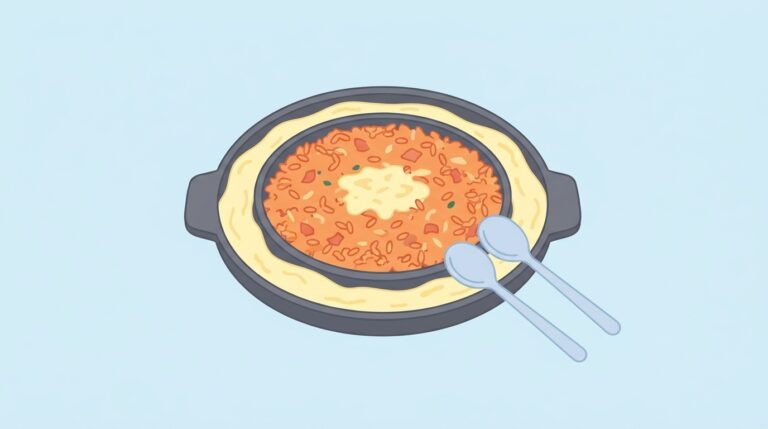
Suddenly, your Korean friend grabs your arm with genuine urgency in their eyes. “Wait! Are you crazy? We haven’t even had dessert yet!” Before you can wonder if they are ordering bingsu or ice cream, your friend enthusiastically calls out to the server: “사장님, 밥 두 개 볶아주세요!” (Boss, please fry two bowls of rice!). In Korea, the true grand finale of any savory feast—be it K-BBQ, gamjatang (pork backbone stew), tteokbokki, or dakgalbi—is never cake or chocolate. It is 볶음밥 (Bokkeumbap: Fried Rice), fondly dubbed the “K-Dessert” (한국인의 찐 디저트).
Many of our intermediate learners share the same frustration: “I didn’t know I had to leave leftover sauce, so I ate everything clean!” or “I didn’t know how many portions to order, and the server looked confused when I tried to order plain steamed rice.” Today, drawing from over a decade of guiding food lovers across Seoul, I will teach you the exact phrases, table manners, and unspoken nunchi rules you need to conquer the iconic Korean post-meal fried rice ritual like a true local.
Phase 2: Core Expressions Deep Dive
Here are three essential expressions you will hear and use at almost every hot plate restaurant in Korea.
1. 밥 볶아주세요 (Bap bokk-a-ju-se-yo)
- Pronunciation: [Bap bok-ka-ju-se-yo] (Imagine saying the English word bop, followed by boak-ah-joo-say-yo)
- Meaning: Literal: “Please stir-fry rice.” / Real Nuance: “We are ready for the grand finale—please cook the legendary fried rice using our leftover sauce!”
- K-Culture Moment: In virtually every Korean food reality show (like Tasty Guys or Baek Jong-won’s Alley Restaurant), the cast waits with breathless anticipation for the host to say this exact sentence when the meat is almost finished.
- Editor’s Insight: You don’t say “볶음밥 주세요” (Please give me fried rice) because you aren’t ordering a pre-made dish from the kitchen. You are asking the staff to perform the culinary art of frying rice directly on your table’s hot plate.
- Situation Spectrum: Casual: ⚠️ (Only with friends: 밥 볶아줘) | Semi-formal: ✅ (밥 볶아주세요 – Standard at restaurants) | Formal: ✅ (밥 볶아주시겠어요?)
- 🤔 Think About It: Why does Korean food culture treat rice as an interactive finale rather than just a quiet side dish?
2. 치즈 사리 추가해 주세요 (Chijeu sari chuga-hae-ju-se-yo)
- Pronunciation: [Chee-jeu sah-ree choo-gah-hae-joo-say-yo] (Think cheese + sorry without the rolling ‘r’ + choo-gah)
- Meaning: Literal: “Please add a cheese topping/extra.” / Real Nuance: “Can you melt a thick layer of gooey mozzarella right on top of our fried rice?”
- K-Culture Moment: Watch any viral TikTok or Instagram Reel filmed at a Seoul tteokbokki or dakgalbi restaurant. When the server lifts the lid to reveal molten, stretchy cheese blanketing the red rice, everyone pulls out their phones in unison.
- Editor’s Insight: “사리 (Sari)” refers to extra additions cooked into a main hot dish (like ramen noodles, cheese, or rice cakes). Asking for cheese on your fried rice turns a humble skillet into savory comfort food gold.
- Situation Spectrum: Casual: ⚠️ (치즈 사리 추가해 줘) | Semi-formal: ✅ (치즈 사리 추가해 주세요) | Formal: ✅ (치즈 사리 추가 부탁드립니다)
- 🤔 Think About It: In many Western dishes, cheese is blended into the foundation; why do Koreans love introducing cheese as an optional crowning glory at the very end?
3. 누룽지 만들어 먹자 (Nurungji mandeureo meokja)
- Pronunciation: [Noo-roong-jee mahn-deul-eo meok-jah] (Like new-roong-gee + man-der-uh + meok-jah)
- Meaning: Literal: “Let’s make scorched rice and eat it.” / Real Nuance: “Let it sit on the flame for another minute so the bottom gets super crunchy and charred!”
- K-Culture Moment: In Korean dramas, family members or close colleagues often compete playfully with their metal spoons, scraping every single millimeter of crispy rice off the black iron pan.
- Editor’s Insight: The texture contrast between fluffy, saucy rice on top and the crackling, smoky crust at the bottom is the absolute soul of this culinary custom.
- Situation Spectrum: Casual: ✅ (Used among close peers) | Semi-formal: ⚠️ (누룽지 만들어 먹어요) | Formal: 🚫 (Not typically said to superiors)
- 🤔 Think About It: In Western culinary training, burnt food at the bottom of a pan is a mistake, but in Korea, it is prized as a delicacy. What does this reveal about texture appreciation in Korean gastronomy?
Phase 3: Textbook Korean vs. Real Korean
Situation 1: Ordering fried rice after finishing your main stew or grill
- 📖 교과서 한국어: 식사를 다 마쳤으니 볶음밥을 주문하겠습니다. (Siksareul da machyeosseuni bokkeumbabeul jumunhagessseumnida.) — “Since we finished our meal, I will order fried rice.”
- 🗣️ 진짜 한국어: 사장님, 여기 밥 하나만 볶아주세요! (Sajangnim, yeogi bap hanaman bokk-a-ju-se-yo!) — “Boss, could you please fry just one bowl of rice for us over here?”
- 💡 왜 다를까? Real restaurants are fast-paced. Starting with “여기 (here)” or addressing the owner as “사장님 (Boss)” immediately grabs attention, while “밥 하나만 (just one rice)” sounds polite, modest, and completely natural.
Situation 2: Asking if a specific dish can be made into fried rice
- 📖 교과서 한국어: 이 남은 양념에 밥을 볶는 것이 가능합니까? (I nameun yangnyeome babeul bokkneun geosi ganeunghamnikka?) — “Is it possible to fry rice in this leftover seasoning?”
- 🗣️ 진짜 한국어: 이거 볶음밥 돼요? (Igeo bokkeumbap dwaeyo?) — “Can we do fried rice with this?”
- 💡 왜 다를까? B1 learners often over-rely on textbook patterns like “~하는 것이 가능합니까?”. Native speakers almost always collapse this into the snappy, multi-purpose verb “~돼요?” (Does it work? / Is it possible?).
Phase 4: K-Culture Deep Dive & Non-Verbal Manners
4-1. 눈치 (Nunchi) & Gestures: The Sacred Golden Rules
- The 20% Sauce Buffer Rule: Never eat all the sauce or toppings! If your grill is completely dry, the server cannot make flavorful fried rice. Always leave roughly 3 to 4 mouthfuls of meat, cabbage, and red sauce intact on the grill.
- The Sacred Silence (볶음밥 묵념): When the staff member arrives at your table with a bowl of warm rice, minced kimchi, seaweed flakes (gim), and sesame oil, a hush invariably falls over the table. Do not try to stir it yourself unless prompted! Watching the server work their two metal spatulas with rhythmic clinking is a shared moment of silent respect.
- The Flat Pressing Technique: Once the server says, “드셔도 돼요” (You may eat now), take the back of your metal spoon and gently press the rice down across the entire surface of the skillet. Spreading it thin guarantees the ultimate crispy crust.
4-2. Cultural Code: 탄수화물의 민족 (The Carb Nation)
Foreign travelers are often astonished when Korean friends order rice after eating a huge portion of meat or noodles. In South Korea, historical food culture placed rice at the center of existence—the traditional Korean greeting “밥 먹었어요?” (Have you eaten rice?) reflects how integral it is to well-being. A meal without rice feels spiritually incomplete. By transforming the lingering essence of the dish into seasoned rice, Koreans celebrate both zero food waste and deep communal bonding (정, Jeong).
Phase 5: Real-World Roleplay Scenario
Setting: A vibrant, bustling Dakgalbi restaurant in Sinchon. K-Pop beats thumping in the background, steam rising from round iron tables.
Characters:
* Alex (알렉스): An eager exchange student who loves Korean cuisine.
* Minho (민호): Alex’s Korean college buddy and culinary mentor.
* Server (이모님): An experienced, warm Korean restaurant auntie holding a bowl of fresh ingredients.
- Turn 1 (Alex): 와, 닭갈비 진짜 맛있었어요. 배가 터질 것 같아요! (Wa, dakgalbi jinjja masisseosseoyo. Baega teojil geot gatayo!)
🎭 Leans back happily and pats his full stomach.
“Wow, the spicy chicken was truly delicious. I feel like my stomach is about to burst!” -
Turn 2 (Minho): 잠깐만, 알렉스! 벌써 끝내면 안 되지. 한국인의 찐 디저트 먹어야지! (Jamkkanman, Alex! Beolsseo kkeunnaemyeon an doeji. Hanguginui jjin dijeoteu meogeoyaji!)
🎭 Wags his index finger playfully and points at the remaining sauce on the skillet.
“Hold on, Alex! You can’t finish already. We have to eat the true Korean dessert!” -
Turn 3 (Alex): 디저트요? 여기서 아이스크림도 팔아요? (Dijeoteuyo? Yeogiseo aiseukeurimdo parayo?)
🎭 Tilts his head with wide, bewildered eyes.
“Dessert? Do they sell ice cream here too?” -
Turn 4 (Minho): 하하, 아니! 볶음밥이지! 사장님, 여기 밥 두 개만 볶아주세요! 치즈도 추가해 주세요! (Haha, ani! Bokkeumbabiji! Sajangnim, yeogi bap du gaeman bokk-a-ju-se-yo! Chijeudo chuga-hae-ju-se-yo!)
🎭 Raises his hand slightly and calls out with a confident, cheerful tone.
“Haha, no! Fried rice! Boss, please stir-fry two bowls of rice for us! Add cheese too, please!” -
Turn 5 (Server): 네~ 남은 양념에 맛있게 볶아 드릴게요! 잠시만 기다리세요. (Ne~ nameun yangnyeome masitge bokk-a deurilgeyo! Jamsiman gidariseyo.)
🎭 Arrives swiftly with rice, seaweed flakes, sesame oil, and two metal spatulas.
“Sure thing! I will fry it up deliciously with your leftover sauce! Just a moment.” -
Turn 6 (Alex): 오, 이모님 손놀림이 예술이네요. (O, imonim sonnollimi yesurineyo.)
🎭 Stares in awe as the spatulas chop and flip the red rice at lightning speed.
“Oh, your spatula technique is sheer art, ma’am.” -
Turn 7 (Server): 자, 다 됐어요. 불 약하게 켜둘 테니까 1분 뒤에 드세요! (Ja, da dwaesseoyo. Bul yakhage kyeodul tenikka ilbun dwie deuseyo!)
🎭 Pat-pats the rice into a flat circle, scatters cheese on top, and smiles warmly.
“Alright, all done! I’ll leave the flame on low, so enjoy it in one minute!” -
Turn 8 (Minho): 알렉스, 이제 숟가락으로 꾹꾹 눌러서 누룽지 만들어 먹자! (Alex, ije sutgarageuro kkuk-kkuk nulleoseo nurungji mandeureo meokja!)
🎭 Hands Alex a clean stainless steel spoon with an excited grin.
“Alex, now press it down firmly with your spoon so we can make crispy nurungji!”
🔀 Interactive Choice: The Server Just Left the Skillet. What do you do?
- Choice A: Scoop up the cheese-covered rice immediately with your spoon and eat it.
- Choice B: Wait patiently for 1 to 2 minutes until you hear a sizzling, popping sound at the bottom of the pan.
- Choice C: Turn off the burner switch immediately so the rice doesn’t burn black.
Feedback & Cultural Evaluation:
* Choice A (Risk): You will miss the legendary crunchy crust! Plus, the molten cheese hasn’t fully settled yet, and the rice is burning hot. You’ll burn your tongue!
* Choice B (Best): Pure culinary perfection! Waiting for the sizzle lets the bottom crisp up into golden nurungji while keeping the top moist and savory. You get top marks for Korean foodie etiquette!
* Choice C (Bad): Turning off the stove cold will result in soggy, lukewarm rice. The whole magic of table-side fried rice is the continued gentle roast on low heat! Keep the flame on low.
Phase 6: 10-Second Emotion Shadowing Drill
Practice these lines out loud! Pay attention to the pause markers (/) and embody the emotion tags.
[😋 침을 꿀꺽 삼키며 / Excited and Craving]
“사장님, / 여기 밥 하나 볶아주시고 / 치즈 사리도 / 팍팍 넣어주세요!”
(Sajangnim, / yeogi bap hana bokk-a-jusigo / chijeu sarido / pak-pak neo-eo-ju-se-yo!)
“Boss, please fry one bowl of rice here, and generously throw in some cheese toppings!”-
[🔥 다급하고 진지하게 / Urgent and Serious]
“아직 불 끄지 마! / 밑에 누룽지 생길 때까지 / 조금만 더 기다리자.”
(Ajik bul kkeuji ma! / mite nurungji saenggil ttaekkaji / jogeum-man deo gidarija.)
“Don’t turn off the burner yet! Let’s wait just a bit more until the crispy bottom forms.” -
[😍 감탄하며 / In Awe and Pure Delight]
“와, / 숟가락으로 긁어먹는 누룽지가 / 진짜 예술이다!”
(Wa, / sutgarageuro geulgeo-meokneun nurungjiga / jinjja yesurida!)
“Wow, the scorched rice scraped up with the spoon is a work of art!”
Phase 7: K-Culture Mini Dictionary
-
K-디저트 (K-Dijeoteu)
Translation: The Korean Dessert.
Usage: A humorous, widespread slang term in Korean pop culture referring to carbs (fried rice, noodles, or porridge) consumed immediately after finishing a heavy meal. Used casually on social media and variety shows. -
누룽지 (Nurungji)
Translation: Scorched rice / Crispy rice crust.
Usage: The deeply toasted layer of rice stuck to the bottom of the pot or pan. Highly coveted for its nutty aroma (구수한 맛) and crunch. -
사리 (Sari)
Translation: Extra noodle/topping additions.
Usage: Crucial restaurant vocabulary. When ordering stews or stir-fries, servers will ask: “사리 추가하시겠어요?” (Would you like to add toppings?). Options include 라면 사리 (ramen), 당면 사리 (glass noodles), and 떡 사리 (rice cakes). -
양념 (Yangnyeom)
Translation: Seasoning / Marinade sauce.
Usage: The seasoned base (typically gochujang, garlic, soy sauce, and pepper flakes) that flavors Korean dishes. Remember: never discard all your yangnyeom if you plan to order fried rice!
Phase 8: Traveler’s Survival Kit
Survival Phrases TOP 3
- 밥 볶아주세요 (Bap bokk-a-ju-se-yo)
Pro Tip: Specify the number of bowls: “밥 하나 볶아주세요” (1 bowl), “밥 두 개 볶아주세요” (2 bowls). As a rule of thumb, order one bowl fewer than the number of people if you’re already full! - 치즈 추가해 주세요 (Chijeu chuga-hae-ju-se-yo)
Pro Tip: If you prefer a richer, milder flavor that cuts through spicy chili paste, adding cheese is your best friend. - 불 조금만 줄여주세요 (Bul jogeum-man juryeo-ju-se-yo)
Pro Tip: If the pan starts smoking or smelling charred before you’ve finished eating, use this polite phrase to ask the staff to lower the flame.
Editor’s Travel Note: On-the-Ground Seoul Tips
- Finding Verified Gourmet Spots: Instead of generic search engines, use the [Naver Map app download for English navigation] to search for “철판 볶음밥 맛집” (Hot plate fried rice restaurants) or “닭갈비” (Dakgalbi). Look for places with high local review counts.
- Table Buzzers (벨): Most modern Korean BBQ and stew restaurants have a small call bell button on the side or corner of the table. You don’t need to shout across the room; simply press it, and a polite chime will summon the server.
- Paying at the Counter: In Korea, you do not pay at the dining table. When you finish scraping every speck of nurungji, bring your paper order slip (usually clipped to a small stand on your table) up to the counter near the exit door to pay.
Phase 9: “한 발 더 깊이” (One Step Deeper)
In many Western dining settings, individual courses are strictly separated: appetizers lead into individualized entrees, followed by sugary confections served on pristine dessert plates. Sharing is optional, and plates are quickly cleared away between stages.
In contrast, Korean dining revolves around the communal vessel (냄비 or 불판). Sitting around a single hot surface symbolizes shared life and unity. Transforming the remnants of the main dish into fried rice is more than culinary thriftiness; it is an emotional crescendo where everyone leans forward with their spoons, breaking boundaries and building 정 (Jeong). When you share fried rice scraped from a single hot pan, you cease to be merely diners eating alongside one another—you become 식구 (Sikgu: members of the same dining family).
💬 Your Turn: Have you ever experienced a meal where the post-meal “carb dessert” surprised you? Or do you have a similar tradition in your home culture? Drop your thoughts and stories in the comments below!
Phase 10: FAQ & Avoiding Misunderstandings
Q: Can I order fried rice at any Korean BBQ restaurant?
A: Not always! Fried rice is standard at places with flat iron hot plates (철판), stone grills (돌판), or deep skillet pans (like Dakgalbi, Gopchang, Gamjatang, and Tteokbokki). If you are eating over a direct wire mesh grill (석쇠) with charcoal underneath, you cannot fry rice on it. In those places, order a bowl of 된장찌개 (soybean paste stew) with steamed rice instead!
Q: What is the difference between 공깃밥 (gonggitbap) and 볶음밥 (bokkeumbap)?
A: Great question! 공깃밥 is a standard stainless steel bowl of plain steamed white rice, served immediately to eat alongside your meat. 볶음밥 is an upgraded course where the kitchen brings rice, seaweed, sesame oil, and seasonings to stir-fry directly into your pan.
Q: Is one portion of fried rice enough for two people?
A: Yes! Portions for 볶음밥 are generous because it includes added ingredients like seaweed, kimchi, and sesame oil. If two of you just finished a full portion of stew or meat, saying “밥 하나만 볶아주세요” (Please fry just one bowl) is completely acceptable and common among Koreans.
🚨 Common Mistakes Alert (흔한 실수 TOP 3)
- Mistake: Eating every single scrap of meat, veggies, and sauce before calling the staff.
Correct Action: Stop eating when about 15-20% of the sauce and aromatics remain. The server needs those savory juices to coat the rice! - Mistake: Trying to fry the rice yourself with your own chopstick or spoon.
Correct Action: Sit back and wait. The restaurant staff takes pride in their table-side spatula skills. They will tell you when it is ready to eat. - Mistake: Leaving the stove burner on maximum heat while eating.
Correct Action: High heat turns the crust into bitter charcoal. Keep the flame at the absolute lowest setting (약불) to create a golden, crispy crust without burning it.
Phase 11: Action Mission & Community Challenge
- 🥉 Bronze Mission (Solo Practice): Stand in front of your mirror and practice calling the server naturally: “사장님, 여기 밥 하나 볶아주세요!” Pay attention to your intonation—make it bright and friendly!
- 🥈 Silver Mission (Social Media): Next time you visit a Korean restaurant or cook K-food at home, take a video of the rice sizzling on the pan and post an Instagram Story with the caption: “한국인의 찐 디저트, 볶음밥! #DailyHangul”
- 🥇 Gold Mission (Real-Life Ordering): Visit a local Korean hot-plate restaurant (or visit one during your trip to Korea). Ensure you leave 20% of the sauce, ring the bell, and order fried rice with extra cheese using only Korean!
- 🎮 K-Culture Mission: Watch an episode of a Korean food show (like tvN’s Earth Arcade or Sixth Sense). Spot the exact moment when the cast shouts for fried rice after their main meal and write down the phrase they use in your Korean notebook.
Phase 12: Interactive Quiz Challenge
Test your real-world Korean foodie instincts below!
1. Situation Judgment (상황 판단)
You are at a spicy pork backbone stew (Gamjatang) restaurant with Korean colleagues. The meat is finished, and there is still delicious, rich broth simmering at the bottom. What is the most culturally natural sentence to say?
* (A) 사장님, 공깃밥 두 개 주시고 국물은 치워주세요. (Sajangnim, gonggitbap du gae jusigo gungmureun chiwojuseyo.)
* (B) 사장님, 여기 남은 국물에 밥 두 개만 볶아주세요! (Sajangnim, yeogi nameun gungmure bap du gaeman bokk-a-ju-se-yo!)
* (C) 배부르니까 카페 가서 케이크 먹어요. (Baebureunikka kape gaseo keikeu meogeoyo.)
2. Fill-in-the-Blank (빈칸 채우기)
Complete the sentence to ask for stretchy mozzarella on your hot skillet:
“볶음밥에 ________ 사리 추가해 주세요!”
3. True / False Cultural Fact
True or False: In Korea, if the bottom of the fried rice burns slightly into a crispy crust called ‘누룽지’, it is considered ruined and should be sent back to the kitchen.
👉 Click to reveal answers & explanations!
-
Answer: (B)
Explanation: In dishes like Gamjatang, asking the server to fry rice in the remaining rich broth (남은 국물에 밥 볶아주세요) is the ultimate local ritual. Option A wastes the delicious broth, and Option C ignores the sacred “K-dessert”! -
Answer: 치즈 (Chijeu)
Explanation: “볶음밥에 치즈 사리 추가해 주세요!” (Please add a cheese topping to our fried rice!). This is the most popular topping requested across Korea. -
Answer: False
Explanation: Far from being a mistake, that crispy bottom is the celebrated 누룽지 (Nurungji)! Diners actively wait and press the rice with spoons specifically to cultivate that smoky, crackling texture.







