

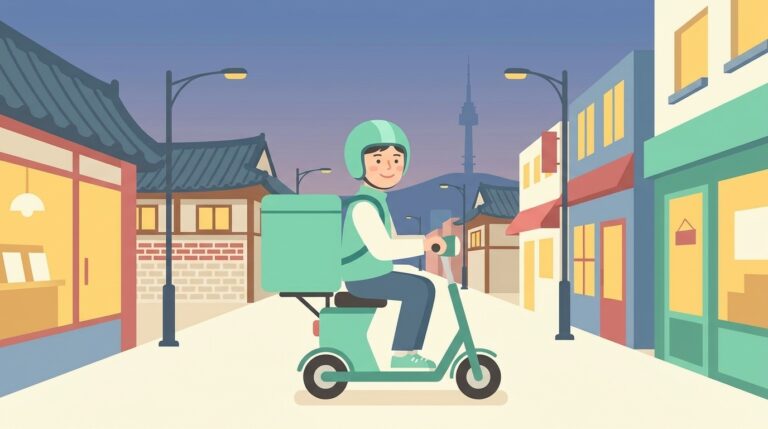
Master the Art of Checking Delivery Times in Korea
Phase 1: 공감 (Late-Night Cravings & The Ticking Clock)
안녕하세요! 매일한글 에디터입니다.
Imagine this: It is 11:30 PM on a rainy Friday in Seoul. You are cozy in your room, watching your favorite K-drama, and you finally decided to treat yourself to late-night chimaek (crispy fried chicken and beer). You navigated the delivery app with great pride, pressed order, and watched the countdown begin. But now, it has been 55 minutes. Your stomach is rumbling, the app status has not updated from “Preparing food,” and you are caught in that dreaded spiral of anxiety: Should I call? What if I sound rude or demanding? How do I even ask when my food will arrive in Korean without offending the shop owner?
Over the past ten years coaching international learners in Korea, I have seen so many students simply wait in silent agony for two hours or give up entirely just to avoid awkward phone calls. Delivery in Korea is world-renowned for its blazing speed, but delays happen—especially during peak dinner hours or bad weather. Asking about your order’s estimated time of arrival (ETA) is completely normal and expected, provided you wrap your question in natural, polite Korean phrasing.
By mastering the nuances in this guide, you will never have to pace your living room wondering where your dinner is. You will be able to check your delivery time with the calm confidence and effortless politeness of a true Seoulite!
Phase 2: 핵심 표현 3선 심층 분석 (Top 3 Essential Expressions)
1. 배달 얼마나 걸려요? (Baedal eolmana geollyeoyo?)
- Pronunciation: [Bae-dal eol-ma-na geol-lyeo-yo] (Think: “Bae” like before + “dahl” like doll, “all-mah-nah”, “girl-yuh-yo”)
- Meaning:
- Literal: Delivery how much does it take?
- Actual Nuance: “How long will the delivery take?” (Casual-polite, direct, and standard).
- K-Culture Moment: The quintessential phrase you hear in office K-dramas when coworkers order quick lunches like jajangmyeon during overtime.
- Editor’s Insight: This is your everyday workhorse phrase. The verb 걸리다 (geollida) specifically means “to take (time).” While perfectly polite due to the -요 ending, it gets straight to the point without fluffy honorifics.
- Situation Spectrum: Casual ✅ | Semi-formal ✅ | Formal ⚠️
- 🤔 Think About It: In English, we often ask “When will it get here?” focusing on the arrival point. In Korean, focusing on the duration of time (걸려요) often feels softer than pinning down an exact minute.
2. 혹시 지금 출발했나요? (Hoksi jigeum chulbalhaennayo?)
- Pronunciation: [Hok-si ji-geum chul-bal-haen-na-yo] (Think: “Hoke-see” + “jee-geum” + “chool-bahl-hane-nah-yo”)
- Meaning:
- Literal: By any chance, has it departed now?
- Actual Nuance: “Has the order gone out for delivery yet?”
- K-Culture Moment: That gentle, face-saving question a character asks over the phone when they suspect the kitchen might have forgotten their order.
- Editor’s Insight: The word 혹시 (hoksi – by any chance) is Korea’s ultimate politeness lubricant. Adding it before an inquiry instantly removes any trace of accusation or impatience, signaling that you understand they might be busy.
- Situation Spectrum: Casual ⚠️ | Semi-formal ✅ | Formal ✅
- 🤔 Think About It: Why is a word like “by any chance” so crucial in Korean service interactions? How does cushioning a question protect the dignity of the person on the other end?
3. 도착 예정 시간이 언제예요? (Dochak yeojeong sigani eonjeyeyo?)
- Pronunciation: [Do-chak yeo-jeong si-gan-i eon-je-ye-yo] (Think: “Dough-chahk” + “yuh-jung” + “see-gahn-ee” + “un-jeh-yeh-yo”)
- Meaning:
- Literal: When is the arrival scheduled time?
- Actual Nuance: “What is the estimated delivery time?”
- K-Culture Moment: Frequently seen in rider messaging apps or written customer service chat channels for logistics and courier services.
- Editor’s Insight: This expression uses Sino-Korean vocabulary (도착 = arrival, 예정 = scheduled/expected). It sounds professional, objective, and clear—perfect for text messages or customer service chats.
- Situation Spectrum: Casual 🚫 | Semi-formal ✅ | Formal ✅
- 🤔 Think About It: Notice how Sino-Korean compound nouns elevate spoken speech into professional inquiry. Can you think of similar Latinate formal phrasing in English?
Phase 3: 교과서 한국어 vs 진짜 한국어 (Textbook vs. Real-Life Korean)
Situation 1: Asking how many minutes are left on a delayed order
- 📖 교과서 한국어 (Textbook): 몇 분 후에 음식이 옵니까? (Myeot bun hue eumsigi omnikka? / After how many minutes will the food come?)
- 🗣️ 진짜 한국어 (Real-Life): 몇 분 정도 더 걸릴까요? (Myeot bun jeongdo deo geollilkkayo? / About how many more minutes might it take?)
- 💡 왜 다를까? (Why is it different?): Textbook Korean loves the stiff, military-style -ㅂ니까 ending. Real Koreans use 정도 (about/approximate) and the soft speculative ending -ㄹ까요? to keep the interaction warm and pressure-free.
Situation 2: Asking if the delivery driver has picked up the food
- 📖 교과서 한국어 (Textbook): 배달원이 음식을 가져갔습니까? (Baedalwoni eumsigeul gajyeogatseumnikka? / Did the delivery person take the food away?)
- 🗣️ 진짜 한국어 (Real-Life): 기사님 픽업하셨나요? (Gisanim pikeophasyeonnayo? / Has the driver picked it up already?)
- 💡 왜 다를까? (Why is it different?): Native speakers refer to drivers respectfully as 기사님 (gisanim), never the clinical term baedalwon. Furthermore, the loanword 픽업하다 combined with the honorific -시- is modern spoken shorthand.
Phase 4: K-Culture 딥다이브 & 비언어적 매너 (Deep Dive & Etiquette)
4-1. 눈치 (Nunchi) & Phone Mannerisms
When calling a restaurant or rider in Korea, your vocal tone does the work of a physical bow. Because face-to-face eye contact is absent, raise your pitch slightly at the start with a friendly “사장님 안녕하세요~” (Sajangnim annyeonghaseyo~).
* Active Listening (Chumsae): Constantly acknowledge what they say with soft, rhythmic nods like “아, 네네~” (Ah, ne-ne~).
* The Non-Aggressive Incline: When asking about late food, never open with “Why is it late?”. Always frame your delay as concern for the driver: “비가 와서 많이 밀리시죠?” (It’s raining, so traffic must be terrible, right?). This instantly triggers empathy on their end.
4-2. The 빨라빨리 (Ppal-li Ppal-li) Paradox
Korea boasts the fastest food delivery ecosystem on earth. You can order hot stew to a picnic mat on the banks of the Han River with a GPS pinpoint! However, this speed creates immense pressure on small business owners and motorcycle couriers. During sudden downpours or snow, “delivery delay notices” appear across apps. In Korean culture, checking delivery times is seen as reasonable, but demanding rush deliveries during adverse weather breaches cultural etiquette. Balance your hunger with warm understanding.
Phase 5: 실전 롤플레이 시나리오 (Real-World Roleplay Scenario)
Setting: It is 10:15 PM. You ordered tteokbokki and fried seaweed rolls 50 minutes ago from a neighborhood shop called “Seoul Bunsik.” The app said it would take 30 minutes. You decide to make a polite phone call.
- 사장님 (Shop Owner): [전화를 밝게 받으며] 네, 서울분식입니다!
(Ne, Seoulbunsik-imnida! / [Answering brightly] Hello, this is Seoul Bunsik!) - 나 (You): [차분하고 공손한 목소리로] 안녕하세요 사장님! 방금 배달 주문했는데요.
(Annyeonghaseyo sajangnim! Banggeum baedal jumunhaenneundeyo. / [Calm and polite voice] Hello, boss! I placed a delivery order just a little while ago.) - 사장님 (Shop Owner): [단말기 영수증을 확인하며] 아, 네! 주소가 어떻게 되시죠?
(Ah, ne! Jusoga eotteoke doesijyo? / [Checking the terminal receipt] Ah, yes! What is your address?) - 나 (You): [주소를 똑똑히 말하며] 마포동 102호예요. 배달 얼마나 걸려요?
(Mapo-dong 102-hoyeyo. Baedal eolmana geollyeoyo? / [Speaking clearly] It’s Mapo-dong Unit 102. How much longer will delivery take?) - 사장님 (Shop Owner): [미안한 표정으로 한숨 쉬며] 아이고, 주문이 밀려서 이제 포장 끝났어요. 혹시 많이 급하세요?
(Aigo, jumuni millyeoseo ije pojang kkeutnasseoyo. Hoksi mani geuphaseyo? / [Sighing with an apologetic tone] Oh dear, orders piled up so we just finished packaging. Are you in a big rush?) - 나 (You): [웃으며 부드럽게] 아, 아니에요! 혹시 지금 출발했나 궁금해서요.
(Ah, anieyo! Hoksi jigeum chulbalhaenna gunggeumhaeseoyo. / [Smiling and gentle] Ah, not at all! I was just wondering if it had departed yet.) - 사장님 (Shop Owner): [안도하며 빠르게] 방금 기사님이 픽업하셨으니 10분 정도 더 걸릴 거예요! 죄송해요!
(Banggeum gisanimi pikeophasyeosseuni sip-bun jeongdo deo geollil geoyeyo! Joesonghaeyo! / [Relieved and speaking swiftly] The driver just picked it up, so it’ll take about 10 more minutes! Sorry about that!) - 나 (You): [밝게 감사 인사를 전하며] 네, 알겠습니다! 조심히 오세요!
(Ne, algessseumnida! Josimhi oseyo! / [Brightly expressing thanks] Yes, understood! Tell them to drive safely!)
🔀 인터랙티브 분기점 (Interactive Branch)
When the owner explains that packaging just finished, what would you say next?
- Choice A: “너무 늦었으니까 그냥 주문 취소해 주세요.” (It’s too late, so just cancel my order.)
- ⚠️ Risk: While your right, food made specifically for you cannot always be canceled without dispute once cooked. It leaves a bitter impression unless the delay exceeded an hour.
- Choice B: “괜찮아요! 천천히 안전하게 가져다주세요.” (That’s totally fine! Please bring it slowly and safely.)
- 🌟 Best: Shows top-tier empathy (nunchi). Often earns you a complimentary canned soda or extra fried dumplings (service) from a grateful owner!
- Choice C: “왜 30분 걸린다고 거짓말하셨어요?” (Why did you lie that it takes 30 minutes?)
- 🚫 Bad: Highly aggressive. Confrontational language causes immediate defensive friction in Korean culture.
Phase 6: 10초 감정 섀도잉 드릴 (Emotional Shadowing Drill)
Read these out loud, observing the / pauses and matching the emotional cues!
[😊 조심스럽고 다정하게 - Polite and gentle]
혹시 / 지금 출발했나요? / 천천히 오셔도 돼요.
(Hoksi / jigeum chulbalhaennayo? / cheoncheonhi osyeodo dwaeyo.)
By any chance… has it departed? / It’s fine to take your time!-
[🤔 궁금하지만 부드럽게 - Inquisitive yet soft]
도착 예정 시간이 / 대략 몇 분 정도 / 남았을까요?
(Dochak yeojeong sigani / daeryak myeot bun jeongdo / namasseulkkayo?)
For the estimated arrival time… / roughly how many minutes / might be remaining? -
[🙏 따뜻하고 배려 넘치게 - Warm and considerate]
비가 많이 오는데 / 기사님 / 조심히 와주세요!
(Biga mani oneunde / gisanim / josimhi wajuseyo!)
It is raining heavily… / dear rider / please come safely!
Phase 7: K-Culture 미니 사전 (Mini Dictionary)
- 배달팁 (Baedal-tip): Delivery fee. Unlike voluntary tipping in Western restaurants, this is a fixed, non-negotiable delivery surcharge calculated by distance and weather.
- 기사님 (Gisanim): Literally “esteemed driver/technician.” The standard, universally respectful title used for delivery riders, taxi drivers, and bus operators.
- 문 앞 배송 (Mun ap baesong): Front-door delivery. Selecting this in an app tells the rider to leave the food quietly outside your door and ring the bell.
- 요청사항 (Yocheongsahang): Special request section. Where you write practical delivery notes, like “Please don’t ring the doorbell because the baby is sleeping” (아기가 자고 있어요. 벨 누르지 말아주세요).
Phase 8: 여행자를 위한 생존 키트 (Traveler’s Survival Kit)
Top 3 Survival Phrases
- 1. 문 앞에 두고 가주세요. (Mun ape dugo gajuseyo.)
Meaning: Please leave it in front of the door.
💡 Pro Tip: Perfect if you are jetlagged, in your pajamas, or still practicing your Korean speaking confidence. - 2. 벨 누르고 문 앞에 놔주세요. (Bel nureugo mun ape nwajuseyo.)
Meaning: Please ring the bell and place it in front of the door. - 3. 얼마나 더 기다려야 해요? (Eolmana deo gidaryeoya haeyo?)
Meaning: How much longer do I have to wait?
💡 Pro Tip: Use this only when a delivery is severely overdue (over 40 minutes late).
Editor’s Travel Note
Foreign visitors often struggle with Korean delivery apps because they frequently require local mobile carrier verification. However, you can download the global friendly 배달의민족 (Baemin) 공식 안내 or use services like Yogiyo and Coupang Eats that accept international credit cards. If you stay in a hotel, remember that most delivery couriers cannot access guest floor elevators. Set your location as the hotel lobby entrance and wait down there when the ETA draws close!
Phase 9: “한 발 더 깊이” (Reflective Essay)
In South Korea, delivery riders are woven into the very fabric of metropolitan life. During freezing winter nights or blistering summer heat, these riders bridge the gap between small local kitchens and hungry homes. When Koreans inquire about late deliveries, they frequently finish the sentence with “조심히 오세요” (Please come safely). This linguistic habit reflects a collectivist awareness: our desire for fast food should never outweigh another human being’s physical safety on a slick asphalt road. Language is more than grammar; it is a mirror of social empathy.
💬 Your Turn: How does your home culture handle food delivery delays? Do you prefer calling directly, or do you rely strictly on app notifications? Share your stories in the comments below!
Phase 10: FAQ & 흔한 실수 (FAQ & Common Mistakes)
Q: Can I call the delivery rider directly on their phone?
A: Yes, delivery apps in Korea usually provide a temporary masked phone number (안심번호) for the driver once pickup is completed. However, calling while they are maneuvering a motorcycle in traffic can be hazardous. It is often safer to text them through the app or call the restaurant first.
Q: Why did the app suddenly add 20 minutes to my arrival time?
A: This usually happens when the restaurant is experiencing a “kitchen rush” (jumun millim) or when severe weather conditions prompt the system to prioritize rider safety by adjusting the dispatch algorithm.
Q: What should I say if they delivered my food to the wrong door?
A: Say politely: “음식이 다른 집 앞으로 간 것 같아요. 확인 부탁드립니다.” (It seems the food went to a different door. Please check for me.)
🚨 흔한 실수 (Common Mistakes) Checklist
- Mistake: Addressing the rider as “아저씨 (Ajeossi)”.
- Correct Action: Always use the respectful title 기사님 (Gisanim). Ajeossi can sound slightly dismissive to service providers.
- Mistake: Forgetting to state your delivery address when calling the shop.
- Correct Action: Restaurants handle dozens of orders at once. Start with your neighborhood and room number: “마포동 102호 주문자인데요…” (I’m the person who ordered for Mapo-dong #102…).
- Mistake: Using stiff, blunt questions like “언제 와요?” (When are you coming?).
- Correct Action: Add the magic softener: “혹시 언제쯤 도착할까요?” (By any chance, around when might it arrive?).
Phase 11: 액션 미션 & 참여 유도 (Action Missions)
- 🥉 Bronze Mission (Solo Shadowing): Stand in front of your mirror and practice saying: “혹시 지금 출발했나요? 조심히 오세요!” three times with a bright, welcoming vocal tone.
- 🥈 Silver Mission (Social Media): Post a screenshot of your favorite K-food craving on Instagram or Threads and caption it in Korean with the phrase: 배달 얼마나 걸려요?
- 🥇 Gold Mission (Real Life Action): The next time you order delivery or takeout in Korea, write “기사님, 빗길에 조심히 오세요! (Rider, please drive safely on the wet roads!)” in the delivery note field.
- 🎮 K-Culture Mission: Watch an episode of a modern reality show like I Live Alone (나 혼자 산다) and spot how celebrities interact when their food delivery arrives!
Phase 12: 인터랙티브 퀴즈 챌린지 (Interactive Quiz)
Test your skills with these three quick questions!
Q1. Which of the following is the most polite, natural way to check if your food has left the kitchen?
(A) 왜 아직도 안 와요?
(B) 혹시 지금 출발했나요?
(C) 빨리빨리 배달해 주세요.
👉 정답 및 해설 보기 (Click to view Answer & Explanation)
- 정답: (B)
- 해설: “혹시 지금 출발했나요?” uses the buffer word 혹시 (by any chance) and the polite inquisitive ending -했나요?, making it the gold standard of polite communication. (A) is rude, and (C) sounds demanding.
Q2. Fill in the blank: “약 15분 ______ 더 걸릴 것 같아요.” (It will likely take about 15 more minutes.)
(A) 정도 (jeongdo)
(B) 사람 (saram)
(C) 매일 (maeil)
👉 정답 및 해설 보기 (Click to view Answer & Explanation)
- 정답: (A)
- 해설: 정도 (jeongdo) means “about” or “approximately” when attached after time units (e.g., 15분 정도 = about 15 minutes).
Q3. True or False? In Korea, calling a delivery driver “배달원!” (Baedalwon!) directly is the most respectful form of address.
👉 정답 및 해설 보기 (Click to view Answer & Explanation)
- 정답: False
- 해설: Baedalwon is a formal occupational noun found in statistics or news articles. In daily speech, always address them respectfully as 기사님 (Gisanim)!







