

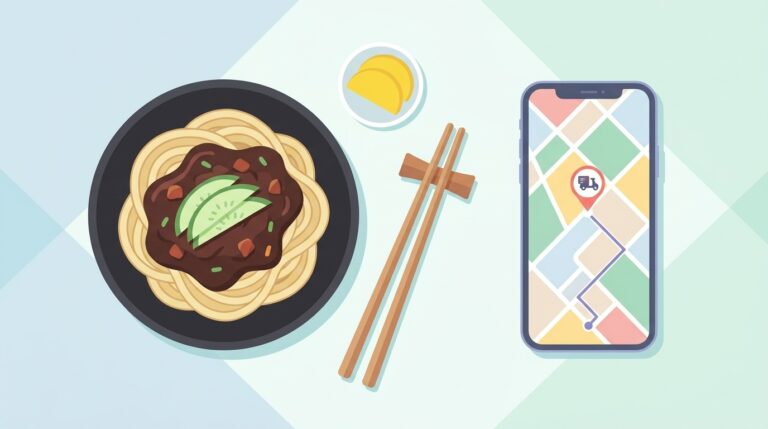
Phase 1: 공감 (Story-driven Opening)
안녕하세요! 매일한글 에디터입니다. Have you ever found yourself sitting on your living room floor at 11 PM, watching a K-drama character aggressively mix a glossy, jet-black bowl of Jjajangmyeon, while your stomach lets out an embarrassing roar? We have all been there! But then reality hits: you want to order food delivery in Korea, yet opening an app or speaking on the phone triggers instant panic. What if the restaurant asks a question you don’t understand? What if you accidentally order five bowls instead of one? Don’t worry at all! Based on real coaching feedback from dozens of our A2 beginner students, I have crafted this foolproof survival guide so you can order Korea’s favorite comfort food with total confidence. Let’s dive in together!
Phase 2: 핵심 표현 3선 심층 분석 (Top 3 Essential Expressions)
1. 짜장면 한 그릇 배달해 주세요 (Jjajangmyeon han geureut baedalhae juseyo)
- Pronunciation: [Jjajangmyeon han geureut baedal-hae joo-seh-yo] (Think of Jja like a crisp ‘cha-cha’, geureut like ‘good’ ending with a soft ‘t’, and baedal like the English word ‘pedal’ with a soft ‘b’.)
- Meaning: Literal: “Please deliver one bowl of Jjajangmyeon.” / Real Nuance: “Hi, I’d like to place a delivery order for one Jjajangmyeon, please.”
- K-Culture Moment: You hear this line in almost every slice-of-life drama when college students or overworked office workers order lunch directly to their study rooms or offices.
- Editor’s Insight: In Korean, counting units matter! For food in bowls, we use 그릇 (geureut). Even if you forget the counter, saying “짜장면 하나 배달해 주세요 (Jjajangmyeon hana baedalhae juseyo)” works perfectly fine for everyday situations.
- Situation Spectrum: Casual ⚠️ | Semi-formal ✅ | Formal ✅
- 🤔 Think About It: In English, we simply say “a pizza” or “a burger,” but Korean pairs specific counters to item shapes (e.g., bowls, bottles, plates). How does this reflect the visual-oriented nature of Korean description?
2. 단무지 많이 주세요 (Danmuji mani juseyo)
- Pronunciation: [Dan-moo-jee mah-nee joo-seh-yo] (Danmuji sounds like ‘Dan-moo-jee’, and mani sounds like ‘money’ spoken quickly with a light ‘ah’ sound.)
- Meaning: Literal: “Please give me a lot of yellow pickled radish.” / Real Nuance: “Could you throw in extra yellow radish pickles, please?”
- K-Culture Moment: The iconic yellow, crunchy pickled radish is the ultimate soulmate of greasy black bean noodles. Koreans will happily forfeit extra napkins before they give up extra Danmuji!
- Editor’s Insight: Koreans love generosity in side dishes. Asking for 많이 (mani – a lot) is never considered rude in casual eateries—it actually shows you appreciate their side dishes!
- Situation Spectrum: Casual ✅ | Semi-formal ✅ | Formal ⚠️
- 🤔 Think About It: In many Western restaurants, asking for “extra” side dishes might mean an additional line on your bill. Why do you think Korean food culture considers banchan (side dishes) an open hospitality gift?
3. 문 앞에 두고 벨 눌러 주세요 (Mun ape dugo bel nulleo juseyo)
- Pronunciation: [Moon ahp-eh doo-goh bell nool-ler joo-seh-yo] (Mun sounds like ‘moon’, ape like ‘up-eh’, and bel like ‘bell’.)
- Meaning: Literal: “Leave it in front of the door and press the bell.” / Real Nuance: “Please leave it at my door and ring the doorbell.”
- K-Culture Moment: Essential for contactless delivery! Whether you’re working in your pajamas, feeling introverted, or binge-watching shows, this is the #1 instruction written on modern delivery notes.
- Editor’s Insight: If you don’t want the bell to wake up a sleeping roommate or pet, swap 벨 눌러 주세요 for 문자 주세요 (munja juseyo – please text me).
- Situation Spectrum: Casual ⚠️ | Semi-formal ✅ | Formal ✅
- 🤔 Think About It: Notice how polite requests end in ~주세요 (~juseyo). It keeps your delivery instruction respectful even when you are giving directions to a busy courier.
Phase 3: 교과서 한국어 vs 진짜 한국어 (Textbook vs. Real-Life Korean)
Situation 1: Asking if delivery is available
- 📖 교과서 한국어 (Textbook Korean): 배달이 가능합니까? (Baedari ganeunghabnikka? – Is delivery feasible?)
- 🗣️ 진짜 한국어 (Real-Life Korean): 배달 돼요? (Baedal dwaeyo? – Do you deliver?)
- 💡 Why is it different? Textbook phrases use stiff, hyper-formal verb endings like
-합니까 (-habnikka). In real life, native speakers prefer the concise, warm, and natural-해요 (-haeyo)form.
Situation 2: Asking how long the food will take
- 📖 교과서 한국어 (Textbook Korean): 배달하는 데 시간이 얼마나 소요됩니까? (Baedalhaneun de sigani eolmana soyodoebnikka? – How much time will the delivery consume?)
- 🗣️ 진짜 한국어 (Real-Life Korean): 얼마나 걸려요? (Eolmana geollyeoyo? – How long will it take?)
- 💡 Why is it different? The Chinese-character verb
소요되다 (soyodoeda - to take/consume)sounds like an official transit announcement! Real conversational Korean relies on the natural verb걸리다 (geollida - to take time).
Phase 4: K-Culture 딥다이브 & 비언어적 매너 (Culture & Non-Verbal Manners)
4-1. 눈치 (Nunchi) & Delivery Gestures
When interacting directly with a delivery rider at your front door, body language speaks louder than words:
* Two-Handed Courtesy: When receiving the plastic food bag, use both hands or hold one forearm with your opposite hand. This micro-gesture communicates high respect and gratitude.
* The 15-Degree Nod: A slight, swift upper-body bow accompanied by “감사합니다! (Gamsahamnida! – Thank you!)” acknowledges the hard work of the rider who dashed through traffic for you.
4-2. Cultural Code: The Moving Day Jjajangmyeon & The Great Sauce Debate
In Korea, eating Jjajangmyeon is a sacred tradition on 이삿날 (Isannal – Moving Day). Because your kitchen appliances are still packed in boxes and everyone is covered in dust, Jjajangmyeon is the cheapest, quickest, and most satisfying reward meal.
Furthermore, when you order sweet and sour pork (탕수육 – Tangsuyuk) with your noodles, you will face Korea’s greatest culinary feud:
* 부먹 (Bumeok): Pouring the sweet sauce all over the crispy pork.
* 찍먹 (Jjikmeok): Dipping each piece individually into the sauce to keep the batter crunchy.
* Pro-tip: If you are eating with Korean friends, always ask: “부먹이에요, 찍먹이에요? (Bumeogieyo, jjikmeogieyo?)” before touching the sauce container!
Phase 5: 실전 롤플레이 시나리오 (Real-Life Roleplay Scenario)
Setting: 8:30 PM on a Friday. You are craving noodles and decide to call the legendary neighborhood Chinese restaurant Dongbo-seong (동보성).
Characters: You (Hungry learner) and Ajusshi (The energetic restaurant owner).
- Ajusshi: 네, 동보성입니다! (Ne, Dongboseong-imnida!)
🎭 Action: Answers on the first ring with rapid, cheerful neighborhood energy.
Translation: “Yes, this is Dongbo-seong!” -
You: 안녕하세요, 배달 돼요? (Annyeonghaseyo, baedal dwaeyo?)
🎭 Action: Speaking clearly with polite tone.
Translation: “Hello, do you deliver?” -
Ajusshi: 네, 됩니다! 어디신가요? (Ne, doemnida! Eodisingayo?)
🎭 Action: Pen clicking sound in the background.
Translation: “Yes, we do! Where are you located?” -
You: 역삼동 101호예요. (Yeoksam-dong baek-il-hoyeyo.)
🎭 Action: Stating your neighborhood area and room number.
Translation: “It is Yeoksam-dong, room 101.” -
Ajusshi: 네, 뭐 갖다 드릴까요? (Ne, mwo gatda deurilkkayo?)
🎭 Action: Listening attentively to jot down order.
Translation: “Alright, what can I bring you?” -
You: 짜장면 한 그릇하고 짬뽕 하나 주세요. (Jjajangmyeon han geureuthago jjamppong hana juseyo.)
🎭 Action: Checking notes to order noodles.
Translation: “Please give me one bowl of Jjajangmyeon and one spicy seafood noodle soup.” -
Ajusshi: 단무지는 더 챙겨 드려요? (Danmujineun deo chaenggyeo deuryeoyo?)
🎭 Action: Asking considerately before closing receipt.
Translation: “Shall I pack extra yellow pickled radish for you?” -
You: 네! 단무지 많이 주세요. 문 앞에 두고 벨 눌러 주세요! (Ne! Danmuji mani juseyo. Mun ape dugo bel nulleo juseyo!)
🎭 Action: Smiling into the phone.
Translation: “Yes! Lots of radish please. Please leave it at the door and ring the bell!”
🔀 Interactive Decision Point: The Owner Asks About Payment!
The owner says: “결제는 어떻게 하시겠어요? (Gyeoljeneun eotteoke hasigesseoyo? – How would you like to pay?)”
- Option A: “카드로 할게요! (Kadeuro halkkeyo! – I will pay by card!)”
Feedback: [BEST CHOICE] Clean, clear, and perfectly natural. The rider will prepare a portable card reader. - Option B: “돈 없어요. (Don eopseoyo. – I have no money.)”
Feedback: [BAD CHOICE] Yikes! This sounds like you are expecting free charity food or attempting dine-and-dash fraud. Avoid! - Option C: “직접 줄게요. (Jikjeop julgeyo. – I will give it directly.)”
Feedback: [RISK] Grammatically awkward and ambiguous. Does it mean cash or card? Instead, say “만나서 현금 결제할게요 (Mannaseo hyeongeum gyeoljehalkkeyo – I’ll pay cash in person)”.
Phase 6: 10초 감정 섀도잉 드릴 (10-Second Emotion Shadowing Drill)
Practice these lines with pause marks (/) and dynamic pitch changes:
[😊 Hungry & Excited]
짜장면 / 한 그릇 / 배달해 주세요!
(Jjajangmyeon / han geureut / baedalhae juseyo!)-
[🙏 Sweet & Craving]
단무지 / 진짜 / 많이 주세요!
(Danmuji / jinjja / mani juseyo!) -
[🤫 Quiet & Polite]
문 앞에 두고 / 벨만 / 살짝 눌러 주세요.
(Mun ape dugo / belman / saljjak nulleo juseyo.)
Phase 7: K-Culture 미니 사전 (Mini Dictionary)
-
탕짜면 (Tangjjamyeon)
Translation: Tangsuyuk + Jjajangmyeon split bowl.
Real-Life Usage: When you crave deep-fried pork but eating a full dish by yourself is too expensive or heavy, order this genius dual-bowl invention. -
곱빼기 (Gopbaegi)
Translation: Extra-large jumbo portion (double portion).
Real-Life Usage: Starving after a hike or workout? Say: “짜장면 곱빼기로 주세요 (Jjajangmyeon gopbaegiro juseyo – Make my Jjajangmyeon a jumbo size, please!)” usually for just an extra 1,000 KRW. -
찍먹 vs 부먹 (Jjikmeok vs Bumeok)
Translation: Dipping sauce eater vs Pouring sauce eater.
Real-Life Usage: A playful personality test at Korean dinner tables that sparks endless friendly debates. -
서비스 (Seobiseu)
Translation: Compliments of the house / Free bonus item.
Real-Life Usage: If you order a large family meal, the restaurant might include fried dumplings (군만두 – Gunmandu) with a cheerful note: “서비스예요! (It’s on the house!)”
Phase 8: 여행자를 위한 생존 키트 (Traveler’s Survival Kit)
Survival Expressions TOP 3
- 젓가락 두 개 챙겨 주세요. (Jeotgarak du gae chaenggyeo juseyo.)
Romanization: [Jeot-gah-rahk doo geh chaeng-gyuh joo-seh-yo]
Pro Tip: Modern delivery apps default to no disposable cutlery. Use this phrase if you don’t have chopsticks at your Airbnb! - 얼마나 걸려요? (Eolmana geollyeoyo?)
Romanization: [Uhl-mah-nah gull-lyuh-yo?]
Pro Tip: Perfect for checking delivery ETA politely. - 맛있게 잘 먹겠습니다! (Masitge jal meokgetseumnida!)
Romanization: [Mah-sheet-geh jahl muhk-get-seum-nee-dah]
Pro Tip: Said before opening your food container as a show of appreciation for the meal.
Editor’s Travel Note
Navigating Korean delivery apps as a traveler without an ARC (Alien Registration Card) used to be tough, but you now have great options! Check out English-friendly services by visiting the Coupang Eats delivery app download or the Shuttle Delivery official website which accept foreign credit cards. If ordering by phone, prepare cash or say “카드로 결제할게요 (Kadeuro gyeoljehalkkeyo)” when placing your order.
Phase 9: “한 발 더 깊이” (Cultural Reflection)
Korean delivery culture is not simply about fast logistics; it reflects the deep social principle of 신뢰 (Sinroe – Mutual Trust) and the rapid pulse of 빨리빨리 (Ppalli-ppalli – Quick, Quick) culture. For decades, traditional Korean restaurants delivered warm porcelain bowls wrapped in steel carriers without upfront payments, expecting customers to simply leave clean bowls outside their doorsteps for collection the next morning. While disposable plastic and digital payments have modernized the experience, this underlying warmth and mutual trust remain at the heart of Korean hospitality.
💬 Your Turn: Have you ever experienced food delivery late at night in your hometown? How does it compare to Korea’s ultra-speedy motorcycle culture? Drop your stories in the comments below!
Phase 10: FAQ & 흔한 실수 (FAQ & Common Mistakes)
Q: Can I order just one bowl of Jjajangmyeon for delivery in Korea?
A: Yes! While some restaurants set a minimum order amount (최소주문금액 – Choeso jumun geumaek), many neighborhood Chinese diners will deliver a single bowl, sometimes with a small delivery fee.
Q: What should I do with the empty plastic containers after eating?
A: Rinse them thoroughly with warm water to remove grease and dark sauce stains, then separate the clear plastic lids and containers into your building’s designated recycling area.
Q: Is tipping customary for food delivery couriers in Korea?
A: No! Tipping is not part of Korean culture. The delivery fee is already included in your order total, so a heartfelt bow and “감사합니다 (Thank you)” is the best reward.
🚨 Common Mistakes Alert Board
- Mistake: Forgetting to request cutlery on apps.
Correct Action: Toggle the “일회용 수저 필요해요 (I need disposable utensils)” button in the app checkout menu. - Mistake: Confusing Jjajangmyeon with Jjambbong.
Correct Action: Jjajangmyeon (짜장면) is the black savory bean sauce noodle; Jjambbong (짬뽕) is the spicy red seafood broth noodle. - Mistake: Saying “고마워 (Gomawo)” to the delivery rider.
Correct Action: Gomawo is informal banmal used only with close friends. Always use the respectful polite form: “감사합니다! (Gamsahamnida!)”
Phase 11: 액션 미션 & 참여 유도 (Action Missions)
- 🥉 Bronze Mission (Solo Practice): Stand in front of your mirror and practice saying: “짜장면 한 그릇 배달해 주세요!” smoothly in under 3 seconds.
- 🥈 Silver Mission (Social Sharing): Share this phrase on your Instagram Story or study notes, tagging your favorite Korean drama snack buddy.
- 🥇 Gold Mission (Real Action): Use a delivery app or visit a local Korean noodle shop to order food in Korean using the phrase “문 앞에 두고 벨 눌러 주세요” or “단무지 많이 주세요”!
🎮 K-Culture Mission: In your next K-drama watch party, spot an actor slithering down Jjajangmyeon noodles and pause to repeat the exact counter word they used!
Phase 12: 인터랙티브 퀴즈 챌린지 (Interactive Quiz Challenge)
Question 1 (Situational): You want to tell the restaurant rider to leave the food by your front entrance and ring the bell. Which sentence should you write in the memo?
* A) 문 앞에서 기다려 주세요. (Wait in front of the door.)
* B) 문 앞에 두고 벨 눌러 주세요. (Leave it at the door and ring the bell.)
* C) 문을 열고 들어오세요. (Open the door and come in.)
Question 2 (Fill-in-the-Blank): Complete the phrase to ask for extra pickled yellow radish:
* “단무지 _______ 주세요!” (mani / jogeum)
Question 3 (True/False): In Korea, it is mandatory to leave a cash tip for delivery drivers upon arrival. (True / False)
👉 Click to reveal answers & explanations!
- Answer 1: B! Option B is the exact courteous standard phrase for contactless delivery. Option A makes them wait, and Option C invites a stranger into your private home!
- Answer 2: 많이 (mani)! 많이 means “a lot / plenty”. (If you said 조금 (jogeum), you would be asking for “a little bit” of radish!)
- Answer 3: False! Tipping is not practiced in Korea. A warm verbal thank you (“감사합니다”) is all that is expected!







