

Phase 1: Empathy (Immersion & Story-Driven Opening)
안녕하세요! 매일한글 에디터입니다.
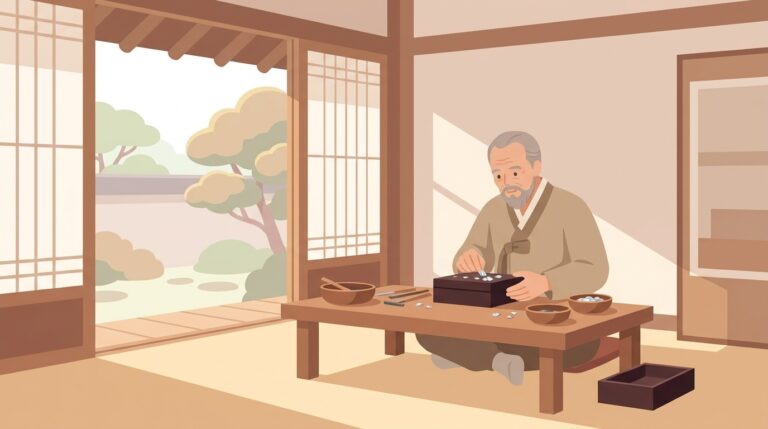
Imagine walking through the stone-walled alleys of Bukchon or the timber-scented workshops of Jeonju. You peer inside a quiet gongbang (craft studio) where a gray-haired master is meticulously laying gossamer-thin mother-of-pearl strips onto black lacquer—a painstaking craft known as Najeonchilgi. You have studied Korean for years, passed TOPIK Level 5 or 6, and feel confident discussing macroeconomics, social dynamics, or your favorite K-dramas. But the second you step across the threshold to talk about the generational survival of traditional crafts, your tongue locks up. You find yourself blurting out elementary phrasing like: “이거 진짜 오래됐네요. 인기가 없어서 힘들겠어요” (Igeo jinjja oraedaenneyo. Ingiga eopseoseo himdeulgesseoyo – “This is really old. It must be tough because it’s not popular”).
Instantly, the air freezes. You didn’t mean to sound dismissive, yet your vocabulary failed to honor the spiritual gravitas and multi-century resilience of Korean Intangible Cultural Heritage (Muhyeong Yusan). When engaging with master artisans (Jang-in) or discussing heritage preservation in university seminars and museum tours, clinical textbook phrases fall flat. Based on over ten years of coaching advanced learners who felt tongue-tied in cultural heritage contexts, this guide unpacks the high-register, philosophically rich language needed to discuss transmission, lineage, and cultural preservation like an authentic cultural insider. Let’s elevate your Korean into the realm of true nuance.
Phase 2: Core Expressions (Top 3 In-Depth Analysis)
1. 대를 잇다 (Dae-reul itda)
- Pronunciation: [Dae-reul itda] (Think of dae like “day” with a soft ‘t’ ending, and itda like “eat-dah” with a sharp stop).
- Meaning: Literal: “To connect the generations” | Nuanced: To carry forward a familial, artistic, or cultural lineage despite steep hardships.
- K-Culture Moment: Commonly heard in historical epics and documentaries, such as master potters in Icheon or pansori singers reflecting on their apprentices dedicating decades to continuing a fragile family craft.
- Editor’s Insight: Unlike the utilitarian verb gyeseunghada (to inherit/succeed), dae-reul itda evokes an emotional chain of human lives sacrifice. It acknowledges the weight of ancestry and commitment.
- Situation Spectrum: Casual: ⚠️ | Semi-formal: ✅ | Formal: ✅
- 🤔 Think About It: In your native tongue, do you describe preserving a craft in terms of institutional legacy, or as a bloodline/familial continuity as Koreans do with the word dae (generation)?
2. 맥이 끊기다 (Maeg-i kkeunkida)
- Pronunciation: [Mae-gi kkeun-ki-da] (Pronounce maek like “mac” with an open vowel; kkeunkida begins with a tense double-k sound like the ‘k’ in “sky”).
- Meaning: Literal: “The pulse/artery is severed” | Nuanced: A traditional practice, aesthetic lineage, or cultural continuity has completely died out or lost its living practitioners.
- K-Culture Moment: Used poignantly in investigative cultural programs and heritage documentaries when reporting that the last surviving weaver of Hansan ramie fabric (Hansan Mosi) has passed away without an initiated apprentice.
- Editor’s Insight: Maek refers to the arterial pulse in traditional medicine and the geomantic spine of mountains (Baekdudaegan). To say the maek is cut means the living lifeblood of the heritage has ceased flowing.
- Situation Spectrum: Casual: ⚠️ | Semi-formal: ✅ | Formal: ✅
- 🤔 Think About It: Why does Korean culture treat intangible traditions as living biological organisms with pulses (maek) rather than static historical artifacts?
3. 전수받다 (Jeonsu-batda)
- Pronunciation: [Jeon-su-bat-da] (Jeon sounds like “John” with a soft ‘o’, su like “sue”, batda like “baht-dah”).
- Meaning: Literal: “To receive transmission” | Nuanced: To be personally initiated into the profound, unwritten mastery and secret techniques of an art form directly by an authorized grandmaster.
- K-Culture Moment: In the drama Jeongnyeon: The Star is Born, when young traditional theater singers struggle through grueling master-disciple training to inherit vocal techniques (deuk-eum).
- Editor’s Insight: Do not confuse this with baeuda (to learn). You learn Spanish or guitar; you jeonsu-batda an Intangible Cultural Property technique that carries legal and spiritual responsibility under national stewardship.
- Situation Spectrum: Casual: 🚫 | Semi-formal: ✅ | Formal: ✅
- 🤔 Think About It: How does the social contract of learning change when the skill requires official state-sanctioned transmission (jeonsu) rather than just informal commercial training?
Phase 3: Textbook Korean vs. Real Korean
Situation 1: Expressing that a traditional craft is barely surviving
- 📖 교과서 한국어: 이 전통 기술은 인기가 없어서 곧 사라질 것입니다. (I jeontong gisul-eun ingiga eopseoseo got sarajil geosimnida.) — “Because this traditional technique lacks popularity, it will disappear soon.”
- 🗣️ 진짜 한국어: 워낙 전수자가 귀해서 겨우 명맥만 유지하고 있는 실정이에요. (Wonak jeonsujaga gwihaeseo gyeou myeongmaengman yujihago inneun siljeong-ieyo.) — “Initiated apprentices are so scarce that it’s in a state of barely keeping its faint lineage alive.”
- 💡 왜 다를까?: The textbook version sounds blunt, unsympathetic, and overly commercial (“no popularity”). Advanced native speakers use myeongmaek (faint lifeline) and siljeong (actual state of affairs) to express solemn empathy for the craft’s endangered status.
Situation 2: Praising an artisan’s lifelong dedication
- 📖 교과서 한국어: 선생님은 아주 오랜 시간 동안 이 공예를 열심히 만들었습니다. (Seonsaengnim-eun aju oraen sigan dong-an i gong-yereul yeolsimhi mandeureotseumnida.) — “Teacher, you have made this craft diligently for a very long time.”
- 🗣️ 진짜 한국어: 평생을 바쳐 묵묵히 외길 인생을 걸어오신 장인정신에 절로 고개가 숙여집니다. (Pyeongsaeng-eul bachyeo mungmukhi oegil insaeng-eul geol-eomosin jang-injeongsine jeollo gogaega sugyeojimnida.) — “I naturally bow my head in reverence to your craftsmanship, having silently walked this singular path for an entire lifetime.”
- 💡 왜 다를까?: Saying someone “worked hard making things” minimizes cultural reverence. Phrases like oegil insaeng (a life on a single road) and gogaega sugyeojida (one’s head bows spontaneously in deep respect) reflect the elevated aesthetic praise customary in Korean cultural heritage circles.
Phase 4: K-Culture Deep Dive & Non-verbal Manners
4-1. 눈치 (Nunchi) & Spatial Etiquette in the Master’s Workshop
When stepping into an artisan’s studio (gongbang) or an academy for traditional performing arts (jeonsugwan), your physical presence speaks before your mouth does:
* Hand Placement: Never touch raw materials, lacquered trays, or traditional chisels without explicit permission. When invited to hold an artifact, cradle it with both hands (du son-euro), elbows tucked close to your torso, maintaining a slightly bent posture to minimize the drop distance if it slips.
* Physical Height Hierarchy: If the master sits cross-legged on the floor working on a low table, never stand towering directly over them while talking. Kneel or sit on your heels (gureoanja) to keep your eye level slightly below theirs.
* The Nunchi of Silence: True craftsmanship requires intense acoustic and tactile concentration. Avoid filling quiet spaces with nervous chatter. Observe in stillness until the artisan sets down their tools and offers tea.
4-2. Cultural Code: The “Human Cultural Asset” Ecosystem
Korea holds one of the world’s most sophisticated legal frameworks for heritage preservation: the Gukga Muhyeong Yusan (National Intangible Cultural Heritage) system. Masters are recognized as Boyuja (Holders), colloquially honored as Ingan-munhwajae (“Living National Treasures”). Below them stand Isuja (Certified Completers) and Jeonsusaeng (Apprentices). Understanding this hierarchy prevents social blunders—never casually call an official Holder just a “technician” (gisulja); they are stewards of national identity.
Phase 5: Real-World Roleplay Scenario
Setting: The lacquerware workshop of Master Park Sung-ho, a certified holder of traditional Mother-of-Pearl craft (Najeonchilgi), situated in Tongyeong. Rain gently taps on the courtyard stones.
Characters:
* Julian: An overseas curator researching intangible crafts (C1 level).
* Master Park: A 74-year-old Living National Treasure who has preserved the workshop for 50 years.
- Turn 1 (Julian): 선생님, 작업 중에 불쑥 찾아뵈어 송구합니다. 공방의 결이 참 깊습니다. (Seonsaengnim, jageop jung-e bulssuk chajabaeweo songguhamnida. Gongbang-ui gyeori cham gipseumnida.)
🎭 Bowing at a precise 45-degree angle, holding his notebook with both hands.
“Master, I apologize for intruding while you are working. The atmosphere and character of this workshop feel profound.” -
Turn 2 (Master Park): 아이고, 먼 길 오느라 욕봤소. 마침 옻칠을 말리던 참이니 편히 앉으시오. (Aigo, meon gil oneura yokbwatso. Machim otchireul mallideon cham-ini pyeonhi anjeusio.)
🎭 Wiping his hands on an indigo cloth, gesturing warmly toward a wooden floorboard.
“Oh, you had a tough journey coming from afar. I was just setting the lacquer to dry, so please sit comfortably.” -
Turn 3 (Julian): 조심스럽습니다만, 이 영롱한 자개 빛깔의 맥을 잇는 일이 점점 지난해지고 있다고 들었습니다. (Josimseoreopseumnida-man, i yeonglonghan jagae bitkkalui maegeul inneun iri jeomjeom jinanhaejigo itdago deureotseumnida.)
🎭 Looking with reverence at the finished chest, maintaining a modest, soft vocal cadence.
“If I may say so cautiously, I have heard that maintaining the lifeline of this luminous mother-of-pearl craftsmanship is becoming increasingly arduous.” -
Turn 4 (Master Park): 허허, 그렇지요. 손이 워낙 많이 가고 돈벌이가 안 되니 젊은이들이 쉬이 버티질 못해요. (Heoheo, geureochiyo. Soni wonak mani gago donbeoriga an doeni jeolmeun-ideuri swii beotijil mothaeyo.)
🎭 Sighing gently while looking at his calloused fingertips.
“Haha, indeed. It takes an enormous amount of manual effort and makes little money, so young folks can’t easily endure it.” -
Turn 5 (Julian): 그럼에도 이 비전(秘傳)의 기술을 전수받고 있는 전수장학생이 계신지요? (Geureom-edo i bijeon-ui gisureul jeonsubatgo inneun jeonsu-janghaksaeng-i gyesinjiyo?)
🎭 Leaning slightly forward with genuine, respectful curiosity.
“Even so, is there currently an apprentice scholar receiving transmission of these esoteric secrets?” -
Turn 6 (Master Park): 다행히 몇 해 전부터 눈빛이 다부진 녀석 하나가 들어와 구슬땀을 흘리고 있소. (Dahaenghi myeot hae jeonbuteo nunbichi dabujin nyeoseok hanaga deureowa guseulttameul heulligo itso.)
🎭 A proud, quiet smirk touches the corners of his mouth.
“Fortunately, a couple of years ago, a determined fellow with fiery eyes came in and has been sweating bullets learning the ropes.” -
Turn 7 (Julian): 천만다행입니다. 선생님께서 묵묵히 지켜오신 장인정신이 다음 세대로 오롯이 전해지길 염원합니다. (Cheonmandahaeng-imnida. Seonsaengnimkkeseo mungmukhi jikyeo-osin jang-injeongsini daeum sedero orosi jeonhaejigil yeomwonhamnida.)
🎭 Placing both palms lightly on his knees, bowing slightly from the waist.
“What an immense relief. I sincerely pray that the craftsmanship you have steadfastly guarded will be transferred wholly and purely to the next generation.” -
Turn 8 (Master Park): 고맙소. 우리 전통의 숨결을 이리 헤아려주니 내 가슴이 뭉클하구려. 차 한잔 듭시다. (Gomapso. Uri jeontong-ui sumgyeoreul iri hearyeojuni nae gaseumi mungkeulhaguryeo. Cha hanjan deupsida.)
🎭 Pouring warm roasted barley tea into a hand-thrown ceramic cup and passing it with two hands.
“Thank you. Seeing you understand the breathing spirit of our tradition touches my heart. Let us share a cup of tea.”
🔀 Interactive Decision Point
Suppose Master Park asks you: “외국인 눈에는 이런 낡은 공예를 고집하는 게 미련해 보이지 않소?” (“In foreign eyes, doesn’t insisting on maintaining such outdated crafts look foolish?”) How do you reply?
- Option A: “네, 솔직히 요즘은 공장에서 플라스틱으로 훨씬 싸고 빠르게 대량생산할 수 있으니까요.”
Feedback: [Bad / Social Disaster] Dismisses decades of artistic soul as economically inefficient. It shows a lack of empathy and reduces heritage to simple industrial logic. - Option B: “아닙니다! 유행은 빠르게 변하지만, 세월을 이겨낸 무형유산의 혼은 현대 디자인이 결코 흉내 낼 수 없는 독보적인 품격을 지니고 있습니다.”
Feedback: [Best / Cultural Masterclass] Beautifully validates the emotional burden of the master. Words like seowor-eul igyeonaen (having endured the passage of time) and dokbojeok pumgyeok (unrivaled dignity) elevate the conversation to intellectual peers. - Option C: “괜찮아요. 정부 지원금이 나오니까 계속 버티실 수 있지 않나요?”
Feedback: [Risk / Insensitive Mistake] Bringing up government stipends touches on an insecurity: many traditional masters receive minimal financial support, barely enough for material costs. It comes off as pragmatic cynicism.
Phase 6: 10-Second Emotional Shadowing Drill
Sharpen your cadence, emotional depth, and pause dynamics with these high-register sentences:
[🥺 경건하고 안타깝게 - Solemn & Empathetic]
수백 년 동안 이어져 온 맥이 / 우리 세대에서 끊기지 않도록 / 사회적 관심이 절실합니다.
(Subaek nyeon dong-an ieojyeo on maegi / uri sedeedeseo kkeunkiji antorok / sahoejeok gwansimi jeolsilhamnida.)
“To ensure that this lineage preserved for hundreds of years / does not get severed in our generation / societal attention is desperately needed.”-
[✨ 존경심을 가득 담아 - Full of Reverent Wonder]
한평생 외길을 걸어오신 장인의 손끝에서 / 비로소 전통의 숨결이 / 오롯이 되살아납니다.
(Hanpyeongsaeng oegireul geol-eomosin jang-inui sonkkeuteseo / biroso jeontong-ui sumgyeori / orosi doesar-anamnida.)
“At the fingertips of the master who walked a single path all their life / only then does the breath of tradition / vividly and fully resurrect.” -
[🔥 단호하고 결연하게 - Resolute & Visionary]
무형유산은 박제된 과거가 아니라 / 끊임없이 시대와 호흡하며 / 계승되어야 할 미래 자산입니다.
(Muhyeong-yusaneun bakjedoen gwageoga anira / kkeun-imeopsi sidaewa hoheuphamyeo / gyeseungdoeeoya hal mirae jasan-imnida.)
“Intangible heritage is not a taxidermied relic of the past / but a vital future asset / that must be inherited while constantly breathing with the present era.”
Phase 7: K-Culture Mini Dictionary
-
무형유산 (Muhyeong-yusan)
Literal: Intangible Heritage.
Usage: The officially preferred legal and academic term replacing muhyeong munhwajae. Used in high-level policy debates, museum panels, and cultural commentary to refer to living expressions, folklore, vocal music, and craftsmanship. -
이수자 (Isuja)
Literal: A certified completer.
Usage: An apprentice who has undergone rigorous state-evaluated training (often 3 to 5+ years) under a Living National Treasure and officially passed the state examination to transmit the craft. -
장인정신 (Jang-injeongsin)
Literal: Artisan spirit.
Usage: The uncompromising, ascetic devotion to perfection in one’s craft, regardless of profit, speed, or fame. Often invoked in business and high tech today to commend meticulous Korean engineering. -
명맥 (Myeongmaek)
Literal: Thread of life / Faint pulse.
Usage: Used in formal discourse almost exclusively paired with verbs like yujihada (maintain) or itda (connect) when an ancient practice is sustained by only a tiny handful of resilient people.
Phase 8: Traveler’s Survival Kit for Craft Villages
Top 3 Survival Expressions
- 작업하시는 데 방해되지 않게 조용히 참관해도 될까요?
(Jageophasineun de banghaedoeji anke joyonghi chamgwanhaedo doelkkayo?)
Pro Tip: Asking “May I observe quietly without disturbing your work?” immediately disarms artisans wary of noisy tourists. - 이 문양에는 어떤 상징적 의미가 깃들어 있습니까?
(I munyang-eneun eotteon sangjingjeok uimiga gitdeul-eo itseumnikka?)
Pro Tip: Uses the elegant literary verb gitdeulda (to be imbued with). Artisans light up when asked about the philosophy behind motifs like lotus blossoms or dragons. - 시연 과정을 사진에 담아도 결례가 되지 않겠습니까?
(Siyeon gwajeong-eul sajine dama-do gyeolryega doeji anketseumnikka?)
Pro Tip: High-register method of asking for photography: “Would capturing the demonstration process in photos be an impoliteness?”
Editor’s Travel Note
When seeking genuine intangible heritage encounters beyond Seoul’s tourist souvenirs, take the KTX down to the National Intangible Heritage Center in Jeonju (Gungnip Muhyeong Yusanwon). Check out the National Heritage Administration Portal to reserve open studio days (Gonggae Haengsa) where National Living Treasures invite the public into their workshops for free demonstrations. For navigation, download the Naver Map App as Western map engines often misplace the winding alley studios of Tongyeong and Andong.
Phase 9: “한 발 더 깊이” (One Step Deeper)
In Western museology, preservation has historically centered on the tangible artifact—the marble statue, the cathedral stone, the conserved oil painting behind climate-controlled glass. Korea’s worldview, however, acknowledges that wooden architecture burns, silk rots, and paper crumbles. What survives across a millennium is not the fragile matter, but the human body that memorized the rhythmic curve of the chisel, the hand that judges the moisture of the mulberry pulp, and the breath that projects the pansori sob. Intangible heritage preservation is fundamentally humanistic: we preserve the artisan so the spirit stays alive.
💬 Your Turn: Does your culture prioritize preserving physical relics or safeguarding living human knowledge systems? Let’s converse in the comments below in advanced Korean!
Phase 10: FAQ & Avoiding Misunderstandings
Q: Can I address a Living National Treasure as ‘선생님’ (Seonsaengnim)?
A: Yes, but with added respect. While Seonsaengnim is standard, addressing them as 명장님 (Myeongjangnim – Master Craftsman) or 보유자 선생님 (Boyuja Seonsaengnim – Holder Teacher) honors their specific national title with elevated decorum.
Q: What is the difference between 무형문화재 (Muhyeong Munhwajae) and 무형유산 (Muhyeong Yusan)?
A: Muhyeong Munhwajae (“Intangible Cultural Property”) was the historic official term used since 1962. In 2024, Korea updated its state classification system to Muhyeong Yusan (“Intangible Heritage”) to align with UNESCO terminology and reflect a broader, forward-looking heritage framework.
Q: Is it rude to offer to buy something directly from an artisan’s workshop?
A: It can be awkward if phrased transactionally (e.g., “이거 얼마예요?”). Instead, ask politely if they sell finished pieces to private collectors: “혹시 일반인도 소장할 수 있는 작품이 따로 마련되어 있습니까?” (“By any chance, are there works available that an individual could collect?”).
🚨 Common Mistakes Warning Board
- Calling a master a “기술자” (Gisulja): Gisulja means an industrial or repair technician. For cultural masters, always use 장인 (Jang-in) or 명장 (Myeongjang).
- Confusing ‘전수’ (Jeonsu) with ‘전수조사’ (Jeonsujosa): Jeonsu (傳授) means passing down artistic heritage; jeonsujosa (全數調査) means an exhaustive statistical survey! Mixing these up in a seminar causes instant laughter.
- Touching freshly applied lacquer (Otchil): Uncured lacquer contains urushiol, which can cause severe skin blisters and allergic dermatitis. Never touch workshop surfaces without asking.
Phase 11: Action Missions
- 🥉 Bronze Level: Practice the 3 shadowing sentences from Phase 6, recording yourself on voice notes until you can smoothly pronounce myeongmaekman gyeou yujihago inneun siljeong-ieyo in under 4 seconds.
- 🥈 Silver Level: Watch a YouTube documentary on Korean traditional crafts (search terms: 국가무형유산 전승자 or EBS 극한직업 장인) and write a 3-sentence critique in Korean using 대를 잇다 and 장인정신 in the comments.
- 🥇 Gold Level: Visit an artisan studio or traditional cultural booth in Korea, greet the craftsperson using Phase 8 survival etiquette, and ask one question about their design symbolism using 문양에 깃든 상징적 의미.
- 🎮 K-Culture Mission: Watch the K-drama Jeongnyeon: The Star is Born or The Painter of the Wind, identify two scenes where master-apprentice friction occurs, and note how high-register honorifics change during formal training moments.
Phase 12: Interactive Quiz Challenge
Test your mastery of Korean intangible heritage concepts. Formulate your answers before checking the accordion below!
- Situational Judgment: You are writing an essay on why an ancient weaving art is in danger. Which phrase provides the most sophisticated and culturally evocative nuance?
- (a) 돈을 못 벌어서 인기가 완전히 바닥났습니다.
- (b) 배울 사람이 없어서 명맥이 끊길 위기에 처해 있습니다.
- (c) 기계보다 효율이 안 나와서 사람들이 싫어합니다.
- Fill in the Blank: 장인의 비법과 혼을 온전히 물려받는 과정을 일컬어 기술을 ________ 받는다고 표현합니다.
- Hint: Sounds like Jeon-su-bat-da.
- Cultural True or False: An officially designated Boyuja (Holder) of a National Intangible Cultural Heritage is commonly and honorifically called an 인간문화재 (Ingan-munhwajae) by the general public. (True / False)
Click to reveal answers & explanations!
-
Answer: (b)
Explanation: 명맥이 끊길 위기에 처해 있다 (“In danger of its lifeline being severed”) captures the tragic, living continuity of the tradition with high stylistic sophistication. (a) and (c) are far too coarse and focus only on crude market economics. -
Answer: 전수 (Jeonsu)
Explanation: The full phrase is 전수받다 (to receive the authorized transmission from a master). -
Answer: True
Explanation: While administrative legal paperwork uses Boyuja (Holder), the term Ingan-munhwajae (“Living Human Cultural Asset”) remains the beloved and respectful vernacular term used across news media and civil society.






