

안녕하세요! 매일한글 에디터입니다.
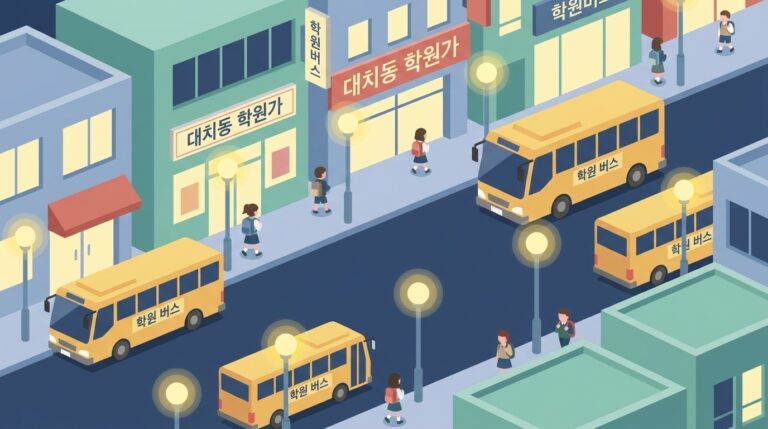
Picture this: It is exactly 9:55 PM on a brisk Thursday night in Daechi-dong, Gangnam. Neon storefronts glow with names of elite academies, but instead of winding down, the streets erupt into pure gridlock. Dozens of bright yellow shuttle buses double-park along the boulevard, hazard lights blinking in unison. Weary middle and high schoolers clutching iced Americanos sprint through the crosswalks to catch their ride home, while anxious mothers wait in parked sedans with warm snacks and thermos bottles. If you have watched hit K-dramas like Crash Course in Romance (일타 스캔들) or the legendary SKY Castle, you might have assumed those scenes were cinematic exaggeration. But this is the raw, nightly reality of Korea’s hagwon (학원, private cram school) culture and the immense pressure of sagoyukbi (사교육비, private education expenses).
Understanding how Koreans talk about education fever goes far beyond academic terminology. It unlocks the psychological engine behind Korean work ethic, dinner table debates, generational sacrifice, and social mobility. Over the years, our intermediate learners living in Korea have told us that few topics bond you faster with Korean parents and colleagues than commiserating over the relentless academic treadmill. In this B2-level guide, we will explore the authentic, real-world expressions native speakers actually use when talking about hagwon life and tuition shock.
1. 등골 브레이커 (Deung-gol beu-re-i-keo)
- Pronunciation: [Deung-gol beu-re-i-keo] (Sounds like Deung-goal followed by the English word breaker)
- Meaning: Literal: “Spine breaker” | Real Nuance: An expense so outrageously steep that it metaphorically breaks parents’ backs to afford it.
- K-Culture Moment: Seen frequently in family dramas whenever tuition bills arrive. A mother stares at an invoice for comprehensive CSAT prep courses, rubs the back of her neck, and groans: “This academy fee is a complete spine-breaker!”
- Editor’s Insight: Originally popularized in youth culture to describe luxury winter parkas that every student demanded, this term has firmly migrated into adult vocabulary to describe exorbitant private tutoring fees that devour household budgets.
- Situation Spectrum: Casual ✅ | Semi-formal ⚠️ | Formal 🚫
- 🤔 Think About It: In your native language, what body part or metaphor is used to describe expenses that demand extreme physical and financial sacrifice from parents?
2. 학원 뺑뺑이를 돌리다 (Hagwon ppaeng-ppaeng-i-reul dol-li-da)
- Pronunciation: [Hak-won ppaeng-ppaeng-i-reul dol-li-da] (The pp is a tense, pop-from-the-lips sound; ppaeng-ppaeng mimics spinning like a dizzy top)
- Meaning: Literal: “To spin someone around hagwons” | Real Nuance: To shuffle a child from one cram school to another in an endless, dizzying daily relay (math at 4 PM, English at 6 PM, essay writing at 8 PM).
- K-Culture Moment: Mothers sharing coffees at a neighborhood cafe confessing with mixed guilt and duty: “I hate spinning my kid through the hagwon loop, but if I stop, they fall behind.”
- Editor’s Insight: The word 뺑뺑이 (ppaeng-ppaeng-i) implies a carousel that moves so fast you get disoriented. When parents use this phrase, it carries a bittersweet mixture of parental guilt, exhaustion, and societal helplessness.
- Situation Spectrum: Casual ✅ | Semi-formal ✅ | Formal 🚫
- 🤔 Think About It: Why do you think Korean uses kinetic, circular verbs like “spinning” rather than linear terms like “scheduling” to describe academic pressure?
3. 사교육비 폭탄을 맞다 (Sa-gyo-yuk-bi pok-tan-eul mat-da)
- Pronunciation: [Sa-gyo-yuk-bi pok-tan-eul mat-da] (Pok-tan pops with an aspirated ‘P’ sound, resembling pohk-tahn)
- Meaning: Literal: “To be hit by a private education fee bomb” | Real Nuance: To suffer a severe financial shock due to accumulated monthly tuition, consulting, and textbook fees.
- K-Culture Moment: A father sits at the kitchen counter looking at his banking app, dramatically clutching his chest in mock despair after seeing three separate academy auto-debits on the same day.
- Editor’s Insight: Koreans love attaching the suffix 폭탄 (bomb) to overwhelming financial hits—such as 세금 폭탄 (tax bomb) or 난방비 폭탄 (winter heating bill bomb). Pairing it with 사교육비 highlights how volatile and non-negotiable these educational expenses feel.
- Situation Spectrum: Casual ✅ | Semi-formal ✅ | Formal ⚠️
- 🤔 Think About It: How does framing education costs as a sudden “bomb strike” reflect the survival mindset of middle-class families in high-stakes societies?
Phase 3: 교과서 한국어 vs 진짜 한국어
Situation 1: Describing the crushing burden of academy tuition
- 📖 교과서 한국어: 사교육비 지출이 너무 많아서 가계 경제가 어렵습니다. (Sa-gyo-yuk-bi ji-chul-i neo-mu man-a-seo ga-gye gyeong-je-ga eo-ryeop-seum-ni-da. / “Private education expenditures are so high that our household economy is difficult.”)
- 🗣️ 진짜 한국어: 애들 학원비 때문에 진짜 허리가 휠 지경이에요. (Ae-deul hak-won-bi ttae-mun-e jin-jja heo-ri-ga hwil ji-gyeong-i-e-yo. / “My back is literally bending under the weight of the kids’ hagwon fees.”)
- 💡 왜 다를까? Textbook Korean leans on formal, clinical economic terms (지출, 가계 경제). In real life, native Koreans express emotional and physical exhaustion through somatic idioms like 허리가 휘다 (one’s back bends under heavy load).
Situation 2: Describing a child’s packed after-school routine
- 📖 교과서 한국어: 학생들은 방과 후에 여러 학원에 다닙니다. (Hak-saeng-deul-eun bang-gwa hu-e yeo-reo hak-won-e da-nim-ni-da. / “Students attend several academies after school.”)
- 🗣️ 진짜 한국어: 방과 후부터 밤 10시까지 학원 릴레이 뛰어요. (Bang-gwa hu-bu-teo bam yeol-si-kka-ji hak-won ril-le-i ttwieo-yo. / “They run a non-stop hagwon relay from after school until 10 PM.”)
- 💡 왜 다를까? While the textbook uses the generic verb 다니다 (to attend), native speakers describe the frantic rush between academies as 릴레이 뛰다 (to run an athletic relay), reflecting the physical sprint from one building to the next.
Phase 4: K-Culture 딥다이브 & 비언어적 매너
4-1. 눈치(Nunchi) & Gestures
When discussing children’s education in Korea, modesty and shared commiseration are vital. Even if someone’s child achieved the top rank in an advanced hagwon level test (레벨 테스트), boasting openly will instantly ruin the social atmosphere. Instead, experienced parents practice strategic modesty: they sigh softly, shake their heads, and say, “아이고, 말도 마세요…” (Oh, don’t even get me started…). When listening to a friend complain about tutoring costs, tilt your head slightly, let out a quiet sigh (“휴…”), and nod empathetically. Touching your own lower back while saying “허리가 휘어요” demonstrates heartfelt solidarity.
4-2. Cultural Code Analysis
In popular K-dramas like Crash Course in Romance, you witness the cultural phenomenon of the 일타강사 (Star Instructor)—celebrity teachers who boast rock-star followings and earn billions of won. Parents wait in line outside academy buildings from 5:00 AM just to secure front-row seats for their children. To curb this intense competition and protect students’ health, the Korean government enacted a strict 10:00 PM curfew on hagwons (학원 심야교습 제한). Yet at 10:01 PM in districts like Daechi-dong and Mok-dong, the street becomes an open-air sea of yellow shuttles and waiting parents. This nightly migration reveals that education fever is not simply about grades; it represents familial sacrifice, communal anxiety, and the relentless drive for upward mobility.
Phase 5: 실전 롤플레이 시나리오
Setting: A quiet cafe near Daechi Station, Gangnam, at 9:45 PM on a Tuesday. You run into Su-jin, an acquaintance waiting for her middle school daughter to finish an advanced math hagwon session.
- 수진: 에디터 씨, 여기서 다 보네요! 민지 수학 학원 끝나는 거 기다리고 있어요.
(Editeo ssi, yeo-gi-seo da bo-ne-yo! Min-ji su-hak hak-won kkeut-na-neun geo gi-da-ri-go iss-eo-yo. / “Editor, what a surprise to see you here! I’m waiting for Min-ji’s math hagwon class to wrap up.”)
🎭 [피곤한 기색으로 따뜻한 머그잔을 매만지며 / Touching her warm mug with a visibly tired expression] -
나 (You): 수진 씨, 아직 안 들어가셨어요? 벌써 밤 10시가 다 되어 가는데요.
(Su-jin ssi, a-jik an deul-eo-ga-syeoss-eo-yo? Beol-sseo bam yeol-si-ga da doe-eo ga-neun-de-yo. / “Su-jin, you haven’t gone home yet? It’s already almost 10 PM.”)
🎭 [손목시계를 확인하며 걱정 어린 표정으로 / Checking wristwatch with a concerned look] -
수진: 에휴, 오늘 영어 학원 끝나자마자 바로 수학으로 뺑뺑이 돌렸거든요.
(E-hyu, o-neul yeong-eo hak-won kkeut-na-ja-ma-ja ba-ro su-hak-eu-ro ppaeng-ppaeng-i dol-lyeoss-geo-deun-yo. / “Sigh, as soon as English finished today, I spun her right into math hagwon.”)
🎭 [깊은 한숨을 내쉬며 고개를 절레절레 흔든다 / Exhaling a deep sigh and shaking her head] -
나 (You): 아이고, 민지도 고생이지만 수진 씨도 라이딩하느라 허리 휘시겠어요.
(A-i-go, Min-ji-do go-saeng-i-ji-man Su-jin ssi-do ra-i-ding-ha-neu-ra heo-ri hwi-si-gess-eo-yo. / “Oh dear, Min-ji has it rough, but your back must be bending from all the driving and tutoring bills.”)
🎭 [진심으로 공감하듯 따뜻하게 고개를 끄덕인다 / Nodding warmly in genuine empathy] -
수진: 맞아요. 매달 학원비 고지서 나올 때마다 진짜 사교육비 폭탄 맞은 기분이에요.
(Maj-a-yo. Mae-dal hak-won-bi go-ji-seo na-ol ttae-ma-da jin-jja sa-gyo-yuk-bi pok-tan maj-eun gi-bun-i-e-yo. / “Exactly. Every month when the academy bill arrives, it feels like I took a direct hit from an education bomb.”)
🎭 [스마트폰 알림을 씁쓸하게 쳐다보며 / Looking bitterly at the tuition notification on her smartphone] -
나 (You): 남들도 다 하니까 안 보낼 수도 없고, 진짜 등골 브레이커네요.
(Nam-deul-do da ha-ni-kka an bo-nael su-do eopt-go, jin-jja deung-gol beu-re-i-keo-ne-yo. / “Because everyone else does it you can’t just stop; it really is a total spine-breaker.”)
🎭 [목소리를 낮추며 깊이 맞장구를 친다 / Lowering voice slightly and chiming in in complete agreement] -
수진: 내 말이 그 말이에요! 그래도 에디터 씨가 제 마음을 알아주니 속이 좀 후련하네요.
(Nae mal-i geu mal-i-e-yo! Geu-rae-do Editeo ssi-ga je ma-eum-eul al-a-ju-ni sok-i jom hu-ryeon-ha-ne-yo. / “That is so true! Still, having you understand how I feel makes me feel so much better.”)
🎭 [비로소 엷은 미소를 지으며 어깨를 으쓱인다 / Finally offering a gentle smile and relaxing her shoulders] -
나 (You): 민지 나오면 따뜻한 붕어빵이라도 사 먹이고 같이 힘내세요!
(Min-ji na-o-myeon tta-tteut-han bung-eo-ppang-i-ra-do sa meok-i-go gat-i him-nae-se-yo! / “When Min-ji comes out, buy some warm fish pastries together and keep your spirits up!”)
🎭 [주머니에서 핫팩을 꺼내 건네며 응원한다 / Pulling a hand warmer from your pocket and handing it over encouragingly]
🔀 인터랙티브 분기점 (Interactive Decision Point)
Imagine Su-jin sighs and tells you: “학원비가 너무 많이 들어서 이번 달 가족 여행도 취소했어요.” (Tutoring fees are so high we had to cancel our family vacation this month.) How do you reply?
- Option A: “그래도 애 미래를 위한 투자니까 아까워하지 마세요!” (Still, it’s an investment in her future, so don’t regret it!)
- Feedback: [Bad ❌] Invalidates her real emotional and financial distress. It sounds condescending and preachy.
- Option B: “진짜 사교육비 때문에 숨이 턱턱 막히네요. 부모 노릇 하기 참 힘들죠?” (Seriously, tutoring costs make you feel suffocated. Being a parent is so tough, isn’t it?)
- Feedback: [Best 🌟] Excellent B2 empathetic communication. It validates both the financial weight and emotional sacrifice without judgment.
- Option C: “그냥 학원 다 끊고 혼자 공부하라고 하세요.” (Just cancel all the academies and tell her to study on her own.)
- Feedback: [Risk ⚠️] Ignores the competitive reality of relative grading in Korea; dismisses her dilemma as foolish.
Phase 6: 10초 감정 섀도잉 드릴
- Sentence 1: [😮 한숨 쉬며 안타깝게 / With a heavy sigh and sympathetic tone]
“애 학원 / 뺑뺑이 돌리느라 / 하루가 다 가요.”
(Ae hak-won / ppaeng-ppaeng-i dol-li-neu-ra / ha-ru-ga da ga-yo.)
“Running my child / through the endless hagwon loop / takes up the entire day.” -
Sentence 2: [💸 억울하고 씁쓸하게 / Indignant and bitter over financial strain]
“이번 달 학원비 고지서 보니까 / 진짜 / 사교육비 폭탄 맞았네요.”
(I-beon dal hak-won-bi go-ji-seo bo-ni-kka / jin-jja / sa-gyo-yuk-bi pok-tan maj-ass-ne-yo.)
“Looking at this month’s academy invoice / honestly / it feels like I was hit by an education fee bomb.” -
Sentence 3: [🤝 깊이 공감하며 힘을 실어줄 때 / With heartfelt camaraderie and gentle comfort]
“남들 다 하니까 / 불안해서 멈출 수가 없죠 / 정말 등골 브레이커예요.”
(Nam-deul da ha-ni-kka / bul-an-hae-seo meom-chul su-ga eopt-jyo / jeong-mal deung-gol beu-re-i-keo-ye-yo.)
“Because everyone else does it / you can’t stop out of anxiety / it is truly a spine-breaker.”
Phase 7: K-Culture 미니 사전 (4 Keywords)
- 일타강사 (Il-ta gang-sa) | Number One Star Instructor | The top-ranked instructor whose lectures sell out within seconds. Stemming from 1등 스타 강사 (first-place star instructor), Koreans also use “일타” metaphorically in everyday conversation to refer to anyone who is the undisputed master or go-to expert of a field.
- 대치동맘 (Dae-chi-dong mam) | Daechi-dong Super Mom | Refers to mothers in Gangnam’s Daechi-dong known for organizing hyper-competitive study groups, scheduling admissions consultancies, and driving their children between academies. Used colloquially to describe any intensely dedicated stage parent.
- 킬러 문항 (Kil-ler mun-hang) | Killer Question | Extremely complex, multi-concept questions intentionally placed on the Korean College Scholastic Ability Test (CSAT/수능) to separate the top 1% from the rest. Widely discussed on national news and morning talk shows when debating the necessity of private tutoring.
- 학군지 (Hak-gun-ji) | Elite School District | Neighborhoods renowned for having top-tier public and private schools paired with dense clusters of cram schools (such as Daechi, Mok-dong, and Bundang). In South Korea, real estate valuations are heavily determined by whether an apartment complex sits inside an established 학군지.
Phase 8: 여행자를 위한 생존 키트
Top 3 Survival Expressions:
- 여기 학원가가 어디예요? (Yeo-gi hak-won-ga-ga eo-di-ye-yo?)
- Meaning: “Where is the main academy street around here?”
- Pro Tip: Use this to find the student food districts in Daechi-dong or Noryangjin, where you can find delicious, budget-friendly Korean meals like cup-bap (컵밥) and spicy tteokbokki.
- 이 근처에 늦게까지 하는 스터디 카페 있나요? (I geun-cheo-e neut-ge-kka-ji ha-neun seu-teo-di ka-pe inn-na-yo?)
- Meaning: “Is there a study cafe open late around here?”
- Pro Tip: Korean study cafes (스터디 카페) are modern, peaceful sanctuaries offering ergonomic desks, blazing Wi-Fi, and self-serve coffee bars for travelers who need to work remotely.
- 학원 셔틀버스 정류장이 어디인가요? (Hak-won syeo-teul-beo-seu jeong-ryu-jang-i eo-di-in-ga-yo?)
- Meaning: “Where is the academy shuttle bus pickup point?”
- Pro Tip: Useful if you are working as an ESL teacher or visiting family in an educational district.
Editor’s Travel Note:
If you want to experience the vibrant, bustling rhythm of modern Korean student life, take Subway Line 3 to Daechi Station between 9:45 PM and 10:15 PM on a weekday evening. Before you go, be sure to complete your 네이버 지도 앱 다운로드 so you can easily navigate pedestrian alleys and pinpoint open study cafes. International credit cards work seamlessly across convenience stores and cafes in academy areas, but keep your physical T-Money transit card handy to board neighborhood feeder buses (마을버스) smoothly.
Phase 9: “한 발 더 깊이” (Thought Question)
In South Korea, education is rarely an individual quest; it is a shared family venture. Stemming from centuries of Confucian civil service examination traditions (과거 제도), educational attainment has long stood as the single most reliable ladder for social and economic elevation. When modern Korean parents dedicate enormous portions of their disposable income to sagoyukbi, it is rarely out of vanity—it is an agonizing act of love in a fiercely compressed society where social safety nets are narrow and relative grading (상대평가) leaves little margin for error.
💬 Your Turn: In your home country, is academic achievement viewed primarily as an individual pursuit, or is it seen as a collective family investment? Share your perspective in the comments below!
Phase 10: FAQ & 오해 방지
Q: Is hagwon culture exclusive to high school students preparing for the CSAT?
A: Not at all! Hagwons exist for every age bracket in South Korea. There are “English kindergartens” (영어유치원) for toddlers, coding, swimming, and piano academies for elementary students, and specialized exam academies in Noryangjin for adults preparing for national civil servant examinations (공무원 시험).
Q: Why do parents complain about tuition yet continuously send their children to hagwons?
A: It stems from deep-rooted educational FOMO and relative grading. Because Korean school exams and the CSAT rank students on a curved percentage system, parents fear that taking their child off the hagwon circuit will cause their grades to drop relative to their peers, jeopardizing university admissions.
Q: Can foreign adults enroll in Korean hagwons?
A: Yes! While youth-focused CSAT prep academies require entrance diagnostic tests, adult language academies (어학원), baking academies (제과제빵 학원), and computer programming bootcamps welcome adult foreign learners with open arms.
🚨 흔한 실수 (Common Mistakes) TOP 3
- Mistake: Confusing 과외 (gwa-oe) with 학원 (hagwon).
- Correct Action: 학원 is an accredited commercial academy with group classrooms. 과외 refers strictly to private 1-on-1 or small-group home tutoring.
- Mistake: Translating “cramming” literally as 벼락치기 학교.
- Correct Action: Always use 학원. The word 벼락치기 only functions as a noun for the act of last-minute cramming the night before an exam.
- Mistake: Using casual slang like 등골 브레이커 in a formal meeting or parent-teacher conference.
- Correct Action: In professional or formal environments, choose refined phrasing like 사교육비 부담이 상당합니다 (The burden of private education costs is substantial).
Phase 11: 액션 미션 & 참여 유도
- 🥉 Bronze Mission (Solo Shadowing): Stand in front of a mirror and practice saying: “애들 학원비 때문에 허리가 휠 지경이에요” three times with a realistic, weary sigh.
- 🥈 Silver Mission (Social Connection): Post a short reflection on Instagram Stories or Threads about your favorite Korean drama depiction of education using the hashtag
#DailyHangulEducation. - 🥇 Gold Mission (Real-world Chat): During your next Korean language exchange session, casually ask your partner: “어릴 때 학원 뺑뺑이 많이 돌았어요?” (Did you do a lot of hagwon looping when you were younger?) and listen to their personal stories.
- 🎮 K-Culture Mission: Watch Episode 1 of Crash Course in Romance (일타 스캔들) and count how many times you spot the words 학원 (hagwon) and 입시 (college admissions) on street signs, banners, and bus adverts.
Phase 12: 인터랙티브 퀴즈 챌린지
Q1. Situational Judgment: Your Korean language exchange partner sighs and says: “이번 달 애들 학원비 보니까 진짜 허리가 휘네요.” What is the most culturally empathetic response?
* A) 왜 그렇게 비싼 곳에 보내요? 다른 싼 학원을 찾으세요.
* B) 맞아요, 요즘 사교육비 폭탄이라 다들 등골 휜다고 하더라고요.
* C) 우리나라는 학원비가 공짜인데 한국은 참 이상해요.
Q2. Fill in the Blank: When a child is shuffled continuously between multiple academies without rest, Koreans call this action:
* “학원 ________를 돌리다.”
Q3. True or False: Under current Seoul educational ordinances, general high school hagwons in Gangnam are legally permitted to conduct in-person classes 24 hours overnight. (True / False)
👉 Click here to reveal the answers and explanations!
- Answer: B! Option B empathizes with their financial fatigue using the natural native idiom 사교육비 폭탄. Option A sounds critical and dismissive, while Option C is culturally insensitive.
- Answer: 뺑뺑이 (Ppaeng-ppaeng-i). The full idiom is 학원 뺑뺑이를 돌리다, which paints the dizzying picture of a spinning top.
- Answer: False! Under Seoul Metropolitan Office of Education regulations, in-person youth hagwon classes must strictly conclude by 10:00 PM to safeguard students’ health and well-being.







