

Phase 1: Empathy
안녕하세요! 매일한글 에디터입니다. (Hello! This is your Daily Hangul editor.)
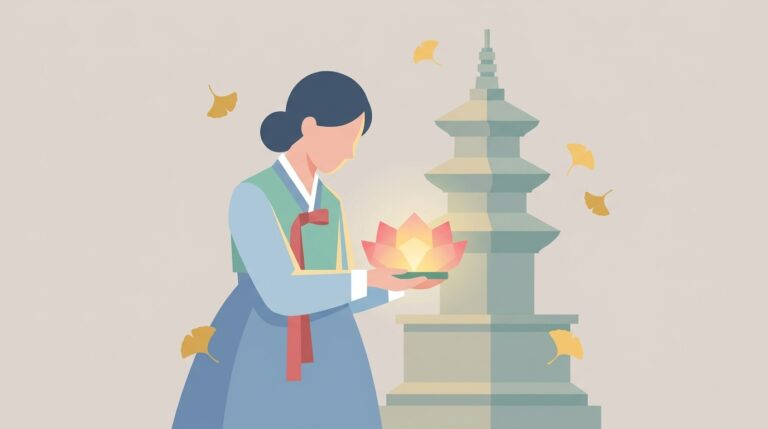
If you have ever watched iconic K-Dramas like Crash Course in Romance or SKY Castle, you probably recall scenes of mothers climbing steep mountain paths at dawn to reach Buddhist temples, or kneeling on icy wooden floors for hours. In Korea, as late summer turns to crisp autumn, an intense spiritual countdown begins: the 부모님의 100일 기도 (Bumonim-ui baek-il gido — Parents’ 100-Day Prayer). With exactly 100 days remaining until the fateful 수능 (Suneung, the College Scholastic Ability Test), countless parents dedicate their entire daily routine to praying for their children’s focus and success.
For foreign learners living in Korea or interacting with Korean families, this period can feel like walking on eggshells. You might wonder: “What should I say to a friend or coworker whose child is preparing for Suneung?” or “Why is everyone suddenly bringing boxes of sticky rice cakes and praying with such intense devotion?” Saying the wrong phrase or offering a casual “Good luck!” can sometimes feel out of touch with the gravity of the moment.
That is why we created this guide based on real feedback from intermediate learners who wanted to navigate this intense cultural season with genuine empathy. By learning the language of parental devotion and exam solidarity, you will not just speak more natural Korean—you will connect deeply with the beating emotional heart of Korean family dynamics.
Phase 2: Core 3 Expressions In-Depth
1. 백일기도를 드리다 (Baek-il-gi-do-reul deu-ri-da)
- Pronunciation: [Baek-il-gi-do-reul deu-ri-da] (Think of baek like “beck”, il like the “ill” in illness, gido rhyming with “key-dough”, and deurida as “dew-ree-dah”)
- Meaning: Literal: “To offer a 100-day prayer” / Nuance: Dedicating 100 uninterrupted days of sacrifice and heartfelt prayers for a major life milestone, almost always for Suneung.
- K-Culture Moment: Seen when a mother in a drama packs warm water into a thermos and leaves the house at 4:30 AM every morning toward Jogyesa Temple.
- Editor’s Insight: Notice the verb 드리다 (deurida), which is the humble/honorific form of 주다 (juda, to give). Prayers in Korean are “offered upward” to heaven or Buddha with maximum humility.
- Situation Spectrum: Casual (🚫 – sounds too formal for casual slang) | Semi-formal (✅) | Formal (✅)
- 🤔 Think About It: Does your home culture have a designated countdown period where family members take on personal sacrifices for someone else’s academic milestone?
2. 정성을 들이다 (Jeong-seong-eul deu-ri-da)
- Pronunciation: [Jeong-seong-eul deu-ri-da] (Pronounce jeong like the British exclamation “jolly” without the -ly, plus a soft nasal -ng; seong rhymes with “song”)
- Meaning: Literal: “To invest heartfelt sincerity/devotion” / Nuance: Giving everything you physically and emotionally have into supporting someone with pure love.
- K-Culture Moment: Grandmothers preparing daily lunchboxes with auspicious ingredients or folding 1,000 paper cranes with meticulous care.
- Editor’s Insight: 정성 (jeongseong) is an untranslatable Korean virtue meaning sincere wholeheartedness. It is not just about effort; it is about pure intention without expecting anything in return.
- Situation Spectrum: Casual (✅ – with friends talking about hobbies/cooking) | Semi-formal (✅) | Formal (✅)
- 🤔 Think About It: How is 정성 different from mere hard work (노력, noryeok)? Noryeok focuses on output, while jeongseong touches the soul.
3. 찰떡같이 붙다 (Chal-tteok-gat-i but-da)
- Pronunciation: [Chal-tteok-gach-i but-da] (Say chal with a crisp, bouncy “ch”, tteok like “tuck” with a tight pop, and butda rhyming with “put-dah”)
- Meaning: Literal: “To stick tightly like glutinous rice cake” / Nuance: To pass the exam with flying colors and get accepted instantly.
- K-Culture Moment: Classmates gifting boxes of 찹쌀떡 (chapssaltteok, sweet rice cakes) and Korean traditional taffy (엿, yeot) right before test day.
- Editor’s Insight: In Korean superstition, slippery foods like seaweed soup (미역국, miyeokguk) make you “slip” (미끄러지다), while sticky foods make you “stick” (붙다) to your desired university campus!
- Situation Spectrum: Casual (✅) | Semi-formal (✅) | Formal (⚠️ – slightly colloquial for official university speeches)
- 🤔 Think About It: What food metaphors do you use when wishing someone luck in competitive environments?
Phase 3: Textbook Korean vs Real Korean
Situation 1: Cheering for an examinee during Suneung season
- 📖 교과서 한국어 (Textbook): 시험을 잘 치르시기를 바랍니다. (Siheom-eul jal chireusigireul baramnida.) — “I hope you take the test well.”
- 🗣️ 진짜 한국어 (Real Native): 긴장하지 말고 컨디션 조절 잘해! 수능 대박 나자! (Ginjanghaji malgo keondisyeon jojeol jalhae! Suneung daebak naja!) — *”Don’t be nervous, take care of your body! Let’s hit the Suneung jackpot!”
- 💡 왜 다를까? (Why the difference?): Textbook Korean sounds like an official test proctor reading instructions. Native speakers prioritize mental health, stamina management (컨디션 조절), and use the uplifting slang 대박 (daebak).
Situation 2: Expressing appreciation to a parent dedicating their time
- 📖 교과서 한국어 (Textbook): 부모님께서 저를 위해 오랜 기간 기도하셨습니다. (Bumonimkkeseo jeoreul wihae oraen gigan gidohasyeotseumnida.) — “My parents prayed for me for a long period.”
- 🗣️ 진짜 한국어 (Real Native): 엄마 정성 덕분에 힘내서 끝까지 완주할 수 있었어요. (Eomma jeongseong deokbune himnaeseo kkeutkkaji wanjuhal su isseosseoyo.) — *”Thanks to mom’s wholehearted devotion, I found the strength to finish the race.”
- 💡 왜 다를까? (Why the difference?): Native speakers use the marathon metaphor 완주하다 (wanjuhada, to run until the end) and directly credit their parents’ 정성 (devotion), highlighting the emotional partnership between student and parent.
Phase 4: K-Culture Deep Dive & Non-Verbal Manners
4-1. 눈치 (Nunchi) & Mindful Gestures
Around autumn in Korea, families with high school seniors are under immense emotional pressure. Demonstrating high 눈치 (nunchi, social radar) involves:
* Lower Your Voice & Step Lightly: If visiting a home where a senior is studying or where parents are conducting evening prayers, avoid loud telephone calls and heavy footsteps.
* Two Hands for Cheering Gifts: When giving cheering gifts like chapssaltteok or vitamin sets, always present the box using both hands with a slight bow. Never toss it casually on a table.
* Avoid Taboo Vocabulary: Never use verbs like 떨어지다 (tteoleojida, to fall/drop), 미끄러지다 (mikkeureojida, to slip), or 죽쑤다 (jukssuda, to ruin things/mess up).
4-2. Cultural Code: The Sacred Pilgrimage of Gatbawi
Every year during the 100-day countdown, thousands of parents climb Palgongsan Mountain near Daegu to visit 갓바위 (Gatbawi), a cliff-side stone Buddha wearing a stone hat that resembles a traditional scholar’s cap. Folk belief holds that Gatbawi grants at least one sincere wish in a person’s lifetime. Parents will do 108배 (baek-pal-bae, 108 full prostrations) daily. This is not seen as helicopter parenting in Korea; rather, it is a shared emotional pilgrimage where parents bear their child’s burden through physical devotion.
Phase 5: Real Role-play Scenario
Setting: A cozy traditional tea shop near Jogyesa Temple in central Seoul. Autumn leaves are falling outside. Min-ji (a Korean friend) meets you after her mother just started her 100-day prayer for Min-ji’s younger brother.
- Min-ji: 우리 엄마, 오늘부터 동생 수능 백일기도 들어가셨어. (Uri eomma, oneulbuteo dongsaeng suneung baek-il-gido deureogasyeosseo.) — “My mom started the 100-day Suneung prayer for my brother starting today.”
🎭 한숨을 쉬며 따뜻한 차를 홀짝인다 / Sighs softly while sipping warm tea - You: 정말? 어머님 정성이 진짜 대단하시다. (Jeongmal? Eomeonim jeongseongi jinjja daedanhasida.) — “Really? Your mother’s devotion is truly remarkable.”
🎭 공감하며 고개를 끄덕인다 / Nods in sincere empathy - Min-ji: 매일 새벽 5시에 절에 가신대. 동생보다 엄마가 더 말라가는 것 같아 걱정이야. (Maeil saebyeok daseot-sie jeore gasindae. Dongsaengboda eommaga deo mallaganeun geot gata geokjeong-iya.) — *”She says she’ll go to the temple at 5 AM every day. I’m worried mom is losing weight faster than my brother.”
🎭 걱정스러운 눈빛으로 창밖을 바라본다 / Looks out the window with worried eyes` - You: 동생도 부담이 크겠지만, 어머님 마음도 정말 애타시겠다. (Dongsaengdo budami keugessjiman, eomeonim maeumdo jeongmal aetasideoda.) — *”I’m sure your brother feels pressured, but your mom’s heart must be so anxious too.”
🎭 차분한 목소리로 위로를 건넨다 / Offers comfort in a calm, soothing voice` - Min-ji: 응. 그래서 나도 집에서 TV도 안 켜고 조용히 지내는 중이야. (Eung. Geuraeseo nado jibeseo tibido an kyeogo joyonghi jinaeneun jung-iya.) — *”Yeah. That’s why I don’t even turn on the TV at home and keep things completely quiet.”
🎭 작게 미소 짓는다 / Gives a faint smile` - You: 온 가족이 한마음으로 응원하고 있네. (On gajogi hanmaeumeuro eungwonhago inne.) — *”The whole family is cheering as one united heart.”
🎭 민지의 손을 살포시 잡아준다 / Gently touches Min-ji’s hand in support` - Min-ji: 고마워. 이번 수능 끝나면 가족끼리 꼭 여행 가고 싶어. (Gomawo. Ibeon suneung kkeutnamyeon gajokkkiri kkok yeohaeng gago sipeo.) — *”Thanks. Once this Suneung is over, I really want our family to go on a trip.”
🎭 희망찬 표정으로 바뀐다 / Expression turns hopeful` - You: 분명 좋은 결과 있을 거야. 동생 수능 찰떡같이 붙을 거야! (Bunmyeong joeun gyeolgwa isseul geoya. Dongsaeng suneung chal-tteok-gachi buteul geoya!) — “There will definitely be good results. Your brother will stick to his college like sticky rice!”
🎭 주먹을 쥐며 활짝 웃는다 / Clenches fist with an encouraging bright smile
🔀 Interactive Choice Point
How would you reply to Min-ji’s mother directly if you bumped into her outside the temple?
* Option A: “어머님, 너무 무리하지 마시고 건강 챙기세요. 정성이 닿아서 꼭 좋은 결과 있을 거예요!” (Eomeonim, neomu murihaji masigo geongang chaenggiseyo. Jeongseongi daaseo kkok joeun gyeolgwa isseul geoyeyo!)
* Option B: “공부는 동생이 하는 건데 왜 어머님이 기도하세요?” (Gongbuneun dongsaengi haneun geonde wae eomeonim-i gidohaseyo?)
* Option C: “시험 점수 몇 점 목표예요? 떨이지면 재수하면 되죠!” (Siheom jeomsu myeot jeom mokpyoyeyo? Tteoreojimyeon jaesuhamyeon doejo!)
- Analysis:
- Option A (Best): Pure warmth! Acknowledges the mother’s health, respects her devotion, and uses positive encouragement without mentioning failure.
- Option B (Risk): Culturally tone-deaf. While logical in individualistic societies, this minimizes the profound collective emotional bond between Korean parents and children.
- Option C (Bad): Disastrous! It asks intrusive questions about scores and uses the ultimate forbidden taboo word: 떨어지다 (to fail/drop).
Phase 6: 10-Second Emotional Shadowing Drill
Practice matching these exact emotional cadences and pauses (/ marks a breath/pause):
[🥺 간절하고 따뜻하게 / Earnestly and warmly]
어머님의 / 간절한 정성이 / 꼭 하늘에 닿을 거예요.
(Eomeonim-ui / ganjeolhan jeongseong-i / kkok haneure daheul geoyeyo.)
“Your sincere devotion / will definitely / reach the heavens.”-
[💪 든든하게 응원하며 / Confidently cheering]
긴장하지 말고 / 평소 실력대로만 / 찰떡같이 붙자!
(Ginjanghaji malgo / pyeongso sillyeokdaeroman / chal-tteok-gachi butja!)
“Don’t be nervous / just perform like you always do / and pass smoothly!” -
[🧘 차분하고 진중하게 / Calmly and respectfully]
백일 동안 / 건강 잃지 않도록 / 마음으로 응원하겠습니다.
(Baek-il dongan / geongang ilchi antorok / maeumeuro eungwonhagesseumnida.)
“Throughout these 100 days / so you don’t lose your health / I will cheer with all my heart.”
Phase 7: K-Culture Mini Dictionary
- 백일기도 (Baek-il-gi-do) | 100-day prayer | Traditionally rooted in Buddhist and shamanic rituals, this is a 100-day spiritual marathon undertaken by parents before Suneung, civil service exams, or major health recoveries.
- 수능 대박 (Su-neung dae-bak) | Suneung jackpot / Ultimate exam victory | The most ubiquitous slogan during October and November. Used on cheering banners, stationery items, and bakery packaging across Korea.
- 찹쌀떡 (Chap-ssal-tteok) | Glutinous red-bean rice cake | A traditional food gift symbolizing adherence and success due to its intensely chewy texture that “sticks” to whatever it touches.
- 간절함 (Gan-jeol-ham) | Desperate earnestness / Sincere longing | The core emotional driver behind Korean exam culture; the deep internal sentiment that your earnest dedication can move mountains.
Phase 8: Traveler’s Survival Kit
Survival Expressions TOP 3
- 기도 중이니 방해하지 마세요. (Gido jung-ini banghaehaji maseyo.)
Meaning: “Prayer in progress, please do not disturb.”
Pro Tip: Frequently found posted on signs outside temple main halls (대웅전) and quiet cathedral chapels from August to November. - 수능 대박 세트 있나요? (Suneung daebak set-eu innayo?)
Meaning: “Do you have the Suneung jackpot gift set?”
Pro Tip: Use this at major bakeries like Paris Baguette or rice cake boutiques to find beautifully packaged traditional gift sets. - 마음으로 함께 빌게요. (Maeumeuro hamkke bilgeyo.)
Meaning: “I will pray along with you in my heart.”
Pro Tip: The most polite, non-intrusive way to support a Korean coworker whose child is taking the exam.
Editor’s Travel Note
If you visit iconic temples like Bongeunsa in Gangnam or Jogyesa in Insadong during autumn, you will witness thousands of lanterns labeled with students’ names. If you plan to visit, open your Naver Map transit guide for city buses to find direct routes to mountain temples. Please turn your phone on silent, walk only around the perimeter of the courtyard, and never step directly in front of someone performing prostrations.
Phase 9: “한 발 더 깊이” (One Step Deeper)
In Western individualist frameworks, high school exams belong solely to the student. In Korea, however, educational attainment has historically represented collective familial elevation. The 100-day prayer is not merely superstition; it acts as an emotional lightning rod. By waking at dawn and enduring physical exhaustion alongside their child, Korean parents subtly communicate: “You are never alone in this dark tunnel; we carry this weight together.” This profound intergenerational solidarity is the true bedrock of modern Korea’s relentless educational drive.
💬 Your Turn: Does your culture have a tradition where parents undergo physical or mental challenges to support their children’s goals? Share your stories in the comments below!
Phase 10: FAQ & Avoiding Misunderstandings
Q: Is the 100-day prayer strictly for Buddhist families?
A: Not at all! While the term 백일기도 originated within Korean Buddhism, Protestant and Catholic parents hold dedicated early-morning prayer sessions (새벽기도, saebyeok-gido) or novenas with the exact same 100-day countdown timeline. Even non-religious parents observe personal self-restraint routines during this period.
Q: Can I ask a Korean friend how their child scored right after Suneung ends?
A: Absolutely not! Test scores are intensely private and emotionally charged. Wait for them to bring it up first. Simply say: “그동안 고생 많으셨어요” (You went through so much effort all this time).
Q: Why do people gift forks (포크) and toilet paper (휴지) for exams?
A: In Korean wordplay, a fork allows you to “stab/poke accurately” (잘 찍다, jal jjikda), meaning guessing unknown multiple-choice questions correctly! Unrolling toilet paper (풀리다, pullida) symbolizes all difficult exam problems “unraveling smoothly.”
🚨 흔한 실수 (Common Mistakes) 경고판
- Mistake: Gifting seaweed soup (미역국) or porridge (죽) to an examinee.
Correct Action: Gift sticky rice cakes (찹쌀떡), chocolates, or vitamins instead. - Mistake: Saying “시험 떨어지면 어때요, 다시 보면 되죠” (What if you fail, you can just retry).
Correct Action: Say “노력한 만큼 좋은 결과 있을 거예요” (You will get great results proportional to your hard work). - Mistake: Walking straight through the center aisle in a Buddhist temple during prayer season.
Correct Action: Walk along the outer edges quietly so you do not break the concentration of praying parents.
Phase 11: Action Mission & Engagement
- 🥉 Bronze Mission: Practice saying “수능 대박 나세요!” out loud 3 times with enthusiastic facial energy.
- 🥈 Silver Mission: Leave a comment below using the word 정성 (jeongseong) in a short sentence expressing gratitude to your own mentors or family.
- 🥇 Gold Mission: Look up an episode of Reply 1988 (응답하라 1988) or SKY Castle and identify the scene where mothers pray or prepare food for test takers.
- 🎮 K-Culture Mission: On your next walk past a Korean bakery in October/November, spot the signs that say 합격 기원 (Wishing for your acceptance) and post a picture to your study story!
Phase 12: Interactive Quiz Challenge
Test your knowledge of Korean exam culture and respectful communication!
- Situation Judgment: Your Korean colleague mentions her daughter is taking Suneung in two weeks. Which phrase is the most respectful and heartwarming?
- A) “시험 망치면 어떡해요?” (Siheom mangchimyeon eotteokaeyo?)
- B) “어머님 정성이 가득하니 꼭 찰떡같이 붙을 거예요!” (Eomeonim jeongseongi gadeukhani kkok chal-tteok-gachi buteul geoyeyo!)
- C) “수능 쉬우니까 걱정 마세요.” (Suneung swiunikka geokjeong maseyo.)
- Fill in the Blank: Koreans avoid eating ________ (miyeokguk) before an exam because they believe it causes them to slip and fail.
-
True or False: The 100-day prayer period is only observed by students, while parents carry on with their normal social lives.
👉 Click to view Answers & Explanations
- Answer: B — Acknowledges the mother’s sincere devotion (정성) and uses the auspicious idiom 찰떡같이 붙다 (stick like rice cake). A is tactless, and C trivializes Korea’s toughest exam.
- Answer: 미역국 (Seaweed soup) — Its slippery texture gives rise to the superstition of slipping down the exam ranking list.
- Answer: False — The 100-day prayer is primarily undertaken by parents and grandparents who sacrifice personal comfort and sleep to spiritually support their children.







