

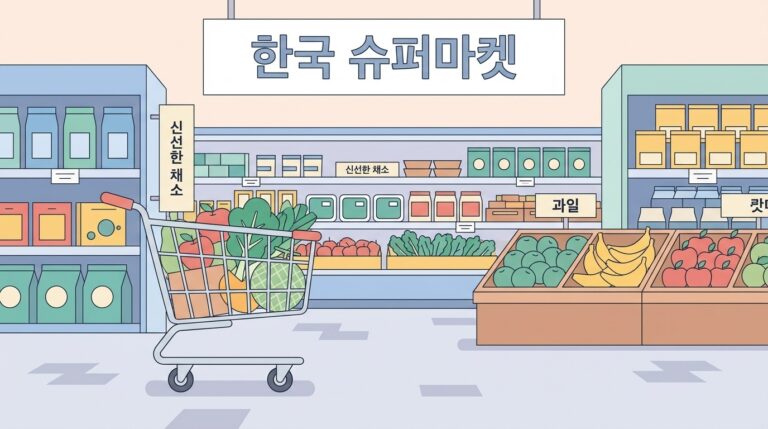
Phase 1: Empathy (Welcome to the Grocery Aisles!)
안녕하세요! I’m your Daily Hangul editor. Have you ever walked into a giant Korean hypermarket like E-mart, Lotte Mart, or Homeplus, feeling ready for a feast, only to freeze at the front entrance?
You see a shiny row of metal carts locked together with chains. You try to pull one, but it won’t budge. A friendly local glances at you, slides a 100-won coin into a small slot, and click—the cart magically releases! As you head inside, the next challenge arrives: maneuvering through narrow aisles filled with bustling families, navigating towards sizzling dumpling sample stations, and rolling onto a steep moving walkway ramp where your cart suddenly locks its wheels like it’s glued to the floor.
Navigating a grocery cart in Korea is an authentic cultural initiation. If you don’t know what to say when someone stops right in front of you, or how to politely squeeze past someone inspecting a row of kimchi jars, it can feel intimidating. This guide is built directly from real student feedback to help you glide through Korean supermarket aisles with total confidence, flawless manners, and natural A2-level Korean phrases!
Phase 2: Core Expressions Deep Dive
Here are three essential expressions you will use every single time you push a cart in Korea.
1. 잠시만 지나갈게요 (Jamsiman jinagalgeyo)
- Pronunciation: [Jahm-she-mahn jee-nah-gahl-geh-yo] (Sounds like: Jahm-see-mahn like a calm sea breeze, jee-nah-gahl-geh-yo)
- Meaning: Literal: “I will pass by for a moment.” / Real Nuance: “Pardon me, just squeezing past with my cart!”
- K-Culture Moment: Think of any weekend family scene in a Korean variety show like The Return of Superman where a parent gently guides a cart through a crowded snack aisle.
- Editor’s Insight: In English, we usually say “Excuse me” or “Sorry.” But in Korean marts, using the active announcement “지나갈게요” (I am passing through) is much more natural and helpful because it alerts people behind or beside you that a heavy cart is moving.
- Situation Spectrum: Casual: ✅ | Semi-formal: ✅ | Formal: ⚠️
- 🤔 Think About It: Why do you think Korean uses an action verb (“I will pass”) rather than just an apology (“I am sorry”) when moving in public spaces?
2. 동전 있어요? (Dongjeon isseoyo?)
- Pronunciation: [Dong-jeon ees-seo-yo?] (Rhymes with: Dong-jun, followed by ees-saw-yo)
- Meaning: Literal: “Do you have a coin?” / Real Nuance: “Do you have a 100-won coin for the cart?”
- K-Culture Moment: In modern K-dramas, you often see characters going on cute grocery dates, frantically checking their coats and pockets at the cart bay because South Korea is virtually cashless!
- Editor’s Insight: Korean carts use a deposit lock that requires a 100-won coin (백 원). You get it back when you return the cart. If you don’t have one, ask your shopping buddy this exact question.
- Situation Spectrum: Casual: ✅ | Semi-formal: ✅ | Formal: ✅
- 🤔 Think About It: In a country where everyone pays with smartphones, why do marts still rely on a physical 100-won coin deposit system?
3. 카트 여기 둘게요 (Kateu yeogi dulgeyo)
- Pronunciation: [Kah-teu yeo-gee dool-geh-yo] (Sounds like: Car-teu yaw-ghee dool-geh-yo)
- Meaning: Literal: “I will place the cart here.” / Real Nuance: “I’m just parking my cart here for a second while I grab an item.”
- K-Culture Moment: Often said to store clerks (이모님) near narrow promotion stands when you step away from your cart so you don’t block the entire aisle.
- Editor’s Insight: Korean grocery aisles can get crowded. Leaving your cart at the end of the aisle and walking into a tight corner with just your hands is high-level Korean shopping etiquette!
- Situation Spectrum: Casual: ✅ | Semi-formal: ✅ | Formal: ⚠️
- 🤔 Think About It: How does temporarily parking a cart show respect for communal shopping flow?
Phase 3: Textbook Korean vs. Real Korean
Let’s upgrade your textbook phrases to what native speakers actually use in the aisles.
Situation 1: Squeezing your cart past someone
- 📖 교과서 한국어: 실례합니다. 지나가도 되겠습니까? (Silryehamnida. Jinagado doegesseumnikka?) — “Excuse me. May I pass?”
- 🗣️ 진짜 한국어: 잠시만 지나갈게요~ (Jamsiman jinagalgeyo~) — “Just passing through for a second~”
- 💡 왜 다를까? “실례합니다” sounds too stiff and dramatic, almost like an official negotiation. In real life, a melodic, gentle notification is much warmer and fits the busy mart vibe.
Situation 2: Asking where to leave or return your cart
- 📖 교과서 한국어: 카트를 반납하는 장소는 어디입니까? (Kateureul bannaphaneun jangsoneun eodiimnikka?) — “Where is the location for returning the cart?”
- 🗣️ 진짜 한국어: 카트 어디에 둬요? (Kateu eodie dwoyo?) — “Where do I put the cart?”
- 💡 왜 다를까? Everyday shoppers favor simple verbs like “두다” (to put/place) instead of Sino-Korean formal vocabulary like “반납 장소” (return location).
Phase 4: K-Culture Deep Dive & Non-Verbal Manners
4-1. 눈치 (Nunchi) & Cart Gestures
- The Moving Walkway Magic Lock: In Korean hypermarkets, the ramps connecting floors are moving walkways without steps (무빙워크). Korean carts have grooved magnetic wheels that automatically lock into the floor ribs! When you roll onto the ramp, don’t panic when the cart won’t move forward—it’s designed to lock so it won’t roll down. Just hold the handle firmly.
- The One-Handed Half-Bow: When nudging your cart forward through a tight spot, raise one hand flat at chest level and give a micro-nod (15-degree head tilt). This non-verbal cue signals: “Thank you for making room!”
4-2. The Sishik (시식) Corner Phenomenon
Korean supermarkets are famous for their food sampling corners (시식 코너). You will smell grilled pork belly (삼겹살) or sizzling dumplings (만두) from two aisles away!
* Etiquette Rule: Never block the main aisle with your cart while waiting for a toothpick sample. Park your cart against the non-busy shelf, step forward to grab your sample, say “감사합니다” (Gamsahamnida), and take a step back.
Phase 5: Real-Life Roleplay Scenario
Setting: It is 7:00 PM on a Friday at Homeplus. The evening discount stickers are being placed on fresh food. You are steering a cart towards the deli section.
Character: You (A2 Korean Learner) and a bustling Mart Clerk Auntie (이모님).
- You: 저기요, 잠시만 지나갈게요. (Jeogiyo, jamsiman jinagalgeyo.)
🎭 Politely announcing your cart while maneuvering past a stack of ramen boxes. - Clerk: 네, 지나가세요~ 이쪽 만두 세일해요! (Ne, jinagaseyo~ Ijjok mandu seilhaeyo!)
🎭 Smiling and pointing tongs toward freshly fried dumplings. - You: 와, 맛있겠네요! 카트 여기 둘게요. (Wa, masitgenneyo! Kateu yeogi dulgeyo.)
🎭 Parking the cart neatly to the side so others can pass. - Clerk: 네, 편하게 두고 하나 드셔보세요. (Ne, pyeonhage dugo hana deusyeoboseyo.)
🎭 Handing you a fresh sample on a small paper cup. - You: 잘 먹겠습니다. 혹시 백 원짜리 동전 있어요? (Jal meokgetseumnida. Hoksi baek-won-jjari dongjeon isseoyo?)
🎭 Enjoying the dumpling and remembering your friend needs a coin for another cart. - Clerk: 동전 교환기는 저기 고객센터 앞에 있어요. (Dongjeon gyohwangineun jeogi gogaekseenteo ape isseoyo.)
🎭 Pointing toward the customer service desk. - You: 아, 알겠습니다. 감사합니다! (A, algetseumnida. Gamsahamnida!)
🎭 Giving a bright nod. - Clerk: 쇼핑 맛있게 해요~ (Shopping masitge haeyo~)
🎭 Waving warmly.
🔀 Interactive Choice Point
You finish your shopping and are approaching the checkout lane, but another shopper’s cart is slightly blocking the entrance to lane 4. What do you say?
- Choice A: 저기요, 잠시만 지나갈게요~ (Jeogiyo, jamsiman jinagalgeyo~)
- Choice B: 비켜주세요! (Bikyeojuseyo!)
- Choice C: 야! 카트 치워! (Ya! Kateu chiwo!)
Feedback:
* Choice A (Best): Perfect! It is courteous, friendly, and instantly signals your intent to slip by safely.
* Choice B (Risk): “비켜주세요” means “Get out of the way!” While grammatically polite in ending, it sounds demanding and cold in a supermarket context.
* Choice C (Bad): Never say this! It means “Hey! Move your cart!” in very rude casual talk. You will get stern looks from everyone around you.
Phase 6: 10-Second Emotion Shadowing Drill
Practice these with natural rhythm! Pauses are marked with /.
[😊 Friendly & Light]
저기요~ / 잠시만 지나갈게요!
(Jeogiyo~ / Jamsiman jinagalgeyo!)-
[🤔 Curious & Inquiring]
혹시 / 백 원짜리 동전 / 있어요?
(Hoksi / baek-won-jjari dongjeon / isseoyo?) -
[🤝 Polite & Thoughtful]
카트는 / 여기 두고 갈게요~
(Kateuneun / yeogi dugo galgeyo~)
Phase 7: K-Culture Mini Dictionary
- 카트 (Kateu): Shopping cart. Used identically to the English word, making it super easy to remember!
- 백 원 동전 (Baek-won dongjeon): A 100-won coin. The universal key that unlocks carts at almost every major supermarket in Korea.
- 시식 코너 (Sisik koneo): Free food tasting corner. One of the top highlights of Korean grocery shopping.
- 무빙워크 (Mubingweokeu): Moving walkway / flat sloped ramp. The mechanical walkway where cart wheels lock into place automatically.
Phase 8: Traveler’s Survival Kit
Top 3 Cart Phrases
- 백 원짜리 바꿔주세요. (Baek-won-jjari bakkwojuseyo.)
Meaning: “Please exchange this for a 100-won coin.”
Pro Tip: Use this at the customer service desk (고객만족센터) if you only have a 1,000-won bill. - 먼저 가세요. (Meonjeo gaseyo.)
Meaning: “Please go ahead of me.”
Pro Tip: Great to say when your cart has 20 items and the person behind you is only holding one carton of milk. - 바구니로 할게요. (Baguniro halkeyo.)
Meaning: “I will use a basket instead.”
Pro Tip: If you don’t have coins or the mart is too packed, look for hand baskets (장바구니) stacked near the entrance.
Editor’s Travel Note
Before heading out on your shopping adventure, check your store location using the Naver Map app download for navigation. Major hypermarkets in Korea usually close on the 2nd and 4th Sunday of every month by city regulation, so checking the schedule beforehand will save your day!
Phase 9: One Step Deeper (Cultural Reflection)
In a bustling city with high population density like Seoul, supermarkets are shared micro-communities. The 100-won coin cart system is rarely about the 7 cents it represents; it is a gentle psychological commitment to the collective good. By requiring a tiny deposit, customers willingly return carts to their original bays, keeping the parking lots and sidewalks clear for everyone.
💬 Your Turn: In your home country, do carts require a coin deposit, or are they left free to unlock? Tell us your experience in the comments below!
Phase 10: FAQ & Common Mistakes
Q: What should I do if I don’t have a 100-won coin?
A: Don’t worry! Near the cart storage area or customer service desk, look for a coin exchange machine (동전교환기). You can insert a 1,000-won bill to get ten 100-won coins, or simply ask a staff member for assistance.
Q: Can I take the cart out to the parking lot or street?
A: You can push the cart directly to the underground parking lot via the moving walkways. However, taking it outside onto city sidewalks is usually prohibited.
Q: My cart won’t move on the sloped travelator ramp! Did it break?
A: Not at all! The cart wheels are specially designed with magnetic grooves that lock into the metal ridges of the ramp for safety. It will release automatically when you reach the flat floor.
🚨 Common Mistakes Warning Board
- Leaving the cart in the middle of an aisle:
Wrong Action: Walking away to taste samples while leaving the cart parked right in the center.
Correct Action: Pull the cart parallel to a shelf before stepping away, and say, “카트 여기 둘게요” (Kateu yeogi dulgeyo). - Saying “실례합니다” abruptly to someone behind you:
Wrong Action: Using overly formal textbook phrases that startle people.
Correct Action: A warm, smiling “잠시만 지나갈게요~” (Jamsiman jinagalgeyo~) is natural and friendly. - Forgetting your coin after returning the cart:
Wrong Action: Pushing the cart in and immediately walking away.
Correct Action: Plug the lock chain into the cart back, and retrieve your 100-won coin from the side slot!
Phase 11: Action Missions
- 🥉 Bronze Mission: Practice saying “잠시만 지나갈게요!” three times aloud in your room with a light nod.
- 🥈 Silver Mission: Screenshot your favorite Korean supermarket snack or instant ramyeon aisle, share it on your Instagram Story, and caption it with “카트 여기 둘게요!”.
- 🥇 Gold Mission: Go to a local Korean mart (or an Asian supermarket nearby) and navigate the aisles using real Korean phrases with confidence!
- 🎮 K-Culture Mission: Watch an episode of a Korean variety show (like I Live Alone or Three Meals a Day) and spot how Koreans shop with their carts in local marts!
Phase 12: Interactive Quiz Challenge
Q1. [Context Judgment]
You are pushing your cart, and an elderly woman is browsing tea bags directly in your path. What is the most polite and natural phrase to use?
* A) 비켜주세요 (Bikyeojuseyo)
* B) 잠시만 지나갈게요 (Jamsiman jinagalgeyo)
* C) 저리 가세요 (Jeori gaseyo)
Click to view answer & explanation
Answer: B
Explanation: “잠시만 지나갈게요” is respectful, polite, and commonly used in crowded grocery stores. Options A and C sound blunt or disrespectful.
Q2. [Fill in the Blank]
To unlock a shopping cart in a Korean hypermarket, you usually need a ___-won coin.
* A) 10 (십)
* B) 100 (백)
* C) 500 (오백)
Click to view answer & explanation
Answer: B (백 원)
Explanation: Almost all Korean grocery carts are calibrated specifically for 100-won coins.
Q3. [True or False Culture Check]
When riding the moving walkway ramp (무빙워크) with your cart, you should push with maximum force to keep the wheels spinning.
* True or False?
Click to view answer & explanation
Answer: False
Explanation: The wheels are built to lock onto the ramp for safety! Forcing the cart can damage the wheels or cause an accident. Just hold the handle gently until you reach the level ground.







