

Phase 1: 공감 (Story-Driven Opening)
안녕하세요! 매일한글 에디터입니다. (Hello! I’m your Daily Hangul editor.)
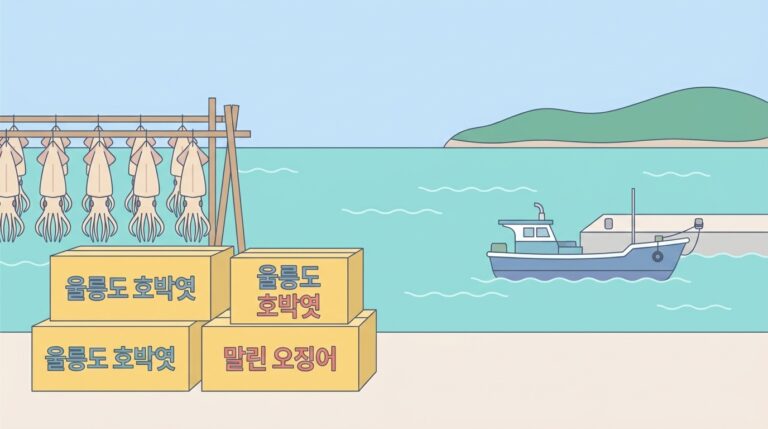
Picture this: After braving a three-hour turbulent ferry ride across the East Sea, you finally step onto the emerald shores of Ulleungdo Island (울릉도). The crisp maritime breeze hits you, carrying the savory, unmistakable aroma of freshly grilled squid sizzling over charcoal at Dodong Port (도동항). Rows of translucent squid hang drying along the harbor like coastal bunting, and friendly vendors wave yellow boxes of handmade pumpkin taffy (hobangnyeot) toward passersby.
You walk up with confidence, armed with standard textbook Korean: “오징어 얼마예요?” (How much is the squid?). But the vendor replies in a rapid, booming Gyeongsang-tinged coastal dialect: “이거 오늘 아침에 땡겨온 당일바리 피데기라 완전 쫀득합니더! 엿도 한번 씹어보소, 이 안 달라붙어예!”
Suddenly, your mind freezes. Dang-il-bari? Pidegi? You wanted to ask for a semi-dried squid that isn’t rock-hard, negotiate a small taste without coming across as cheap, and distinguish real Ulleungdo pumpkin taffy from cheap corn syrup knockoffs. Advanced Korean learners often stumble not over basic grammar, but over regional lexicon, authentic market pragmatics, and the unspoken social codes of Korean island communities. This field-tested C1 guide draws directly from our learners’ real travel mishaps so you can navigate local island stalls like a seasoned resident.
Phase 2: 핵심 표현 3선 심층 분석 (Top 3 Core Expressions)
1. 이거 당일바리예요? (Igeo dang-il-bari-yeyo?)
- Pronunciation: [I-geo dang-il-ba-ri-ye-yo?] (Think of ‘dang-il’ like ‘dawn deal’ said fast, and ‘bari’ like ‘body’ with a soft flap)
- Meaning: Literal: “Is this today’s catch?” | Nuance: “Was this caught and brought in today? (Signaling you know premium seafood terminology)”
- K-Culture Moment: In variety shows like 2 Days & 1 Night (1박 2일) or Three Meals a Day (삼시세끼), cast members sprint to fishing boats at dawn asking if the fish are dang-il-bari to ensure maximum sashimi-grade freshness.
- Editor’s Insight: At the C1 level, dropping dang-il-bari (당일바리) instantly transforms you from a naive tourist into an insider. While standard Korean uses 오늘 잡은 것 (something caught today), coastal traders respect travelers who know the maritime trade vocabulary.
- Situation Spectrum: Casual ⚠️ | Semi-formal ✅ | Formal 🚫
- 🤔 Think About It: In Western markets, pre-packaged labels declare catch dates. In Korean harbor markets, freshness is validated through active verbal banter and mutual recognition of expertise.
2. 호박엿이 많이 달지 않고 구수하네요. (Hobangnyeosi mani dalji anko gusuhaneyo.)
- Pronunciation: [Ho-bang-nyeo-si ma-ni dal-ji an-ko gu-su-ha-ne-yo?] (Pronounce ‘yeot’ softly into ‘si’, and ‘gu-su’ like ‘goo-soo’)
- Meaning: Literal: “The pumpkin taffy isn’t very sweet and is savory/earthy.” | Nuance: “This is the highest compliment you can pay a traditional Korean dessert—subtle, deep, and not sickeningly sugary.”
- K-Culture Moment: Watch any K-Drama where a matriarch tastes a dessert; the ultimate culinary praise on Korean television is never “it’s sweet!” but “달지 않아서 좋다” (It’s great because it’s not overly sweet).
- Editor’s Insight: Ulleungdo’s authentic pumpkin taffy is renowned because it balances earthy pumpkin (dan-hobak) flavor without sticking aggressively to dental work. Calling it 구수하다 (gusuhada – nutty, deep, wholesome) validates the artisan’s craft.
- Situation Spectrum: Casual ✅ | Semi-formal ✅ | Formal ✅
- 🤔 Think About It: Why does Korean culture value 달지 않은 디저트 (not-too-sweet desserts)? It reflects an aesthetic preference for natural, fermented, and grounded grain tones rather than processed sugars.
3. 맛보기로 덤 좀 챙겨주실 수 있나요? (Matbogiro deom jom chaeng-gyeojusil su innayo?)
- Pronunciation: [Mat-bo-gi-ro deom jom chaeng-gyeo-ju-sil su in-na-yo?] (Rhyme ‘deom’ with ‘hum’, and blend ‘chaeng-gyeo’ cleanly)
- Meaning: Literal: “Could you pack a little free bonus as a taste sample?” | Nuance: “Could you generously slip in an extra piece for me to try?”
- K-Culture Moment: Seen across market scenes in dramas like Our Blues (우리들의 블루스), where market warmth (jeong) is traded through spontaneous handfuls tossed into grocery baskets.
- Editor’s Insight: 덤 (deom) is untranslatable—it’s the tangible manifestation of Jeong (정, emotional connection). Asking for a discount (깎아주세요) can feel cold or transactional on an island; asking for 덤 with a polite smile invites the vendor into a friendly communal bond.
- Situation Spectrum: Casual ⚠️ | Semi-formal ✅ | Formal 🚫
- 🤔 Think About It: Bargaining in Korea isn’t always about driving down the price tag; it’s often about asking the seller to bestow affection through extra goods.
Phase 3: 교과서 한국어 vs 진짜 한국어 (Textbook vs. Real-Life Korean)
Situation 1: Inquiring about soft, semi-dried squid texture
- 📖 교과서 한국어: 반건조 오징어는 부드럽습니까? (Bangeonjo ojingeoneun budeoreopseumnikka? – “Is the semi-dried squid soft?”)
- 🗣️ 진짜 한국어: 피데기라 식감이 딱딱하지 않고 쫀득하죠? (Pidegira sikgami ttakttakhaji anko jjondeukhajyo? – “This is pidegi, so it has a chewy bite without being tough, right?”)
- 💡 왜 다를까?: Native islanders and seafood lovers rarely say 반건조 오징어 in spoken banter. They use the regional/culinary term 피데기 (pidegi) paired with sensory texture verbs like 쫀득하다 (pleasantly chewy/springy).
Situation 2: Checking if the taffy sticks to teeth
- 📖 교과서 한국어: 이 엿은 치아에 붙습니까? (I yeoseun chia-e batseumnikka? – “Does this taffy adhere to teeth?”)
- 🗣️ 진짜 한국어: 이거 이빨에 들러붙는 엿 아니죠? (Igeo ippare deulleobeunneun yeot anijyo? – “This doesn’t uncomfortably stick to your teeth, does it?”)
- 💡 왜 다를까?: Traditional taffy (yeot) has a reputation for yanking out fillings. Real shoppers directly check if it’s 들러붙다 (cling stubbornly) in an easygoing, conversational cadence.
Phase 4: K-Culture 딥다이브 & 비언어적 매너 (Deep-Dive & Body Language)
4-1. 눈치 (Nunchi) & Gestures: The Port Vendor Protocol
- The Squid Inspection Touch: Never touch the middle fleshy belly of hanging dried squid with bare, greasy hands—vendors consider this disrespectful to their drying curation. Instead, gently support the wooden dowel or inspect the golden hue with your eyes. If invited to feel the softness, lightly pinch the outer mantle between two fingers.
- Accepting Samples with Both Hands: When an elder vendor cuts a warm strip of grilled squid or snaps a shard of pumpkin taffy with huge shears, cup both hands together (두 손) to receive it, nodding your head slightly. Eating it immediately in front of them with an expressive nod shows respect for their product.
4-2. Cultural Code: Island Hospitality and Linguistic Myth
- The Etymology of Ulleung Taffy: Did you know Ulleungdo pumpkin taffy was originally not made of pumpkin? Historically, the island lacked rice paddies for standard taffy malt, so settlers used the sap and bark of the native hubang tree (후박나무). Mainland visitors misheard hubak-yeot as hobak-yeot (pumpkin taffy)! Embracing the misunderstanding, islanders planted sweet pumpkins across the volcanic hillsides, creating the legendary golden confection we enjoy today.
- The Rough Exterior of Island Dialect: Gyeongsang and East Sea coastal speech sounds sharp, abrupt, and loud. Don’t mistake volume for anger! High wind speeds and engine noise on fishing docks shaped a vocal style that is punchy and direct. Beneath the gruff tone lies deep maritime hospitality (섬인심).
Phase 5: 실전 롤플레이 시나리오 (Real-Life Roleplay Scenario)
- Setting: Dodong Harbor market alleyway. Squid drying racks sway against the sea mist. Steam rises from a cast-iron roaster.
- NPC: Auntie Myeong-ja (명자 이모), a 60-something vendor wielding traditional confectioner scissors (엿가위), sporting a sun visor and floral apron.
- 손님 (You): 이모님, 안녕하세요! 앞에 걸려 있는 오징어 때깔이 진짜 곱네요. (Imo-nim, annyeohaseyo! Ape geollyeo inneun ojing-eo ttaekkari jinjja gomneyo.)
🎭 행동 지문: Admiring the golden squid racks with your hands politely folded.
“Auntie, hello! The color on those squids hanging in front is truly gorgeous.” -
명자 이모: 어서 오소! 방금 덕장에서 걷어온 당일바리라 그래! 만져봐라, 말랑말랑하제? (Eoseo oso! Bang-geum deokjang-eseo geodeo-on dang-il-bari-ra geurae! Manjyeobwara, mallang-mallang-haje?)
🎭 행동 지문: Snipping a sample of squid with brass scissors and offering it over.
“Welcome! It’s because they’re today’s catch just brought down from the drying rack! Feel it, tender, isn’t it?” -
손님 (You): 와, 진짜 피데기 식감이 촉촉하고 쫀득하네요! (Wa, jinjja pidegi sikgami chokchokhago jjondeukhaneyo!)
🎭 행동 지문: Tasting the sample with both hands cupped, nodding in delight.
“Wow, the texture of this pidegi is genuinely moist and springy!” -
명자 이모: 맛을 딱 아네! 이거 한 축 사가면 육지 가서 딴 오징어 못 묵는기라. (Maseul ttak ane! Igeo han chuk sagamyeon yukji gaseo ttan ojing-eo mot mungneun-gira.)
🎭 행동 지문: Proudly tapping a bundle of 20 dried squids.
“You really know your flavors! If you take one bundle (chuk) of this, you won’t be able to eat mainland squid ever again.” -
손님 (You): 서울 가져가서 부모님이랑 구워 먹으려고요. 혹시 호박엿도 직접 달이신 거예요? (Seoul gajyeogaseo bumonim-irang guwo meogeuryeogoyo. Hoksi hobangnyeotto jikjeop dari-sin geoyeyo?)
🎭 행동 지문: Looking curiously at the amber-colored candy chunks in the wooden display.
“I want to take it back to Seoul to grill with my parents. Did you also simmer this pumpkin taffy yourself?” -
명자 이모: 당연하제! 설탕 범벅인 가짜 엿하고 비교하믄 섭하지. 한번 씹어보소, 이빨에 하나도 안 들러붙는다! (Dang-yeonhaje! Seoltang beombeog-in gajja yeothago bigyohameun seophaji. Hanbeon ssibeoboso, ippare hanado an deulleobeunneunda!)
🎭 행동 지문: Snapping a generous chunk of taffy and handing it to you.
“Of course! It hurts my pride if you compare this to fake taffy covered in refined sugar. Chew a piece—it doesn’t stick to your teeth at all!” -
손님 (You): 많이 달지 않고 뒷맛이 엄청 구수하네요! 오징어 두 축이랑 엿 세 박스 할게요. (Mani dalji anko dwinmasi eomcheong gusuhaneyo! Ojing-eo du chuk-irang yeot se bakseu halgeyo.)
🎭 행동 지문: Pulling out your payment card while smiling warmly.
“It’s not cloyingly sweet and has such a clean, nutty aftertaste! I’ll take two bundles of squid and three boxes of taffy.” -
명자 이모: 아이고 손도 크네! 고마워서 어쩌나, 가면서 씹어먹을 맛보기 덤 좀 넉넉히 싸줄게! (Aigo sondo keune! Gomawoseo eojjeona, gamyeonseo ssibeomeogeul matbogi deom jom neongneokhi ssajulge!)
🎭 행동 지문: Chuckling happily and sliding three extra grilled squid legs and a handful of candy into your shopping bag.
“Oh my, you’re generous! I’m so grateful—let me pack you plenty of free nibbles to chew on your way!”
🔀 Interactive Decision Point (선택지)
Suppose Auntie finishes ringing up your total. How do you respond to seal the relationship?
- Option A: “깎아주시면 다음에도 꼭 올게요!” (Discount it and I’ll definitely come back next time!)
Feedback: Bad. ❌ Island margins on squid are slim due to high boat fuel costs. Demanding discounts can dampen the mood instantly. - Option B: “이모님, 너무 친절하셔서 그런데 맛보기로 덤 몇 개만 더 챙겨주실 수 있나요?” (Auntie, you’re so kind—could you toss in a couple more sample treats for the road?)
Feedback: Best. 🌟 Praising her hospitality while playfully asking for deom flatters her maternal pride (imo-nim) and unlocks generous bonuses. - Option C: “현금으로 낼 테니 반값으로 해주세요.” (I’ll pay cash, so give it to me half price.)
Feedback: Risk. ⚠️ Suggesting cash discounts is fine, but asking for unreasonable cuts like “half price” comes across as predatory to proud local artisans.
Phase 6: 10초 감정 섀도잉 드릴 (Emotional Shadowing Drill)
Practice these natural rhythm pauses (/) with visceral emotional tones:
[🌊 바다 내음 가득 찬 감탄 / Impressed & Awestruck]
와! / 당일바리라 그런지 / 빛깔이 / 투명하게 살아있네요!
(Wa! / Dang-il-bari-ra geureonji / bitkkari / tumyeonghage sara-inneyo!)-
[😋 담백하고 깊은 미식가의 평가 / Discerning Foodie Tone]
이 호박엿은 / 설탕 단맛이 아니라 / 호박 본연의 맛이라 / 되게 구수해요.
(I hobangnyeoseun / seoltang danmasi anira / hobak bon-yeon-ui masira / doege gusuhaeyo.) -
[🥺 애교 섞인 정겨운 부탁 / Warm, Playful Appeal]
이모님 인심 믿고 / 많이 샀는데, / 배에서 먹을 덤 / 조금만 챙겨주세요~
(Imo-nim insim mitgo / mani sanneunde, / bae-eseo meogeul deom / jogeum-man chaeng-gyeojuseyo~)
Phase 7: K-Culture 미니 사전 (Mini Glossary)
-
당일바리 (Dang-il-bari)
Literal: Single-day vessel haul.
Usage: Seafood caught on a day-trip fishing run and brought to market immediately without long-term freezer storage. Represents peak freshness. -
피데기 (Pidegi)
Literal: Coastal dialect for semi-dried squid (반건조 오징어).
Usage: Retaining roughly 40-50% moisture, it offers the aroma of dried seafood combined with the succulent, tender chew of fresh squid. -
축 (Chuk)
Literal: Traditional counter for squids.
Usage: One chuk equals exactly 20 squids. Knowing counters (한 축, 두 축) signals top-tier C1 Korean fluency to merchants. -
식감 (Sikgam) & 쫀득하다 (Jjondeukhada)
Literal: Mouthfeel & To be pleasantly chewy/glutinous.
Usage: While Western culinary reviews focus heavily on flavor and spices, Korean gastronomy places equal weight on 식감 (texture). 쫀득하다 denotes the satisfying resistance when biting into fresh squid or rich taffy.
Phase 8: 여행자를 위한 생존 키트 (Traveler’s Survival Kit)
Survival TOP 3 Phrases
- 한 축에 몇 마리 들어가요? (Han chug-e myeot mari deureogayo?)
Pro Tip: Test phrase to double-check sizing grades (small, medium, large squid). - 이거 육지까지 상온 보관해도 되나요? (Igeo yukji-kkaji sang-on bogwanhaedo doenayo?)
Pro Tip: Essential for pidegi, which usually requires ice packs (아이스팩) if your journey home takes more than 5 hours. - 택배 발송도 가능해요? (Taekbae balsong-do ganeunghaeyo?)
Pro Tip: Most reputable Ulleungdo stalls offer mainland courier delivery right to your hotel or home.
Editor’s Travel Note
- Ferry & Weather Monitoring: Ferries to Ulleungdo (from Gangneung, Mukho, or Pohang) are notoriously weather-dependent. Make sure to track bookings via the 가보고 싶은 섬 웹사이트 rather than generic travel portals.
- Navigation & Stalls: Google Maps often lacks real-time alleyway mapping in Ulleungdo. Use the 네이버 지도 앱 다운로드 to locate portside stalls and fish cleaning sheds.
- Payment Etiquette: Credit cards are widely accepted even at small stalls, but keeping 10,000 KRW bills ready is deeply appreciated when buying small sample cups of taffy or asking for custom packaging.
Phase 9: “한 발 더 깊이” (Cultural Reflection)
In Korean mainland markets, transactions have largely transitioned into contactless kiosks, barcodes, and automated deliveries. Yet on an isolated volcanic island like Ulleungdo, commerce remains an intimate theater of human survival and shared pride. Squid fishing is backbreaking nocturnal work under thousand-watt lights against punishing waves; simmering pumpkin mash for days over wood smoke requires relentless patience. When an islander hands you 덤, they aren’t offloading inventory—they are sharing the rugged vitality of the East Sea. Language here is not a mere instrument of commerce; it is an affirmation of shared endurance.
💬 Your Turn: What traditional food in your culture requires a specific local terminology to buy authentically? Have you ever experienced a market where bargaining felt more like building friendship than saving money? Share your thoughts below!
Phase 10: FAQ & 오해 방지 (FAQ Schema)
Q: Is bargaining for squid in Ulleungdo considered rude?
A: Blatantly demanding discounts (“깎아주세요!”) on premium seafood is frowned upon because fishing here involves high risks and fuel expenses. However, politely asking for an extra piece (“맛보기 덤 좀 챙겨주실 수 있나요?”) or rounding down small change when buying multiple bundles (축) is considered warm, acceptable market banter.
Q: Why does some Ulleungdo pumpkin taffy taste different from store-bought versions?
A: Mass-manufactured mainland versions frequently rely on high-fructose corn syrup (물엿) and artificial flavoring. Authentic Ulleungdo hobangnyeot contains a significant percentage of real native pumpkin mash and malt, resulting in an amber brown color, lower cloying sweetness, and zero sticky residue on tooth enamel.
Q: Can I bring semi-dried squid (피데기) back home on an international flight?
A: Domestic travel with cooked or dried seafood on Korean trains and ferries is completely fine. However, agricultural/quarantine customs regulations in many countries (such as the US, Australia, or EU) restrict entering with animal products that retain high moisture. If traveling internationally, opt for fully dried squid (마른오징어) in commercially sealed vacuum packages, or enjoy your pidegi freshly roasted right on the island!
🚨 흔한 실수 (Common Mistakes) 경고판
- Mistake: Using the counter 개 (gae) for bundles of squid.
Correct Action: Say 한 축 (han chuk = 20 squids) or 마리 (mari) for individual pieces. Saying “오징어 한 개 주세요” marks you as a novice. - Mistake: Calling all sweet snacks 사탕 (candy).
Correct Action: Taffy made from grains/vegetable starch is 엿 (yeot). Calling it 사탕 misses the culinary lineage entirely. - Mistake: Tearing squid horizontally across the grain.
Correct Action: Traditional roasted squid tastes vastly more tender when peeled along the natural grain lines from side to center. Watch the locals roast it!
Phase 11: 액션 미션 & 참여 유도 (Action Missions)
- 🥉 Bronze Mission: Stand in front of your mirror and practice the phrase: “이거 당일바리 피데기 맞죠? 식감이 완전 쫀득하네요!” until it rolls off your tongue in under 3 seconds.
- 🥈 Silver Mission: Find a Korean variety show episode filmed on Ulleungdo (e.g., 1박 2일 Ulleungdo special) and leave a comment identifying whether the cast ordered 마른오징어 (dried) or 피데기 (semi-dried).
- 🥇 Gold Mission: Visit a Korean local traditional market or seafood center (like Noryangjin in Seoul or Jagalchi in Busan) and use the word 당일바리 or 덤 during an actual purchase!
🎮 K-Culture Challenge: Next time you watch an actor eat something sweet in a K-Drama, listen closely: do they say “너무 달콤해요” or “많이 안 달아서 맛있어요”? Post the drama title and timestamp in our community forum!
Phase 12: 인터랙티브 퀴즈 챌린지 (Interactive Quiz)
1. Situational Judgment: You want to check if the pumpkin taffy is of artisanal quality without offending the maker. What is the most culturally refined C1 phrasing?
* A) 이거 설탕을 얼마나 넣었길래 이렇게 비싸요?
* B) 많이 달지 않고 호박 맛이 구수해서 부모님 선물로 딱이네요.
* C) 이 엿은 이에 들러붙으니까 다른 거 주세요.
🔍 정답 및 해설 확인하기 (Click to reveal answer)
- Correct Answer: B
- Explanation: Praising traditional confections as 많이 달지 않고 구수하다 (not overly sweet and wholesome) directly compliments the artisan’s technique. Option A is offensive, while Option C is bluntly dismissive.
2. Fill-in-the-Blank: Complete the market merchant counter dialogue:
“오징어 스무 마리 한 묶음을 세는 고유 단위는 한 ( )이다.”
🔍 정답 및 해설 확인하기 (Click to reveal answer)
- Correct Answer: 축 (Chuk)
- Explanation: In traditional Korean counting systems, 20 squids are grouped and counted as 한 축 (han chuk).
3. True or False Cultural Quiz: Authentic Ulleungdo pumpkin taffy (호박엿) has always historically been made with sweet pumpkins since the Three Kingdoms period.
🔍 정답 및 해설 확인하기 (Click to reveal answer)
- Correct Answer: False (X)
- Explanation: It originally evolved from the bark/sap of the hubang tree (후박나무). Settlers began using pumpkins only after mainlanders repeatedly misheard hubak as hobak (pumpkin)!






