

Phase 1: Empathy (Story-Immersive Opening)
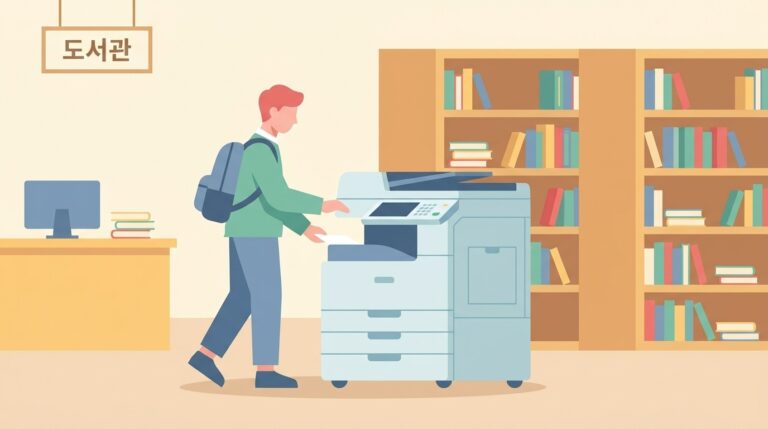
안녕하세요! 매일한글 에디터입니다. Have you ever stood before a massive, glowing multifunction photocopier in a pin-drop silent Korean public library, clutching your study notes while a cold sweat breaks out on your forehead? In K-Dramas like Cheese in the Trap, university students breeze through modern campus print rooms with effortless grace. In real life, however, you’re squinting at confusing touchscreen buttons like “양면” and “흑백”, praying the machine doesn’t jam while a line quietly forms behind you!
Take a deep breath—you are not alone. Over 80% of our beginner students confess that automated machines in quiet Korean spaces feel like an unexpected survival test. This lesson is built on real-world classroom feedback to give you foolproof phrases, social cues, and practical know-how so you can print, copy, and scan in Korea without breaking a sweat.
Phase 2: 3 Core Expressions Deep-Dive
1. 이거 복사 어떻게 해요? (Igeo boksa eotteoke haeyo?)
- Pronunciation: [Igeo boksa eotteoke haeyo?] (Pronounce “boksa” like “poke-sah” with a soft p, and “eotteoke” like “uh-ttoh-keh”)
- Meaning: “How do I copy this?” (Literal) / “Could you show me how to make a copy with this?” (Nuance)
- K-Culture Moment: The relatable scene in a campus webtoon where a flustered freshman shyly turns to a friendly sunbae (senior) by the library printer for quick guidance.
- Editor’s Insight: Using “이거” (this) while lightly gesturing toward your document instantly clarifies your intention without needing complicated technical vocabulary.
- Situation Spectrum: Casual (⚠️) / Semi-formal (✅) / Formal (✅)
- 🤔 Think About It: In English, we often ask “Can you help me?” but Korean learners often say “How is it done?” (어떻게 해요?). Why do you think Korean tends to focus on the process rather than the person’s ability?
2. 종이가 걸렸어요. (Jong-iga geollyeosseoyo.)
- Pronunciation: [Jong-iga geollyeosseoyo.] (“Jong-i” sounds like “jong-ee”, and “geollyeosseoyo” rhymes with “cull-yeo-ssuh-yo”)
- Meaning: “The paper got caught.” (Literal) / “The paper is jammed.” (Nuance)
- K-Culture Moment: The classic office drama moment in Misaeng where an urgent contract report freezes inside the printer tray at the worst possible second.
- Editor’s Insight: “걸리다” means to get snagged or stuck. It describes a passive situation, so it naturally sounds blameless and polite when reporting a machine error to staff.
- Situation Spectrum: Casual (⚠️) / Semi-formal (✅) / Formal (✅)
- 🤔 Think About It: Notice how Korean uses a neutral state verb (“it got stuck”) instead of an accusatory phrase like “The machine broke my paper.” How does this reflect Korean harmony in shared spaces?
3. 카드로 결제할 수 있나요? (Kadeuro gyeoljehal su innayo?)
- Pronunciation: [Kadeuro gyeoljehal su innayo?] (“Kadeu” sounds like “kah-deu”, “gyeolje” rhymes with “gyuhl-jeh”)
- Meaning: “Can I pay with a card?” (Literal) / “Do you take credit or debit card here?” (Nuance)
- K-Culture Moment: Visiting a trendy unmanned 24-hour print shop in Hongdae where students swipe T-money or check cards to unlock the copy screen.
- Editor’s Insight: In modern Korea, almost all public copiers and unmanned print cafes are cashless. Using “-ㄹ 수 있나요?” softens the inquiry into a polite, natural question.
- Situation Spectrum: Casual (🚫) / Semi-formal (✅) / Formal (✅)
- 🤔 Think About It: In your home country, do libraries accept cash coins or digital card swipes? How has cashless payment changed public service manners?
Phase 3: Textbook Korean vs. Real Korean
Situation 1: Asking staff or another user for printer guidance
- 📖 교과서 한국어 (Textbook Korean): 복사기 작동법을 설명해 주시겠습니까? (Boksagi jakdongbeobeul seolmyeonghae jusigessseumnikka? – “Would you be kind enough to explain the operation of this photocopier?”)
- 🗣️ 진짜 한국어 (Real Korean): 저기요, 이거 복사 어떻게 해요? (Jeogiyo, igeo boksa eotteoke haeyo? – “Excuse me, how do I make a copy on this?”)
- 💡 왜 다를까? (Why is it different?): Textbook phrasing uses heavy, formal grammar meant for written administrative notices. In everyday life, native speakers use a gentle “저기요” (excuse me) paired with the flexible question ending “-어떻게 해요?” to sound friendly and approachable.
Situation 2: Informing the librarian that the tray is out of paper
- 📖 교과서 한국어 (Textbook Korean): 인쇄 용지가 전량 소진되었습니다. (Inswe yongjiga jeollyang sojindoeeosseumnida. – “The printing paper has been completely depleted.”)
- 🗣️ 진짜 한국어 (Real Korean): 여기 종이가 다 떨어졌어요. (Yeogi jong-iga da tteoreojyeosseoyo. – “The paper ran out here.”)
- 💡 왜 다를까? (Why is it different?): Real Koreans rely on the phrase “다 떨어지다” (to completely run out of something). It sounds natural, casual, and describes everyday resource shortages like coffee, toilet paper, or printer paper.
Phase 4: K-Culture Deep Dive & Non-Verbal Manners
4-1. 눈치 (Nunchi) & Library Etiquette
Korean public libraries (공공도서관) and study cafes (스터디카페) hold an intense cultural norm of quiet courtesy (정숙, jeongsuk). When approaching someone for copier assistance:
* Lower your voice to a half-whisper: Do not project your voice across the copy corner. Step in close before speaking.
* The Two-Hand Card Gesture: When paying a counter assistant with your card, always hand it over holding the edges with both hands (or supporting your right forearm with your left hand). Never toss or flick a payment card onto the counter.
* Nunchi around queue speed: If your print job is 50 pages long and someone arrives behind you holding one sheet of passport ID, making eye contact with a warm nod and offering them a quick turn displays peak everyday nunchi.
4-2. The Korean Print Culture Phenomenon
Exam culture in South Korea has spurred an entire industry of 24-hour automated printing franchises like “프린트카페” (Print Cafe 24) near every major university such as Yonsei, Korea University, and Hongik. Understanding these self-service touchscreens is an essential life hack for any student or remote worker navigating Seoul.
Phase 5: Real-World Roleplay Scenario
Setting: Mapo Public Library (마포평생학습관), 2nd Floor Digital Resource Room.
Characters: You (an international resident needing to copy a visa document) and Min-ji (a helpful college student waiting nearby).
- Turn 1 (You): 🎭 Approaching quietly with a slight head bow
저기요, 혹시 이거 복사 어떻게 해요?
(Jeogiyo, hoksi igeo boksa eotteoke haeyo?)
“Excuse me, by any chance, how do I make a copy on this?” -
Turn 2 (Min-ji): 🎭 Smiling softly and pointing to the monitor screen
화면에서 ‘복사’ 누르고, 종이 여기에 올려두시면 돼요.
(Hwamyeon-eseo ‘boksa’ nureugo, jong-i yeogie ollyeodusimyeon dwaeyo.)
“Press ‘Copy’ on the screen, and place your paper right here.” -
Turn 3 (You): 🎭 Tapping the screen and looking at the card slot
카드로 결제할 수 있나요?
(Kadeuro gyeoljehal su innayo?)
“Can I pay with a credit card?” -
Turn 4 (Min-ji): 🎭 Nodding and gesturing toward the card terminal on the right
네, 오른쪽에 카드 꽂으시면 돼요.
(Ne, oreunjjoge kadeu kkojeusimyeon dwaeyo.)
“Yes, you just insert your card into the slot on the right.” -
Turn 5 (You): 🎭 Machine beeps loudly with a flashing red alert icon
어? 갑자기 빨간 불이 들어왔어요. 종이가 걸렸어요.
(Eo? Gapjagi ppalgan buri deureowasseoyo. Jong-iga geollyeosseoyo.)
“Oh? A red light suddenly came on. The paper is jammed.” -
Turn 6 (Min-ji): 🎭 Peeking at the paper tray gently
아, 1번 트레이에 걸린 것 같아요. 사서 선생님 불러드릴까요?
(A, ilbeon teureie geollin geot gatayo. Saseo seonsaengnim bulleodeurilkkayo?)
“Ah, it looks like it got caught in Tray 1. Shall I call the librarian for you?” -
Turn 7 (You): 🎭 Bowing slightly with relief
정말 감사합니다. 도와주셔서 다행이에요.
(Jeongmal gamsahamnida. Dowajusyeoseo dahaeng-ieyo.)
“Thank you so much. I’m so relieved you helped me.” -
Turn 8 (Min-ji): 🎭 Waving hand softly in a warm, polite gesture
아니에요! 금방 해결될 거예요.
(Anieyo! Geumbang haegyeoldoel geoyeyo.)
“Not at all! It will be sorted out in no time.”
🔀 Interactive Branching Choice
When the paper jams in Turn 5, how do you handle it?
* Choice A: Whisper quietly to Min-ji: “종이가 걸렸어요. 어떻게 하죠?” (Jong-iga geollyeosseoyo. Eotteoke hajyo? – The paper jammed. What should I do?)
* Choice B: Loudly shout across the quiet study room: “선생님! 복사기 망가졌어요!” (Seonsaengnim! Boksagi manggajyeosseoyo! – Teacher! The copier broke down!)
* Choice C: Yank the paper tray aggressively with both hands until the sheet rips.
- Feedback for Choice A (Best): Perfect! Whispering keeps library calm, and asking “어떻게 하죠?” invites courteous mutual problem-solving.
- Feedback for Choice B (Bad): Breaking the silence in a Korean library will invite sharp stares (눈총, nunchong) from surrounding students.
- Feedback for Choice C (Risk): High risk of tearing the paper inside the roller or permanently damaging public property. Always seek assistance!
Phase 6: 10-Second Emotion Shadowing Drill
Read these aloud, pausing at the slash (/) and channeling the tagged emotion!
[🥺 당황스럽지만 조심스럽게 / Hesitant & apologetic]
저기요, / 이거 복사 / 어떻게 해요?
(Jeogiyo, / igeo boksa / eotteoke haeyo?)-
[⚙️ 객관적이고 차분하게 / Calm & factual]
기계에서 / 종이가 / 걸렸어요.
(Gigye-eseo / jong-iga / geollyeosseoyo.) -
[😊 감사하며 안도하듯 / Grateful & relieved]
도와주셔서 / 정말 / 감사해요!
(Dowajusyeoseo / jeongmal / gamsahaeyo!)
Phase 7: K-Culture Mini Dictionary
-
복사 (Boksa) | Photocopy
Refers strictly to optical copying from a physical page to another sheet. Widely seen on copier touchscreens as “복사 시작” (Start Copy). -
출력 / 인쇄 (Chullyeok / Inswe) | Printout
“인쇄” is standard printing, while “출력” is used in offices and print shops when outputting digital files from a USB stick or computer. -
종이 걸림 (Jong-i Geollim) | Paper Jam
The exact technical notification that pops up on Korean digital screens when sheets get trapped in paper rollers. -
결제 (Gyeolje) | Payment / Checkout
The universal financial term used on all Korean touchscreens and self-serve kiosks when processing credit cards or mobile pay.
Phase 8: Traveler’s Survival Kit
Top 3 Survival Phrases
-
양면으로 해주세요. (Yangmyeon-euro haejuseoyo.)
Romanization: [Yangmyeon-euro haejuseoyo.]
Pro Tip: Use this to request double-sided printing, saving paper and halving your fee! -
흑백으로 출력할게요. (Heukbaek-euro chullyeokhalgeyo.)
Romanization: [Heukbaek-euro chullyeokhalgeyo.]
Pro Tip: Korean copiers default to color, which costs roughly 4 to 5 times more. Specify “흑백” (black & white) to save cash. -
영수증 필요해요. (Yeongsujeung piryohaeyo.)
Romanization: [Yeongsujeung piryohaeyo.]
Pro Tip: Essential if you need proof of expense for student clubs, university grants, or business visas.
Editor’s Travel Note
Need printing late at night? Search for “프린트카페” (Print Cafe) or “킨코스코리아” (Kinko’s Korea) on the Naver Map App Download Page. Remember that nearly all public printing facilities in South Korea only accept physical credit/debit cards or local transport cards (T-money); coin slots are virtually non-existent today!
Phase 9: “One Step Deeper” (Reflective Essay)
In South Korea, shared public infrastructure operates on an implicit foundation of communal mindfulness. Libraries are viewed not merely as repositories for books, but as sanctuaries of dedicated ambition where students and job-seekers spend twelve hours a day pursuing life-defining milestones. When you handle machinery softly, report paper shortages conscientiously, and lower your voice by the photocopier, you become part of this collective mutual respect. What does library etiquette look like in your hometown, and how do people balance public sharing with individual speed?
💬 Your Turn: Have you ever experienced machine panic in a foreign country? Share your funniest copier or print shop story in the comments below!
Phase 10: FAQ & Avoiding Misunderstandings
Q: Can I use cash coins to make copies in Korean public libraries?
A: In almost all modern public libraries and university centers, coin-operated machines have been phased out. You will need a credit card, check card, or a pre-charged T-money transportation card to activate the self-checkout kiosks.
Q: What is the difference between “복사” (boksa) and “인쇄” (inswe)?
A: “복사” (photocopy) means placing an existing physical sheet of paper on the glass scanner to duplicate it. “인쇄” (print) means sending a digital file (PDF, Word, photo) from a library PC or USB stick to print onto paper.
Q: What should I do if my document is private and I left it on the copier glass?
A: Head straight to the librarian desk and say: “복사기에 서류를 두고 왔어요” (Boksagie seoryureul dugo wasseoyo – “I left my documents on the copy machine”). Librarians usually collect forgotten sheets in a lost-and-found tray.
🚨 Common Mistakes Warning Board
- Mistake: Forgetting to switch print mode from color (컬러) to black & white (흑백).
- Correct Action: Always verify that the screen button says “흑백 (Black/White)” before pressing start, or you might pay 500 KRW per page instead of 50-70 KRW!
- Mistake: Pulling hard on a jammed piece of paper while the machine is running.
- Correct Action: Leave the tray open and alert library staff using: “종이가 걸렸어요” (Jong-iga geollyeosseoyo).
- Mistake: Speaking at full volume when asking a stranger for printer help.
- Correct Action: Lean in slightly, whisper quietly, and open with a polite “저기요…” (Jeogiyo…).
Phase 11: Action Mission & Engagement
- 🥉 Bronze Level: Stand in front of your mirror and practice saying: “이거 복사 어떻게 해요?” (Igeo boksa eotteoke haeyo?) 5 times with a gentle, questioning intonation.
- 🥈 Silver Level: Share a story or photo of your study setup or Korean notebook on Instagram/X and caption it with: “오늘도 열공! 종이가 다 떨어졌어요!” (Studying hard today too! Ran out of paper!). Tag @DailyHangul!
- 🥇 Gold Level: Visit a local Korean library or a 24-hour Print Cafe in your area, successfully print a 1-page document using the Korean menu screen, and say “감사합니다” (Gamsahamnida) to the staff!
- 🎮 K-Culture Mission: Watch an episode of a campus romance K-drama (like Weightlifting Fairy Kim Bok-joo or Do You Like Brahms?) and spot the scene where characters print sheet music or lecture notes.
Phase 12: Interactive Quiz Challenge
1. Situational Judgment:
You are at the university library copier, and the screen suddenly flashes yellow with an empty tray icon. What is the most natural sentence to report this to the desk assistant?
* A) 종이가 다 떨어졌어요. (Jong-iga da tteoreojyeosseoyo.)
* B) 복사기가 죽었어요. (Boksagiga jugeotseoyo.)
* C) 인쇄를 절대 안 해요. (Inswereul jeoldae an haeyo.)
2. Fill-in-the-Blank:
Excuse me, can I pay by card?
“______로 결제할 수 있나요?”
3. True or False (Culture):
In modern Korean public libraries, it is common and expected to pay for photocopies using 100 KRW coins in a physical coin slot.
* (True / False)
👉 Click here for Answers and Explanations!
-
Correct Answer: A
Explanation: “종이가 다 떨어졌어요” is the natural colloquial way to say you’ve run out of paper. Saying the machine “died” (B) or “never prints” (C) is unnatural or rude. -
Correct Answer: 카드 (Kadeu)
Explanation: “카드로 결제할 수 있나요?” (Can I pay by card?) is the essential phrase for all automated kiosks. -
Correct Answer: False
Explanation: Today, almost all Korean public copiers require credit cards, check cards, or T-money transit cards. Coin slots are virtually obsolete!







