

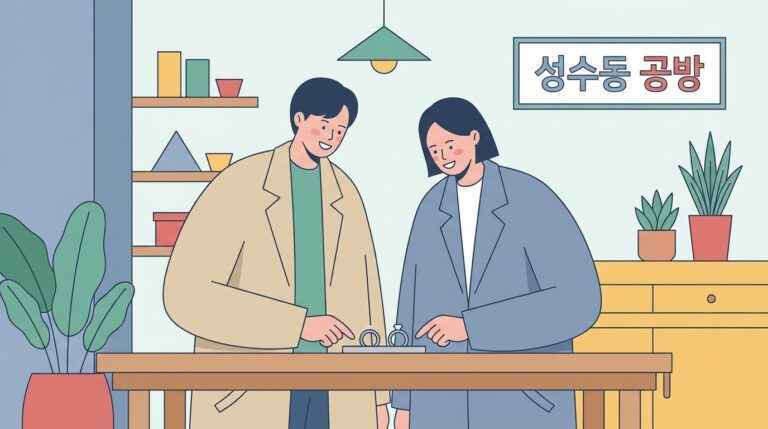
Phase 1: 공감 (Story-Driven Opening)
안녕하세요! 매일한글 에디터입니다.
Imagine strolling down the trendy, red-brick alleys of Seongsu-dong on a crisp Saturday afternoon. You and your Korean partner stop outside a minimalist boutique with warm lighting. In the display window, two sleek, coordinated overcoats catch your eye, alongside a set of delicate, brushed-silver bands. Your heart flutters with excitement—you want to suggest getting a matching item, something uniquely Korean, a tangible badge of your relationship. But suddenly, your mind freezes.
How do you suggest matching clothes without sounding like you want identical kindergarten uniforms? If you want to propose getting couple rings, how do you bring it up naturally without sounding like an abrupt marriage proposal? Many of our intermediate learners share this exact frustration: “I know the word ‘같다’ (to be the same) and ‘옷’ (clothes), but saying ‘우리 같은 옷 사자’ felt childish and awkward!”
Matching items—lovingly called 커플템 (keopeultem)—is an art form in modern Korean dating culture. Gone are the days of wearing identical neon hoodies. Today, it’s about subtle harmonies, thoughtful anniversaries, and shared memories at artisan workshops. This guide is crafted specifically for B2 intermediate learners who want to move past clunky textbook sentences and speak with the playful, emotionally intelligent fluency of a real Seoul insider. Let’s master the art of matching together!
Phase 2: 핵심 표현 3선 심층 분석 (Core Expressions)
1. 우리 이거 세트로 맞출까? (Uri igeo seteuro matchulkka?)
- Pronunciation: [Oo-ri ee-geo seh-teu-ro ma-chul-kka?] (Sound analogy: Say ‘match’ with an energetic snap, like striking a wooden matchstick).
- Meaning: Literal: “Shall we match this as a set?” / Nuance: “What do you think about getting these as a matching couple item?”
- K-Culture Moment: You will hear this in almost every contemporary romance drama when a couple browses phone cases in Hongdae or sneakers in Gangnam. It’s casual, breezy, and tests the waters without putting pressure on the partner.
- Editor’s Insight: The verb 맞추다 (matchuda) literally means to fit parts together, solve a puzzle, or tailor-make something. In dating, it expresses intentional harmony. Using -ㄹ까? (-lkka?) softens the suggestion into a shared consideration.
- Situation Spectrum: Casual (✅) / Semi-formal (⚠️ – sounds too intimate for colleagues) / Formal (🚫)
- 🤔 Think About It: In English, “matching” often evokes matching socks or loud identical shirts. Why do you think Korean uses the word “맞추다” (to coordinate/align together) rather than simply “buying the same thing”?
2. 똑같은 것보다 시밀러룩이 덜 부담스럽지 않아? (Ttokgateun geotboda similleorugi deol budamseureopji ana?)
- Pronunciation: [Ttok-ga-teun geot-bo-da shi-mil-leo-roo-gi deol boo-dam-seu-reop-ji ah-na?] (Sound analogy: ‘Ttok’ sounds like the sharp snap of breaking a chocolate bar).
- Meaning: Literal: “Rather than the exact same thing, isn’t a similar look less overwhelming?” / Nuance: “Wouldn’t coordinating our outfits be way more subtle and stylish than wearing identical clothes?”
- K-Culture Moment: Used by stylish young couples discussing weekend OOTD (Outfit of the Day) on Instagram reels or YouTube dating vlogs. It shows refined aesthetic taste.
- Editor’s Insight: 부담스럽다 (budamseureopda) is one of the most culturally loaded B2 words in Korean. It captures the psychological weight of feeling awkward, overly intense, or pressured. Proposing a 시밀러룩 (similleoruk) relieves that social pressure while keeping the romantic bond.
- Situation Spectrum: Casual (✅) / Semi-formal (⚠️) / Formal (🚫)
- 🤔 Think About It: How does your home culture view publicly showing off couple status compared to Korea’s nuanced transition from bold matching to understated harmony?
3. 우리 백일 기념으로 커플링 공방 예약할까? (Uri baegil ginyeomeuro keopeulling gongbang yeyakhalkka?)
- Pronunciation: [Oo-ri bae-gil gi-nyeom-eu-ro keo-peul-ring gong-bang yeh-yak-hal-kka?] (Sound analogy: ‘Gong-bang’ rhymes with an artisan song sung in a cozy loft).
- Meaning: Literal: “Shall we reserve a couple ring workshop to celebrate our 100th day?” / Nuance: “For our 100-day milestone, let’s go make handmade rings together!”
- K-Culture Moment: In shows like Transit Love (환승연애) or reality dating content, booking a DIY jewelry studio (공방) is the ultimate romantic date milestone for the iconic 100-day mark.
- Editor’s Insight: Unlike Western culture, where a ring often implies pre-engagement or marriage, a Korean 커플링 (keopeulling) celebrates commitment at 100 days, one year, or whenever both feel serious. Framing it around a 공방 (gongbang – artisan workshop) shifts the focus from cost to shared memory-making.
- Situation Spectrum: Casual (✅) / Semi-formal (⚠️) / Formal (🚫)
- 🤔 Think About It: Why is the experience of making something together becoming more prestigious in urban Korean youth culture than simply buying a luxury brand?
Phase 3: 교과서 한국어 vs 진짜 한국어 (Textbook vs. Real-Life Korean)
Situation 1: Suggesting matching sneakers or clothes
- 📖 교과서 한국어: 우리 같은 운동화를 사서 함께 신읍시다. (Uri gateun undonghwCommon mistakeaseul saseo hamkke sineupsida.) — “Let us buy identical sneakers and wear them together.”
- 🗣️ 진짜 한국어: 우리 이 운동화 컬러 다르게 맞춰 신을까? (Uri i undonghwa keolleo dareuge matchwo sineulkka?) — “Shall we match these sneakers in different colorways?”
- 💡 왜 다를까? Textbook Korean teaches stiff proposition endings like
-ㅂ시다and literal phrases like같은 옷을 사다. Native speakers almost universally use the compound verb 맞춰 입다 (matchwo ipda – coordinate clothes) or 맞춰 신다 (matchwo sinda – coordinate shoes) to express couple coordination naturally.
Situation 2: Putting on the couple ring for the first time
- 📖 교과서 한국어: 이것은 우리의 사랑의 증표입니다. (Igeoseun uriui sarangui jeungpyoimnida.) — “This is a token of our love.”
- 🗣️ 진짜 한국어: 커플링 끼니까 진짜 우리 연애하는 거 실감 난다! (Keopeulling kkinikka jinjja uri yeonaehaneun geo silgam nanda!) — “Now that we’re wearing couple rings, our relationship finally feels real!”
- 💡 왜 다를까? Melodramatic declarations sound like a 1980s TV drama script. Real Koreans express heartfelt relationship milestones through sensory expressions like 실감 나다 (silgam nada – to finally feel real / hit home).
Phase 4: K-Culture 딥다이브 & 비언어적 매너 (Deep Dive & Nuance)
4-1. 눈치 (Nunchi) & Ring Finger Etiquette
In Korea, finger placement carries social signaling. A couple ring is worn on the left ring finger (네 번째 손가락), identical to where a wedding band sits in many cultures. If you wear a ring here in Korea, people instantly assume you are passionately taken!
When browsing jewelry stores or workshops, practice proper nunchi: never check the price tag in front of the clerk and immediately gasp or debate costs loudly. Instead, observe your partner’s reactions through mirrored glances. Lean in closely, compare the ring against your partner’s skin tone, and ask softly: “이 색감이 자기 손통에 더 잘 받는 것 같아” (This tone seems to complement your skin tone much better). Subtlety is intimacy.
4-2. The Evolution of Couple Culture: From “Twins” to “Similar Look”
During the 2000s, Korean couples proudly wore head-to-toe matching tracksuit sets or graphic tees to amusement parks like Lotte World. Today’s Korean MZ generation views that as slightly cheesy (촌스럽다).
The contemporary aesthetic benchmark is 시밀러룩 (Similar Look): pairing complementary color palettes (e.g., beige trench coats with matching navy accents) or shared textures (linen in summer, corduroy in autumn). It communicates: “We belong together, but we respect each other’s individual style.”
Phase 5: 실전 롤플레이 시나리오 (Real-Life Roleplay)
Setting: A sunlit artisan silver studio in Yeonnam-dong. You and your partner, Minji (민지), are sitting across a jeweler’s workbench covered with wooden mallets and silver strips.
- 민지: 와, 반지 디자인 진짜 많다! 자기는 심플한 게 좋아, 아니면 포인트 들어간 게 좋아? (Wa, banji dijain jinjja manta! Jagineun simpeulhan ge joa, animyeon pointeu deureogan ge joa?)
🎭 Leaning forward, resting her chin on her hands while scanning the sample tray.- “Wow, there are so many ring designs! Honey, do you prefer something simple, or something with a distinctive accent?”
- 당신 (You): 난 매일 끼고 다닐 거니까 너무 튀지 않고 은은한 디자인이 좋을 것 같아. (Nan maeil kkigo danil geonikka neomu twiji anko euneunhan dijaini joeul geot gata.)
🎭 Picking up a matte silver band and showing it under the lamp light.- “Since I’ll wear it every day, I think a subtle, understated design that doesn’t stand out too loudly would be best.”
- 민지: 맞아, 데일리로 끼려면 그게 안 질리지! 우리 안쪽에 각인도 새길 수 있대. (Maja, deilliro kkiryeomyeon geuge an jilliji! Uri anjjoge gagingdo saegil su itdae.)
🎭 Eyes lighting up as she points to an engraving sample sheet.- “Exactly! For daily wear, you never get tired of that. They say we can engrave the inside too.”
- 당신 (You): 진짜? 우리 사귄 날짜랑 서로 이니셜 새기면 진짜 의미 있겠다. (Jinjja? Uri sagwin naljjarang seoro inisyeol saegimyeon jinjja uimi itgetda.)
🎭 Smiling warmly and sliding a ring sizer onto Minji's left fourth finger.- “Really? If we engrave our anniversary date and each other’s initials, that would be so meaningful.”
- 민지: 어때? 손가락 사이즈 딱 맞아? 너무 조이거나 헐렁하지 않아? (Eottae? Songgarak sa-i-jeu ttak maja? Neomu jo-i-geona heol-leong-ha-ji ana?)
🎭 Gently turning the metal ring around her finger to feel the fit.- “How is it? Does your finger size feel right? It’s not too tight or loose, right?”
- 당신 (You): 헐렁하지도 않고 딱 편안해. 민지 네 손에도 그 굵기가 되게 예쁘게 어울린다. (Heolleonghajido anko ttak pyeon-anhae. Minji ne sonedo geu gukgiga doege yeoppeuge eoul-linda.)
🎭 Holding her hand gently alongside yours to compare how they look together.- “Not loose at all, it feels just comfortable. That thickness looks really flattering on your hand too, Minji.”
- 민지: 헤헤, 다행이다! 완성되면 우리 이거 끼고 뚝섬 한강공원 산책 가자. (Hehe, dahaeng-ida! Wanseong-doemyeon uri igeo kkigo Ttukseom Hangang-gong-won sanchaek gaja.)
🎭 Clapping hands together playfully with a bright, blushing smile.- “Hehe, what a relief! When it’s finished, let’s wear these and take a stroll around Ttukseom Hangang Park.”
- 당신 (You): 좋아! 완성된 반지 끼고 손잡고 걸으면 진짜 설레겠다. (Joa! Wanseong-doen banji kkigo sonjapgo georeumyeon jinjja seollegeitda.)
🎭 Giving a reassuring nod and smiling warmly.- “Sounds wonderful! Holding hands while wearing our finished rings will make my heart flutter.”
🔀 인터랙티브 분기점 (Choose Your Response)
Minji asks: “근데 우리 다음엔 커플티도 맞춰 입어볼까?” (By the way, should we match couple t-shirts next time?)
- Option A: “커플티는 너무 유치하고 촌스러워서 절대 싫어.” (Couple shirts are childish and tacky, absolutely no.)
- 👉 Feedback [BAD]: Way too blunt! While honest, it dismisses her enthusiasm cold turkey and creates unnecessary awkwardness.
- Option B: “그래, 좋아! 다음 주에 동대문 가서 똑같은 형광색 티셔츠 사자!” (Sure, let’s go to Dongdaemun next week and buy identical neon t-shirts!)
- 👉 Feedback [RISK]: Enthusiastic, but overcorrecting into cringe territory. She might wonder if you’re teasing her.
- Option C: “완전 똑같은 건 살짝 부담스러우니까, 색감만 톤온톤으로 시밀러룩 맞춰볼까?” (Since identical shirts might feel a bit much, how about we coordinate a tone-on-tone similar look?)
- 👉 Feedback [BEST]: Perfect B2 execution! Shows mutual style respect, avoids embarrassment, and uses high-level aesthetic vocabulary (톤온톤, 시밀러룩).
Phase 6: 10초 감정 섀도잉 드릴 (Shadowing Drill)
Practice matching speech melody, pauses (/), and emotional nuance:
[😊 기쁘고 설레며 - Playful & Heart-fluttering]
“우리 이거 / 컬러만 다르게 해서 / 세트로 맞출까?”
(Uri igeo / keolleoman dareuge haeseo / seteuro matchulkka?)-
[🤔 센스 있게 조율하며 - Thoughtful & Tactful]
“완전 똑같은 옷보다는 / 시밀러룩이 / 훨씬 세련돼 보여.”
(Wanjeon ttokgateun otbodaneun / similleorugi / hwolssin seryeondwae boyeo.) -
[🥺 감동받고 다정하게 - Tender & Sincere]
“반지 안쪽에 / 우리 처음 만난 날 / 새기니까 / 기분 되게 몽글몽글하다.”
(Banji anjjoge / uri cheoeum mannan nal / saeginikka / gibun doege monggeul-monggeulhada.)
Phase 7: K-Culture 미니 사전 (Mini Dictionary)
- 커플템 (Keopeultem): Contraction of Couple + Item. Refers to any coordinated accessory or garment worn by partners (e.g., rings, keychains, phone cases, sneakers).
- 시밀러룩 (Similleoruk): “Similar Look.” The modern styling technique where partners coordinate fabrics, moods, or color palettes without purchasing identical pieces.
- 기념일 (Ginyeomil): Anniversaries. In Korea, this encompasses not just annual dates, but 100-day increments (100일, 200일, 300일) and Valentine’s/White Day, which frequently trigger couple-item gifting.
- 공방 데이트 (Gongbang Deiteu): “Workshop Date.” A hugely popular experiential date where couples craft bespoke perfume, leather goods, pottery, or silver rings together.
Phase 8: 여행자를 위한 생존 키트 (Traveler’s Survival Kit)
서바이벌 표현 TOP 3
- 혹시 이거 다른 색상도 있나요? (Hoksi igeo dareun saeksangdo innayo?)
- Pro Tip: Essential when building a subtle 시밀러룩 with contrasting pastel or neutral tones.
- 두 개 같이 사면 할인되나요? (Du gae gachi samyeon harindoenayo?)
- Pro Tip: Small accessory boutiques frequently run 1+1 or couple pair bundle promotions.
- 반지 안쪽에 각인 새기는 데 얼마나 걸려요? (Banji anjjoge gagin saegineun de eolmana geollyeoyo?)
- Pro Tip: Laser engraving takes 15–30 minutes, whereas hand-stamping during workshops is immediate.
Editor’s Travel Note
If you plan to visit a couple-ring workshop in Yeonnam-dong or Seongsu, avoid walking in without a booking on weekends. Open your browser and navigate via the 네이버 지도 앱 다운로드 to search for “커플링 공방” (couple ring workshop) or “은공방” (silver studio). Most locations accept reservations through Naver Booking. Don’t worry about sizing differences: Korean jewelers use standard 호수 (hosu) sizes, and studios provide physical ring-sizing mandrels on the spot!
Phase 9: “한 발 더 깊이” (Cultural Reflection)
In Western individualist traditions, romantic devotion is often communicated through exclusive personal devotion or quiet commitments. Korean dating culture, however, thrives on visible belonging and the philosophical concept of 우리 (Uri – “We / Us”). Wearing a keopeultem is not mere vanity or showing off; it is a warm, mutual reassurance that says, “We are navigating the frantic pace of Seoul life together, as one team.” It transforms ordinary streetwear into a comforting sanctuary of shared identity.
💬 Your Turn: Have you ever worn matching couple items with someone special? Would you prefer identical items or a subtle “similar look”? Share your romantic fashion style in the comments below!
Phase 10: FAQ & 오해 방지 (FAQ & Common Mistakes)
Q: Does getting a couple ring mean we are engaged to be married?
A: Not at all! While wedding rings are also worn on the left ring finger, a couple ring (커플링) in Korea simply marks a committed, monogamous relationship. Young couples routinely exchange rings around their 100-day or 1-year anniversary as a romantic milestone.
Q: Can LGBTQ+ couples wear couple rings openly in Seoul?
A: Yes! Hand-making rings at boutique artisan studios in areas like Yeonnam-dong, Seongsu, and Itaewon is widely embraced. Studio artists treat all couples with courteous professionalism and warmth.
Q: What is the most popular first couple item besides rings?
A: Coordinated sneakers (커플 운동화) and matching phone cases or AirPods cases are the most popular starting items because they are practical, casual, and affordable.
🚨 흔한 실수 (Common Mistakes) 경고판
- ❌ Mistake 1: Using “우리 같은 거 입자!” in a public clothing shop.
- 👉 Correct Action: Say “우리 시밀러룩으로 맞춰 입자!” Saying 같은 거 sounds like asking to buy twin pajama sets.
- ❌ Mistake 2: Assuming engagement when your Korean partner brings up 반지 맞추기 (making rings).
- 👉 Correct Action: Breathe easy! Understand this is a customary dating milestone, often associated with celebrations like the 100-day anniversary.
- ❌ Mistake 3: Insisting on paying 50/50 right at the boutique counter with two separate cards.
- 👉 Correct Action: It’s smoother for one person to pay and settle via KakaoPay later, or one buys the rings while the other treats dinner/coffee.
Phase 11: 액션 미션 & 참여 유도 (Action Missions)
- 🥉 Bronze Mission: Stand in front of your mirror and practice the shadowing sentence: “우리 이거 세트로 맞출까?” three times with a bright, natural tone.
- 🥈 Silver Mission: Browse a Korean fashion retail site (like Musinsa or 29CM) and screenshot two items that create an aesthetic 시밀러룩. Post them on your Instagram Story with the caption: “시밀러룩 도전!”
- 🥇 Gold Mission: On your next date or simulated conversation with your language exchange partner, use the phrase “~덜 부담스럽지 않아?” to tactfully suggest an alternative plan.
- 🎮 K-Culture Mission: Watch an episode of a dating reality show like Heart Signal or Transit Love. Spot when a couple wears coordinated colors and note what phrase they use to describe it!
Phase 12: 인터랙티브 퀴즈 챌린지 (Interactive Quiz)
1. 상황 판단 (Situational Judgment)
You and your partner are picking out sneakers in Myeongdong. You want to suggest matching shoes, but in different colors so you don’t look completely identical. Which sentence is the most natural B2-level phrase?
* ① 우리 똑같은 색으로 신발 사자.
* ② 완전 똑같은 것보다 색깔만 다르게 맞춰 신는 게 덜 부담스럽지 않아?
* ③ 당신과 저의 신발을 통일합시다.
2. 빈칸 채우기 (Fill in the Blank)
- “반지 안쪽에 우리 사귄 날짜를 (_________) 새기니까 훨씬 뜻깊다.”
- (A) 각인으로
- (B) 세트로
- (C) 촌스럽게
3. True / False 문화 퀴즈
- In Korea, wearing a ring on the fourth finger of the left hand is strictly reserved for legally married couples. (True / False)
👉 정답 및 해설 확인하기 (Click to reveal answers & explanations)
- 정답: ②
- 해설: Phrase ② uses the nuanced 맞춰 신다 alongside the culturally intelligent phrase 덜 부담스럽지 않아?, balancing couple bonding with personal taste.
- 정답: (A) 각인으로
- 해설: 각인 (gagin) means engraving. Engraving dates or initials inside rings is standard custom in Korean couple workshops.
- 정답: False
- 해설: Korean couples wear 커플링 (couple rings) on the left ring finger long before marriage as an affectionate symbol of their relationship.
- 해설: Korean couples wear 커플링 (couple rings) on the left ring finger long before marriage as an affectionate symbol of their relationship.







