

Phase 1: Empathy (Story-Driven Opening)
안녕하세요! 매일한글 에디터입니다. (Hello! This is your Daily Hangul editor.)
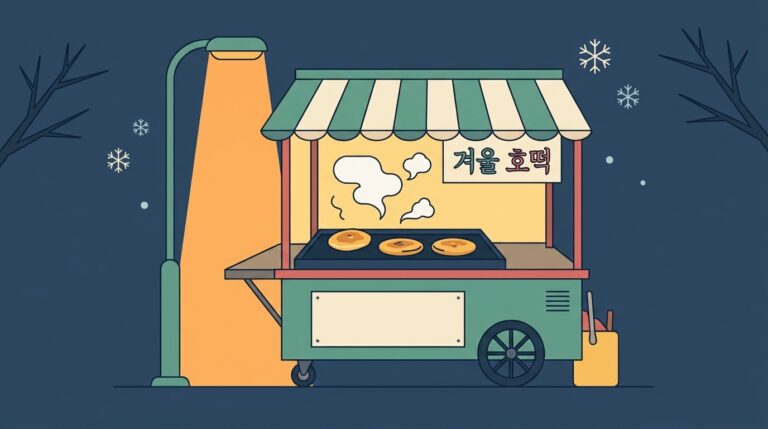
Picture this: It is a crisp, freezing November evening in Seoul. You are strolling through the bustling alleys of Myeongdong or Insadong, hands tucked deep into your coat pockets, your breath turning into white puffs of steam. Suddenly, a sweet, nutty aroma of roasted nuts, cinnamon, and caramelizing brown sugar stops you in your tracks. There it is: a glowing street food cart with a sizzling flat griddle. You step up and order your very first winter pancake. The vendor slides the golden, puffy treat straight from the bubbling oil into a folded, thick paper cup.
It feels wonderfully warm against your cold fingertips. Unable to resist, you take a huge, eager bite. Instant regret! A pocket of molten brown sugar syrup bursts forth, sticking straight to the roof of your mouth like sweet culinary lava. Your eyes water, your feet do a frantic little tap-dance on the pavement, and you desperately try to inhale cold air without dropping the pancake.
If you have ever burned the roof of your mouth on a Korean street pancake, congratulations—you have experienced an official Korean winter rite of passage! But how do you express this culinary agony naturally without sounding like an archaic textbook? Based on real survival stories from our intermediate learners, this practical B1 guide will equip you with authentic, colorful Korean expressions, street etiquette, and survival hacks so you can order, savor, and survive Korea’s tastiest seasonal street food.
Phase 2: Core Expressions Deep Dive
Here are three must-know expressions for navigating the fiery world of Korean street food.
1. 입천장 다 까졌어요 (Ip-cheon-jang da kka-jyeo-sseo-yo)
- Pronunciation: [Ip-cheon-jang da kka-jyeo-sseo-yo] (Sounds like: eep-chuhn-jahng da kkah-jyuh-ssuh-yoh)
- Meaning: Literal: “The roof of my mouth is completely peeled.” | Nuance: “I severely burned the roof of my mouth (and the skin came off)!”
- K-Culture Moment: Commonly heard on Korean variety shows like I Live Alone or Omniscient Interfering View when a celebrity hastily gulps down boiling soup or fresh fried treats.
- Editor’s Insight: The noun 입천장 (ipcheonjang) literally combines ‘mouth’ (입) and ‘ceiling’ (천장). The verb 까지다 (kkajida) means to be scraped or peeled. Koreans rarely say “I got a minor burn”; they dramatically declare that their mouth ceiling has been “peeled off” to highlight the sudden intensity of the heat.
- Situation Spectrum: Casual ✅ | Semi-formal ✅ | Formal ⚠️ (In an official medical setting, use 입천장을 데였습니다)
- 🤔 Think About It: In English, you simply say “I burned my tongue/mouth.” Why do you think Korean specifically targets the physical sensation of the delicate palate peeling off?
2. 꿀 조심하세요 (Kkul jo-sim-ha-se-yo)
- Pronunciation: [Kkul jo-sim-ha-se-yo] (Sounds like: kool joh-sheem-hah-seh-yoh)
- Meaning: Literal: “Be careful of the honey.” | Nuance: “Watch out for the boiling hot sugar filling!”
- K-Culture Moment: Street vendors shout this affectionately as they hand over the folded cup, as seen in countless travel vlogs and dramas set in traditional outdoor markets.
- Editor’s Insight: Even though hotteok filling is made of brown sugar, cinnamon, and crushed peanuts, vendors traditionally call this molten syrup 꿀 (kkul, honey). Saying Kkul josimhaseyo warns you that the crust might feel warm, but the molten core inside is boiling liquid sugar.
- Situation Spectrum: Casual ✅ | Semi-formal ✅ | Formal ✅
- 🤔 Think About It: Calling melted brown sugar ‘honey’ creates an endearing, appetizing image. Does your native culture use poetic food metaphors to describe temperature or sweetness?
3. 호호 불면서 드세요 (Ho-ho bul-myeon-seo deu-se-yo)
- Pronunciation: [Ho-ho bul-myeon-seo deu-se-yo] (Sounds like: hoh-hoh bool-myuhn-suh deuh-seh-yoh)
- Meaning: Literal: “Eat while blowing ho-ho.” | Nuance: “Make sure you gently blow on it to cool it down as you eat.”
- K-Culture Moment: The classic onomatopoeia 호호 (ho-ho) is iconic in Korean winter commercials, especially for warm steamed buns (Hoppang) and street snacks.
- Editor’s Insight: In Korean, the sound of blowing gently to cool down hot food is ho-ho (호호), whereas blowing forcefully to blow out a candle is hoo-hoo (후후). Using the grammar form -(으)면서 (“while doing”) makes this advice sound caring and domestic.
- Situation Spectrum: Casual ✅ | Semi-formal ✅ | Formal ✅
- 🤔 Think About It: How do sound-symbolic words (onomatopoeia/mimetic words) change the emotional temperature of everyday instructions in Korean compared to English?
Phase 3: Textbook Korean vs. Real Korean
Level up your B1 naturalness by replacing robotic classroom phrasing with what native speakers actually say on the sidewalk.
Situation 1: Warning a friend that the street snack is dangerously hot
- 📖 교과서 한국어 (Textbook Korean): 음식의 온도가 매우 높으니 주의하십시오. (Eumsig-ui ondoga maeu nopeuni juu-ihasipsio.) — “The temperature of the food is very high, so please exercise caution.”
- 🗣️ 진짜 한국어 (Real Korean): 진짜 뜨거우니까 조심해서 먹어! (Jinjja tteu-geo-u-ni-kka jo-sim-hae-seo meo-geo!) — “It is seriously scalding hot, so eat carefully!”
- 💡 왜 다를까? (Why is it different?): Street snacks are casual comfort foods. Formal warnings sound like a government industrial machinery manual. Real Koreans use 진짜 뜨거우니까 (it is really hot, so…) to convey immediacy and friendship.
Situation 2: Reacting after taking that fiery, fateful bite
- 📖 교과서 한국어 (Textbook Korean): 구강 상피 세포에 화상을 입었습니다. (Gugang sangpi sepodeure hwasang-eul ibeossseumnida.) — “I suffered a thermal burn on my oral epithelial cells.”
- 🗣️ 진짜 한국어 (Real Korean): 앗, 뜨거! 입천장 다 뎄네. (At, tteu-geo! Ip-cheon-jang da den-ne.) — “Ouch, hot! The roof of my mouth is completely scorched.”
- 💡 왜 다를까? (Why is it different?): Spontaneous pain triggers exclamations like 앗, 뜨거! (At, tteugeo!). The verb 데다 (deda, to get burned by hot liquid/steam) paired with the spontaneous exclamatory ending -네 (-ne) perfectly captures immediate shock.
Phase 4: K-Culture Deep Dive & Non-Verbal Manners
4-1. 눈치 (Nunchi) & Street Gestures
When eating hot street food in Korea, your body language matters as much as your words:
* The Inhale-Exhale Open-Mouth Ventilator: If the hotteok syrup attacks your palate, never spit it out onto the ground or back into the cup. Koreans immediately open their mouth slightly and rapidly inhale cold air with a sharp “Hah-hah-hoh-hoh” sound while gently fanning their mouth with one hand. Everyone around you will immediately understand and sympathize.
* The Paper Cup Pinch Grip: Street vendors serve hotteok in a standard paper cup folded horizontally or creased vertically. Do not squeeze the bottom of the cup upward! Squeezing pumps boiling brown sugar straight out of the pastry into your lips. Hold the rim and gently wiggle the pastry upward with your teeth.
* The Stepping Back Courtesy: Never stand directly in front of the griddle register while wrestling with your hot snack. Step two paces to the side so other customers can order while you cool down.
4-2. Cultural Code Analysis: The Soul of Winter Street Carts (Pojangmacha)
Korean winter cuisine is built on contrasts: freezing street winds paired with scorching, comforting treats. Hotteok originated from Chinese merchants who settled in Korea in the late 19th century, but Koreans localized it by replacing savory fillings with sweet brown sugar, cinnamon, and local seeds (like Busan’s famous Ssiat Hotteok).
There is also an unspoken cultural rule of hospitality: almost every hotteok stand sits next to a steaming vat of fish cakes (eomuk). You are universally welcome to take a small paper cup of hot fish cake broth (eomuk gukmul) for free, which locals sip to balance the sugar rush—though be careful, because sipping boiling broth after burning your palate is double trouble!
Phase 5: Real-World Roleplay Scenario
- Location: A cozy winter food stall at the entrance of Gwangjang Market.
- Characters:
- Alex: A curious intermediate Korean traveler craving sweets.
- Imo-nim (이모님): A warm, fast-working street food stall owner wielding dual spatulas.
— dialogue —
Turn 1
Alex: 이모님, 꿀호떡 하나만 주세요! 얼마예요?
(Imo-nim, kkul-ho-tteok ha-na-man ju-se-yo! Eol-ma-ye-yo?)
“Auntie, please give me one honey hotteok! How much is it?”
🎭 Leaning toward the warm griddle with an excited, hungry smile.
Turn 2
Imo-nim: 하나에 이천 원! 바로 구워줄 테니까 1분만 기다려요, 학생.
(Ha-na-e i-cheon won! Ba-ro gu-wo-jul te-ni-kka il-bun-man gi-da-ryeo-yo, hak-saeng.)
“Two thousand won for one! I will grill it fresh right now, so wait just one minute, dear student.”
🎭 Pressing the dough ball flat with a circular steel press with rhythmic sizzling sounds.
Turn 3
Alex: 네! 냄새가 진짜 예술이네요. 날씨가 추워서 더 기대돼요.
(Ne! Naem-sae-ga jin-jja ye-sur-i-ne-yo. Nal-ssi-ga chu-wo-seo deo gi-dae-dwae-yo.)
“Yes! The aroma is truly incredible. Because the weather is cold, I am looking forward to it even more.”
🎭 Rubbing gloved hands together to stay warm.
Turn 4
Imo-nim: 자, 나왔어요! 꿀 엄청 뜨거우니까 호호 불면서 천천히 먹어요!
(Ja, na-wa-sseo-yo! Kkul eom-cheong tteu-geo-u-ni-kka ho-ho bul-myeon-seo cheon-cheon-hi meo-geo-yo!)
“Here you go, it’s ready! The honey is extremely hot, so blow gently and eat slowly!”
🎭 Slipping the piping hotteok into a paper cup and handing it over with two hands.
Turn 5
Alex: 감사합니다! 잘 먹겠습니다! …앗! 뜨거! 씁- 하-!
(Gam-sa-ham-ni-da! Jal meok-ge-sseum-ni-da! …At! Tteu-geo! Sseup- ha-!)
“Thank you! I will enjoy this! …Ouch! Hot! Ssshh- haah-!”
🎭 Taking a greedy bite, freezing in shock, and frantically fanning his open mouth.
Turn 6
Imo-nim: 아이고! 내가 조심하라고 했잖아! 입천장 안 데였어요? 괜찮아요?
(A-i-go! Nae-ga jo-sim-ha-ra-go haet-jan-a! Ip-cheon-jang an de-yeo-sseo-yo? Gwaen-chan-a-yo?)
“Oh dear! Didn’t I tell you to be careful! Did you burn the roof of your mouth? Are you okay?”
🎭 Chuckling with maternal concern while reaching for a paper cup of cold water.
Turn 7
Alex: 으아, 꿀이 확 나왔어요. 입천장 다 까진 것 같아요…
(Eu-a, kkul-i hwak na-wa-sseo-yo. Ip-cheon-jang da kka-jin geot ga-ta-yo…)
“Ugh, the syrup gushed right out. I think the roof of my mouth is completely peeled…”
🎭 Laughing sheepishly while touching his cheek with eyes watering.
Turn 8
Imo-nim: 자, 여기 시원한 보리차 마셔요. 다음부터는 꼭 반으로 살짝 쪼개서 식혀 먹어요!
(Ja, yeo-gi si-won-han bo-ri-cha ma-syeo-yo. Da-eum-bu-teo-neun kkok ban-eu-ro sal-jjak jjo-gae-seo sik-hyeo meo-geo-yo!)
“Here, drink this refreshing cold barley tea. Next time, make sure to tear it slightly in half to cool it off!”
🎭 Patting Alex's shoulder and handing him a cup of cold tea.
— end dialogue —
🔀 Interactive Choice Point
You just burned your mouth on street food in front of a bustling crowd! How do you respond to the stall owner?
- Option A: “이모, 너무 뜨거운데 환불해 주세요!” (Imo, neomu tteugeounde hwanbulhae juseyo! — Auntie, this is too hot, give me a refund!)
- Option B: “앗, 욕심내다가 입천장 데였어요! 그래도 진짜 맛있네요.” (At, yoksim-naeda-ga ipcheonjang deyeosseoyo! Geuraedo jinjja masitneyo. — Ah, I got greedy and burned my mouth! But it is still delicious.)
- Option C: (Spitting the entire bite onto the sidewalk napkins in silence).
[Feedback Evaluation]
- Option A (Bad): 🚫 Highly rude. Korean street snacks are inherently served sizzling hot, and vendors warn you in advance. Demanding a refund over natural food temperature breaches local street etiquette.
- Option B (Best): ✅ Charming, polite, and humorous. You own up to your eagerness (*yoksim-naeda* means 'to get greedy/impatient'), compliment the food, and validate the vendor's craft. The owner will likely offer you free broth or tea!
- Option C (Risk): ⚠️ Unhygienic and embarrassing. Spitting out street food in plain sight will shock passersby. If you cannot swallow it, discreetly turn away into a tissue.
Phase 6: 10-Second Emotional Shadowing Drill
Practice these lines out loud! Pay close attention to the pause slashes (/) and mirror the designated emotion tags.
[🔥 고통과 다급함 / Agony & Urgency]
앗, / 뜨거! / 꿀이 갑자기 터져서 / 입천장 다 까졌어요!
(At, / tteu-geo! / Kkul-i gap-ja-gi teo-jyeo-seo / ip-cheon-jang da kka-jyeo-sseo-yo!)
“Ouch, / hot! / The syrup suddenly burst out / and the roof of my mouth is completely scraped!”-
[🥺 머쓱하고 애교 섞어서 / Sheepish & Whiny Playfulness]
너무 맛있어 보여서 / 급하게 먹다가 / 입천장 데였어요…
(Neo-mu ma-si-sseo bo-yeo-seo / geup-ha-ge meok-da-ga / ip-cheon-jang de-yeo-sseo-yo…)
“It looked so delicious / that I ate too hastily / and burned the roof of my mouth…” -
[🤝 다정하고 노련하게 / Warm & Caring Warning]
속에 있는 꿀이 / 용암처럼 뜨거우니까 / 호호 불어서 드세요!
(Sog-e it-neun kkul-i / yong-am-cheo-reom tteu-geo-u-ni-kka / ho-ho bur-eo-seo deu-se-yo!)
“Because the honey inside / is as hot as lava / please blow gently on it before eating!”
Phase 7: K-Culture Mini Dictionary
- 호떡 (Hotteok): A beloved pan-fried Korean flatbread filled with dark brown sugar, cinnamon powder, and chopped peanuts or sunflower seeds. Consumed widely during late autumn and winter across traditional markets.
- 입천장 (Ipcheonjang): The hard and soft palate (literally “mouth ceiling”). Highly vulnerable to high-temperature carbohydrates like hotteok, ddukbokki, and tteokguk.
- 겉바속촉 (Geot-ba-sok-chok): A modern Korean portmanteau describing ideal texture: “crispy on the outside, tender/moist on the inside” (겉은 바삭하고 속은 촉촉한). The hallmark of a masterfully fried hotteok.
- 어묵 국물 (Eomuk gukmul): Savory, piping-hot kelp-and-radish fish cake broth. Vendors ladle it into paper cups for customers standing by the stall to warm their hands and cleanse their palates.
Phase 8: Survival Kit for Travelers
🧰 Top 3 Street Stall Survival Expressions
- 종이컵 하나 더 주실 수 있나요? (Jongi-keop hana deo jusil su innayo?)
Meaning: “Could you give me one more paper cup?”
Pro Tip: Double-cupping creates an insulating air gap so your fingers won’t burn through thin single-layer cups. - 조금만 식혀서 먹을게요. (Jogeum-man sik-hyeo-seo meogeulkeyo.)
Meaning: “I will let it cool down a little bit before eating.”
Pro Tip: Great to say when an eager vendor is watching you, waiting to see if you like your first bite. - 계좌이체 되나요? (Gye-jwa-i-che doe-na-yo?)
Meaning: “Do you accept bank account transfer?”
Pro Tip: While many modern stalls take cards, tiny legacy carts still prefer cash or direct bank transfer. If you don’t have Korean won bills, this phrase is your lifeline.
🗺️ Editor’s Travel Note
- Navigation Guide: When hunting for legendary street food hubs, avoid relying on global mapping apps that lack local transit details. Instead, use the Naver Map street food navigation guide to search for landmark spots like Namdaemun Hotteok Alley or Mangwon Market.
- Payment Protocol: Always keep 5,000 to 10,000 KRW cash in crisp bills inside your coat pocket for street stalls. If a cart has a laminated paper showing bank account numbers, you can use domestic banking apps or simply pay with exact cash to see the vendor’s biggest smile.
Phase 9: “한 발 더 깊이” (One Step Deeper: Thought Prompt)
Korean street food culture is one of the clearest windows into the concept of 정 (Jeong)—the warm, unspoken affection and communal bonding that runs through Korean society. When a street food vendor tells you, “Tteugeo-uni kkul josimhae!” (Watch out, the honey is hot!), they are not merely issuing a safety disclaimer; they are treating you like their own niece, nephew, or grandchild on a freezing winter evening. Street carts erase social hierarchies; corporate executives in tailored suits and college students stand elbow-to-elbow in front of the same sizzling griddle, blowing ho-ho on their paper cups.
💬 Your Turn: Have you ever burned your mouth on a famous local dish while traveling abroad? How would you comfort a friend in your language who just burned their tongue? Share your funniest street food mishaps in the comments below!
Phase 10: FAQ & Avoiding Misunderstandings
Q: Can I use the word “데이다” (de-i-da) for spicy food that burns my mouth?
A: No! 데다/데이다 (deda/de-ida) strictly refers to physical thermal burns from temperature (hot liquids, steam, pans). For spicy burning sensations from chili peppers (gochugaru), say “혀가 얼얼해요” (Hyeoga eor-eol-hae-yo / “My tongue is numb/tingling”) or “너무 매워서 불나요” (Neomu maewoseo bulnayo / “It’s so spicy it’s on fire”).
Q: Is it considered rude to ask for a knife or scissors at a hotteok stall to cut it open?
A: It is not rude at all! You can politely ask: “가위로 반 잘라 주실 수 있어요?” (Gawiro ban jalla jusil su isseoyo? / “Could you cut it in half with scissors?”). Most vendors gladly snip it, letting the steam escape so the sweet syrup cools down quickly.
Q: What should I do if the hot sugar syrup drips onto my fingers?
A: Immediately grab wet wipes (mul-ti-syu) or dry napkins (hyu-ji) provided on the stall counter. Street syrup contains sugar and oil, meaning it retains heat and sticks to your skin. Wipe it off swiftly, then douse with cold bottled water or ask: “찬물 좀 주실 수 있나요?” (Chan-mul jom jusil su innayo?).
🚨 Common Mistakes Alert (Top 3 Pitfalls)
- ❌ Mistake 1: Saying “입천장을 태웠어요” (Ipcheonjangeul taewosseoyo).
- Why it fails: 태우다 means to set something on fire or burn something into black ash (like burning toast). You did not incinerate your mouth to ashes!
- Correct Action: Say “입천장 데였어요” (Ipcheonjang deyeosseoyo) or “입천장 까졌어요” (Ipcheonjang kkajyeosseoyo).
- ❌ Mistake 2: Squeezing the bottom of the folded paper cup immediately upon receiving it.
- Why it fails: The bottom contains the pool of molten sugar. Squeezing creates a hydraulic effect that squirts 90°C cinnamon syrup straight upward.
- Correct Action: Gently squeeze only the middle rim or bite the top crust first to create a steam vent.
- ❌ Mistake 3: Drinking boiling fish cake soup right after scalding your palate.
- Why it fails: Hot soup will intensify the palate damage.
- Correct Action: Request cold drinking water: “시원한 물 한 컵만 주세요” (Siwonhan mul han keopman juseyo).
Phase 11: Action Mission & Community Challenge
Put your learning to the test with our 3-step action roadmap:
- 🥉 Bronze Level (Solo Drill): Stand in front of your mirror with an imaginary paper cup. Practice saying: “앗, 뜨거! 호호 불면서 먹어야겠어요!” three times with authentic facial expressions.
- 🥈 Silver Level (Community Share): Hop onto your Instagram story or language exchange app (like HelloTalk) and post a photo of your favorite comfort snack with the Korean caption: #겉바속촉 #입천장조심 #꿀호떡.
- 🥇 Gold Level (Real-World Execution): Visit a local Korean town bakery or Seoul street food cart. Order using “꿀호떡 하나 주세요!” and when the vendor reminds you to be careful, reply brightly with “네, 호호 불어 먹을게요!”.
🎮 K-Culture Discovery Mission: Watch an episode of tvN’s Jinny’s Kitchen (서진이네) or Street Food Fighter (스트리트 푸드 파이터). Watch closely for moments when someone takes a bite of hot food: listen for whether they say 앗 뜨거! or comment on 입천장!
Phase 12: Interactive Quiz Challenge
Test your street smarts and Korean reflexes with these three quick checks!
Question 1. Situation Reaction
You took a huge bite of hotteok, and molten cinnamon sugar just scalded your palate. Which sentence is the most natural to say to your Korean friend?
* (A) 제 구강 표피가 불타고 있습니다.
* (B) 으악, 너무 뜨거워서 입천장 다 까졌어!
* (C) 꿀이 너무 매워서 혀가 아파요.
🔍 Click to reveal the Answer & Explanation
Correct Answer: (B)
* Explanation: (B) is vivid, natural colloquial Korean for “Argh, it was so hot that the roof of my mouth is completely peeled!” (A) is absurdly clinical and robotic. (C) incorrectly uses ‘spicy’ (매워서) to describe hot temperature syrup.
Question 2. Fill in the Blank
Complete the vendor’s advice using the correct onomatopoeia for blowing gently on hot food:
“손님, 꿀이 엄청 뜨거우니까 ( ) 불면서 드세요!”
* (A) 쿨쿨 (kul-kul)
* (B) 헐레벌떡 (heol-le-beol-tteok)
* (C) 호호 (ho-ho)
🔍 Click to reveal the Answer & Explanation
Correct Answer: (C) 호호
* Explanation: 호호 (ho-ho) represents the gentle blowing sound made to cool down hot winter snacks. (A) 쿨쿨 is the sound of deep snoring, and (B) 헐레벌떡 describes running breathlessly in a rush.
Question 3. Cultural True or False
True or False: At Korean street carts serving both hotteok and fish cakes (eomuk), it is customary and completely acceptable to take a paper cup and ladle out some warm fish cake broth to sip while waiting for your hotteok.
🔍 Click to reveal the Answer & Explanation
Correct Answer: True (O)
* Explanation: Yes! Broth (eomuk gukmul) is widely considered complimentary for standing patrons at street carts. Just remember to practice nunchi: don’t crowd the paying customers ordering fish cakes, and always handle the communal ladle with clean hands.







