

Phase 1: Empathy (Story-Immersive Opening)
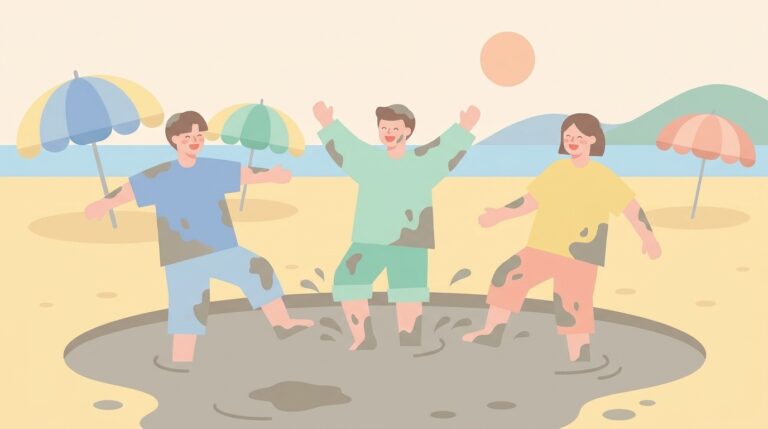
안녕하세요! 매일한글 에디터입니다. Welcome back, my adventurous language explorers! Picture this: July under the blazing sun of Daecheon Beach. You are surrounded by thousands of joyful people completely slathered in smooth grey mud, upbeat K-pop blasting from giant speakers, and epic inflatable slides looming in front of you. But as you step off the bus, reality hits. Where do you leave your backpack? How do you ask someone to put mud on your back without sounding awkward? What if you freeze at the ticket booth?
Over the past ten years coaching international travelers, I have seen so many learners get paralyzed by textbook anxiety at Korean summer festivals. You don’t need a hundred grammar rules to thrive at Boryeong—you just need a handful of punchy, natural phrases that instantly connect you with locals. This guide is crafted directly from real learner experiences to make sure you dive straight into the fun with total confidence.
Phase 2: Deep Dive into 3 Core Expressions
1. 표 어디서 사요? (Pyo eodiseo sayo?)
- Pronunciation: [Pyo eo-di-seo sa-yo?] (Think of “pyo” like pure without the ‘r’, “eo-di” like uh-dee, and “sa-yo” like saw-yo)
- Meaning: Literal: “Ticket where buy?” | Actual Nuance: “Where can I buy a ticket?”
- K-Culture Moment: Walking up to crowded festival booths where long lines split between online reservations and on-site ticket booths.
- Editor’s Insight: In Korean, dropping subject particles like ‘는/은’ (neun/eun) in quick conversational inquiries makes you sound far more natural and relaxed.
- Situation Spectrum: Casual ⚠️ | Semi-formal (Polite) ✅ | Formal ✅
- 🤔 Think About It: Notice how Koreans skip “excuse me, can you tell me…” and jump straight to the key noun and location? How does your native language handle directness in busy public spaces?
2. 머드 발라 주세요! (Meodeu balla juseyo!)
- Pronunciation: [Meo-deu bal-la ju-se-yo!] (Say “mud” with an open ‘uh’ sound, then “bal-la”, followed by the polite “joo-seh-yo”)
- Meaning: Literal: “Mud apply please!” | Actual Nuance: “Please put some mud on me!”
- K-Culture Moment: Standing in the self-mud zone looking at your clean shoulders, gesturing cheerfully to a festival volunteer or new friend.
- Editor’s Insight: The verb 바르다 (bareuda – to apply/smear) changes to 발라요 (ballayo) or 발라 주세요 (balla juseyo). It’s the exact same verb used for putting on sunscreen or skincare cream in K-beauty!
- Situation Spectrum: Casual ⚠️ | Semi-formal (Polite) ✅ | Formal 🚫
- 🤔 Think About It: In many Western cultures, asking a stranger to smear mud on your back might feel personal, but at Boryeong, it’s the ultimate communal icebreaker. How do festivals in your country lower personal boundaries?
3. 물품 보관함 어디에 있어요? (Mulpum bogwanham eodie isseoyo?)
- Pronunciation: [Mool-poom bo-gwan-ham eo-di-e it-seo-yo?] (“Mool-poom” sounds like wool with an M and boom, “bo-gwan-ham” sounds like bow-gwan-hahm)
- Meaning: Literal: “Locker where is located?” | Actual Nuance: “Where are the storage lockers?”
- K-Culture Moment: Clutching your dry clothes, passport, and wallet before entering the water-and-mud blast zones.
- Editor’s Insight: 물품 (mulpum) means goods/items and 보관함 (bogwanham) means storage box. If this tongue-twister feels too long in an emergency, pointing to your bag and saying “라커 어디예요? (Rakeo eodiyeyo? – Where is the locker?)” works just fine!
- Situation Spectrum: Casual ⚠️ | Semi-formal (Polite) ✅ | Formal ✅
- 🤔 Think About It: Compound Sino-Korean words (물품 + 보관 + 함) assemble like building blocks. Breaking them into smaller components makes remembering advanced vocabulary much easier.
Phase 3: Textbook Korean vs. Real Korean
Scenario 1: Asking someone to take your photo
- 📖 교과서 한국어: 저의 사진을 찍어 주실 수 있습니까? (Jeoui sajineul jjigeo jusil su itseumnikka? – Would you be able to take my photograph?)
- 🗣️ 진짜 한국어: 사진 한 장만 찍어 주세요! (Sajin han jangman jjigeo juseyo! – Could you snap a photo for me?)
- 💡 왜 다를까?: Textbook Korean often uses rigid honorific interrogatives that sound like an official interview. Real native speakers at dynamic summer festivals keep it warm, brief, and friendly using “한 장만” (just one shot).
Scenario 2: Asking where to rinse off after the mud pit
- 📖 교과서 한국어: 세면장이 어디에 위치하고 있습니까? (Semyeonjang-i eodie wichi-hago itseumnikka? – Where is the wash facility situated?)
- 🗣️ 진짜 한국어: 여기 어디서 씻어요? (Yeogi eodiseo ssiseoyo? – Where do we wash off around here?)
- 💡 왜 다를까?: Nobody uses formal administrative vocabulary like 세면장 (wash facility) when standing soaked on a beach. Simple verbs like 씻다 (ssitda – to wash) combined with 어디서 (eodiseo – where) communicate instantly.
Phase 4: K-Culture Deep Dive & Non-Verbal Manners
4-1. 눈치 (Nunchi) & Festival Etiquette
- The Eye-Shield Bow: When someone offers to apply mud or splash you, tilt your head slightly forward and shield your eyes with both hands. It shows you welcome the fun while gently reminding them to avoid your eyes.
- Two-Hand Towel Pass: When asking staff for paper towels or festival wristbands, receive items with both hands or with your right hand supported at the wrist by your left forearm. Even in swimwear and mud, this basic gesture of courtesy wins instant smiles.
4-2. Cultural Code Analysis: The Spirit of 흥 (Heung)
- Korea’s Boryeong Mud Festival originated in 1998 to promote mineral-rich cosmetic mud from Daecheon flats. However, it quickly transformed into a nationwide celebration of 흥 (Heung)—an infectious, collective release of joy and excitement.
- If you have ever watched variety shows like Running Man, you know that sliding around in a mud pit (갯벌 – gaetbeol) is Korea’s favorite comedy equalizer. In the mud, social status, age, and formalities vanish.
Phase 5: Real-Life Roleplay Scenario
- Setting: Entrance plaza of Boryeong Mud Festival on Daecheon Beach. Bass beats echo in the air.
- Characters: Minho (Friendly festival volunteer in an orange shirt) and Alex (Excited beginner traveler).
-
Alex: 실례합니다, 표 어디서 사요? (Sillyehamnida, pyo eodiseo sayo?)
🎭 Looking around the crowded square holding a festival brochure
“Excuse me, where do I buy tickets?” -
Minho: 저기 파란색 부스 보여요? 저기서 사시면 돼요! (Jeogi paransaek buseuboyeoyo? Jeogiseo sasimyeon dwaeyo!)
🎭 Smiling and pointing toward the large blue canopy
“See that blue booth over there? You can buy them right there!” -
Alex: 아, 보여요! 감사합니다. (A, boyeoyo! Gamsahamnida.)
🎭 Nodding politely with a relieved smile
“Ah, I see it! Thank you.” -
Minho: 팔찌 착용하고 머드존 들어가세요! (Paljji chagyonghago meodeujon deureogaseyo!)
🎭 Tapping his own wrist to remind Alex
“Put on your wristband before entering the Mud Zone!” -
Alex: 네! 그런데 물품 보관함 어디에 있어요? (Ne! Geureonde mulpum bogwanham eodie isseoyo?)
🎭 Pointing to a bulky backpack
“Okay! But where are the luggage lockers?” -
Minho: 샤워실 옆에 있어요. 락커는 천 원짜리 동전 필요해요. (Syawosil yeope isseoyo. Rakkeoneun cheon wonjjari dongjeon piryohaeyo.)
🎭 Gesturing toward the left building and mimicking a coin drop
“They are right next to the shower rooms. You will need a 1,000-won coin for the lockers.” -
Alex: 동전이 없는데 지폐 바꿀 수 있어요? (Dongjeoni eomneunde jipye bakkul su isseoyo?)
🎭 Holding up a paper bill with an inquisitive look
“I don’t have coins, can I exchange cash?” -
Minho: 네, 보관함 바로 앞에 동전 교환기 있어요! (Ne, bogwanham baro ape dongjeon gyohwangi isseoyo!)
🎭 Giving a friendly thumbs up
“Yes, there is a change machine right in front of the lockers!”
🔀 Interactive Decision Point
What should Alex do next?
* Option A: “머드존 바로 갈래요!” (Meodeujon baro gallaeyo! – Run straight to the mud zone with the backpack on!)
Feedback (Bad): High risk! Your electronics and passport will get soaked within two minutes. Mud slides require empty hands.
* Option B: “물품 보관함 먼저 다녀올게요!” (Mulpum bogwanham meonjeo danyeoolgeyo! – Go to the locker first!)
Feedback (Best): Perfect decision! Securing your gear first lets you enjoy every mud slide and foam party worry-free.
* Option C: “가방 모래사장에 두고 갈게요!” (Gabang moraeseajang-e dugo gallaeyo! – Leave the bag unattended on the sand!)
Feedback (Risk): Korea is safe, but summer festival tides and huge crowds mean lost items are hard to recover.
Phase 6: 10-Second Emotion Shadowing Drill
Practice matching the rhythm and emotional pauses marked by /.
[😊 Exciting & Cheerful]
머드 발라 주세요! / 진짜 / 기대돼요!
(Meodeu balla juseyo! / Jinjja / gidaedwaeyo!)
“Please put mud on me! I’m really looking forward to this!”-
[🥺 Urgent & Inquiring]
저기요, / 물품 보관함이 / 어디에 있어요?
(Jeogiyo, / mulpum bogwanhami / eodie isseoyo?)
“Excuse me, where are the storage lockers?” -
[😎 Cool & Friendly]
사진 한 장만 / 예쁘게 / 찍어 주세요!
(Sajin han jangman / yeoppeuge / jjigeo juseyo!)
“Could you please take a nice photo for me?”
Phase 7: K-Culture Mini Dictionary
-
갯벌 (Gaetbeol)
- Translation: Tidal mudflat
- Practical Context: Korea’s western coast is famous for expansive tidal flats rich in natural minerals, which form the base for Boryeong’s festival mud.
- 물품 보관함 (Mulpum bogwanham)
- Translation: Storage locker / Left luggage facility
- Practical Context: Found across festival grounds, subway stations, and train terminals. Keep this word saved on your phone for all your Korean travels.
- 방수팩 (Bangsupaek)
- Translation: Waterproof pouch
- Practical Context: Sold at every convenience store and beach stall near Daecheon Beach. Essential for keeping your smartphone operational during water cannon events.
- 셔틀버스 (Syeoteulbeoseu)
- Translation: Shuttle bus
- Practical Context: Free or cheap seasonal shuttles that run between Daecheon Train Station (대천역), Boryeong Bus Terminal, and the beach festival venue.
Phase 8: Survival Kit for Travelers
Top 3 Survival Expressions
- 화장실 어디예요? (Hwajangsil eodiyeyo? – Where is the restroom?)
- Pro Tip: Restrooms near the main stage get busy fast; look for public beach restrooms located 200 meters down the boardwalk.
- 물 한 병 주세요. (Mul han byeong juseyo. – One bottle of water, please.)
- Pro Tip: July heat in Boryeong is intense. Stay hydrated between mud sessions.
- 카드 돼요? (Kadeu dwaeyo? – Do you take credit cards?)
- Pro Tip: Most food stalls accept foreign credit cards, but coin lockers and small temporary booths often prefer cash.
Editor’s Travel Note
- Booking Train Tickets: Avoid sold-out weekend trains from Yongsan Station to Daecheon Station by reserving early using the Korail Talk train reservation app.
- Navigation: Google Maps has limited transit accuracy in Korea. Prepare in advance by completing the Naver Map app download for live walking and bus directions.
Phase 9: One Step Deeper (Thoughtful Reflection)
Korean social interactions normally observe polite distance, hierarchy, and respect for personal boundaries. Yet the moment you step into the Boryeong mud zone, those rigid social codes melt away. Grey mud acts as a joyful equalizer: teachers, corporate managers, foreign backpackers, and local grandmothers all laugh together coated in the same mineral paste. It is a brilliant glimpse into the communal warmth (정 – Jeong) that underpins modern Korean society.
💬 Your Turn: Does your culture have a festival where normal social rules disappear and strangers play together? Share your story in the comments below!
Phase 10: FAQ & Common Mistakes
Q: Is it rude to smear mud on a stranger at the festival?
A: Not at all, as long as you are inside the designated mud zones! Always approach with a smile, avoid throwing mud near someone’s eyes or ears, and use the magic phrase: 머드 발라 드릴까요? (Meodeu balla deurilkkayo? – Shall I put some mud on you?).
Q: Can I use English at ticket booths and locker stations?
A: Major ticket booths usually have English-speaking staff or English signage. However, temporary locker staff and food truck vendors are often local college students or seniors who appreciate simple Korean phrases like “표 어디서 사요?” or “얼마예요?”.
Q: What clothes should I wear to the festival?
A: Wear clothes you won’t mind throwing away or dark swimwear. The grey mud can permanently stain white and light-colored fabrics. Do not wear expensive leather sandals or jewelry.
🚨 Common Mistakes TOP 3
- Wearing Brand-New White Sneakers
- Correct Action: Wear secure water shoes or old sneakers with dark socks that you can wash thoroughly.
- Using Casual Talk (반말 – Banmal) with Staff
- Correct Action: Even if the vibe is wild and energetic, always end your requests to staff with “~요” (~yo) or “주세요” (juseyo).
- Leaving Your Phone Unprotected
- Correct Action: Buy a certified 방수팩 (waterproof pouch) and test it with a piece of tissue paper before putting your phone inside.
Phase 11: Action Mission & Engagement
- Bronze Mission (Solo Practice): Stand before a mirror and repeat “물품 보관함 어디에 있어요?” three times without looking at the romanization.
- Silver Mission (Social Share): Leave a comment below introducing yourself and writing your favorite summer festival expression in Korean characters.
- Gold Mission (Real-Life Action): Next time you attend an outdoor event or visit a Korean market, ask for items using “~ 주세요!” (~ juseyo!).
🎮 K-Culture Mission: Watch an episode of a Korean variety show featuring a mudflat game (such as Running Man Episode 209 or 2 Days & 1 Night) and see if you can spot players shouting “살려주세요!” (Save me!) or “도와주세요!” (Help me!).
Phase 12: Interactive Quiz Challenge
1. Situational Judgment
You are standing in front of the mud pit and need someone to help you cover your back with mud. What is the most natural sentence to say with a smile?
* A) 머드 발라 주세요! (Meodeu balla juseyo!)
* B) 당신은 나에게 머드를 바르십시오. (Dangsineun na-ege meodeureul bareusipsio.)
* C) 머드를 어디서 삽니까? (Meodeureul eodiseo samnikka?)
2. Fill in the Blank
Complete this essential sentence to ask for the ticket counter:
“표 ________ 사요?” (Where do I buy tickets?)
3. Cultural True / False
(True / False): You should use formal military speech (-하십시오) when talking to festival volunteers at Boryeong Beach.
👉 Click here to reveal answers & explanations!
-
Answer: A
Explanation: “머드 발라 주세요!” is polite, warm, and natural. Option B uses an awkward, commanding tone, while Option C asks where to purchase mud. -
Answer: 어디서 (eodiseo)
Explanation: “어디서” means “where (at which location)”, making the full sentence “표 어디서 사요?”. -
Answer: False
Explanation: Polite everyday speech ending in ~요 (such as ~해요, ~주세요) is ideal and respectful for festival volunteers.







