

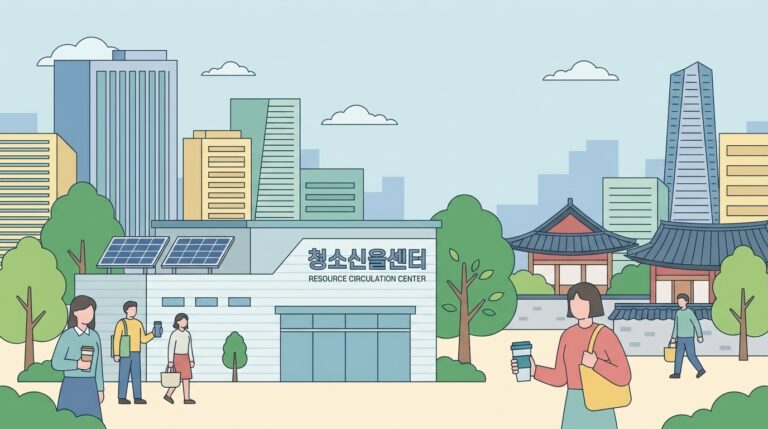
Phase 1: Empathy
안녕하세요! 매일한글 에디터입니다.
Picture this: You are standing in the middle of a chic pop-up store in Seongsu-dong, surrounded by trendsetters sipping cold brew from sleek stainless containers. Your Korean colleagues are passionately debating the latest ESG corporate strategy: “단순한 재활용을 넘어서 순환 경제의 선순환 고리를 완성해야 합니다” (Beyond simple recycling, we must complete the virtuous cycle of the circular economy). You understand the isolated words—recycling, economy—yet bridging that gap to articulate nuanced sustainability frameworks, life cycle assessments, and industrial closed loops in high-level Korean feels like solving a three-dimensional puzzle in the dark.
Many advanced Korean learners hit this exact wall at the C2 plateau. You can order food effortlessly and debate everyday societal shifts, but when stepping into executive conference rooms, think-tanks, or green-tech venture incubators, textbook grammar falls flat. South Korea is moving at breakneck speed toward circular economy transformation—from mandatory volume-based waste schemes to nationwide multi-use cup logistics. In this masterclass, derived directly from executive coaching sessions with global policy analysts and foreign executives in Seoul, we dismantle the linguistic and cultural mechanics of Korea’s circular economy discourse. By mastering these idiomatic, professional expressions, you will instantly command credibility and cultural authority in any sustainability forum.
Phase 2: Core Expressions Deep Dive
1. 자원 순환 체계를 구축하다 (Jawon sunhwan chegyereul guchukhada)
- Pronunciation: [Ja-won sun-hwan che-gye-reul gu-chuk-ha-da] (Think: jah-won soon-hwan chay-gye-reul goo-chook-ha-da)
- Meaning: Literal: “To construct a resource circulation system” | Nuance: Developing an institutionalized, end-to-end circular infrastructure rather than adopting a one-off green initiative.
- K-Culture Moment: Frequently heard in K-dramas featuring visionary chaebol heirs presenting next-generation ESG overhauls in futuristic glass boardrooms.
- Editor’s Insight: At the C2 level, replace pedestrian verbs like 만들다 (to make) or 준비하다 (to prepare) with 구축하다 (to establish/build an architecture). When paired with 자원 순환 (resource circulation), it conveys systemic engineering.
- Situation Spectrum: Casual: 🚫 | Semi-formal: ⚠️ | Formal: ✅
- 🤔 Think About It: Why does Korean administrative discourse favor 자원 순환 (resource circulation) over merely importing “circular economy” as a loanword? What does this reveal about institutional ownership of ecological terms?
2. 새활용 가치를 창출하다 (Saehwallyong gachireul changchulhada)
- Pronunciation: [Sae-hwal-lyong ga-chi-reul chang-chul-ha-da] (Pronounced naturally with liquidization: sae-hwal-yong becomes sae-hwal-lyong)
- Meaning: Literal: “To create upcycling value” | Nuance: Cultivating both economic and environmental worth by fundamentally transforming discarded materials into high-utility goods.
- K-Culture Moment: The signature motto displayed across Seoul Upcycling Plaza (서울새활용플라자) and championed by hip indie lifestyle brands across Yeonnam-dong.
- Editor’s Insight: While 업사이클링 (upcycling) is widely accepted, native Korean policy and refined corporate rhetoric champion the pure Korean portmanteau 새활용 (새 [new] + 활용 [practical application]). Utilizing this native alternative immediately highlights native-level cultural attunement.
- Situation Spectrum: Casual: ⚠️ | Semi-formal: ✅ | Formal: ✅
- 🤔 Think About It: Notice how 새활용 strips away industrial jargon to evoke craftsmanship. Does your native language separate pure linguistic roots from foreign technical terms in sustainability debates?
3. 전과정 평가를 거치다 (Jeongwajeong pyeonggareul geochida)
- Pronunciation: [Jeon-gwa-jeong pyeong-ga-reul geo-chi-da] (Phonetic rhythm: jeon-gwa-jeong pyeong-ga-reul guh-chee-da)
- Meaning: Literal: “To go through a life cycle assessment (LCA)” | Nuance: Evaluating the ecological footprint rigorously from raw material extraction to disposal and reintegration.
- K-Culture Moment: Used by tech reviewers and investigative reporters dissecting modern smartphone packaging and electric vehicle battery supply chains on Korean business news.
- Editor’s Insight: The verb 거치다 (to undergo/pass through a gauntlet or rigorous stage) carries professional gravity. Paired with 전과정 평가 (LCA), it signals that an environmental claim is backed by rigorous empirical auditing.
- Situation Spectrum: Casual: 🚫 | Semi-formal: ⚠️ | Formal: ✅
- 🤔 Think About It: In English, “LCA” is often reduced to an acronym. In Korean, articulating the full phrase 전과정 평가 establishes intellectual gravitas before shortening it in technical briefings.
Phase 3: Textbook Korean vs. Real-World Korean
Situation 1: Proposing reusable containers for a corporate campus
- 📖 교과서 한국어: 우리는 쓰레기를 줄이기 위해 다회용기를 많이 써야 합니다. (Urineun sseuregireul jurigi wihae dahoeyonggireul mani sseoya hamnida. / “We should use a lot of multi-use containers to reduce trash.”)
- 🗣️ 진짜 한국어: 일회용품 저감을 위해 사내 다회용기 순환 시스템을 선제적으로 도입해야 합니다. (Ilhoeyongpum jeogameul wihae sanae dahoeyonggi sunhwan siseutemeul seonjejeogeuro doiphaeya hamnida. / “To curb single-use items, we must preemptively implement an internal multi-use container circulation system.”)
- 💡 왜 다를까?: Native executives replace colloquial pleas like 많이 써야 합니다 with policy terms such as 선제적으로 도입하다 (preemptively implement) and 저감 (reduction/mitigation).
Situation 2: Critiquing a superficial green campaign
- 📖 교과서 한국어: 이 프로젝트는 친환경적인 것 같지만 실제로는 그렇지 않습니다. (I peurojenteuneun chinhwangyeongjeogin geot gatjiman siljeroneun geureochi anseumnida. / “This project seems eco-friendly, but in reality, it isn’t.”)
- 🗣️ 진짜 한국어: 자원 회수 인프라가 결여된 단순 그린워싱에 불과하다는 지적을 피하기 어렵습니다. (Jawon hoesu inpeuraga gyeoryeodoen dansun geurinwosinge bulgwahadaneun jijeogeul pihagi eoryeopseumnida. / “It is difficult to avoid criticism that this is mere greenwashing lacking resource recovery infrastructure.”)
- 💡 왜 다를까?: Advanced Korean leans heavily on nominalization (지적을 피하기 어렵다) and precise technical critique (자원 회수 인프라 결여) to deliver incisive feedback without appearing personal or unpolished.
Phase 4: K-Culture Deep Dive & Non-Verbal Manners
4-1. 눈치(Nunchi) & Professional Gestures
In Korean corporate sustainability meetings, non-verbal delivery speaks louder than raw data. When arguing that an existing supply chain lacks circularity:
* Posture: Keep both hands resting open on the conference table or supporting your presentation remote. Never cross your arms or point a single index finger when citing structural bottlenecks.
* Softening Strategic Pushback: Before delivering critique, tilt your head slightly with a brief micro-nod (끄덕임) and open with “물론 기존 체계의 취지도 십분 공감합니다만…” (While I fully empathize with the intent of the current system…). This honors senior colleagues’ prior efforts before reframing the strategy.
4-2. Cultural Code: The Seongsu Upcycling Phenomenon & K-Pop Album Circularity
Korea’s approach to the circular economy is uniquely polarized between hyper-meticulous municipal sorting and pop-culture consumption. In Seongsu-dong, flagship concept stores build entire storefront interiors using compressed waste plastic, turning closed-loop engineering into aesthetic currency. Simultaneously, the K-Pop industry faces intense public scrutiny over 랜덤 포토카드 (randomized photocards) prompting fans to purchase bulk physical albums that end up discarded. High-level observers examine how entertainment agencies are transitioning toward biodegradable resins and digital-first album formats—a living case study of circular dynamics colliding with commercial fan culture.
Phase 5: Real-World Role-Play Scenario
Setting: Strategy Boardroom, NeoGreen Venture Headquarters, Gangnam. You are meeting Min-woo, the Principal ESG Officer, to audit a newly proposed smart reverse-vending infrastructure.
- Min-woo: 이번 분기 폐플라스틱 수거율이 정체된 원인을 분석해 보셨습니까? (Ibeon bungi pyepeullaseutik sugeoyuri jeongchedoen wonineul bunseokhae bosyeotseumnikka? / “Have you analyzed the root cause of this quarter’s stagnant waste plastic collection rates?”)
🎭 차트를 펜 끝으로 짚으며 진지한 눈빛으로 응시한다 - You: 네, 거점별 회수 인프라의 접근성이 떨어져 실질적 회수가 지연되고 있습니다. (Ne, geojeombyeol hoesu inpeuraui jeopgeunseongi tteoreojyeo siljiljeok hoesuga jiyeondoego itseumnida. / “Yes, recovery is delayed because access to regional collection hubs remains suboptimal.”)
🎭 침착하게 패드를 넘기며 지표를 제시한다 - Min-woo: 단순한 수거 거점 확대만으로는 한계가 명확하지 않겠습니까? (Dansunhan sugeo geojeom hwakdaemanroneun hangyega myeonghwakhaji anketseumnikka? / “Wouldn’t simply expanding collection points have obvious limitations?”)
🎭 턱을 괴고 날카롭게 파고들며 - You: 동감합니다. 따라서 보증금 환급 시스템과 연계한 순환 경제 모델을 안착시켜야 합니다. (Donggamhamnida. Ttaraseo bojeunggeum hwangeup siseutemgwa yeon-gyehan sunhwan gyeongje modereul anchaksikyeoya hamnida. / “Agreed. Therefore, we must establish a circular economy model tied to a deposit-refund system.”)
🎭 양손을 모으고 명확한 어조로 설득한다 - Min-woo: 보증금제 도입 시 초기 운영 비용 부담에 대한 반발은 어떻게 상쇄할 계획입니까? (Bojeunggeumje doip si chogi un-yeong biyong budame daehan banbareun eotteoke sangswaehal gyehoegimnikka? / “How do you plan to offset pushback against initial operational cost burdens?”)
🎭 안경을 고쳐 쓰며 기대감 섞인 표정으로 - You: 폐자원 고부가가치화를 통해 발생하는 수익을 리워드로 환원하는 선순환 구조를 설계했습니다. (Pyejawon gobugagachihwareul tonghae balsaenghaneun su-igeul riwodeuro hwanwonhaneun seonsunhwan gujoreul seolgyehaetseumnida. / “We have engineered a virtuous cycle where proceeds from upcycling waste into high-value resources are returned as rewards.”)
🎭 확신에 찬 미소를 지으며 핵심 슬라이드를 띄운다 - Min-woo: 전과정 평가(LCA) 데이터의 객관적 신뢰도는 이미 확보된 상태인가요? (Jeongwajeong pyeongga deiteoui gaekgwanjeok sinroedoneun imi hwakbodoen sangtae-ingayo? / “Has the objective reliability of the Life Cycle Assessment data already been secured?”)
🎭 메모를 멈추고 고개를 끄덕이며 - You: 공인 인증기관의 검증을 거쳐 탄소 감축 기여도를 수치화해 두었습니다. (Gong-in injeung-gigwanui geomjeung-eul geocheo tanso gamchuk giyeodoreul suchihwahae dueotseumnida. / “We quantified our carbon reduction contributions after rigorous verification by an accredited institution.”)
🎭 자신감 있게 보고서를 양손으로 건넨다
🔀 Interactive Decision Point
How would you conclude this briefing to secure the board’s immediate investment?
- Option A: “어쨌든 친환경이니까 회사 이미지에도 큰 도움이 될 것입니다.” (Anyway, it’s eco-friendly, so it will help corporate image.)
- Option B: “폐자원의 자원화 효율을 극대화하여 ESG 공시 기준을 충족함과 동시에 중장기적 원가 절감을 견인하겠습니다.” (By maximizing waste upcycling efficiency, we will satisfy ESG disclosure standards while driving long-term cost reductions.)
- Option C: “투자 안 해주시면 저희 팀 이번 분기 친환경 목표를 절대 달성 못 합니다.” (If you don’t invest, our team can never hit this quarter’s green targets.)
Branch Feedback:
- Option A (Bad): ❌ Reduces systemic engineering to superficial PR. Undermines your C2 credibility by sounding like an entry-level marketing flyer.
- Option B (Best): 🌟 Flawless C2 executive phrasing. Directly pairs technical terminology (자율 자원화 효율, ESG 공시) with operational benefits (원가 절감 견인).
- Option C (Risk): ⚠️ Uses coercive emotional pleading (투자 안 해주시면). Violates Korean corporate hierarchy and professionalism.
Phase 6: 10-Second Emotional Shadowing Drill
Practice matching native intonation, pauses (/), and deliberate emotional registers.
[🧐 확신에 차고 날카롭게 - Analytical Authority]- 단순 재활용에 그치지 않고, / 자원 순환 생태계를 / 선제적으로 구축해야 합니다.
- Dansun jaehwallyong-e geuchiji anko, / jawon sunhwan saengtae-gyereul / seonjejeogeuro guchukhaeya hamnida.
- (Rather than stopping at simple recycling, / we must proactively build / a resource circulation ecosystem.)
[🌱 차분하고 설득력 있게 - Persuasive Equilibrium]- 제품 기획 단계부터 / 전과정 평가를 거쳐 / 환경 발자국을 최소화했습니다.
- Jepum gihoek dangye-buteo / jeongwajeong pyeonggareul geocheo / hwangyeong baljagugeul choesohwahae-seumnida.
- (From the product planning stage, / through Life Cycle Assessment, / we minimized our environmental footprint.)
[💡 단호하고 미래지향적으로 - Resolute Vision]- 폐기물의 자원화를 통해 / 경제적 편익과 환경적 책무를 / 동시에 달성하겠습니다.
- Pyegimurui jawonhwareul tonghae / gyeongjejeok pyeon-ikgwa hwangyeongjeok chaekmureul / dongsie dalseonghagetseumnida.
- (Through the resource valorization of waste, / we will achieve economic utility and ecological duty / simultaneously.)
Phase 7: K-Culture Mini Dictionary
- 선순환 구조 (Seonsunhwan gujo) | Virtuous Cycle Architecture
- Meaning: A compounding feedback loop where ecological remediation generates economic or operational advantages.
- Usage: Indispensable in pitch decks and corporate meetings: “수거율 상승이 원가 절감으로 이어지는 선순환 구조를 확립했습니다.” (We established a virtuous cycle where higher recovery yields lower procurement costs.)
- 다회용기 보증금제 (Dahoeyong-gi bojeunggeumje) | Deposit-Refund System for Reusables
- Meaning: A state- and civic-backed operational loop where consumers deposit funds refundable upon scanning multi-use cups or lunchboxes at automated kiosks.
- Usage: Used when discussing urban zero-waste pilot projects in Seoul, Sejong, and Jeju.
- 새활용플라자 (Saehwallyong Peullaja) | Seoul Upcycling Plaza
- Meaning: The world’s largest cultural and industrial hub dedicated exclusively to upcycling ventures, situated in Seongdong-gu, Seoul.
- Usage: A cultural benchmark for circular urban planning: “새활용플라자 입주 기업들과의 오픈 이노베이션을 추진 중입니다.” (We are pursuing open innovation with resident companies at Seoul Upcycling Plaza.)
- 폐자원 에너지화 (Pyejawon eneojihwa) | Waste-to-Energy Valorization
- Meaning: Upgrading combustible or organic municipal and industrial waste into high-grade synthetic gas, thermal heat, or electricity.
- Usage: High-frequency terminology in industrial manufacturing, infrastructure investments, and municipal administration.
Phase 8: Survival Kit for Travelers & Expats
Top 3 On-the-Ground Circular Economy Expressions
- 다회용기로 이용할게요. 보증금 환급은 어디서 받나요?
- (Dahoeyonggiro iyonghalgeyo. Bojeunggeum hwangeubeun eodiseo bannayo?)
- Pro Tip: Use this at zero-waste coffee shops or mega-events across Seoul to decline single-use paper cups and navigate the smart reverse-vending terminals.
- 종량제 봉투에 넣어야 하나요, 전용 수거함에 배출해야 하나요?
- (Jongnyangje bongtue neoeoya hanayo, jeonyong sugeohame baechulhaeya hanayo?)
- Pro Tip: Crucial for long-term residents sorting complex packaging (e.g., styrofoam vs. composite PE). Saves you from heavy civic fines.
- 무라벨 제품으로 구매하고 싶은데 진열 구역이 따로 있습니까?
- (Murabel jepumeuro gumaehago sipeunde jinyeol guyeogi ttaro itseumnikka?)
- Pro Tip: 무라벨 (label-free) bottled water and drinks are now mandatory or prioritized across Korean hypermarkets to ease plastic recycling loops.
Editor’s Travel Note: The Zero-Waste Smart Navigator
When navigating Korea’s sophisticated waste sorting, download specialized regional infrastructure apps. Search for the [Happy Habit multi-use cup return system guide] to locate automated reverse kiosks in central Seoul. When exploring sustainable brands, search “제로웨이스트” (Zero Waste) inside the [Naver Map application download portal] to find refill stations where you bring personal glass containers for detergents and cosmetics. Remember: Korea’s smart subway stations also house automated reverse vending machines that reimburse transit card credit in exchange for washed aluminum cans!
Phase 9: “One Step Deeper” (Reflective Humanities Essay)
Korea’s relentless efficiency in circular waste management cannot be understood through green technology alone; its true engine is sociological. Deeply rooted in historic communal mutual aid systems known as Dure (두레) and Pumasi (품앗이), Korean collectivism views resource stewardship as an explicit shared civic responsibility rather than a private hobby. When the national Volume-Based Waste Fee System (쓰레기 종량제) was introduced in 1995, it succeeded because citizens accepted collective auditing (눈치 and communal self-policing) as a natural social contract. In modern corporate spheres, circularity has shifted from moral righteousness (도덕적 당위성) to systemic survival (생존 전략). To converse fluently in Korean about the circular economy is to touch the pulse of how a nation with scarce natural resources engineers social discipline into high-tech sustainable prosperity.
💬 Your Turn: How does your home country conceptualize the boundary between personal civic responsibility and state-led circular policy? Drop your insights below in high-level Korean using today’s expressions!
Phase 10: FAQ & Common Misconceptions
Q: Is it acceptable to use ‘리사이클링’ (Recycling) and ‘업사이클링’ (Upcycling) interchangeably in formal presentations?
A: In high-level Korean business settings, using loanwords interchangeably signals imprecise thinking. 재활용 (recycling) implies downcycling or reprocessing material back to baseline feedstocks, whereas 새활용 or 업사이클링 must be reserved for interventions that yield higher value, design, or utility. Mixing them in front of ESG investors undermines your authority.
Q: What is the linguistic difference between ‘일회용품 감축’ and ‘일회용품 저감’?
A: While both mean reducing single-use items, 감축 (減縮) is commonly applied to quantitative target-setting (e.g., 온실가스 감축 – greenhouse gas emission reduction), whereas 저감 (低減) emphasizes mitigating intensity, frequency, or generated volume over an ongoing operational process.
Q: Why do Koreans say ‘분리배출’ instead of ‘분리수거’?
A: This is a classic native litmus test. 분리배출 (separate discharge) is what the consumer/citizen does when sorting and putting out waste. 분리수거 (separate collection) is what municipal cleaning personnel or contractors do when collecting it. Saying “저는 분리수거를 철저히 해요” is technically an inverted perspective; native professionals say “철저하게 분리배출합니다.”
🚨 Common Mistakes Alert Board
- Mistake: Saying “이 플라스틱은 재활용 가능성이 높습니다” (Awkward translation of “high recyclability”).
- Correct Action: Use “자원 순환성(재활용성)이 뛰어납니다” (Demonstrates high resource circularity).
- Mistake: Using “자연을 지키다” in boardroom presentations.
- Correct Action: Replace children’s book language with “환경 발자국 저감 및 생태계 보전” (Mitigating ecological footprints and preserving ecosystems).
- Mistake: Writing “업싸이클” or “리싸이클” with fortis consonants (쌍시옷).
- Correct Action: Standard Korean loanword orthography strictly mandates flat sibilants: 업사이클링, 리사이클링.
Phase 11: Action Missions
- 🥉 Bronze Level Mission (Solo Drill): Read Phase 6’s Shadowing Drills out loud three times. Record your voice, focusing on pausing sharply at the
/marks to eliminate hesitations before technical nouns. - 🥈 Silver Level Mission (Social Engagement): Visit a local eco-brand, zero-waste shop, or examine an eco-packaged Korean beverage. Post an Instagram story or note using the sentence: “이 제품은 자원 순환 체계를 고려하여 설계되었습니다.” Tag us at @DailyHangul!
- 🥇 Gold Level Mission (Real-World Execution): Enter a specialty café or a zero-waste hub in Korea (or online community) and state: “다회용기 보증금 환급 절차를 안내받을 수 있을까요?” Secure your beverage using a circular container.
- 🎮 K-Culture Media Mission: Watch an episode of a recent corporate K-drama (like Queen of Tears or business-themed variety shows). Spot whether executives refer to green initiatives simply as 친환경 or employ advanced compounds like 지속가능경영 and 순환 경제.
Phase 12: Interactive Quiz Challenge
Test your mastery before heading into your next strategic briefing!
1. Situation Judgment: You need to explain to a foreign partner that simply burning waste for disposal is unacceptable and resource regeneration is paramount. Which phrase is most professional?
* (A) 쓰레기를 태우지 말고 예쁘게 다시 써야 합니다.
* (B) 단순 소각 방식을 탈피하여 폐자원 에너지화 및 순환 체계를 확립해야 합니다.
* (C) 불태우는 것은 친환경이 아니므로 환경청에 신고당할 수 있습니다.
2. Fill in the Blanks: Fill in the professional terms for life cycle assessment and circularity.
* 당사는 제품 기획 단계부터 ( ) 평가를 거쳐 제품의 ( ) 순환성을 대폭 개선했습니다.
3. True or False Culture Check:
* Saying “주민 여러분, 쓰레기를 올바르게 분리수거해 주시기 바랍니다” is the most linguistically accurate term for citizens putting their trash out. (True / False)
🔍 Click to Reveal Answers & In-Depth Explanations
- Answer: (B)
- Explanation: Option (B) uses sophisticated, professional syntax (탈피하여, 폐자원 에너지화, 순환 체계를 확립해야 합니다). Option (A) sounds childlike, while (C) sounds like an inappropriate emotional threat.
- Answer: 전과정 / 자원
- Sentence: 당사는 제품 기획 단계부터 전과정 평가를 거쳐 제품의 자원 순환성을 대폭 개선했습니다. (Our company underwent a Life Cycle Assessment starting from the product design stage, significantly improving the product’s resource circularity.)
- Answer: False
- Explanation: As analyzed in Phase 10, citizens discharge sorted materials (분리배출), whereas authorities collect them (분리수거). The accurate civic announcement is “올바르게 분리배출해 주시기 바랍니다.”
- Explanation: As analyzed in Phase 10, citizens discharge sorted materials (분리배출), whereas authorities collect them (분리수거). The accurate civic announcement is “올바르게 분리배출해 주시기 바랍니다.”







