

Phase 1: Empathy & Story Immersion
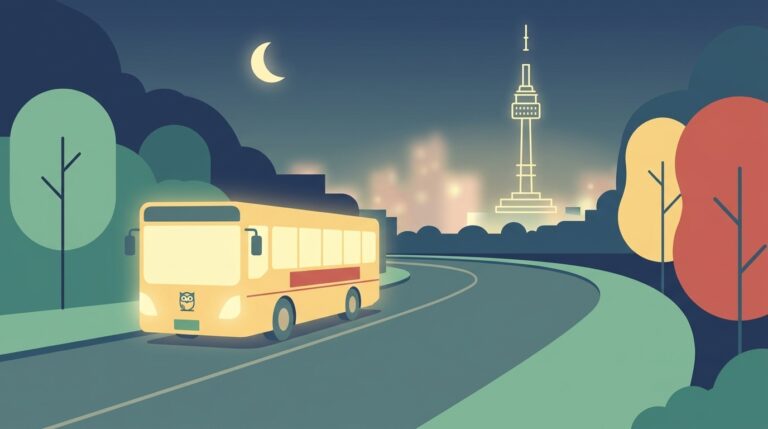
안녕하세요! 매일한글 에디터입니다. Have you ever stood under the flickering fluorescent awning of a convenience store at 1:45 AM in Gangnam or Hongdae, clutching a lukewarm canned coffee while watching the taxi indicator lights speed by in glowing crimson—all marked “예약” (Reserved) or “빈차” (Empty) drivers simply ignoring your frantic waving? You check your transit app with bleary eyes. The subways went to sleep over an hour ago. Your only lifeline back to your suburban sanctuary in Gyeonggi-do or the outskirts of Seoul is the mythical “올빼미 버스” (Owl Bus)—the iconic late-night bus network identified by the letter ‘N’.
When the bus finally rounds the corner, your heart sinks: it is packed wall-to-wall with weary night-shift hospital staff, service workers, and exhausted salarymen, resembling a moving tin of sardines. You are left on the curb as the doors hiss shut. At this moment, transportation ceases to be a mere logistical convenience; it becomes an existential question of equity and fundamental rights.
At a C2 (Mastery) level, you are no longer just asking “Where is the bus stop?” You are stepping into the civic arena where language shapes municipal policy and public welfare. Based on feedback from veteran expats, exchange scholars, and civic activists navigating Korean bureaucracy, this masterclass equips you with the nuanced, high-register discourse necessary to articulate policy critiques, submit compelling public petitions (민원), and advocate for expanding late-night transit infrastructure. Let’s elevate your Korean from surviving the night to championing the community.
Phase 2: Deep Dive into Core Expressions
1. 심야 이동권 보장을 위해 올빼미 버스 노선 확충이 시급합니다.
- Pronunciation: [Sim-ya i-dong-gwon bo-jang-eul wi-hae ol-ppae-mi beo-seu no-seon hwak-chung-i si-geup-ham-ni-da] (Sounds like: Seem-yah ee-dong-gwon bo-jahng-eul wee-hae ol-ppae-mee buh-seu no-seon hwahk-choong-ee see-geup-hahm-nee-dah)
- Meaning: Literal: “To guarantee late-night mobility rights, expanding Owl Bus routes is urgent.” / Nuance: A sophisticated, policy-oriented declaration asserting that night transit is not a commercial luxury, but an essential constitutional right for working citizens.
- K-Culture Moment: In the critically acclaimed drama My Liberation Notes (나의 해방일지), the Sanpo siblings constantly struggle with the soul-crushing dread of missing the final train out of Seoul. This exact phrase echoes what their characters would submit to the provincial governor’s petition portal.
- Editor’s Insight: Notice the term “이동권” (Right to Mobility). In Korean civic discourse, affixing “~권” (right) elevates an inconvenience to a matter of human dignity and social justice. Pairing it with “시급합니다” (is urgent) conveys solemn administrative gravity without sounding hysterical.
- Situation Spectrum: Casual 🚫 | Semi-formal ⚠️ | Formal ✅
- 🤔 Think About It: In your native tongue, do you frame public transit availability as a commercial consumer demand or a fundamental civil right (이동권)? How does this distinction shift the ethical weight of your argument?
2. 배차 간격을 단축하고 첫차·막차 시간을 탄력적으로 운영해 주십시오.
- Pronunciation: [Bae-cha gan-gyeog-eul dan-chuk-ha-go cheot-cha-mak-cha si-gan-eul tal-ryeok-jeog-eu-ro un-yeong-hae ju-sip-si-o] (Sounds like: Bae-chah gahn-gyuh-geul dahn-chook-hah-go chut-chah-mahk-chah see-gahn-eul tahl-lyuhk-juh-geu-ro oon-young-hae joo-sheep-shee-oh)
- Meaning: Literal: “Shorten the dispatch intervals and operate the first and last bus schedules flexibly, please.” / Nuance: A constructive, solution-driven demand proposing pragmatic administrative recalibration rather than just complaining about long waits.
- K-Culture Moment: Heard during city council public hearings (주민공청회) or in modern political satires when neighborhood representatives negotiate route timetables with Seoul Metropolitan Government officials.
- Editor’s Insight: “배차 간격” (dispatch headway/interval) and “탄력적” (elastic/flexible) are indispensable C2 administrative lexicon words. Utilizing “~해 주십시오” sets an impeccable standard of polite yet unyielding assertiveness suitable for formal petitions.
- Situation Spectrum: Casual 🚫 | Semi-formal ⚠️ | Formal ✅
- 🤔 Think About It: Notice how Korean administrative appeals balance strict formal honorifics with decisive imperatives. Does your language have a similar way to remain flawlessly polite while demanding structural change?
3. 대중교통 사각지대 해소를 위해 시민들의 목소리에 귀 기울여야 합니다.
- Pronunciation: [Dae-jung-gyo-tong sa-gak-ji-dae hae-so-reul wi-hae si-min-deul-ui mok-so-ri-e gwi gi-ul-yeo-ya ham-ni-da] (Sounds like: Dae-joong-gyo-tong sah-gahk-jee-dae hae-so-reul wee-hae see-meen-deul-ui mohk-so-ree-eh gwee gee-ool-yuh-yah hahm-nee-dah)
- Meaning: Literal: “To eliminate public transit blind spots, you must tilt your ear toward the voices of citizens.” / Nuance: A principled civic appeal highlighting marginalized neighborhoods and demanding communicative democracy from urban planners.
- K-Culture Moment: Frequently used in Korean investigative journalism broadcasts such as PD Note (PD수첩) or In-Depth 60 Minutes (추적 60분) when reporting on transit deserts left behind by gentrification.
- Editor’s Insight: The idiom “귀를 기울이다” (to tilt one’s ear / to listen attentively) softens what would otherwise be a harsh command (“~해야 합니다”), transforming it into a high-level moral entreaty.
- Situation Spectrum: Casual ⚠️ | Semi-formal ✅ | Formal ✅
- 🤔 Think About It: Why does Korean rhetoric favor somatic metaphors—like “tilting an ear” (귀를 기울이다) or “stepping with one’s feet” (발 벗고 나서다)—when arguing for community solidarity?
Phase 3: Textbook Korean vs. Real-World Korean
Situation 1: Petitioning the Metropolitan Transit Division for Route Increases
- 📖 교과서 한국어 (Textbook Style):
- 밤에 버스를 더 많이 다니게 해 주세요. 시민들이 집에 가기 힘들어요.
- (Pam-e beo-seu-reul deo manh-i da-ni-ge hae ju-se-yo. Si-min-deul-i jib-e ga-gi him-deul-eo-yo.)
- “Please make more buses run at night. It is difficult for citizens to go home.”
- 🗣️ 진짜 한국어 (Real-World C2 Register):
- 심야 시간대 병목 현상이 극심하니, 거점 간 증차를 통한 배차 간격 조정이 불가피합니다.
- (Sim-ya si-gan-dae byeong-mok hyeon-sang-i geuk-sim-ha-ni, geo-jeom gan jeung-cha-reul tong-han bae-cha gan-gyeok jo-jeong-i bul-ga-pi-ham-ni-da.)
- “Because late-night bottlenecks are extreme, fleet expansion to adjust dispatch headways between key hubs is inevitable.”
- 💡 왜 다를까? (Cultural & Sociological Context):
- Textbook Korean sounds like an elementary school request. Bureaucrats and civic panels operate on institutional vocabulary: “병목 현상” (bottleneck phenomenon), “증차” (fleet increase), and “불가피하다” (to be inevitable/unavoidable). Using analytical terminology compels decision-makers to treat your proposal as a credible policy brief rather than emotional whining.
Situation 2: Speaking with Fellow Commuters Waiting for an Overcrowded Owl Bus
- 📖 교과서 한국어 (Textbook Style):
- 사람이 너무 많아서 버스를 탈 수가 없습니다. 버스가 더 필요합니다.
- (Sa-ram-i neo-mu manh-a-seo beo-seu-reul tal su-ga eops-seum-ni-da. Beo-seu-ga deo pil-yo-ham-ni-da.)
- “There are too many people, so I cannot ride the bus. More buses are needed.”
- 🗣️ 진짜 한국어 (Real-World C2 Register):
- 만차라 그냥 지나치네요. 매일 이 지경인데, 심야 수요를 감안하면 추가 노선 편성이 상식 아닌가요?
- (Man-cha-ra geu-nyang ji-na-chi-ne-yo. Mae-il i ji-gyeong-in-de, sim-ya su-yo-reul gam-an-ha-myeon chu-ga no-seon pyeon-seong-i sang-sik a-nin-ga-yo?)
- “It’s fully packed and just drove right past us. It’s like this every single night; given the late-night demand, isn’t adding routes just basic common sense?”
- 💡 왜 다를까? (Cultural & Sociological Context):
- Native speakers express shared solidarity in public frustrations by invoking collective shared values: “이 지경” (this dire state) and “상식 아닌가요?” (Isn’t it common sense?). It invites agreement through rhetorical empathy without crossing into aggressive vulgarity.
Phase 4: K-Culture Deep Dive & Non-verbal Etiquette
4-1. 눈치 (Nunchi) & Gestures: Mastering Formal Civic Decorum
When participating in civic consultation forums (시민참여예산 회의) or submitting formal verbal complaints at district offices (구청 민원실), emotional outbursts immediately trigger administrative defense mechanisms. To project mastery:
* The Open-Palm Presentation (양손 바치기): When presenting statistical graphs or route maps, never point with an index finger. Direct the attention of officials using an open hand with palms tilted slightly upward. This signals respect while firmly controlling the room’s visual focus.
* The Empathetic Pause (경청의 끄덕임): When an official counters with budget limitations, maintain steady eye contact, nod slowly two or three times to signal “I comprehend your fiscal constraints” (경청), then follow up with “다만…” (However…) to pivot right back to your policy demand.
* Postural Firmness (단호한 자세): Keep shoulders relaxed but upright; do not lean back or fold your arms over your chest (which registers as dismissive arrogance).
4-2. The Midnight Mosaic: The Socioeconomic Genesis of the “Owl Bus”
Seoul’s “올빼미 버스” was born in 2013 not from whimsical urban planning, but from revolutionary big-data engineering. The city analyzed over 3 billion nocturnal phone calls and taxi dispatch logs from telecommunication giants to map the exact trajectories of Seoul’s nocturnal workforce—designated with an ‘N’ prefix (such as the famous N13, N26, and N61).
In Korean society, the late-night transit dispute highlights deep sociological fissures. Between the subway shutdown (~midnight to 1:00 AM) and sunrise, a silent army of janitorial staff, market stall tenders at Dongdaemun, shift nurses, and young gig-economy couriers populate the streets alongside corporate workers reeling from obligatory corporate dinners (회식). Expanding these routes is not merely about helping late-night revelers save on cab fares; it is the frontline battleground for labor equity and urban safety.
Phase 5: Real-World Roleplay Scenario
Setting: The Seoul Metropolitan Government Citizen Hall (시민청 간담회). You are a community advocate presenting to Director Park from the Urban Transportation Division.
- Turn 1: 박 주무관 (Director Park)
- 심야 대중교통 노선 개편안에 대해 주민 여러분의 의견을 수렴하고자 합니다.
- (Sim-ya dae-jung-gyo-tong no-seon gae-pyeon-an-e dae-hae ju-min yeo-reo-bun-ui ui-gyeon-eul su-ryeom-ha-go-ja ham-ni-da.)
- “We are here to collect residents’ opinions regarding the reorganization plan for late-night public transit lines.”
🎭 Adjusts his microphone professionally and arranges policy dossiers on the desk.
- Turn 2: 학습자 (You – Learner)
- 현재 외곽 지역으로 향하는 올빼미 버스의 배차 간격이 지나치게 길어 시민들의 피로도가 극에 달했습니다.
- (Hyeon-jae oe-gwak ji-yeok-eu-ro hyang-ha-neun ol-ppae-mi beo-seu-ui bae-cha gan-gyeok-i ji-na-chi-ge gil-eo si-min-deul-ui pi-ro-do-ga geuk-e dal-haess-seum-ni-da.)
- “Currently, the dispatch headway for Owl Buses heading toward the outer districts is excessively long, pushing citizens’ fatigue to the absolute breaking point.”
🎭 Speaks with poised composure, tapping a finger gently on the commuter survey data.
- Turn 3: 박 주무관 (Director Park)
- 한정된 예산과 운수 종사자들의 피로 누적 문제로 인해 즉각적인 증차는 현실적으로 난관이 많습니다.
- (Han-jeong-doen ye-san-gwa un-su jong-sa-ja-deul-ui pi-ro nu-jeok mun-je-ro in-hae jeuk-gak-jeok-in jeung-cha-neun hyeon-sil-jeok-eu-ro nan-gwan-i manh-seum-ni-da.)
- “Due to limited budgets and accumulated driver fatigue, an immediate fleet increase poses many practical obstacles.”
🎭 Shows an apologetic expression, interlocking his fingers defensively.
- Turn 4: 학습자 (You – Learner)
- 물론 행정적 고충은 이해합니다만, 이는 단순한 편의가 아니라 야간 근로자들의 기본적인 이동권 문제입니다.
- (Mul-ron haeng-jeong-jeok go-chung-eun i-hae-ham-ni-da-man, i-neun dan-sun-han pyeon-ui-ga a-ni-ra ya-gan geul-ro-ja-deul-ui gi-bon-jeok-in i-dong-gwon mun-je-ip-ni-da.)
- “I certainly understand the administrative constraints; however, this is not a matter of simple convenience, but of fundamental mobility rights for night-shift workers.”
🎭 Nods once respectfully to acknowledge his point before making firm eye contact.
- Turn 5: 박 주무관 (Director Park)
- 말씀하신 이동권의 취지에는 전적으로 공감합니다. 그렇다면 어떤 대안이 가장 시급하다고 보십니까?
- (Mal-sseum-ha-sin i-dong-gwon-ui chwi-ji-e-neun jeon-jeok-eu-ro gong-gam-ham-ni-da. Geu-reoh-da-myeon eo-tteon dae-an-i ga-jang si-geup-ha-da-go bo-sim-ni-kka?)
- “I completely empathize with the principle of mobility rights you stated. In that case, which alternative do you deem most urgent?”
🎭 Picks up his pen attentively, ready to write down specifics.
- Turn 6: 학습자 (You – Learner)
- 전면 증차가 어렵다면, 심야 피크 시간대인 새벽 1시부터 3시 사이에 거점형 맞춤 버스를 탄력 배차해 주십시오.
- (Jeon-myeon jeung-cha-ga eo-ryeop-da-myeon, sim-ya pi-keu si-gan-dae-in sae-byeok han-si-bu-teo se-si sa-i-e geo-jeom-hyeong mat-chum beo-seu-reul tal-ryeok bae-cha-hae ju-sip-si-o.)
- “If a comprehensive fleet increase is unfeasible, please introduce flexible dispatching of hub-tailored shuttle buses during peak midnight hours between 1:00 AM and 3:00 AM.”
🎭 Presents an annotated district route map using both hands.
- Turn 7: 박 주무관 (Director Park)
- 빅데이터 분석을 통해 혼잡 구간을 선별한다면 시범 운행을 전향적으로 검토해 볼 여지가 있겠군요.
- (Bik-de-i-teo bun-seok-eul tong-hae hon-jap gu-gan-eul seon-byeol-han-da-myeon si-beom un-haeng-eul jeon-hyang-jeog-eu-ro geom-to-hae bol yeo-ji-ga it-get-gun-yo.)
- “If we pinpoint congested sectors through big-data analytics, there may indeed be room to proactively consider a pilot run.”
🎭 Pushes up his spectacles and nods thoughtfully in genuine agreement.
- Turn 8: 학습자 (You – Learner)
- 긍정적인 검토에 감사드립니다. 교통 소외 계층을 배려하는 선진 행정을 기대하겠습니다.
- (Geung-jeong-jeok-in geom-to-e gam-sa-deu-rim-ni-da. Gyo-tong so-oe gye-cheung-eul bae-ryeo-ha-neun seon-jin haeng-jeong-eul gi-dae-ha-get-seum-ni-da.)
- “Thank you for your constructive consideration. We look forward to forward-thinking governance that supports transit-marginalized citizens.”
🎭 Bows politely from the waist with a reassuring, dignified smile.
🔀 Interactive Choice Point: How do you conclude your formal presentation?
- Choice A: “타 지자체의 탄력 배차 성공 사례와 심야 택시 승차난 완화 데이터를 서면으로 추가 제출하겠습니다.” (I will submit supplementary written data regarding successful flexible dispatch cases from other municipalities and midnight taxi shortage mitigation.)
- Outcome: BEST! High-level bureaucratic pragmatism. Submitting written precedent (“서면 제출”) gives civil servants the documentation they need to justify budget reallocations to their superiors.
- Choice B: “말만 검토한다고 얼버무리지 마시고 당장 다음 주부터 노선 신설해 주세요!” (Don’t just gloss over it by saying you’ll review it; establish the new route right now starting next week!)
- Outcome: BAD. Emotional demands violate civil decorum and cause administrators to label you as an unreasonable complainant (악성 민원인).
- Choice C: “네, 공무원분들이 알아서 잘 처리해 주실 테니 믿고 기다리겠습니다.” (Yes, since public officials will handle it well on their own, I will just trust you and wait.)
- Outcome: RISK. Relinquishing civic accountability without locking in a timeline or review mechanism causes municipal proposals to stall indefinitely.
Phase 6: 10-Second Emotion Shadowing Drill
Master the persuasive cadence of Korean public discourse. Pay close attention to pauses marked with / and emotional directions.
- Drill 1: [👔 Firm, articulate, and logically poised]
- 심야 이동권 보장은 / 단순한 편의가 아니라 / 시민 모두를 위한 / 필수 공공재입니다.
- (Sim-ya i-dong-gwon bo-jang-eun / dan-sun-han pyeon-ui-ga a-ni-ra / si-min mo-du-reul wi-han / pil-su gong-gong-jae-im-ni-da.)
- “Guaranteeing late-night mobility rights / is not a mere convenience, / but an essential public good / for all citizens.”
- Drill 2: [🤝 Empathetic, diplomatic, yet uncompromising]
- 행정적 한계에만 머무르지 마시고, / 취약 시간대 배차 간격 단축을 / 전향적으로 검토해 주십시오.
- (Haeng-jeong-jeok han-gye-e-man meo-mu-reu-ji ma-si-go, / chwi-yak si-gan-dae bae-cha gan-gyeok dan-chuk-eul / jeon-hyang-jeog-eu-ro geom-to-hae ju-sip-si-o.)
- “Rather than remaining constrained by administrative limits, / please examine shortening headways during vulnerable hours / with an open-minded approach.”
- Drill 3: [💡 Visionary, analytical, and solution-oriented]
- 거점 중심의 순환 노선 확충이야말로 / 심야 교통 사각지대를 해소할 / 가장 현실적인 해법입니다.
- (Geo-jeom jung-sim-ui sun-hwan no-seon hwak-chung-i-ya-mal-ro / sim-ya gyo-tong sa-gak-ji-dae-reul hae-so-hal / ga-jang hyeon-sil-jeok-in hae-beop-im-ni-da.)
- “Expanding hub-centered circular routes / is indeed the most viable solution / to resolve late-night transit blind spots.”
Phase 7: K-Culture Mini Dictionary
- 이동권 (I-dong-gwon) | Right to Mobility
- The socio-legal principle that all residents possess the constitutional right to safe, accessible physical transit regardless of their income, disability, or work schedule.
- 배차 간격 (Bae-cha gan-gyeok) | Dispatch Interval / Transit Headway
- The scheduled duration between consecutive vehicles on a bus or train line. Shortening headways (배차 간격 단축) is the number one priority in Korean public transit petitions.
- 사각지대 (Sa-gak-ji-dae) | Blind Spot / Unserved Margin
- Originating from driving optics, this term is ubiquitous in Korean sociology and policy to describe populations or geographic areas excluded from social safety nets or municipal services.
- 공론화 (Gong-ron-hwa) | Public Deliberation / Bringing to Public Discourse
- The societal act of elevating a dormant community problem into mainstream debate through media coverage, citizen assemblies, and institutional petitions.
Phase 8: Survival Kit for Travelers & Expats
TOP 3 Real-World Night Transit Phrases
- 이 버스가 오늘 막차인가요?
- (I beo-seu-ga o-neul mak-cha-in-ga-yo?) | “Is this bus the last run of the day?”
- Pro Tip: Ask the bus driver immediately upon boarding if you see the bus display showing an orange indicator. If it’s the last run, transfers to connecting lines may not operate.
- 올빼미 버스는 중앙차로 정류장에서 타야 하나요?
- (Ol-ppae-mi beo-seu-neun jung-ang-cha-ro jeong-ryu-jang-e-seo ta-ya ha-na-yo?) | “Do I need to board the Owl Bus at the center-lane island bus stop?”
- Pro Tip: In key arteries like Gangnam-daero or Jongno, late-night ‘N’ buses almost exclusively use the center-lane transit islands (중앙차로) rather than curbside bus stops.
- 심야 할증 요금은 얼마인가요?
- (Sim-ya hal-jeung yo-geum-eun eol-ma-in-ga-yo?) | “How much is the late-night surcharge fare?”
- Pro Tip: Owl Buses cost slightly more than daytime buses (around ₩2,500 using a transit card), but standard transfer discounts (환승할인) still apply within 30 minutes!
Editor’s Travel Note: Night Commuting Strategy
- Download urban navigation apps in advance: Check real-time Seoul night bus locations using the 네이버 지도 앱 다운로드 or inspect live bus arrival boards via 카카오맵 대중교통 길찾기.
- Late-Night Taxi Reality Check: Seoul taxis apply a 20% to 40% midnight surcharge (심야 할증) between 10:00 PM and 4:00 AM. If an N-bus route is within walking distance, prioritizing the Owl Bus can save you upwards of ₩30,000 to ₩50,000 on a single commute back from downtown Seoul.
Phase 9: One Step Deeper (한 발 더 깊이)
In South Korea, public transit is not merely an engineering feat; it is a collective mirror reflecting societal ethics. When Seoul inaugurated the first Owl Buses in 2013, the city celebrated it as an emblem of data-driven convenience. Yet underneath that tech optimism lies a sobering reality: Korea’s rapid economic development was built on the backs of nocturnal laborers whose schedules fall outside the regular 9-to-6 societal rhythm. By advocating for transit route expansion, you are engaging with the ongoing dialectic between municipal fiscal prudence and the fundamental human right to safe passage. To speak this language at a C2 level is to step beyond being a passive spectator and become an active participant in Korean civic life.
💬 Your Turn: In your hometown or country, is late-night transit treated as a basic public welfare guarantee or a for-profit luxury service? How would you formulate an appeal to your local transit authority using the concepts of “사각지대” (blind spots) and “이동권” (mobility rights)? Share your thoughts below!
Phase 10: FAQ & Common Mistakes
Q: How do residents officially submit a petition to expand an Owl Bus route?
A: You can file an official civil petition (민원) through the Seoul 120 Dasan Call Center, access the online “응답소 (Eungdapso)” petition portal, or propose it during the annual “시민참여예산” (Citizen Participatory Budgeting) forum where citizens directly vote on municipal fund allocations.
Q: Why do Seoul Owl Bus numbers always begin with the letter ‘N’?
A: The ‘N’ stands for “Night” (심야). The two subsequent digits correspond to Seoul’s administrative transit zones: the first digit indicates the departure district and the second represents the destination district (e.g., N13 connects Zone 1 Dobong/Nowon with Zone 3 Songpa/Gangnam).
Q: Can foreigners participate in civic discussions regarding public transport?
A: Absolutely. Registered foreign residents (외국인등록자) residing in Seoul have legal standing to submit administrative inquiries, participate in public transit feedback surveys, and propose improvements via the Seoul Global Center and city administrative portals.
🚨 Common Mistakes Warning Board
- Mistake 1: Relying on casual informal demands on civic noticeboards.
- Wrong: 버스 좀 더 늘려 주세요. 밤마다 너무 힘들어요. (Beo-seu jom deo neul-lyeo ju-se-yo…)
- Correct Action: Always employ administrative nominalized clauses and formal honorific endings: “심야 시간대 이용객 과밀 해소를 위해 노선 확충 및 증차를 정중히 건의합니다.”
- Mistake 2: Confusing ‘첫차’ (first bus) with ‘막차’ (last bus) on night routes.
- Wrong: Assuming the Owl Bus “첫차” starts at dawn like ordinary lines.
- Correct Action: Remember that Owl Bus “첫차” schedules typically begin around 23:30 (11:30 PM) and their “막차” departs around 03:45 to 04:10 AM!
- Mistake 3: Misattributing route planning solely to the bus operating company.
- Wrong: Complaining exclusively to the private transport company (운수회사).
- Correct Action: In Seoul’s semi-public transit system (준공영제), routes and timetables are regulated by the metropolitan government (지자체 교통기획과). Direct your policy proposals to the city hall rather than individual bus depots.
Phase 11: Action Missions
- 🥉 Bronze Mission (Solo Shadowing):
- Record your voice delivering the 3 Phase 6 Shadowing Drills. Focus on crisp diction of complex consonant clusters such as “확충이야말로” [hwak-chung-i-ya-mal-ro] and “배차 간격” [bae-cha-gan-gyeok].
- 🥈 Silver Mission (Community Engagement):
- Write a 2-sentence civic proposal in Korean on your social study feed: State one transit problem in your neighborhood using “~ 사각지대 해소를 위해 ~ 확충이 시급합니다” and tag
#매일한글 #DailyHangul #KoreanC2.
- Write a 2-sentence civic proposal in Korean on your social study feed: State one transit problem in your neighborhood using “~ 사각지대 해소를 위해 ~ 확충이 시급합니다” and tag
- 🥇 Gold Mission (Real-World Application):
- Open the Seoul Eungdapso (응답소) or KakaoMap route review section for an ‘N’ bus line and compose a formal, constructive critique analyzing its current headway and proposing optimized stop allocations.
- 🎮 K-Culture Mission:
- Stream an episode of a workplace K-drama like Misaeng (미생) or My Liberation Notes (나의 해방일지). Identify the non-verbal exhaustion portrayed during transit commutes and write down two phrases you would use to comfort or advocate for those characters.
Phase 12: Interactive Quiz Challenge
Test your mastery of Korean civic discourse and night transport policy with these three C2-level challenges!
1. Contextual Judgment
You are speaking at a neighborhood district transport hearing. An official notes: “심야 노선 확대는 운수회사의 적자를 유발할 우려가 큽니다.” (Expanding late-night routes raises significant concerns about transit company deficits). Which response demonstrates the most proficient, persuasive C2 civic register?
* A) “적자가 나든 말든 시민들이 타겠다는데 왜 말이 많으십니까?”
* B) “단기적 적자 폭보다 대중교통 사각지대 방치로 인한 사회적 비용 손실이 훨씬 크다는 점을 감안해야 합니다.”
* C) “그럼 버스 요금을 두 배로 올리고 택시를 타라고 하세요.”
2. Terminology Fill-in-the-Blank
Complete the policy statement:
“심야 시간대 노동자들의 기본적인 ( ________ ) 보장과 대중교통 ( ________ ) 해소를 위해 지자체 차원의 탄력적 배차 정책이 마련되어야 합니다.”
3. Cultural True or False
True or False? The Seoul Owl Bus (‘N’ Bus) network does not permit transit transfer fare discounts (환승할인) because it operates on a specialized late-night surcharge rate system.
👉 Click here to reveal the answers and detailed explanations!
Quiz Explanations
- Contextual Judgment: Correct Answer is B
- Explanation: Choice B brilliantly pivots the debate from narrow fiscal deficits to comprehensive socioeconomic losses (“사회적 비용 손실”) using sophisticated governance terminology. Choice A is emotionally combative and disrespectful, while Choice C is defeatist and sarcastic.
- Fill-in-the-Blank: Correct Answers are (이동권) and (사각지대)
- Full Sentence: “심야 시간대 노동자들의 기본적인 이동권 보장과 대중교통 사각지대 해소를 위해 지자체 차원의 탄력적 배차 정책이 마련되어야 합니다.”
- (To guarantee late-night workers’ fundamental right to mobility and eliminate public transit blind spots, flexible dispatch policies at the local government level must be established.)
- Cultural True or False: False (F)
- Explanation: Even though the base fare of the Owl Bus is higher (~₩2,500), Seoul’s integrated transit fare structure maintains transfer discount benefits (환승할인) between connecting night buses within a 30-minute window (extended to 60 minutes between 21:00 and 07:00).
- Explanation: Even though the base fare of the Owl Bus is higher (~₩2,500), Seoul’s integrated transit fare structure maintains transfer discount benefits (환승할인) between connecting night buses within a 30-minute window (extended to 60 minutes between 21:00 and 07:00).







