

Curating Your Sohwakhaeng List: Advanced Korean Expressions for Mental Wellness
Phase 1: Empathy (Story-Immersive Opening)
안녕하세요! 매일한글 에디터입니다.
Picture this: It is 8:45 PM on a Tuesday in Gangnam. Neon signs flicker against the drizzle, subway Line 2 is packed to the brim with exhausted professionals clutching lukewarm iced Americanos, and you feel that familiar weight in your chest. You have been striving to conquer the demanding Korean ethos of gatsaeng (living an ultra-productive, god-tier life), but your cognitive bandwidth is completely drained. As an advanced Korean speaker, you already know standard vocabulary like “스트레스 받아요” (I’m stressed) or “쉬고 싶어요” (I want to rest). But when you sit down with a close Korean friend at an ambient LP bar in Euljiro, those textbook phrases fall remarkably flat. They fail to capture the delicate, introspective longing for quiet restoration that actually heals the soul.
Over the past ten years of coaching executives, diplomats, and passionate scholars navigating Korean work and academic cultures, the single biggest emotional bottleneck I have witnessed is the inability to articulate psychological boundaries without sounding either cold or defeated. In a culture characterized by collective acceleration and hyper-efficiency, self-care is not a grand, dramatic retreat; it is an art of intentional micro-recovery known as 소확행 (Sohwakhaeng — Small but Certain Happiness).
Mastering the nuanced discourse around mental care at a C2 level allows you to move beyond basic survival Korean into authentic, soul-to-soul intimacy. This guide was built directly on field notes and real communicative breakthroughs from advanced learners just like you, offering you the precise linguistic instruments to protect your peace, curate your restorative rituals, and connect meaningfully with Koreans on an emotional plane.
Phase 2: Core 3 Expressions In-Depth Analysis
1. 소소하지만 확실한 행복을 챙기다 (Sosohajiman hwaksilhan haengbogeul chaenggida)
- Pronunciation: [So-so-ha-ji-man hwak-sil-han haeng-bo-geul chaeng-gi-da] (Think of the flowing rhythm of saying “so-so,” followed by a sharp pop on “hwak” like snapping your fingers, and “chaeng-gi-da” pronounced with deliberate intent, like tucking a passport safely into your breast pocket.)
- Meaning:
- Literal: To take care of small, trivial, yet definite happiness.
- Nuanced: To actively carve out and prioritize tangible, everyday micro-joys amid a relentless schedule.
- K-Culture Moment: You will hear this in reflective lifestyle documentaries or cozy slice-of-life K-dramas (like My Liberation Notes or Warm and Cozy), when a burnt-out protagonist intentionally buys a specific bakery pastry or sits by the window simply watching rain puddles.
- Editor’s Insight: Notice the verb 챙기다 (chaenggida). In Korean, chaenggida implies dynamic guardianship—you don’t just passively “feel” happiness; you claim it, pack it, and safeguard it like your morning vitamins.
- Situation Spectrum:
- Casual (반말): ✅ (소소하지만 확실한 행복 좀 챙겨야겠어.)
- Semi-formal (해요체): ✅ (요즘은 소소하지만 확실한 행복을 챙기려고 애쓰고 있어요.)
- Formal (하십시오체): ⚠️ (격식적인 자리에서는 다소 감성적인 표현일 수 있음)
- 🤔 Think About It: Why does Korean culture contrast smallness (소소함) with certainty (확실함)? How does this subvert the Western teleological pursuit of grandiose, macro-level life goals?
2. 일상의 결을 차분히 매만지다 (Ilsang-ui gyeoreul chabunhi maemanjida)
- Pronunciation: [Il-sang-ui gyeo-reul cha-bun-hi mae-man-ji-da] (The word “gyeol” glides smoothly on the tongue like running your hand across polished cedarwood, followed by the soft hum of “chabunhi” and the delicate, tactile cadence of “mae-man-ji-da”.)
- Meaning:
- Literal: To calmly stroke and smooth down the natural grain/texture of daily life.
- Nuanced: To slow down and recalibrate one’s inner rhythm; tending to the chaotic frays of your mental space with mindful tenderness.
- K-Culture Moment: Commonly used in literary essays, intellectual radio programs (like MBC’s late-night cultural broadcasts), and by thoughtful songwriters explaining their creative burnout recovery.
- Editor’s Insight: 결 (Gyeol) refers to the intrinsic grain—of wood, stone, skin, or emotional disposition. When your gyeol is ruffled by chronic stress, you don’t fight it; you gently smooth it down. This is the hallmark of C2-level psychological self-awareness.
- Situation Spectrum:
- Casual (반말): ⚠️ (너무 문학적이어서 절친 사이의 진솔한 대화나 글에 어울림)
- Semi-formal (해요체): ✅ (주말 동안에는 일상의 결을 차분히 매만져 보려고요.)
- Formal (하십시오체): ✅ (바쁜 일상 속에서도 삶의 결을 매만지는 시간이 필요합니다.)
- 🤔 Think About It: In your native tongue, do you describe time and mental health as an architectural structure to build, or an organic grain to align with? How does the metaphor of gyeol change your attitude toward emotional exhaustion?
3. 마음의 여백을 두다 (Maeum-ui yeobaegeul duda)
- Pronunciation: [Ma-eum-ui yeo-bae-geul du-da] (Let the open vowel “yeo” exhale naturally like a sigh of relief, followed by the soft acoustic drop of “baek” and “du-da”.)
- Meaning:
- Literal: To place white space / negative space in one’s mind.
- Nuanced: To maintain intentional emotional and psychological margin; intentionally leaving room for serendipity, silence, and non-action.
- K-Culture Moment: Frequent in modern Korean wellness literature, minimalist architecture reviews, and dialogues between mentor and mentee in contemplative indie cinema.
- Editor’s Insight: Stemming from traditional Korean painting (hangukhwa), 여백 (Yeobaek) is not empty nothingness; it is the vital breathing space that gives meaning to ink. To say you need yeobaek in your mind is a sophisticated, dignified way of declining extra burdens.
- Situation Spectrum:
- Casual (반말): ✅ (이제는 마음에 여백 좀 두고 살려고.)
- Semi-formal (해요체): ✅ (일정도 좋지만 마음에 여백을 좀 두는 게 어떨까요?)
- Formal (하십시오체): ✅ (현대인에게는 마음에 여백을 두는 지혜가 절실합니다.)
- 🤔 Think About It: How does the visual concept of aesthetic negative space challenge the modern trap of viewing mental rest merely as “unproductive downtime”?
Phase 3: Textbook Korean vs. Real Korean
Situation 1: Explaining your need for solitary rest
- 📖 교과서 한국어:
- 스트레스가 심해서 집에서 아무것도 안 하고 푹 쉴 거예요.
- (Seuteureseuga simhaeseo jibeseo amugeotdo an hago puk swil geoyeyo.)
- Translation: Because my stress is severe, I will do nothing at home and rest deeply.
- 🗣️ 진짜 한국어:
- 이번 주말엔 완전히 로그아웃하고 나만의 케렌시아에서 재충전 좀 하려고요.
- (Ibeon jumaren wanjeonhi rogeu-aut-hago namanui keren-sia-eseo jaechungjeon jom haryeogoyo.)
- Translation: This weekend, I’m planning to log out completely and recharge in my personal querencia.
- 💡 왜 다를까?: The textbook version pathologizes your state as an acute medical crisis (“stress is severe”). In contrast, native Korean professionals speak in contemporary metaphors—using digital parlance (logout) blended with poetic concepts like querencia (안식처) to project proactive emotional curation.
Situation 2: Finding delight in mundane comfort rituals
- 📖 교과서 한국어:
- 퇴근한 후에 따뜻한 차를 마시면 기분이 아주 좋습니다.
- (Toegeunhan hue ttatteuthan chareul masimyeon gibuni aju joseumnida.)
- Translation: When I drink warm tea after leaving work, my mood is very good.
- 🗣️ 진짜 한국어:
- 퇴근길에 갓 구운 붕어빵 한 봉지 사 들고 들어가는 게 제 찐 소확행이에요.
- (Toegeungire gat gu-un bungeoppang han bongji sa deulgo deureoganeun ge je jjin sohwakhaeng-ieyo.)
- Translation: Grabbing a bag of freshly baked fish pastries on my way home from work—that is my bona fide micro-joy.
- 💡 왜 다를까?: Native Korean mental health discourse thrives on vivid, tactile imagery. Replacing generic joy (“기분이 좋습니다”) with the crunchy sensory reality of bungeoppang and the authentic colloquial amplifier 찐 (jjin: genuine/real) demonstrates natural cultural fluency.
Phase 4: K-Culture Deep Dive & Non-Verbal Etiquette
4-1. Nunchi (눈치) & Gestures: The Sanctuary of Solitary Spaces
In fast-paced metropolitan hubs like Seoul, personal mental care often takes place in designated shared-solitude environments: vinyl listening bars, traditional Hanok tea houses in Seochon, or “book bars” (chaek-bar) in Yeonhui-dong.
* The Gaze (시선 처리): Never let your eyes dart around or settle on what others are reading, journaling, or listening to. Maintain soft, neutral, middle-distance eye contact. Respecting another person’s yeobaek (mental breathing room) means offering an invisible shield of non-intrusion.
* The Somatic Release (한숨의 결): While deep, audible sighs (hansum) in professional spaces are perceived as toxic negativity, in healing spaces, an intentional, gentle downward exhale paired with dropping one’s shoulder tension signals that you have officially “arrived” at your sanctuary.
* Low-Decibel Nunchi (소리 죽이기): In spaces dedicated to relaxation, handle mugs, journal covers, and silverware with a light touch. Placing a ceramic cup silently on a saucer without clinking demonstrates the highest form of civic empathy.
4-2. Cultural Code Analysis: From “갓생 (Gatsaeng)” Burnout to “멍때리기 (Meong-tteorigi)”
Korean society has recently witnessed an ideological clash between two paradigms:
1. 갓생 (Gatsaeng): A portmanteau of God (갓) and Life (생), driving youth toward rigorous time-blocking, pre-dawn study groups, and endless credentialing.
2. 멍때리기 (Meong-tteorigi): The deliberate state of letting one’s mind go completely vacant.
This counter-movement has spawned viral sub-phenomena: 물멍 (mul-meong) (zoning out while watching flowing water along the Han River), 불멍 (bul-meong) (mesmerized by campfires), and even national zoning-out competitions (Meong-tteorigi Competitions) organized by local governments. In contemporary Korea, zoning out is no longer stigmatized as laziness; it is framed as a defiant neurological detox—an essential psychological survival mechanism within an ultra-connected ecosystem.
Phase 5: Real-Life Roleplay Scenario
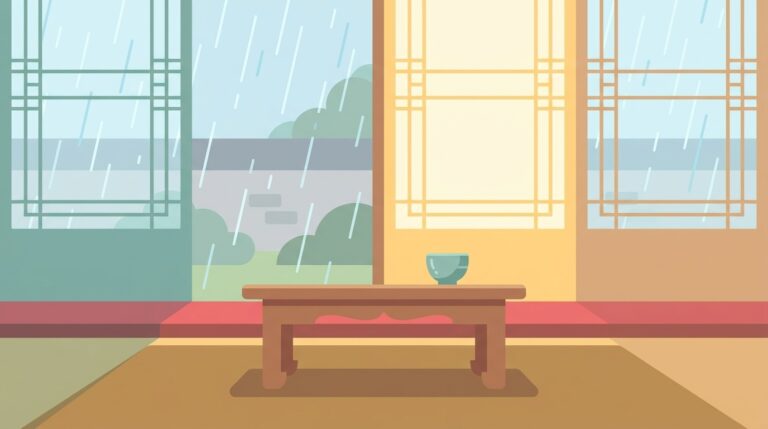
Setting: A dimly lit, quiet acoustic café and independent bookstore tucked deep inside an alley of Seochon. Soft lo-fi piano plays through vintage Tannoy speakers. Rain patters gently on the glass.
NPC Character: Jian (지안), 30s, empathetic and perceptive curator of the space who knows how to read the emotional climate of weary regulars.
Dialogue
- 지안: (조용히 찻잔을 내려놓으며 따뜻한 눈빛으로 건넨다)
- Jian: (Joyonghi chatjaneul naeryeonocheumyeo ttatteuthan nunbicheuro geonnenda)
- (🎭 Setting down a ceramic cup silently, offering a warm, inquiring glance)
- 어서 오세요. 오늘따라 표정에 피로가 조금 묻어나는 것 같아요. 괜찮으세요?
- (Eoseo oseyo. Oneulttara pyojeonge piroga jogeum mudeonaneun geot gatayo. Gwaenchaneuseyo?)
- “Welcome. You seem to have a bit of fatigue lingering on your face today. Are you holding up all right?”
- 학습자 (You): (찻잔의 온기를 손바닥으로 감싸 쥐며 미소 짓는다)
- You: (Chatjanui ongireul sonbadageuro gamssa jwimyeo miso jinneunda)
- (🎭 Cupping the warmth of the tea mug with both palms, offering a tired smile)
- 네, 이번 주 내내 프로젝트 마감 때문에 치열하게 달렸더니 기운이 좀 부쳤나 봐요.
- (Ne, ibeon ju naenae peurojekteu magam ttaemune chiyeolhage dallyeotdeoni giuni jom buchyeonna bwayo.)
- “Yes, I ran flat out all week due to project deadlines, so I suppose my energy fell a bit short.”
- 지안: (깊게 공감하듯 고개를 천천히 끄덕인다)
- Jian: (Gipge gonggamhadeut gogaereul cheoncheonhi kkeodeoginda)
- (🎭 Nodding slowly with deep empathy)
- K-직장인의 삶이란 늘 그렇죠. 그럴 땐 거창한 휴식보다 확실한 온기 하나가 더 절실하잖아요.
- (K-jikjanginui sariran neul geureojyo. Geureol ttaen geochanghan hyusikboda hwaksilhan ongi hanaga deo jeolsilhajanayo.)
- “Such is the life of a Korean office worker. In times like these, a single moment of reliable warmth is more urgent than any grand vacation, isn’t it?”
- 학습자 (You): (창밖의 빗방울을 응시하며 차분하게 말을 잇는다)
- You: (Changbakkui bitbang-eureul eungshihamyeo chabunhage mareul inneunda)
- (🎭 Staring out at the raindrops on the window, continuing quietly)
- 맞아요. 그래서 오늘은 퇴근길에 여기서 조용히 일상의 결을 좀 매만지려고 들렀어요.
- (Majayo. Geuraeseo oneureun toegeungire yeogiseo joyonghi ilsang-ui gyeoreul jom maemanjiryeogo deulleosseoyo.)
- “Exactly. That’s why on my way home, I dropped by here to quietly smooth out the grain of my everyday life.”
- 지안: (반가운 기색을 띠며 잔잔한 미소를 띤다)
- Jian: (Bangaun gisaegeul ttimyeo janjanhan misoreul ttin-da)
- (🎭 Showing a glint of appreciation with a serene smile)
- 멋진 표현이네요. 손님만의 확실한 멘탈 케어 리스트가 있으신가 봐요?
- (Meotjin pyohyeon-ineyyo. Sonnim-manui hwaksilhan mental keo riseuteuga isseusin-ga bwayo?)
- “What a wonderful expression. It sounds like you have your own definitive mental care list?”
- 학습자 (You): (고개를 끄덕이며 차를 한 모금 음미한다)
- You: (Gogaereul kkeodeogimyeo chareul han mogeum eummihanda)
- (🎭 Nodding gently and taking a mindful sip of tea)
- 대단한 건 아니고요, 이런 빗소리 들으면서 온전히 멍때리는 시간이 제겐 최고의 소확행이에요.
- (Daedanhan geon anigoyo, ireon bitsori deureumyeonseo onjeonhi meong-tteorineun sigani jegen choego-ui sohwakhaeng-ieyo.)
- “It’s nothing grand, but listening to this sound of rain while completely zoning out is my ultimate micro-joy.”
- 지안: (LP 판을 뒤집어 더 잔잔한 첼로 연주곡을 얹는다)
- Jian: (LP paneul dwijibeo deo janjanhan chello yeonjugogeul eonneunda)
- (🎭 Flipping the vinyl record to cue a calm, resonant cello piece)
- 그 마음 충분히 알 것 같아요. 마음에 여백이 생겨야 비로소 내일이 기대되는 법이니까요.
- (Geu ma-eum chungbunhi al geot gatayo. Ma-eume yeobaegei saenggyeoya biroso naeiri gidaedoeneun beob-inikkoyo.)
- “I completely understand that feeling. Only when negative space opens up in the mind can one truly look forward to tomorrow.”
- 학습자 (You): (가슴에 손을 얹고 편안한 호흡을 내쉰다)
- You: (Gaseume soneul eonko pyeon-anhan hoheubeul naeswinda)
- (🎭 Placing a hand over your chest and releasing a peaceful breath)
- 덕분에 복잡했던 머릿속이 한결 정돈되는 느낌이에요. 온전히 쉬어 갈게요.
- (Deokbune bokjaphaetdeon meoritsogi hangyeol jeongdon-doeneun neukkim-ieyo. Onjeonhi swieo galgeyo.)
- “Thanks to you, my tangled thoughts feel noticeably untangled. I’ll enjoy this complete rest.”
🔀 Interactive Branching Moment
Jian leans over softly and asks: “If you were to add one more thing to your personal recovery list tonight, what would it be?”
- Option A: “오늘 밤엔 핸드폰 알림 다 끄고, 제가 좋아하는 수필집 읽으면서 온전히 나만의 속도를 찾으려고요.”
(Tonight, I plan to turn off all phone notifications and read a favorite essay collection to recover my personal pace.)- Outcome (Best): Perfect C2 pragmatic register. It harmonizes the literary tone of the conversation and shows an advanced understanding of self-regulated mental health. Jian will likely offer an essay recommendation from his curated shelf.
- Option B: “빨리 집에 가서 소주 한 병 마시고 취해서 자고 싶어요.”
(I just want to hurry home, chug a bottle of soju, get drunk, and sleep.)- Outcome (Bad): Abrupt tone shift. While realistically candid among close friends over pork belly, it destroys the quiet, reflective aesthetic established in this artisanal cultural sanctuary.
- Option C: “솔직히 번아웃이라 아무 생각도 안 나네요. 사장님이 제 힐링 처방전 좀 짜주실래요?”
(Honestly, I’m so burned out that my mind is blank. Could you curate a healing prescription for me, Boss?)- Outcome (Risk): Conversational and endearing, but places an emotional labor burden on the shopkeeper unless you are genuinely close. Use only if a high degree of jeong (intimate rapport) has already been established.
Phase 6: 10-Second Emotion Shadowing Drill
Read these aloud, mimicking the pauses (/) and breathing the exact emotional nuance indicated by the bracketed tags.
[☕ 깊은 숨을 내쉬며 - Reflective and Grounded]
바쁜 일상 속에서도 / 소소하지만 확실한 행복을 챙기는 게 / 결국 내 마음을 지키는 힘이더라고요.
(Bappeun ilsang sogeseodo / sosohajiman hwaksilhan haengbogeul chaenggineun ge / gyeolguk nae ma-eumeul jikineun him-ideoragoyo.)
“Even in a hectic life… taking care of small but certain joys… turns out to be the real strength that protects my heart.”-
[🌿 담담하고 포근하게 - Poetic and Gentle]
주말만큼은 / 세상의 소음을 잠시 차단하고 / 일상의 결을 차분히 매만져 보려 해요.
(Jumal-mankeumeun / sesang-ui soeumeul jamsi chadanhago / ilsang-ui gyeoreul chabunhi maemanjyeo boryeo haeyo.)
“For the weekend at least… blocking out the world’s noise for a while… I intend to calmly smooth down the grain of my life.” -
[🤍 비워내듯 홀가분하게 - Relieved and Unburdened]
아무것도 채우지 않아도 괜찮아요 / 마음에 여백이 있어야 / 새로운 숨을 쉴 수 있으니까요.
(Amugeotdo chae-uji anado gwaenchanayo / ma-eume yeobaegei isseoya / saeroun sumeul swil su isseunikkayo.)
“It’s completely fine not to fill anything in… only when there is negative space in the heart… can we draw a brand new breath.”
Phase 7: K-Culture Mini Dictionary
- 멍때리기 (Meong-tteorigi)
- Translation: Zoning out / Intentional mental idling.
- Usage: Highly utilized across self-care blogs, media, and social circles. Can be combined with various elements: 숲멍 (zoning out in a forest), 구름멍 (watching clouds). Essential for indicating that you are intentionally turning off executive brain function.
- 갓생 (Gatsaeng)
- Translation: Living an ultra-productive, exemplary life (God + 生).
- Usage: Widely used by Gen Z and millennials on social media to describe diligent routines (gym at 6 AM, studying Korean, journaling). In mental care dialogues, it is frequently critiqued: “갓생 살다가 갓(God) 곁으로 갈 뻔했다” (I almost went to meet God while trying to live a gatsaeng—a popular dark humor joke about burnout).
- 마음챙김 (Ma-eum-chaenggim)
- Translation: Mindfulness / Attentive self-attunement.
- Usage: Widely applied in psychology, meditation retreats, corporate wellness seminars, and high-end yoga studios throughout Seoul. Refers to non-judgmental observation of one’s current psychological climate.
- 안식처 (An-sik-cheo) / 케렌시아 (Querencia)
- Translation: Sanctuary / Safe haven for soul recovery.
- Usage: Both the traditional Sino-Korean word (ansikcheo) and the borrowed term querencia are used in intellectual, lifestyle, and design contexts to designate the physical or psychological refuge where one feels totally safe and unmonitored.
Phase 8: Survival Kit for Travelers & Urban Seekers
Survival Expressions TOP 3
- 혹시 여기 오래 앉아 책을 읽어도 괜찮을까요?
(Hoksi yeogi orae anja chaekeul ilgeodo gwaenchanheulkkayo?)- Pro Tip: When seeking mental respite in independent cafes, asking this politely before ordering demonstrates superior nunchi. It alerts the owner to your intentions, and they often offer you the quietest corner table.
- 조용히 음악에 집중할 수 있는 좌석으로 부탁드립니다.
(Joyonghi eum-age jipjunghal su inneun jwaseogeuro butakdeurimnida.)- Pro Tip: Use this at LP vinyl listening cafes (such as those in Euljiro, Hapjeong, or Seongsu) to secure seats equipped with dedicated premium headphones.
- 혼자만의 시간을 좀 보내고 싶은데, 주변에 산책하기 좋은 코스가 있을까요?
(Honjamanui siganeul jom bonaego sipeunde, jubyeone sanchaekhagi joeun koseuga isseulkkayo?)- Pro Tip: Excellent for striking an authentic, gentle conversation with guesthouse hosts in Gangneung, Jeju, or Gyeongju.
Editor’s Travel Note: Urban Healing Itinerary
- App Guide: Avoid searching for generic “cafes” on global search engines. Instead, open your Korean mapping platform and search using Korean queries like “독서하기 좋은 조용한 카페” (quiet cafes good for reading) or “심야 서점” (midnight bookstores). Make sure to check reviews via the 네이버 지도 길찾기 앱 다운로드 to verify operating hours, noise warnings, and “no kids / no laptop” zones.
- Local Secret: Escape the concrete intensity of downtown Seoul by heading to Seonjeongneung (선정릉) in the center of Gangnam—a UNESCO World Heritage Royal Tomb wrapped in a dense, quiet pine forest where you can practice sup-meong for a mere 1,000 KRW entrance fee.
Phase 9: “한 발 더 깊이” (A Step Deeper)
South Korea’s modern history is defined by compressed economic growth (압축 성장), a phenomenon that elevated the nation from post-war poverty to an international powerhouse within decades. However, this breakneck speed ingrained a cultural subconscious governed by the ppalli-ppalli (faster, faster) imperative and relentless comparison. In this sociolinguistic arena, consciously seeking Sohwakhaeng is not merely an aesthetic lifestyle trend; it is a gentle philosophical resistance against being commodified solely by your productivity. When you choose to speak of yeobaek (negative space) and the gyeol (grain) of your days, you are adopting a linguistic lineage that refuses burnout as a badge of honor.
💬 Your Turn: What does your personal Sohwakhaeng look like when you are overwhelmed? Have you found a moment in your daily life where you had to intentionally “smooth down the grain” of your mind? Let us know in the comments below using today’s expressions!
Phase 10: FAQ & Avoiding Misunderstandings
Q: Can I use “소확행 (Sohwakhaeng)” in a professional business presentation or resume?
A: Yes, but with stylistic care. If you are discussing modern marketing trends, consumer behavior, or corporate employee wellness initiatives, 소확행 is widely accepted as a standard cultural and economic term. However, if describing your personal work philosophy, it is more professional to use expressions like “일상 속 성취감” (everyday sense of accomplishment) or “지속 가능한 원동력” (sustainable driving force) to avoid appearing lacking in professional ambition.
Q: What is the exact difference between “쉼 (Swim)” and “휴식 (Hyusik)”?
A: While 휴식 (hyusik) is a Sino-Korean noun denoting the functional, physical cessation of labor (taking a break between meetings, vacation leave), 쉼 (swim) is a pure Korean noun bearing profound emotional warmth. Swim encompasses existential rest—letting the spirit breathe, stillness of thought, and spiritual replenishment.
Q: Is zoning out (멍때리기) ever considered impolite?
A: Absolutely. While culturally celebrated in private, leisure, or designated nature spaces, doing it during active group interactions, team meetings, or dinner conversations with elders will be perceived as extreme disinterest or lack of nunchi. Context is everything.
🚨 흔한 실수 (Common Mistakes) Top 3
- Directly translating “I need space” as “공간이 필요해요” in romantic/mental burnout contexts.
- Why it’s wrong: Gonggan refers to physical, spatial square footage. To a native ear, this sounds like you are requesting an extra storage room or apartment space.
- Correct Action: Say “혼자만의 생각이 좀 필요해요” (I need some time for solitary thoughts) or “마음을 정리할 시간이 필요해요” (I need time to sort out my feelings).
- Confusing “소소하다 (sosohada)” with “시시하다 (sisihada)”.
- Why it’s wrong: Sosohada means humble, modest, and pleasantly simple. Sisihada means boring, pathetic, or utterly beneath notice.
- Correct Action: Never say “내 시시한 행복”; say “내 소소하지만 확실한 행복”.
- Overusing “힐링 (Healing)” in intellectual or literary conversations.
- Why it’s wrong: While widespread in mass commercial marketing, relying exclusively on the loanword healing at a C2 level sounds repetitive and linguistically superficial.
- Correct Action: Elevate your repertoire with “심신의 안정” (stability of mind and body), “마음의 결을 다듬다” (trimming the grain of the mind), or “온전한 쉼” (wholesome rest).
Phase 11: Action Missions & Engagement
- 🥉 Bronze Mission (Solo Practice): Look around your desk right now. Identify one sensory micro-joy (the steam of your coffee, the weight of your favorite fountain pen) and write a single sentence in your journal using the phrase: “나만의 소소하지만 확실한 행복은 바로 [ ]이다.”
- 🥈 Silver Mission (SNS & Community): Take a minimalist photo of your current evening setting. Post it with the caption: “오늘 하루도 치열하게 달린 나를 위해, 마음의 여백을 두는 시간 🌿 #소확행 #마음챙김” and tag someone who needs a breather.
- 🥇 Gold Mission (Real-Life Mastery): Visit an indie café, library, or tranquil neighborhood spot this week. Initiate a short, gentle conversation with the barista or a Korean friend describing your search for restorative calm, naturally incorporating the expression “일상의 결을 매만지다”.
- 🎮 K-Culture Mission: Watch an episode of a healing-genre Korean variety show (such as Three Meals a Day or Hyori’s Homestay). Keep an active ear out for how the cast describes resting without doing anything. Write down at least two variations of how they articulate relaxation!
Phase 12: Interactive Quiz Challenge
1. Situational Judgment
You are sitting with your Korean team leader after an exhausting quarterly launch. She sighs softly, massaging her temples, and says: “이번 프로젝트 끝내느라 다들 영혼까지 갈아 넣었네요.” (Everyone ground down their very souls to finish this project). Which response demonstrates the highest C2 emotional intelligence and thematic mastery?
* A) “네, 그러니까 오늘 야근은 절대 하지 마시고 회식도 취소해 주세요.”
* B) “정말 치열하게 달려온 만큼, 이번 주말엔 팀장님도 마음의 여백을 챙기고 푹 쉬셨으면 좋겠어요.”
* C) “제 멍때리기 스킬을 전수해 드릴 테니 팀장님도 업무 시간에 멍 좀 때리세요.”
2. Fill-in-the-Blank
Fill in the missing native Korean word that refers to the “natural grain or texture” of life and emotional equilibrium:
“주말 동안 복잡한 생각은 다 내려놓고, 흐트러진 일상의 ( )을 차분히 매만져 보려고 해요.”
3. True or False Cultural Insight
True or False: In contemporary South Korea, the phrase 소확행 (Sohwakhaeng) was originally coined by a Korean mental health doctor during the 1997 IMF financial crisis to treat national depression.
👉 Click to reveal answers & in-depth explanations!
- Correct Answer: B
- Explanation: Choice B strikes the exact balance of advanced professional deference, deep empathy, and sophisticated emotional resonance using 마음의 여백. Choice A is overly confrontational and abrasive. Choice C misapplies the casual slang 멍때리기 inappropriately to a superior in a workplace context.
- Correct Answer: 결 (Gyeol)
- Explanation: 결 is the unique Korean conceptual noun for intrinsic grain/texture. When combined with 매만지다, it elevates the sentence to a masterclass level of mindful elegance.
- Correct Answer: False
- Explanation: 소확행 (小確幸) was actually coined by Japanese author Haruki Murakami in his 1986 essay collection Afternoon in the Islets of Langerhans, describing simple pleasures like eating freshly baked bread or wearing new underwear. However, Korean society adopted, popularized, and transformed it into a pivotal socio-cultural counter-narrative against gatsaeng hyper-productivity in the late 2010s.
- Explanation: 소확행 (小確幸) was actually coined by Japanese author Haruki Murakami in his 1986 essay collection Afternoon in the Islets of Langerhans, describing simple pleasures like eating freshly baked bread or wearing new underwear. However, Korean society adopted, popularized, and transformed it into a pivotal socio-cultural counter-narrative against gatsaeng hyper-productivity in the late 2010s.






