

Phase 1: Empathy (Real-Life Story Opening)
안녕하세요! 매일한글 에디터입니다.
Picture this: you are walking through the buzzing, sunlit streets of Hongdae, holding a fresh iced Americano, when suddenly a familiar face pops out of the crowd. It is your Korean language partner from last year! Your eyes meet, your heart starts pounding, and your mind frantically searches through your mental phrasebook.
You open your mouth, but all that comes out is a stiff, robotic: 안녕하세요? (Annyeonghaseyo?). The moment you say it, you feel a pang of regret. Saying a standard “Hello” to someone you have known for months feels far too distant—like greeting a bank teller or a stranger at an elevator. You want that warm, expressive, cinematic K-Drama reunion feeling where friends smile warmly and say, “It’s been so long!” That magical key phrase you need is 오랜만이에요 (Oraenmanieyo).
Over the past decade of coaching foreign learners, I have watched countless beginners stumble right here. They know how to say hello, and they know how to say goodbye, but they get stuck in the vast ocean in between. Today, we are breaking down how to greet someone after time apart with genuine warmth, zero awkwardness, and authentic Korean etiquette. Let’s dive in!
Phase 2: Top 3 Core Expressions In-Depth
1. 오랜만이에요 (Oraenmanieyo)
- Pronunciation: [Oraenmanieyo] (Sound analogy: Think of saying “Oh-rain-mahn-ee-yeo”—almost like shouting “All rain money, yo!” when you spot an old pal!)
- Meaning: Literal: “It has been a long interval” | Real Nuance: A joyful, polite “Long time no see!” that hits the sweet spot between warmth and respect.
- K-Culture Moment: In almost every romantic K-Drama timeskip, the estranged leads lock eyes at a crosswalk while the acoustic soundtrack swells, whispering: 오랜만이에요… (Oraenmanieyo…).
- Editor’s Insight: Built from oraenman (a long time) and -ieyo (polite ending), this expression is the gold standard for anyone you speak polite Korean (jondaenmal) with.
- Situation Spectrum: Casual (⚠️ – use 오랜만이야 instead) / Semi-formal (✅ – universal favorite) / Formal (⚠️ – upgrade to 오랜만입니다 in formal settings).
- 🤔 Think About It: In English, “Long time no see” feels very casual. Why do you think Korean maintains polite sentence endings even when reconnecting with friends?
2. 잘 지냈어요? (Jal jinaesseoyo?)
- Pronunciation: [Jal jinaesseoyo] (Sound analogy: “Jahl gee-neh-ssuh-yo”—”Jal” rhymes with “pal”, followed by “gee-net-saw-yo”).
- Meaning: Literal: “Did you spend time well?” | Real Nuance: “How have you been?” or “Have you been doing alright?”
- K-Culture Moment: When K-Pop idols host an anniversary livestream after months on a world tour, they gaze into the camera and coo: 잘 지냈어요? (Jal jinaesseoyo?).
- Editor’s Insight: This is the peanut butter to 오랜만이에요‘s jelly. Native speakers almost never use one without the other!
- Situation Spectrum: Casual (⚠️ – drop the -요 with peers) / Semi-formal (✅ – ideal for everyday life) / Formal (⚠️ – use 잘 지내셨습니까? for elders).
- 🤔 Think About It: Notice how Koreans ask about spending time well rather than asking how you feel right now. What does this reveal about valuing long-term wellbeing?
3. 얼마 만이에요! (Eolma manieyo!)
- Pronunciation: [Eolma manieyo] (Sound analogy: “Uhl-mah mahn-ee-yeo”—”Eolma” sounds like “all-ma”).
- Meaning: Literal: “After how much time is this!” | Real Nuance: “It feels like forever!” or “Look how long it’s been!”
- K-Culture Moment: When old variety show cast members reunite on a holiday special, they throw their arms up and yell: 와, 이게 얼마 만이에요! (Wa, ige eolma manieyo!).
- Editor’s Insight: Use this when you want to emphasize dramatic surprise at the passage of time.
- Situation Spectrum: Casual (⚠️ – 얼마 만이야!) / Semi-formal (✅ – vibrant and expressive) / Formal (🚫 – too casual/emotional for boardrooms).
- 🤔 Think About It: Exclaiming about the duration of absence validates how much you missed seeing each other.
Phase 3: Textbook Korean vs. Real Korean
Situation 1: Meeting an acquaintance after 6 months
- 📖 교과서 한국어: 오랫동안 만나지 못했습니다. (Oraetdong-an mannaji mothaessseumnida. – “We have not met for an extended duration.”)
- 🗣️ 진짜 한국어: 와, 진짜 오랜만이에요! (Wa, jinjja oraenmanieyo! – “Wow, it’s really been so long!”)
- 💡 왜 다를까?: Written grammar formulas sound like a legal deposition. Real speakers add lively adverbs like 진짜 (jinjja, really) to convey genuine emotion instantly.
Situation 2: Inquiring about their life during the gap
- 📖 교과서 한국어: 그동안 안녕하셨습니까? (Geudong-an annyeonghasyeosseumnikka? – “Have you stayed peaceful in the interim?”)
- 🗣️ 진짜 한국어: 그동안 어떻게 지냈어요? (Geudong-an eotteoke jinaesseoyo? – “How have you been spending your days lately?”)
- 💡 왜 다를까?: Unless you are speaking to the chairman of a corporation, conversational Korean favors the approachable -yo ending over heavy historical drama speech.
Phase 4: K-Culture Deep Dive & Non-Verbal Manners
4-1. 눈치 (Nunchi) & Gestures
When saying 오랜만이에요, your body language carries half the message:
1. The 15-Degree Head Nod: You do not need a full 90-degree waist bow for friends, but a quick, polite nod combined with open eye contact conveys immediate warmth.
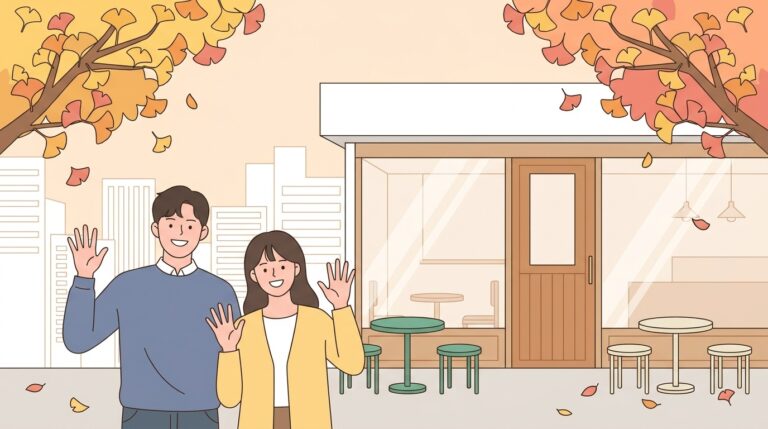
2. The Double-Hand Wave: Rather than one high, aggressive wave, Koreans often wave with two hands near chest height, accompanied by a bright smile.
3. Respect Personal Space: Resist the temptation to go for a tight Western bear hug right away. Unless you are close friends of the same age, keep comfortable personal space.
4-2. Cultural Code Analysis
In Korea, saying “오랜만이에요” triggers an unwritten cultural rule: the 밥 (Bap, Meal) Promise. Within two minutes of reuniting, one of you will naturally say: 우리 밥 한 번 먹어요! (Uri bap han beon meogeoyo!, Let’s share a meal sometime!). In Korean relational culture, sharing food is the ultimate sign of maintaining social connection.
Phase 5: Real-Life Roleplay Scenario
Setting: A sunlit artisan cafe in Yeonnam-dong. You are waiting for your cold brew when Min-woo (민우), a friendly Korean friend you met at a language meetup eight months ago, taps your shoulder.
- Min-woo: 어? 혹시 Sarah 씨 아니에요? (Eo? Hoksi Sarah ssi anieyo?) [🎭 Removing his sunglasses with wide eyes] “Huh? Aren’t you Sarah?”
- You: 민우 씨! 와, 진짜 오랜만이에요! (Min-woo ssi! Wa, jinjja oraenmanieyo!) [🎭 Bowing slightly with an excited two-handed wave] “Min-woo! Wow, it’s really been so long!”
- Min-woo: 맞아요, 벌써 반년 넘었네요! 잘 지냈어요? (Majayo, beolsseo bannyeon neomeotneyo! Jal jinaesseoyo?) [🎭 Chuckling warmly and leaning forward] “Right, it’s already been over half a year! Have you been doing well?”
- You: 네, 덕분에 잘 지냈어요. 민우 씨는요? (Ne, deokbune jal jinaesseoyo. Min-woo ssineunyo?) [🎭 Holding your coffee sleeve and smiling] “Yes, I’ve been well thanks to you. What about you, Min-woo?”
- Min-woo: 저도 새 프로젝트 하느라 바빴어요. 서울에는 언제 왔어요? (Jeodo sae peurojekteu haneura bappasseoyo. Seoureneun eonje wasseoyo?) [🎭 Tilting head attentively] “I’ve been busy with a new project too. When did you arrive in Seoul?”
- You: 저 지난주에 왔어요. (Jeo jinanju-e wasseoyo.) [🎭 Speaking clearly with confident eye contact] “I arrived last week.”
- Min-woo: 정말요? 그럼 우리 이번 주에 꼭 밥 한 번 먹어요! (Jeongmalyo? Geureom uri ibeon jue kkok bap han beon meogeoyo!) [🎭 Pulling out his phone to open KakaoTalk] “Really? Then let’s definitely grab a meal together this week!”
- You: 좋아요! 제가 연락할게요! (Jo-ayo! Jega yeonrakhalgeyo!) [🎭 Nodding enthusiastically with a warm smile] “Sounds awesome! I’ll message you!”
🔀 Interactive Branching Choice
When Min-woo asks you: 잘 지냈어요? (Jal jinaesseoyo?), how do you respond?
- Choice A: “네, 덕분에 잘 지냈어요! 민우 씨는요?” (Ne, deokbune jal jinaesseoyo! Min-woo ssineunyo?)
- Choice B: “응! 오랜만이야! 잘 지냈어!” (Eung! Oraenman-iya! Jal jinaesseo!)
- Choice C: “아니요, 너무 피곤하고 힘들었어요.” (Aniyo, neomu pigonhago himdeureosseoyo.)
Feedback:
* Choice A [Best! 🌟]: Adding 덕분에 (thanks to you / fortunately) sounds exceptionally natural, maintains polite harmony, and bounces the question back to him.
* Choice B [Risk! ⚠️]: Dropping into informal language (banmal) without agreeing on it first can feel abrupt if you previously spoke polite Korean.
* Choice C [Bad! 🛑]: Unloading deep personal stress during an accidental street encounter dampens the celebratory mood of a reunion.
Phase 6: 10-Second Emotion Shadowing Drill
Practice these lines out loud with the pause markers (/) and emotional cues:
[😲 Surprised & Welcoming]
“와! / 진짜 / 오랜만이에요! (Wa! / Jinjja / oraenmanieyo!)”
(Spike pitch on “와!”, pause briefly, stress “진짜”, gently land on “오랜만이에요!”)-
[😊 Warm & Caring]
“그동안 / 잘 지냈어요? (Geudong-an / jal jinaesseoyo?)”
(Soft breath on “그동안”, melodic upward inflection on “요?”) -
[✨ Excited & Sincere]
“우리 / 꼭 / 밥 한 번 먹어요! (Uri / kkok / bap han beon meogeoyo!)”
(Emphasize the promise word “꼭”, finish with an inviting rhythm on “먹어요!”)
Phase 7: K-Culture Mini Dictionary
- 안부 (Anbu) | Inquiring after someone’s peace and health. Native context: When wrapping up a conversation, people say “부모님께 안부 전해주세요” (Send my warm regards to your parents).
- 밥 한 번 먹자 (Bap han beon meokja) | “Let’s eat together sometime.” Native context: A friendly cultural sign-off showing mutual affection, much like “Let’s grab coffee soon.”
- 근황 (Geunhwang) | Recent life updates. Native context: When sitting down after months apart, you say “근황 토크 하자!” (Let’s catch up on life!).
- 반갑다 (Bangapda) | To feel glad to see someone. Native context: The emotional root for “만나서 반가워요” (Nice to meet you) and “반가워요!” (Good to see you!).
Phase 8: Traveler’s Survival Kit
Top 3 Survival Phrases
- 오랜만이에요! (Oraenmanieyo!) – “Long time no see!” (Pro Tip: Say this when returning to a favorite guesthouse or family-run diner in Seoul!)
- 그동안 잘 지내셨어요? (Geudong-an jal jinaesyeosseoyo?) – “Have you been well in the meantime?” (Pro Tip: Use the honorific -syeo- when greeting elders or teachers).
- 또 봬요! (Tto bwaeyo!) – “See you again soon!” (Pro Tip: A polite, modern way to conclude a reunion).
Editor’s Travel Note
When coordinating meetups in Seoul, the most legendary meeting landmarks are Hongdae Station Exit 9 and Gangnam Station Exit 11. To navigate the complex subway exits smoothly, make sure you complete your [Naver Map app download for English navigation] before arriving at the station. Don’t forget to keep your climate card or T-money card topped up!
Phase 9: “One Step Deeper” (Cultural Reflection)
In Western languages, everyday greetings often focus on the present snapshot: “How are you right now?” In Korean culture, relationships are viewed through an ongoing thread of shared history. When you say 오랜만이에요, you are formally honoring the time you spent apart and reaffirming your bond. It signals: “Even though time passed, you were not forgotten.” It turns a simple greeting into a small celebration of reconnecting.
💬 Your Turn: Have you ever unexpectedly bumped into an old friend after months or years apart? How did you break the ice in your native language? Tell me in the comments below!
Phase 10: FAQ & Avoiding Misunderstandings
Q: Can I say 오랜만이에요 to someone I saw just yesterday?
A: No! It specifically denotes a meaningful period of separation—typically several weeks, months, or years. If you saw them yesterday, simply say 안녕하세요! (Annyeonghaseyo!) or 어제 뵙고 또 뵙네요! (Eoje boepgo tto boemneyo!, Good to see you again after yesterday!).
Q: Is 오랜만이에요 polite enough for my university professor or company executive?
A: It is polite, but for figures of high respect, use the formal honorific: 오랜만에 뵙겠습니다 (Oraenmane boepgetseumnida, I am meeting you after a long time) or 오랜만입니다, 교수님 (Oraenmanimnida, gyosunim).
Q: When a Korean friend says “밥 한 번 먹어요”, should I immediately pull out my calendar?
A: Usually, no! While sincere in intent, it is often a warm conversational closer. Smile, reply “좋아요, 연락해요!” (Jo-ayo, yeonrakhaeyo!, Great, let’s text!), and follow up over KakaoTalk later to arrange a concrete time.
🚨 Common Mistakes Alert Board
- ❌ Mistake 1: Using 오랜만입니다 with close friends of the same age. -> Correct Action: Say 오랜만이야! (Oraenman-iya!).
- ❌ Mistake 2: Translating “Good to see you again” word-for-word as 다시 봐서 좋아요. -> Correct Action: Say 다시 만나서 반가워요! or stick to 오랜만이에요!
- ❌ Mistake 3: Saying 오랜만이에요 with a cold, expressionless face. -> Correct Action: Add a bright smile and a gentle nod to communicate genuine joy.
Phase 11: Action Mission & Engagement
- Bronze Level: Say “와, 진짜 오랜만이에요! 잘 지냈어요?” out loud 5 times in front of the mirror with a polite nod.
- Silver Level: Leave a comment below introducing yourself, using today’s phrase in a full sentence.
- Gold Level: Message a Korean friend or language partner on KakaoTalk whom you haven’t spoken to in over a month using: 오랜만이에요! 잘 지냈어요?
- 🎮 K-Culture Mission: Watch any K-Pop idol reunion show or K-Drama episode 1 reunion scene. Spot the first character who says “오랜만이에요” and post their name in the comments!
Phase 12: Interactive Quiz Challenge
1. Situational Judgment:
You run into your former Korean language tutor at an airport after one whole year. What is the most natural and respectful greeting?
A) 안녕! 오랜만이야!
B) 선생님, 진짜 오랜만이에요! 잘 지내셨어요?
C) 어제 만나서 반가웠어요.
2. Fill-in-the-Blank:
A: 수잔 씨, ( )! 벌써 1년 만이네요!
B: 민우 씨! 그동안 잘 지냈어요?
(Hint: The Korean phrase for “Long time no see!”)
3. True or False:
Saying “우리 언제 밥 한 번 먹자!” in Korea always means you have an iron-clad legal commitment to meet this evening. (True / False)
Click here to reveal answers & explanations!
- Answer: B | Adding the honorific title 선생님 (Teacher) and the polite 잘 지내셨어요? shows the ideal blend of warmth and high respect.
- Answer: 오랜만이에요 (Oraenmanieyo) | Perfect fit for an acquaintance you haven’t seen in a year!
- Answer: False | It is an affectionate social gesture affirming your ongoing friendship. Lock down specific dates over KakaoTalk afterward!







