

안녕하세요! 매일한글 에디터입니다. (Annyeonghaseyo! I am your Daily Hangul editor.)
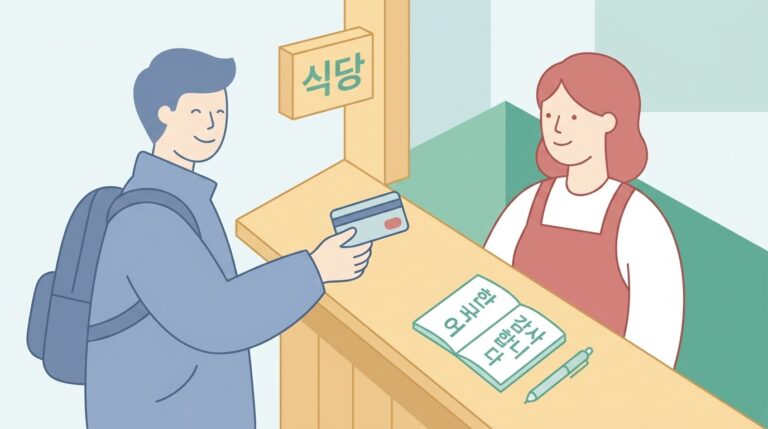
Imagine this classic K-Drama scene: You just finished a piping-hot, sizzling bowl of Kimchi Jjigae at a vibrant, retro diner in the lively alleys of Euljiro, Seoul. The rich aroma is still lingering, you’re happily stuffed, and now you walk up to the counter. You take out your shiny travel credit card, but suddenly, your palms get sweaty. Is this a cash-only traditional spot? Does this little counter terminal accept foreign cards? How do you ask without sounding rude or causing a line to pile up behind you?
So many of our Daily Hangul learners tell us that paying at a restaurant is their number one anxiety trigger in Korea. But here is the good news: South Korea is one of the most card-friendly countries on the planet! From taxis to tiny street cafes, cards are welcome almost everywhere. All you need is one single, magical phrase to glide through checkout like a seasoned local. Today, we will master that exact sentence and unlock the cultural confidence you need at any Korean checkout counter.
Phase 2: Top 3 Essential Expressions for Paying
1. 카드 돼요? (Kadeu dwaeyo?)
- Pronunciation: [Kadeu dwae-yo?] (Sound analogy: Think of saying ‘car-duh’ like a toy car, followed by ‘dway-yo’ like ‘sway’ with a D).
- Meaning: Literal: “Does card work?” | Actual Nuance: “Can I pay with a card?” or “Do you accept cards?”
- K-Culture Moment: You hear this constantly in street-food stalls, pop-up stores in Seongsu-dong, or cozy local tteokbokki joints.
- Editor’s Insight: In English, we often say full sentences like “Excuse me, would it be possible for me to use my credit card?” In Korean, shorter is sweeter! Adding -요 (-yo) at the end ensures you are totally polite and respectful.
- Situation Spectrum:
- Casual (Friends): 🚫 카드 돼? (Kadeu dwae?)
- Semi-formal (Everyday polite – restaurants, cafes): ✅ 카드 돼요? (Kadeu dwaeyo?)
- Formal (High-end hotel or formal business): ⚠️ 카드 결제 되나요? (Kadeu gyeolje doenayo?)
- 🤔 Think About It: Notice how Korean drops the subject “I” or “you” completely. Why do you think Korean communication focuses on the action/result rather than who is performing it?
2. 계산해 주세요 (Gyesanhae juseyo)
- Pronunciation: [Gye-san-hae ju-se-yo] (Sound analogy: ‘Gye’ rhymes with ‘get’ + ‘sahn’ like ‘sauna’ + ‘hae’ like ‘head’ without d + ‘joo-say-yo’).
- Meaning: Literal: “Please calculate for me.” | Actual Nuance: “Check, please!” or “I’d like to pay, please.”
- K-Culture Moment: When the group finishes dinner in a K-drama and someone coolly stands up, walks to the counter, and hands over their black card saying this line.
- Editor’s Insight: Use this when the staff is busy wiping tables or looking down. It politely signals, “I am ready to settle the bill!”
- Situation Spectrum:
- Casual: 🚫 계산해 줘 (Gyesanhae jwo)
- Semi-formal: ✅ 계산해 주세요 (Gyesanhae juseyo)
- Formal: ✅ 계산 부탁드립니다 (Gyesan butakdeurimnida)
- 🤔 Think About It: In English, you ask for the “bill” or “check” (a noun), but in Korean, you ask to “calculate” (a verb). How does this change the way you view the transaction?
3. 영수증 버려주세요 (Yeongsujeung beoryeojuseyo)
- Pronunciation: [Yeong-su-jeung beo-ryeo-ju-se-yo] (Sound analogy: ‘Young’ + ‘soo’ + ‘jung’ + ‘buh-ryuh’ + ‘joo-say-yo’).
- Meaning: Literal: “Please throw away the receipt.” | Actual Nuance: “No receipt needed, thank you!”
- K-Culture Moment: After tapping the card, cashiers almost always ask, “영수증 드릴까요? (Shall I give you the receipt?)” Locals will wave a hand gently and drop this phrase.
- Editor’s Insight: Eco-friendly and fast! Most people check banking apps, so paper receipts are often tossed right away.
- Situation Spectrum:
- Casual: 🚫 영수증 버려줘 (Yeongsujeung beoryeojwo)
- Semi-formal: ✅ 영수증 버려주세요 (Yeongsujeung beoryeojuseyo) / 괜찮아요 (Gwaenchanhayo – It’s okay)
- Formal: ✅ 영수증은 안 주셔도 됩니다 (Yeongsujeungeun an jusyeodo doemnida)
- 🤔 Think About It: Asking someone to throw something away for you might sound direct in some Western languages, but in Korean service culture, it is considered helpful and time-saving for both sides!
Phase 3: Textbook Korean vs. Real Korean
Situation 1: Asking if card payment is possible
- 📖 교과서 한국어 (Textbook Korean): 신용카드로 결제할 수 있습니까? (Sinyongkadeuro gyeoljehal su itseumnikka?)
- 🗣️ 진짜 한국어 (Real Korean): 카드 돼요? (Kadeu dwaeyo?)
- 💡 Why is it different?: Textbooks love ultra-formal vocabulary like 신용카드 (credit card) and 결제 (settlement/payment). But in daily life, Koreans love efficiency. 카드 (Card) and 돼요 (Does it work?) does the whole job in 3 syllables!
Situation 2: Asking for the total amount
- 📖 교과서 한국어 (Textbook Korean): 총금액이 얼마입니까? (Chonggeumaegi eolmaimnikka?)
- 🗣️ 진짜 한국어 (Real Korean): 얼마예요? (Eolmayeyo?)
- 💡 Why is it different?: Unless you are closing a corporate merger, nobody says “총금액 (total amount)” at a neighborhood diner. 얼마예요? is natural, warm, and understood everywhere.
Phase 4: K-Culture Deep Dive & Non-Verbal Manners
4-1. 눈치 (Nunchi) & Polite Card Gestures
Paying in Korea is an art of mutual respect. When paying with a card:
1. The Two-Hand Rule: Always hand your credit card to the cashier using both hands, or support your right wrist/forearm lightly with your left hand. Doing this with one hand can look dismissive!
2. Look for the Terminal: In Korea, many modern spots have customer-facing card readers. Instead of handing your card over, the cashier might point to the terminal. Simply tap your card or insert the IC chip into the slot facing downward.
3. The Micro-Bow: When the cashier hands your card back with both hands, offer a gentle head nod (a micro-bow) and say, “감사합니다 (Gamsahamnida – Thank you).”
4-2. Cultural Code Analysis: The Near-Cashless Republic
Did you know that South Korea has one of the highest credit card usage rates in the world? Over 90% of transactions are cashless! Even humble street stalls at night markets often display payment QR codes or have mini card readers plugged into smartphones. Carrying a thick wallet of bills is rare among locals. However, keeping a 10,000 KRW bill in your pocket is still handy for subway ticket recharges or small seasonal snack stalls like Bungeoppang (fish-shaped pastry) carts in winter.
Phase 5: Real-Life Roleplay Scenario
Setting: A cozy Kimchi stew restaurant in Hongdae during lunchtime.
Characters:
* You (Hungry traveler ready to pay)
* Imo-nim (이모님): Warm, lively middle-aged restaurant owner wearing an apron.
- Turn 1 (You): 🎭 Walking up to the counter near the entrance with your card ready.
저기요, 계산해 주세요! (Jeogiyo, gyesanhae juseyo! / Excuse me, check please!) - Turn 2 (Imo-nim): 🎭 Smiling brightly while wiping her hands on a towel.
네~ 맛있게 드셨어요? (Ne~ masitge deusyeosseoyo? / Yes! Did you enjoy your meal?) - Turn 3 (You): 🎭 Nodding enthusiastically.
네, 정말 맛있었어요! (Ne, jeongmal masisseosseoyo! / Yes, it was really delicious!) - Turn 4 (Imo-nim): 🎭 Tapping on the POS screen.
김치찌개 하나 해서, 9,000원이에요. (Kimchijjigae hana haeseo, guchonwon-ieyo. / One Kimchi stew, that comes to 9,000 won.) - Turn 5 (You): 🎭 Holding up your card with both hands gently.
혹시 카드 돼요? (Hoksi kadeu dwaeyo? / By any chance, can I pay by card?) - Turn 6 (Imo-nim): 🎭 Pointing cheerfully to the IC card slot on the countertop machine.
당연하죠! 여기에 꽂아주세요. (Dang-yeonhajyo! Yeogie kkojajuseyo. / Of course! Please insert it right here.) - Turn 7 (You): 🎭 Inserting the card and waiting for the beep.
영수증은 버려주세요! (Yeongsujeungeun beoryeojuseyo! / You can toss the receipt!) - Turn 8 (Imo-nim): 🎭 Handing the card back with both hands and a beaming smile.
네, 안녕히 가세요! 또 와요! (Ne, annyeonghi gaseyo! Tto wayo! / Sure, goodbye! Come again!)
🔀 Interactive Branching Point
When the owner says the total is 9,000 won, how will you respond?
* Choice A: Hand over your card with one hand while looking at your phone and say: “여기 (Yeogi).”
* Choice B: Present your card with two hands and ask: “카드 돼요? (Kadeu dwaeyo?)”
* Choice C: Throw down a 50,000 won bill and say nothing.
Feedback:
* Choice A (Bad 🚫): Handing an item with one hand and saying the informal “여기” can come across as rude or disrespectful to elders.
* Choice B (Best ✅): Perfect polite manners! Two hands plus the standard polite expression will earn you genuine smiles from any restaurant owner.
* Choice C (Risk ⚠️): While accepted, giving large bills without a word misses out on great polite communication, and small diners may struggle for change during peak rush.
Phase 6: 10-Second Emotion Shadowing Drill
Practice reading these out loud, pausing at the slash (/) and matching the emotional mood:
[😊 Bright & Friendly]
저기요! / 계산해 주세요!
(Jeogiyo! / Gyesanhae juseyo! / Excuse me! / Check, please!)-
[🤔 Slightly Curious & Polite]
저… / 혹시 / 카드 돼요?
(Jeo… / hoksi / kadeu dwaeyo? / Um… / by any chance / does card work?) -
[👋 Easygoing & Cheerful]
감사합니다! / 영수증은 버려주세요!
(Gamsahamnida! / Yeongsujeungeun beoryeojuseyo! / Thank you! / Please throw away the receipt!)
Phase 7: K-Culture Mini Dictionary
- 카드 (Kadeu) | Credit/Debit Card
- Usage: Short for 신용카드 (credit card) or 체크카드 (debit card). The universal word used at all POS counters.
- 현금 (Hyeongeum) | Cash
- Usage: Used when asking “현금 결제 (cash payment)” or if you want to ask “현금만 돼요? (Cash only?)”.
- 영수증 (Yeongsujeung) | Receipt
- Usage: Useful for tax refunds, expense reporting, or simple verification after big purchases.
- 사장님 (Sajangnim) / 이모님 (Imonim) | Boss/Owner or Friendly Auntie
- Usage: Call male or general business owners “사장님”. At cozy, traditional diners run by warm maternal figures, calling the cook/owner “이모님” immediately builds instant warmth and connection!
Phase 8: Traveler Survival Kit
Survival Top 3 Phrases
- 얼마예요? (Eolmayeyo?) – How much is it?
- Pro Tip: Point at the menu item while saying this if you can’t read the Korean price digits yet.
- 따로 계산해 주세요. (Ttaro gyesanhae juseyo.) – Please split the bill / calculate separately.
- Pro Tip: Very useful when traveling with friends who want to pay with their own cards.
- 이거 결제 안 돼요. (Igeo gyeolje an dwaeyo.) – This payment isn’t going through.
- Pro Tip: If your foreign card has a chip reading error, you might hear the clerk say this. Try offering another card or cash.
Editor’s Travel Note
- Essential Navigation: Always carry a navigation tool with accurate English map layers; check out the Naver Map app download to find restaurants that display card acceptance and reviews.
- Foreign Cards: Visa and Mastercard are widely accepted in Korea. However, foreign cards sometimes require a physical swipe rather than contactless tap. If your Apple Pay or contactless card fails, just insert the physical chip directly into the terminal.
Phase 9: One Step Deeper
In Western dining culture, it is common to split every cent individually at the table or wait for a server to bring a leather folder with the bill. In South Korea, however, dining is traditionally seen as a communal sharing experience. You almost always walk up to the front counter to pay, rather than paying at the dining table. Furthermore, while the younger generation frequently practices “더치페이 (Dutch pay)”, it is still very common for friends or coworkers to fight lovingly over who gets to pay the entire bill for the table! When it is your turn to treat, stepping up first and saying “제가 낼게요! (Jega naelgeyo! – I will pay!)” is considered a peak sign of affection and camaraderie.
💬 Your Turn: In your home country, is it customary to pay at the table or walk up to the counter? Have you ever had an awkward payment moment abroad? Share with us below!
Phase 10: FAQ & Common Mistakes
Q: Can I use Apple Pay or Google Pay in Korean restaurants?
A: Apple Pay is increasingly supported (especially at convenience stores, franchises, and cafes with modern terminals), but many smaller independent restaurants still only accept physical chip cards or Samsung Pay. It is always safest to carry a physical credit card.
Q: Do people leave tips in Korean restaurants?
A: No! Tipping does not exist in South Korea. The price on the menu includes tax and service. Leaving extra cash on the table will often cause the kind waiter to run after you into the street to return the money you “forgot”!
Q: What should I say if I need a receipt for business?
A: Simply say: “영수증 주세요 (Yeongsujeung juseyo – Receipt, please).”
🚨 Common Mistakes Board
- Mistake 1: Leaving money or the card on the counter for the cashier to pick up.
- Correct Action: Hand the card directly into the cashier’s hands or place it neatly on the small tray if provided.
- Mistake 2: Waiting at the dining table for 15 minutes waiting for the server to bring the check.
- Correct Action: Grab the bill slip on your table (or remember your table number) and walk to the payment counter near the exit.
- Mistake 3: Using informal “돼? (Dwae?)” with an elderly restaurant owner.
- Correct Action: Always keep the “-요 (-yo)” intact! Say “카드 돼요? (Kadeu dwaeyo?)”.
Phase 11: Action Missions
- 🥉 Bronze Mission (Solo Practice): Stand in front of your mirror with a credit card. Hand it out using both hands and say clearly 3 times: “카드 돼요? (Kadeu dwaeyo?)”.
- 🥈 Silver Mission (Community Sharing): Comment below with your favorite Korean dish you plan to order and pay for on your next trip to Seoul!
- 🥇 Gold Mission (Real-life Execution): Next time you visit a local Korean grocery store or restaurant, ask the staff “카드 돼요?” before paying!
- 🎮 K-Culture Mission: Watch an episode of your favorite slice-of-life K-Drama (like Hospital Playlist or Weightlifting Fairy Kim Bok-joo). Spot the exact moment the characters pay at the counter and notice their hand gestures!
Phase 12: Interactive Quiz Challenge
1. Situational Judgment
You are at a street food market stall. You want to ask if credit cards are accepted. Which phrase is the most natural and polite?
* A) 카드 되냐? (Kadeu doenya?)
* B) 카드 돼요? (Kadeu dwaeyo?)
* C) 돈 받으세요. (Don badeuseyo.)
Click to reveal answer
Correct Answer: B) 카드 돼요? (Kadeu dwaeyo?)
Explanation: Option A is impolite and blunt. Option C means ‘Take money.’ Option B is the ideal, friendly, polite expression for A1 beginners!
2. Fill in the Blank
When you don’t need a paper receipt, you tell the cashier:
“영수증은 ________ 주세요! (Please throw away the receipt!)”
Click to reveal answer
Correct Answer: 버려 (beoryeo)
Full sentence: 영수증은 버려주세요! (Yeongsujeungeun beoryeojuseyo!)
3. True / False Cultural Check
True or False? In South Korea, you should leave a 10% cash tip on the table after finishing your dinner.
Click to reveal answer
Correct Answer: False!
Explanation: There is zero tipping culture in Korea. All service charges are already built into the bill.







