

안녕하세요! 매일한글 에디터입니다.
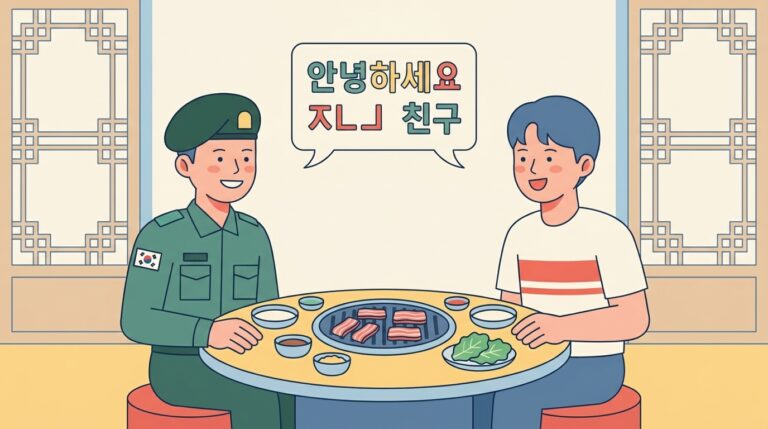
Imagine this: you are walking through the buzzing streets of Hongdae or Gangnam on a crisp Friday afternoon when you spot your Korean friend. But wait—his styled hair is gone, replaced by a neat buzzcut (bamtol meori), and he’s wearing an immaculate camouflage uniform with a black beret tucked under his shoulder epaulet. His eyes are wide as if he just stepped out of a time capsule, taking in the city lights, the smell of sizzling pork belly, and the freedom of civilian air. He is on military leave (hyuga).
If you have Korean male friends or follow K-Pop and K-Dramas, dealing with mandatory military service (gun-dae) is inevitable. Yet many foreign learners find themselves completely frozen in this situation. Should you ask about his weapon? Do you salute him? And why do Koreans suddenly get into fierce arguments at the restaurant cash register over who gets to pay?
Caring for a friend on military leave is one of the deepest bonding experiences in Korean social culture. Today, we will break down the essential phrases, psychological nuances, and unspoken etiquette so you can support your soldier friend like a true insider. Let’s dive in!
1. 고생이 많다 / 고생 많았어 (Gosaeng-i manta / Gosaeng manasseo)
- Pronunciation: [Go-saeng-i man-ta] (Rhymes roughly with “go-sang” like singing on the go, and “man-tah”).
- Meaning: Literal: “There is much hardship.” / Actual Nuance: “You are going through so much; I deeply recognize your toil and sacrifice.”
- K-Culture Moment: In the Netflix hit series D.P., soldiers often look worn down, and when a civilian simply looks them in the eyes and says, “고생 많으십니다” (Gosaeng maneusimnida), their shoulders visibly relax. It is the ultimate antidote to burnout.
- Editor’s Insight: In Western cultures, we often say “Thank you for your service.” While Koreans do say this to veterans, in personal peer relationships, acknowledging their hardship (gosaeng) hits far deeper emotionally. It shows you understand that military service is not merely a job, but a rigorous duty.
- Situation Spectrum:
- Casual (Friends): 고생 많았어! (Gosaeng manasseo!) ✅
- Semi-formal (Acquaintance): 고생 많으세요. (Gosaeng maneuseyo.) ✅
- Formal (Official): 고생이 많으십니다. (Gosaeng-i maneusimnida.) ✅
- 🤔 Think About It: Does your culture focus on thanking the service member for the collective benefit, or sympathizing with their personal struggle? How does this shift your approach to conversation?
2. 먹고 싶은 거 다 골라, 내가 살게 (Meokgo sipeun geo da golla, naega salge)
- Pronunciation: [Meok-go si-peun geo da gol-la, nae-ga sal-ge] (Sound analogy: “Muck-go see-poon go dah goal-lah, nay-gah sahl-geh”).
- Meaning: Literal: “Pick anything you want to eat; I will buy it.” / Actual Nuance: “You’ve been trapped on military rations for months; consider this meal your freedom feast on my dime.”
- K-Culture Moment: You see this constantly on Korean variety shows and YouTube vlogs: whenever a soldier friend meets up with college buddies, the menu is immediately handed over with this exact phrase, followed by an avalanche of fried chicken and barbecue.
- Editor’s Insight: In Korean society, there is an unwritten law: “A civilian never lets an active soldier pay.” Trying to split the bill (Dutch pay) with a soldier on leave is considered a major social faux pas. Even older siblings or younger friends will pull out their cards proudly.
- Situation Spectrum:
- Casual (Close friends): 먹고 싶은 거 다 골라, 내가 쏠게! (Meokgo sipeun geo da golla, naega ssolge!) ✅
- Semi-formal: 맛있는 거 사 드릴게요. (Masinneun geo sa deurilgeyo.) ✅
- Formal: 식사는 제가 대접하겠습니다. (Siksaneun jega daejeop-hagessumnida.) ⚠️ (A bit too stiff for a casual meal)
- 🤔 Think About It: How does food sharing in Korea act as an emotional currency of solidarity?
3. 시간 진짜 안 가지? (Sigan jinjja an gaji?)
- Pronunciation: [Si-gan jin-jja an ga-ji?] (Sound analogy: “See-gahn jeen-jjah ahn gah-jee?”).
- Meaning: Literal: “Time really doesn’t go, right?” / Actual Nuance: “It feels like an eternity in there, doesn’t it? I totally sympathize with your boredom and waiting.”
- K-Culture Moment: Whenever celebrity idols talk about their enlistment on talk shows, interviewers sigh and ask this question. The famous military proverb in Korea goes: “The military clock only moves backwards.”
- Editor’s Insight: Avoid saying “Wow, your service is flying by!” to a soldier. While it feels fast for civilians outside, every minute inside the military fence ticks at snail speed. Asking “시간 진짜 안 가지?” shows you have high emotional intelligence (nunchi).
- Situation Spectrum:
- Casual: 시간 진짜 안 가지? (Sigan jinjja an gaji?) ✅
- Semi-formal: 시간 참 안 가죠? (Sigan cham an gajyo?) ✅
- Formal: 시간이 더디게 느껴지시지요? (Sigani deodige neukkyeojisijiyo?) 🚫 (Unnatural; stick to semi-formal)
- 🤔 Think About It: Why is subjective time perception such an important point of empathy between insiders and outsiders in high-stress environments?
Situation 1: Asking how the military life is
- 📖 교과서 한국어 (Textbook): 군대 생활이 힘듭니까? (Gundae saenghwari himdeumnikka? – “Is your military life difficult?”)
- 🗣️ 진짜 한국어 (Real-world Native): 군대 있을 만해? 요즘 할 만해? (Gundae isseul manhae? Yojeum hal manhae? – “Is military life bearable? Hanging in there these days?”)
- 💡 왜 다를까?: The textbook version sounds like a formal military inspection interview. Real natives use the auxiliary construction
-을 만하다(to be bearable / worth doing) because asking directly “is it hard?” feels blunt, while “할 만해?” gives them room to comfortably vent or shrug it off.
Situation 2: Encouraging them to eat a feast
- 📖 교과서 한국어 (Textbook): 음식을 많이 드십시오. (Eumsigeul mani deusipsio. – “Please eat a lot of food.”)
- 🗣️ 진짜 한국어 (Real-world Native): 오늘 배 터질 때까지 먹어! (Oneul bae teojil ttaekkaji meogeo! – “Eat until your stomach bursts today!”)
- 💡 왜 다를까?: Military mess hall food (jjambap), while improved, is strictly regimented. When dining out on leave, Koreans celebrate civilian culinary freedom with affectionate, hyper-expressive slang like
배 터지다(stomach explodes).
4-1. 눈치 (Nunchi) & Non-Verbal Manners
- The Wallet Duel: When the check arrives at the restaurant or cafe, don’t politely debate. Swiftly step in front of him, hand your card to the clerk, and say, “넌 가만히 있어” (You stay put). Forcing him to pay even 1,000 KRW causes him social discomfort because everyone in the room knows he’s an underpaid conscript.
- Avoid the Dreaded Return Talk: Never bring up his impending return date (bokgwi) on the very first day of leave. Reminding a soldier that he has to go back to base ruins the fleeting joy of civilian freedom. Let him bring it up first.
- Physical Space and Posture: Notice how your friend might look slightly jumpy at sudden loud noises or instinctively sit with his hands on his knees (gak-japgi). Don’t make fun of it—laugh gently and say, “긴장 풀어! 사회잖아” (Relax! You’re in civilian society now).
4-2. Cultural Codes: The Sacred Menu of Military Leave
Why do soldiers crave fast food, thick hamburgers, or sizzling samgyeopsal over delicate fine dining? On base, meals are balanced and portioned, but hot, greasy comfort food is hard to replicate. Taking your friend to a bustling Korean BBQ grill or a popular burger joint where they can eat without standing at attention is the highest form of hospitality.
Setting: A vibrant samgyeopsal restaurant in Hongdae. You are meeting your college classmate Min-jun (민준), who is out on his first official 4-day military leave (ilbyeong jeonggi hyuga).
- 민준 (Min-jun): (짧은 머리를 긁적이며 어색하게 앉는다) 야, 오랜만이다! 나 군복 입고 나와서 좀 튀지 않냐?
(Jjjalbeun meorireul geukjeogimyeo eosaekhage anneunda) Ya, oraenmanida! Na gunbok ipgo nawaseo jom twiji annya?
🎭 Scratching his buzzed hair and sitting somewhat rigidly “Hey, long time no see! Don’t I stand out too much wearing this uniform?” -
You: 전혀 안 이상해! 멋있기만 한데 뭐. 여기까지 오느라 고생 많았어.
Jeonhyeo an isanghae! Meositgiman hande mwo. Yeogikkaji oneura gosaeng manasseo.
🎭 Smiling warmly and pulling out the chair opposite you “Not strange at all! You look dashing. You worked so hard to get here!” -
민준 (Min-jun): 하하, 고맙다. 밖의 공기 마시니까 이제야 좀 실감 나네.
Haha, gomapda. Bakkeui gonggi masinikka ijeya jom silgam nane.
🎭 Taking a deep breath of relief “Haha, thanks. Breathing outside air makes it finally feel real.” -
You: 부대에서는 요즘 어때? 생활관 생활 할 만해?
Budaeesoneun yojeum eottae? Saenghwalgwan saenghwal hal manhae?
🎭 Handing him a glass of ice water “How is it on base these days? Is barracks life bearable?” -
민준 (Min-jun): 어휴, 선임들 눈치 보느라 정신없지. 시간도 더럽게 안 가고.
Eohyu, seonimdeul nunchi boneura jeongsineopji. Sigando deoreopge an gago.
🎭 Sighing dramatically with a grin “Ugh, keeping up with seniors is hectic. And time ticks disgustingly slow.” -
You: 시간 진짜 안 가지? 그래도 벌써 일병 꺾였잖아. 오늘 먹고 싶은 거 다 골라, 내가 살게!
Sigan jinjja an gaji? Geuraedo beolsseo ilbyeong kkeokkyeotjana. Oneul meokgo sipeun geo da golla, naega salge!
🎭 Handing him the whole menu enthusiastically “Time drags, right? Still, you’re already past the midpoint of Private First Class. Pick whatever you want today, it’s on me!” -
민준 (Min-jun): 진짜? 나 그럼 삼겹살 3인분에 된장찌개까지 다 시켜도 돼?
Jinjja? Na geureom samgyeopsal sam-inbune doenjangjjigaekkaji da sikyeodo dwae?
🎭 Eyes lighting up like a child at a toy store “Really? Can I order 3 portions of pork belly and soybean stew as well?” -
You: 당연하지! 오늘 배 터질 때까지 먹어. 사이다도 시켜줄게.
Dangyeonhaji! Oneul bae teojil ttaekkaji meogeo. Saidado sikyeojulge.
🎭 Calling the waiter with confidence “Of course! Eat until your stomach pops today. I’ll get you a soda too.”
🔀 Interactive Branching Point: When the check comes…
Min-jun reflexively pulls out his battered military check card to split the 52,000 KRW bill. What do you do?
- Option A: “야, 군인이 무슨 돈이 있어? 지갑 집어넣어, 내가 낸다니까.” (Hey, how does a soldier have money? Put that wallet away, I told you I’m paying.)
- 👉 Feedback (Best!): Perfect! It’s blunt, warm, and saves his pride while staying true to Korean etiquette.
- Option B: “그래, 고마워! 반반씩 26,000원씩 보낼래?” (Okay, thanks! Want to split it 26,000 KRW each?)
- 👉 Feedback (Bad): A massive cultural miss! Even if he offered out of politeness, taking money from a soldier on leave will leave a bitter aftertaste.
- Option C: “군인 할인 카드로 결제하고 내가 나중에 현금 줄게.” (Pay with your military discount card and I’ll give you cash later.)
- 👉 Feedback (Risk): Pragmatic, but ruins the warmth of the gesture unless it’s a massive amusement park ticket where military discounts save tens of thousands of won.
Repeat each sentence out loud. Mind the pause slashes (/) and embody the indicated emotion!
[🥺 따뜻하고 진심 어린 위로]
“부대에서 / 고생 많았지? / 얼굴 보니까 / 너무 좋다!”
(Budaeeso / gosaeng manatji? / Eolgul bonikka / neomu jota!)
(You worked so hard in the military, right? It’s so great to see your face!)-
[😎 쿨하고 당당하게 지갑 꺼내며]
“지갑 넣어둬! / 오늘은 / 내가 다 쏠 테니까 / 먹기나 해.”
(Jigap neoeodwo! / Oneureun / naega da ssol tenikka / meokgina hae.)
(Put your wallet away! I’m treating today, so just eat up.) -
[🤝 장난스럽지만 깊은 공감을 담아]
“국방부 시계는 / 거꾸로 매달아도 / 돌아간대. / 힘내자!”
(Gukbangbu sigyeneun / geokkuro maedarado / doragandaee. / Himnaeja!)
(They say even if you hang the Ministry of National Defense clock upside down, it still ticks. Hang in there!)
- 휴가 (Hyuga): Military leave or furlough. Soldiers usually get several categories: regular leave (jeonggi hyuga), reward leave for great performance (posang hyuga), and consolatory leave (wiro hyuga).
- 복귀 (Bokgwi): Returning to the military base. On the last day of leave, soldiers must report back to base usually before 8:00 PM or 9:00 PM. Mentioning this word makes any soldier shiver.
- 짬밥 (Jjambap): Military rations/meals. Figuratively used in Korean society to describe seniority and years of experience at a company (e.g., “내가 회사 짬밥이 몇 년인데!” – How many years of corporate ‘jjambap’ do you think I have?!).
- 군바리 (Gunbari): An old slang term for a soldier. Caution: While older generations used it casually, active soldiers today find it slightly derogatory or dismissive. Use 군인 (Gun-in) or 군인 친구 (Gun-in chingu) instead!
Survival Phrases TOP 3
- 충성! (Chungseong!)
Pro Tip: The standard army salute greeting meaning “Loyalty!”. Don’t salute random soldiers on the street, but if you’re greeting a close friend jokingly as an icebreaker, doing a mock salute will make him crack up. - 몸 건강히 다치지 말고! (Mom geonganghi dachiji malgo!)
Pro Tip: The golden parting blessing. When saying goodbye as he heads back to base, this matters ten times more than “have fun”. Safety is every soldier’s top priority. - 군인 할인 되나요? (Gun-in harin doenayo?)
Pro Tip: “Is there a military discount?” Many movie theaters (like CGV, Megabox), theme parks, and cafes offer 10%–30% discounts for uniform-wearing soldiers.
Editor’s Travel Note
- If you are traveling between Seoul and provincial army training centers (like Nonsan, Chuncheon, or Wonju), download the 코레일톡 앱 (KorailTalk App) in advance. Trains are frequently packed on Friday mornings and Sunday evenings with soldiers traveling back and forth.
- When navigating transit stations with your soldier friend, use the 네이버 지도 길찾기 서비스 (Naver Map Transit Guide) to calculate exact arrival times; being late for bokgwi (base return) results in disciplinary action (cheolchang or lost leave days), so punctuality is life!
In South Korea, where nearly every able-bodied adult male completes approximately 18 to 21 months of service, the military is not viewed as a distinct career choice, but as a shared societal rite of passage. This collective experience generates an invisible safety net of mutual empathy. When an elderly shopkeeper slips two extra pieces of fried chicken into a soldier’s bag, or when a college senior pays for a junior soldier’s lunch without a word, it represents a community paying down a collective debt of gratitude. Language here is more than grammar; it is an embrace.
💬 Your Turn: Does your home country have mandatory enlistment or a unique ritual for friends in service? If you had a friend on leave, what is the first meal you’d treat them to? Share in the comments below!
Q: Is it okay to ask a Korean soldier about firearms or tactical training?
A: It’s best to avoid intense questions about weapons, tactical defense, or war scenarios. Keep the conversation focused on their daily human routine: food, friends, sleep, funny stories about their barracks mates, and what TV shows they miss watching.
Q: Why do Korean soldiers wear their full uniforms on the subway or streets?
A: By military regulation, soldiers leaving or returning to base must remain in complete uniform (including their beret or cap) until they reach private quarters or their homes. They cannot loosen their ties, walk with hands in pockets, or unbutton jackets in public view.
Q: What is the best small gift to send to a friend in the military?
A: Skincare products (especially soothing snail mucin cream, all-in-one lotions, and SPF sticks that don’t grease up under helmet straps), padded boot insoles (kkalchang), and handwritten letters (sont-pyeonji) are cherished treasures.
🚨 흔한 실수 (Common Mistakes) 경고판
- Mistake: Teasing their shaved head by rubbing it roughly.
Correct Action: Acknowledge it gently with a warm smile: “머리 짧아도 잘 어울려!” (The short hair suits you well!). Hair loss/buzzcuts can be a sensitive aesthetic shock. - Mistake: Offering an alcoholic drink when they have to return to base within hours.
Correct Action: Military bases perform breathalyzer tests upon return. Alcohol on the final day before check-in can land them in military detention. Stick to coffee, soda, or bubble tea on the day of bokgwi. - Mistake: Complaining about how busy your university or work life is compared to their “free time”.
Correct Action: Never minimize their isolation. Simply listen and validate their stories.
- 🥉 Bronze Level: Practice saying “고생 많았어, 오늘 먹고 싶은 거 다 골라!” aloud three times in front of the mirror with a bright, welcoming gesture.
- 🥈 Silver Level: Find a K-Pop idol who is currently enlisted or recently discharged (e.g., BTS, EXO, or actors) and write an encouraging comment on their official community platform in Korean using “몸 건강히 다치지 말고 파이팅!”.
- 🥇 Gold Level: Next time you see a soldier ordering ahead of you at a convenience store or bakery, politely say “고생이 많으십니다!” with a slight bow.
🎮 K-Culture Mission: Watch Episode 1 of the drama Crash Landing on You or D.P., spot one instance where a soldier talks about food or leave (hyuga), and note down the exact phrase they use!
Q1. Situational Judgment
Your friend Hyun-woo is on his 3rd day of leave. You are at a trendy cafe and he offers to pay for your iced Americano using his cash card. What is the most culturally adept response?
* A) “고마워, 다음에는 내가 살게!” (Thanks, I’ll buy next time!)
* B) “야, 됐어! 군인이 무슨 돈을 써. 내가 살 테니까 앉아 있어.” (Hey, stop! Why would a soldier spend money? I’ll buy, go have a seat.)
* C) “현금영수증 해줄 테니까 네 카드로 긁어.” (Swipe your card and I’ll get a cash receipt.)
Q2. Fill in the Blank
Complete the sentence of heartfelt encouragement for a soldier heading back:
“부대 들어가서도 아프지 말고, 몸 [ ______ ] 잘 다녀와!”
Q3. True or False
In Korean society, it is polite to split the bill (Dutch pay) 50/50 with an active military conscript on leave so they don’t feel indebted to you. (True / False)
👉 Click here to reveal the answers and explanations!
- Q1 Answer: B — A civilian proudly buying food or drinks for a soldier on leave is the standard etiquette. Taking their money is frowned upon!
- Q2 Answer: 건강히 (geonganghi – healthily) — The fixed expression is “몸 건강히 잘 다녀와!” (Stay healthy and come back safe!).
- Q3 Answer: False — Never split the bill with an enlisted soldier on leave. Treating them fully is a sign of solidarity and appreciation for their mandatory service.







