

Phase 1: Empathy
안녕하세요! 매일한글 에디터입니다.
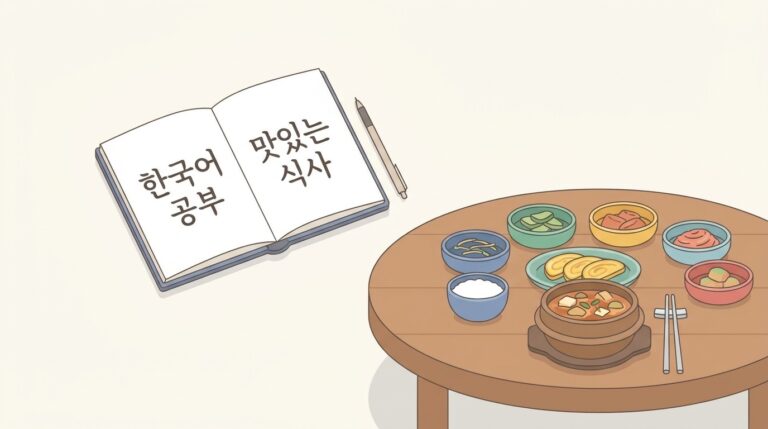
Picture this: you sit down at a vibrant restaurant in Seoul, stomach growling, and order a bowl of fiery Kimchi-jjigae (김치찌개). Before your main pot even begins to simmer, the server lays down five, seven, maybe nine miniature ceramic dishes. There is glistening seasoned spinach, crisp yellow pickled radish, fermented beans, and translucent marinated fish cakes. If you are like most international foodies, your Western dining instincts kick in: “Ah, delicious appetizers!” You grab your chopsticks, polish off the pickled radish, devour the mashed potato salad, and finish the kimchi. But then, your boiling stew arrives. You take a spicy, steaming spoonful, reach for a refreshing counterpoint, and realize… your small plates are totally bare.
Treating banchan (반찬 – side dishes) as separate starters is one of the most common cultural hurdles intermediate Korean learners face. In Korea, a meal is never a solo performance; it is a meticulously tuned culinary orchestra. Banchan are designed to dance in tandem with the main dish—cooling down intense heat, cutting through rich pork fat, and amplifying subtle umami notes. Based on feedback from over 500 intermediate learners in our Daily Hangul community, mastering the art and language of banchan pairings (궁합 – gunghap) will transform you from a confused tourist into a confident, revered dining companion. Let’s explore how to talk about, appreciate, and curate the perfect Korean bite!
Phase 2: Deep Dive into 3 Key Expressions
1. 이 반찬이랑 같이 드셔 보세요. (I banchan-irang gachi deusyeo boseoyo.)
- Pronunciation: I ban-chan-i-rang ga-chi deu-syeo bo-se-yo (Think of the “eu” in deu like the relaxed “u” sound in “put”, flowing smoothly into syeo like “sure”).
- Meaning: Literal: “Please try eating (it) together with this side dish.” | Nuance: A warm, hospitable recommendation encouraging someone to experience a flavor synergy.
- K-Culture Moment: You will hear this constantly on gourmet K-dramas like Let’s Eat (식샤를 합시다) or variety shows like Baek Jong-won’s Alley Restaurant, where local culinary masters teach guests how a specific salty leaf cuts through greasy pork belly.
- Editor’s Insight: Notice the honorific verb 드시다 (deusida – to eat). Using 드셔 보세요 instead of the casual 먹어 봐요 (meogeo bwayo) shows sophisticated intermediate polish and cultural politeness toward your dining partner.
- Situation Spectrum: Casual (⚠️ – use 같이 먹어봐 with close friends) | Semi-formal (✅) | Formal (✅)
- 🤔 Think About It: In your native food culture, do side items exist primarily to complement the main dish in a single forkful, or are they eaten separately? How does the concept of “simultaneous balance” reshape how you view a dining table?
2. 간이 딱 맞아서 밥도둑이에요. (Gan-i ttak maj-aseo bap-dodu-gieyo.)
- Pronunciation: Gan-i ttak ma-ja-seo bap-do-du-gi-e-yo (The ttak has a sharp, popped “t” sound like the click of a tongue).
- Meaning: Literal: “The seasoning is exact, so it’s a rice thief.” | Nuance: The flavor is seasoned so perfectly that it compels you to eat spoonful after spoonful of rice without realizing it.
- K-Culture Moment: Often featured in K-vlogs when eating soy sauce marinated crab (Ganjang Gejang – 간장게장) or braised quail eggs (Jangjorim – 장조림). If a Korean calls your banchan a bap-doduk, it is the highest culinary compliment possible.
- Editor’s Insight: 간 (gan) refers to the salinity and foundational balance of seasoning. 딱 (ttak) means “spot-on” or “precisely.” Calling food a “thief” highlights how rice is the ultimate neutral canvas in Korean cuisine.
- Situation Spectrum: Casual (✅) | Semi-formal (✅) | Formal (⚠️ – slightly colloquial, though acceptable in lighthearted social settings)
- 🤔 Think About It: Why does Korean culture attribute the “theft” to the side dish rather than blaming one’s own appetite? What does this reveal about respect for cooking craftsmanship?
3. 매운맛을 좀 잡아줘요. (Maeun-maseul jom jab-ajwoyo.)
- Pronunciation: Mae-un-ma-seul jom ja-ba-jwo-yo (Catch the rhythm: mae-un-mat flows into ja-ba-jwo-yo with a soft, comforting cadence).
- Meaning: Literal: “It catches the spicy taste a bit.” | Nuance: “It tempers/cuts through the spiciness and soothes your palate.”
- K-Culture Moment: Seen whenever celebrities on shows like Running Man attempt spicy buldak noodles or braised spicy ribs and frantically reach for steamed egg (Gyeran-jjim – 계란찜) or chilled radish water kimchi (Dongchimi – 동치미).
- Editor’s Insight: The verb 잡다 (japda) means “to catch” or “to seize.” In culinary Korean, you “catch” runaway flavors: acidity catches fishiness, and coolness catches overpowering heat.
- Situation Spectrum: Casual (✅) | Semi-formal (✅) | Formal (✅)
- 🤔 Think About It: In English, we might say “it cuts the heat” or “it balances the spice.” How does the metaphor of “catching” an escaped flavor make the dining experience feel more active?
Phase 3: Textbook Korean vs. Real-World Korean
Situation 1: Expressing that two food items taste incredible together
- 📖 교과서 한국어 (Textbook): 이 음식과 반찬의 조합이 매우 훌륭합니다. (I eumsik-gwa banchan-ui johab-i maeu hullyunghamnida. – The combination of this food and side dish is exceedingly magnificent.)
- 🗣️ 진짜 한국어 (Real-World): 와, 이거 둘이 같이 먹으니까 궁합이 진짜 미쳤어요! (Wa, igeo dur-i gachi meogeunikka gunghab-i jinjja michyeosseoyo! – Wow, eating these two together… the chemistry is completely insane!)
- 💡 왜 다를까? (Why the difference?): While textbooks use academic terms like 조합 (combination) and 훌륭하다 (splendid), modern Koreans instinctively use 궁합 (gunghap – energetic compatibility, originally used for marital fortunes) and colloquial hyperbole like 미쳤다 (michyeotda – crazy/wild) to convey genuine delight.
Situation 2: Asking for a banchan refill without sounding demanding
- 📖 교과서 한국어 (Textbook): 반찬을 더 많이 주실 수 있습니까? (Banchan-eul deo mani jusil su itsseumnikka? – Are you capable of giving me more side dishes?)
- 🗣️ 진짜 한국어 (Real-World): 사장님, 여기 깍두기 리필 좀 부탁드려요! (Sajang-nim, yeogi kkakdugi ripil jom butakdeuryeoyo! – Boss, could we please get a refill on the diced radish kimchi here?)
- 💡 왜 다를까? (Why the difference?): Directly translating “can you give me more” sounds surprisingly robotic and skeptical of their ability. Real locals address the owner warmly as 사장님 (sajang-nim) or 이모님 (imo-nim), name the exact banchan, and use the loanword 리필 (ripil) with a softening 좀 부탁드려요 (jom butakdeuryeoyo).
Phase 4: K-Culture Deep Dive & Non-Verbal Manners
4-1. 눈치 (Nunchi) & Table Gestures
When eating Korean banchan, your hands and eyes do half the talking. Here are essential non-verbal table rules:
* The Shared Horizon: Banchan dishes are community property. Never drag a small banchan plate and hoard it directly against your personal rice bowl; keep it in the communal middle space.
* Chopstick Precision: Avoid “wandering chopsticks” (jeotgarak-nunchi), hovering indecisively over several banchan dishes before picking one. Pick your target visually before extending your chopsticks.
* The Ssam Etiquette: When crafting a lettuce wrap (ssam – 쌈) with meat and banchan, construct it to bite-sized proportions. Biting a wrap in half looks clumsy and causes the savory juices to spill. Pop the whole parcel into your mouth in one go!
4-2. Cultural Code Analysis: The Philosophy of Eoulrim (어울림 – Harmony)
Korean cuisine stems from the principle of Yin and Yang and the Five Elements (Obangsaek – 오방색). A heavy, fatty meat like pork belly (Samgyeopsal) is viewed as rich and warm. Therefore, traditional banchan pairings offer cool, sharp, or fermented balances: sour Baek-kimchi (white kimchi), pickled scallions (Pa-jeori), and pungent ssamjang.
In almost every domestic K-Drama, when a character suffers heartbreak, a mother or grandmother places a carefully selected strip of aged kimchi or seasoned wild greens onto their rice spoon. It is not just sustenance; it is an unspoken gesture of restorative love (Jeong – 정), proving that life’s bitter moments must always be paired with restorative warmth.
Phase 5: Real-World Roleplay Scenario
Setting: A bustling, smoke-kissed Samgyeopsal eatery in Mapo-gu, Seoul. Charcoal crackles beneath iron grates, surrounded by half a dozen colorful banchan saucers.
Characters:
* 민지 (Minji): Your food-savvy Korean friend who treats every dinner like high art.
* You (Learner): A culinary explorer eager to match dishes correctly.
- 민지: 고기 다 익었다! 먼저 소금만 살짝 찍어서 먹어 봐.
(Gogi da igeotda! Meonjeo sogeum-man saljjak jjigeoseo meogeo bwa.)
“The meat is cooked! First, try dipping it just lightly in salt.”
🎭 Picks up a golden pork belly strip with metal tongs and places it on your grill edge. -
You: 음! 육즙이 장난 아니네요. 근데 이 나물은 뭐예요?
(Eum! Yukjeub-i jangnan anineyo. Geunde i namur-eun mwoyeyo?)
“Mmm! The juiciness is no joke. But what is this seasoned green here?”
🎭 Points gently with the tip of chopsticks toward a glossy green plate. -
민지: 아, 그거 명이나물이야! 이 반찬이랑 같이 드셔 보세요.
(A, geugeo myeong-inamur-iya! I banchan-irang gachi deusyeo boseoyo.)
“Ah, that’s pickled garlic leaf! Try eating it wrapped together with this side dish.”
🎭 Nods enthusiastically, motioning for you to wrap the meat. -
You: 오, 명이나물에 싸서 먹으니까 기름진 맛을 싹 잡아주네요!
(O, myeong-inamure ssaseo meogeunikka gireumjin maseul ssak jab-ajuneyo!)
“Oh, wrapping it in the garlic leaf completely eliminates the greasy feeling!”
🎭 Eyes widening in genuine culinary revelation. -
민지: 맞지? 삼겹살이랑 명이나물 궁합은 진짜 국룰이야.
(Matji? Samgyeopsal-irang myeong-inamul gunghab-eun jinjja gungnur-iya.)
“Right? Pork belly and garlic leaf pairing is an absolute national rule!”
🎭 Chuckles, taking a sip of refreshing water. -
You: 매운 고추장아찌도 간이 딱 맞아서 밥도둑이에요.
(Maeun gochu-jang-ajjido gan-i ttak maj-aseo bap-dodu-gieyo.)
“The spicy pickled peppers are spot on with seasoning too—a real rice thief.”
🎭 Scoops a small spoonful of steamed white rice with the pepper. -
민지: 밥 한 공기 벌써 다 비웠네? 반찬 좀 더 시킬까?
(Bap han gonggi beolsseor da biwotne? Banchan jom deo sikilkka?)
“You already emptied a whole bowl of rice? Shall we ask for more side dishes?”
🎭 Smiles proudly at your empty rice bowl. -
You: 네! 이모님, 여기 파채랑 명이나물 리필 좀 부탁드려요!
(Ne! Imo-nim, yeogi pachae-rang myeong-inamul ripil jom butakdeuryeoyo!)
“Yes! Auntie, could we please get a refill of scallion salad and garlic leaf here!”
🎭 Lightly raises one hand with a polite, friendly vocal tone.
🔀 Interactive Choice Point
After eating the heavy meat, you see a boiling bowl of red Doenjang-jjigae (fermented soybean paste stew) arrive. Your mouth is slightly burned and spicy. What do you do?
- Choice A: Scoop a spoonful of cold sweetened pumpkin salad or cool steamed egg (Gyeran-jjim) and say: “이 반찬이 매운맛을 좀 잡아주네요.” (This side dish soothes the spicy heat.)
- Choice B: Pour all the spicy stew into the banchan plates and mix them together randomly.
- Choice C: Demand the server replace all banchan with French fries.
-
Choice Feedback:
- Choice A (Best): Perfect execution! Balancing temperature and spice with soothing side dishes showcases authentic Korean food intuition.
- Choice B (Risk): Mixing side dishes unprompted ruins individual distinct balances (unless it’s designated bibimbap!).
- Choice C (Bad): Misses the point of Korean banchan culture entirely and creates unnecessary awkwardness.
Phase 6: 10-Second Emotion Shadowing Drill
Practice these lines with rhythm, proper breathing pauses (/), and specified emotional colors!
[🤤 Craving & Impressed]
와 / 간이 딱 맞아서 / 진짜 완전 밥도둑이에요!
(Wa / gan-i ttak maj-aseo / jinjja wanjeon bap-dodu-gieyo!)
“Whoa / the seasoning is spot on / it’s an absolute rice thief!”-
[💡 Realizing a revelation]
이 나물이랑 같이 먹으니까 / 기름진 맛을 / 싹 잡아줘요!
(I namur-irang gachi meogeunikka / gireumjin maseul / ssak jab-ajwoyo!)
“Eating it together with these greens / the oily taste / is totally cut away!” -
[😊 Cheerful & Courteous]
사장님 / 여기 김치랑 깍두기 / 조금만 더 리필 부탁드려요!
(Sajang-nim / yeogi kimchi-rang kkakdugi / jogeum-man deo ripil butakdeuryeoyo!)
“Boss / over here, kimchi and diced radish / could we request just a little refill please!”
Phase 7: K-Culture Mini Dictionary
-
밥도둑 (Bap-doduk) | Noun
Literal: “Rice thief.” A side dish so intensely flavorful, savory, or delicious that it causes you to consume massive bowls of rice without noticing. -
곁들이다 (Gyeotdeurida) | Verb
Literal: “To garnish / To serve along on the side.” Used in culinary contexts to describe intentionally serving or consuming a side dish to balance a main entree. -
삼합 (Samhap) | Noun
Literal: “Three-way harmony.” The culinary philosophy of creating an unbeatable mouthful by stacking three distinct elements simultaneously (e.g., meat + fermented kimchi + seafood/herb). -
리필 (Ripil) | Noun/Verb
Literal: “Refill.” A widely adopted Konglish term used in restaurants. While banchan refills are traditionally free of charge, always state specifically which dish you wish to refresh.
Phase 8: Traveler’s Survival Kit
Top 3 Survival Phrases for Banchan Lovers
-
이거 리필 돼요? (Igeo ripil dwaeyo?)
Meaning: “Is this refillable?”
Pro Tip: While 90% of banchan is free, expensive side dishes like raw marinated crab (Ganjang Gejang) or seasoned raw beef (Yukhoe) may carry an added fee. Ask this politely! -
셀프바는 어디에 있어요? (Selpeuba-neun eodie itsseoyo?)
Meaning: “Where is the self-service bar?”
Pro Tip: Many modern, casual eateries in Korea now use self-service stations for additional kimchi, garlic, and perilla leaves. Look for signs saying 추가 반찬은 셀프 (Additional banchan is self-service). -
덜 맵게 먹을 수 있는 반찬 있을까요? (Deol maepge meogeul su inneun banchan isseulkkayo?)
Meaning: “Would there happen to be side dishes that are less spicy?”
Pro Tip: Great when traveling with children or friends sensitive to capsicum.
Editor’s Travel Note
When hunting for authentic food gems, avoid foreign aggregator sites that only list tourist traps. Instead, use local search engines. We strongly recommend learners install the Naver Map application for local Korean dining to read genuine reviews by neighborhood foodies. Notice whether reviews praise a restaurant’s 밑반찬 (mit-banchan – foundational side dishes)—if the banchan is celebrated, the main dish is guaranteed to be spectacular!
Phase 9: “One Step Deeper” (Reflective Essay)
In Western dining traditions, dishes often arrive in isolated courses: appetizer, soup, salad, main, dessert. This sequential progression reflects an analytical focus on individual components. Korean dining, however, is deeply rooted in communal simultaneity (Dongsi-seong – 동시성). The entire universe of the meal is laid before you at once.
No single plate is meant to be self-sufficient; rather, each meal challenges the eater to become an active artist. You determine whether this bite balances sweet and fermented, or whether the next spoon calms fiery chili with chilled broth. It reinforces a foundational Korean social truth: harmony is not the absence of strong flavors, but the respectful coordination of contrasting elements sitting at the exact same table.
💬 Your Turn: What is your favorite food pairing in your hometown? If you had to create a Korean-style “three-way harmony” (삼합) using ingredients from your country, what would you stack on your spoon? Share your delicious combos in the comments below!
Phase 10: FAQ & Common Mistakes
Q: Is it rude to finish all the banchan before the main dish arrives?
A: It is not considered an insult to the chef, but locals rarely do it. If you eat all your pickled radish and salad beforehand, your palate loses its palate-cleansing tools for the heavy main dish, and servers will constantly rush to refill your empty plates. Pace yourself!
Q: Can I take leftover banchan home in a doggy bag?
A: Generally, no. While leftover main dishes (like pizza, chicken, or unboiled stew) can often be packed to-go (pojang – 포장), banchan served at dine-in tables are provided as fresh, unlimited communal hospitality and are not packaged for takeaway due to hygiene and food safety guidelines.
Q: What should I do if a banchan contains seafood and I have allergies?
A: Always ask beforehand: “해산물 알레르기가 있는데, 이 반찬에 새우젓이나 굴이 들어갔나요?” (I have a seafood allergy; did salted shrimp or oysters go into this side dish?). Many varieties of kimchi use salted fermented shrimp (saeujeot) or fish sauce as a savory base.
🚨 Common Mistakes Warning Board
- Mistake 1: Lifting your rice bowl off the table with your hand while reaching for banchan.
Correct Action: In Korea, lifting your rice bowl is historically associated with begging. Keep the bowl resting on the table and use your spoon for rice and chopsticks for banchan. - Mistake 2: Leaving your metal chopsticks stuck vertically into your rice bowl.
Correct Action: This resembles incense sticks burned during ancestral memorial ceremonies (Jesa – 제사) and brings bad omens. Rest them flat across your bowl or on the paper spoon-rest. - Mistake 3: Requesting endless refills of banchan and leaving them completely uneaten.
Correct Action: Korea takes food waste (Eumsikmul sseuregi) very seriously. Only request refills for dishes you will comfortably finish.
Phase 11: Action Missions & K-Culture Challenge
- 🥉 Bronze Level: Practice the phrase “간이 딱 맞아서 밥도둑이에요!” aloud three times in front of a mirror with genuine delight and expressiveness.
- 🥈 Silver Level: At your next Korean meal (or local K-restaurant), snap a photo of your favorite main dish and its best banchan partner. Post it to your Instagram or Twitter using the sentence: “이 반찬이랑 같이 먹으니까 궁합이 최고예요!”
- 🥇 Gold Level: At an authentic Korean restaurant, ask the server for a specific banchan refill using the full polite formulation: “사장님, [Dish Name] 리필 좀 부탁드려요!”
🎮 K-Culture Mission: Watch an episode of a food-centric K-Drama (like Let’s Eat or Hospital Playlist). Pay attention to the actors’ chopsticks. Notice how they rarely eat the main meat alone—they almost always pinch a strand of garlic or fermented scallion right along with it!
Phase 12: Interactive Quiz Challenge
Test your intermediate culinary and cultural intuition! Check your answers below.
1. Situation Judgment: You are having spicy Dak-galbi (stir-fried spicy chicken). Your tongue is burning from the chili paste. Which banchan pairing is the most culturally and culinarily appropriate choice?
* (A) Sliced fresh red chilies dipped in spicy ssamjang
* (B) Chilled white radish slices (Ssam-mu) or cold sweet corn salad
* (C) Extra hot fermented kimchi stew broth
2. Fill-in-the-Blank: Complete the phrase meaning “The seasoning is spot on, so it’s a real rice thief!”
* “간이 딱 맞아서 ________이에요!”
3. True or False: In traditional Korean dining etiquette, it is polite to pull individual banchan saucers into your personal territory so tablemates do not touch them.
* (True / False)
👉 Click to reveal answers & cultural explanations!
- Answer: (B). Chilled pickled radish (Ssam-mu) or mild corn salad cools down body temperature and cuts through capsaicin (매운맛을 잡아줘요).
- Answer: 밥도둑 (bap-doduk). The complete sentence is “간이 딱 맞아서 밥도둑이에요!”
- Answer: False. Banchan plates are communal elements of table sharing (정 – Jeong). Keep them accessible to everyone at the table!







