

안녕하세요! 매일한글 에디터입니다.
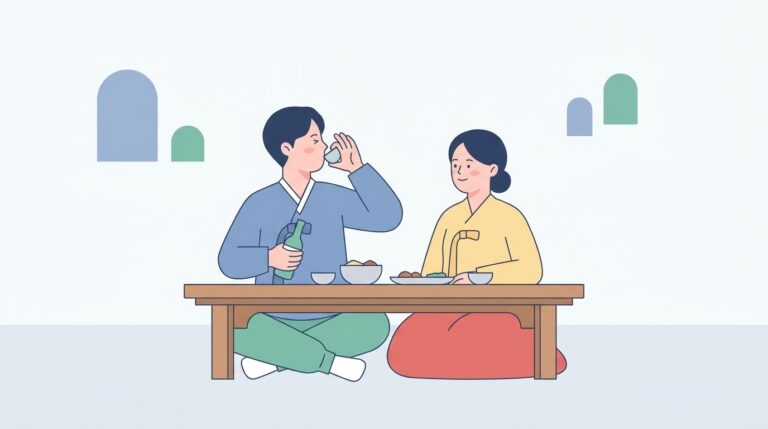
Picture this: You are sitting at a cozy, sizzling Korean BBQ restaurant in Seoul. The aroma of grilled pork belly fills the air, laughter echoes around, and your Korean boss—or your partner’s father—smiles warmly, picks up a green soju bottle, and pours a drink into your shot glass with both hands. Your heart races. In Western culture, you look the person dead in the eye, clink glasses with a firm nod, and take a sip. But here? If you do that, the whole room freezes like a scene straight out of an awkward K-drama moment. Suddenly, you remember seeing your favorite actor whip their head 90 degrees to the side like a secretive ninja just to take a sip of alcohol.
Why on earth do Koreans turn their heads away when drinking with elders? Is it rude? Is it polite? What are you supposed to say while holding that tiny glass? If you have ever felt paralyzed at a Korean dinner table, wondering whether to make eye contact or stare at the floor, you are in the right place. Today, we will decode this famous cultural ritual so you can navigate your next hoesik (company gathering) or family dinner with total confidence and effortless charm.
Phase 2: Core Expressions Deep Dive
Here are three essential expressions you need when drinking with someone older or higher in social hierarchy.
1. 감사합니다, 잘 마시겠습니다 (Gamsahamnida, jal masigessseumnida)
- Pronunciation: Gahm-sah-hahm-nee-dah, jahl mah-she-gess-seum-nee-dah (Think of “jal” like “calm” with a ‘J’, and “gess” like the English word “guess”).
- Meaning: Literally “Thank you, I will drink well.” In reality, it signals deep gratitude and acknowledges that the senior is treating or honoring you.
- K-Culture Moment: In the hit corporate drama Misaeng, the rookie employees always bow slightly and say this before accepting a drink from their team manager.
- Editor’s Insight: Saying this right as the elder finishes pouring proves you know fundamental Korean table manners. Never just grab the glass silently!
- Situation Spectrum:
- Casual: 🚫 (Sounds overly stiff with same-age friends)
- Semi-formal: ✅ (Great for older acquaintances or senior colleagues)
- Formal: ✅ (Mandatory for bosses, in-laws, and professors)
- 🤔 Think About It: In English, we usually say “Cheers!” which places everyone on equal footing. Why do you think Korean focuses on showing gratitude before the first drop even touches your lips?
2. 편하게 마셔요 (Pyeonhage masyeoyo)
- Pronunciation: Pyeon-hah-geh mah-shyuh-yoh (Sounds like “pyun-ha-gay mah-show-yo”).
- Meaning: “Please drink comfortably / Relax and drink.”
- K-Culture Moment: Often said by a benevolent father-in-law in family dramas like Once Again when he wants his future son-in-law to stop trembling and loosen up.
- Editor’s Insight: If a senior says this to you, it is a gesture of warmth! However, cultural pro tip: even if they tell you to “drink comfortably,” you should still slightly angle your body when sipping. Going completely casual right away can seem overly bold.
- Situation Spectrum:
- Casual: ⚠️ (Used towards younger people)
- Semi-formal: ✅ (Used by elders/seniors toward juniors)
- Formal: ✅ (Permissible from a superior to an employee)
- 🤔 Think About It: How do elders in your culture signal that a junior can drop their guard and feel at home?
3. 제가 한잔 올려도 될까요? (Jega hanjan ollyeodo doelkkayo?)
- Pronunciation: Jeh-gah hahn-jahn ohl-lyuh-doh dwel-kkah-yoh? (“Hanjan” rhymes with “flan-john”).
- Meaning: Literally “May I offer (raise) a drink to you?”
- K-Culture Moment: In Itaewon Class, Park Saeroyi carefully pours drinks for the elders who supported him, showing both humility and determination.
- Editor’s Insight: The verb 올리다 (ollida, to raise up/offer) is the honorific form of 주다 (juda, to give). Using ollida instantly elevates your Korean to an educated, polite B1 standard!
- Situation Spectrum:
- Casual: 🚫 (Too ceremonial for friends; say 내가 한잔 줄게 instead)
- Semi-formal: ✅
- Formal: ✅ (Gold standard for showing ultimate respect)
- 🤔 Think About It: Why does the Korean language use vertical metaphors (“raising up”) when referring to actions done for elders?
Phase 3: Textbook Korean vs. Real Korean
Situation 1: Offering a drink to an elder
- 📖 교과서 한국어 (Textbook Korean):
술을 더 드시겠습니까? (Sul-eul deo deusigesseumnikka?) — Would you like to consume more alcoholic beverage? - 🗣️ 진짜 한국어 (Real Korean):
부장님, 한잔 더 따라드릴까요? (Bujangnim, hanjan deo ttaradeurilkkayo?) — Manager, may I pour you another glass? - 💡 왜 다를까? (Why is it different?): Textbook Korean sounds like an airline attendant. In reality, Koreans specify the action of pouring (따라드리다) rather than just asking if they want to drink.
Situation 2: Replying when an elder pours you a drink
- 📖 교과서 한국어 (Textbook Korean):
감사히 받겠습니다. (Gamsahi batgesseumnida.) — I shall receive it thankfully. - 🗣️ 진짜 한국어 (Real Korean):
감사합니다! 제가 딱 마실 만큼만 받겠습니다. (Gamsahamnida! Jega ttak masil mankeumman batgesseumnida.) — Thank you! I will take just as much as I can handle. - 💡 왜 다를까? (Why is it different?): While textbooks encourage formal acceptance, native speakers use lively, self-aware phrases to politely pace their alcohol intake without causing offense.
Phase 4: K-Culture Deep Dive & Non-Verbal Manners
4-1. 눈치 (Nunchi) & The Physical Mechanics of the “Turn-Away”
Drinking with an elder in Korea is a full-body dance of respect. Here is the breakdown:
1. Receiving: Hold your shot glass with both hands. Your right hand wraps around the glass, and your left hand supports the bottom or touches your right forearm/wrist.
2. The Clink: When clinking glasses (짠! Jjan!), position your glass rim slightly lower than the elder’s rim.
3. The Pivot: Turn your head (or your entire torso) roughly 45 to 90 degrees away from the oldest person at the table.
4. The Sip: Shield the bottom of the glass and your mouth with your free hand so they cannot see your throat swallowing. Never look them straight in the eyes while drinking!
4-2. Cultural Code: Confucianism meets Modern Camaraderie
Why hide your mouth? Historically rooted in Neo-Confucianism, consuming alcohol in front of an elder without covering your mouth was seen as revealing primal, unrefined indulgence. By turning away and shielding your drink, you communicate: “I am keeping my composure and honoring your presence.” It is not fear; it is an active display of social care.
Phase 5: Real-Life Roleplay Scenario
Setting: A buzzing pork belly (Samgyeopsal) grill in Jongno, Seoul. You are sitting across from Manager Kim (김 부장님, Kim Bujangnim), who is known to be warm yet observant.
- 김 부장님: 자, 오늘 프로젝트 끝나서 수고 많았어요. 한잔 받아요! (Ja, oneul peurojekteu kkeutnaseo sugo manasseoyo. Hanjan badayo!)
English: Well, you worked hard wrapping up the project today. Take a glass!
🎭 행동: Holds the soju bottle with his right hand, supporting his elbow with his left. - 학습자 (You): 감사합니다, 부장님! 잘 마시겠습니다. (Gamsahamnida, bujangnim! Jal masigessseumnida.)
English: Thank you, Manager! I will drink well.
🎭 행동: Holds the cup with both hands, bowing head slightly as the cup fills. - 김 부장님: 아이고, 두 손으로 안 받아도 돼요. 편하게 마셔요. (Aigo, du soneuro an badado dwaeyo. Pyeonhage masyeoyo.)
English: Oh, no need to hold it with both hands. Relax and drink comfortably!
🎭 행동: Smiles and raises his own glass for a toast. - 학습자 (You): 그래도 예의는 지켜야죠! 건배할까요? (Geuraedo yeoineun jikyeoyajyo! Geonbaehalkkayo?)
English: Still, I must keep good manners! Shall we cheers?
🎭 행동: Clinks glasses, placing your rim carefully lower than his. - 김 부장님: 그래, 건배! (Geurae, geonbae!)
English: Alright, cheers!
🎭 행동: Downs his shot looking ahead. - 학습자 (You): [Pivots head 90 degrees to the left, covers mouth with left hand, and sips].
- 김 부장님: 오, 한국 주도(예절)를 제대로 배웠네! 센스 만점이야. (O, hanguk judoreul jedaero baewonne! Senseu manjeomiya.)
English: Oh! You really learned Korean drinking etiquette properly! Full marks for your intuition! - 학습자 (You): 부장님, 잔 비셨는데 제가 한잔 올려도 될까요? (Bujangnim, jan bisyeonneunde jega hanjan ollyeodo doelkkayo?)
English: Manager, your glass is empty. May I pour you one?
🎭 행동: Picks up the bottle with two hands gracefully.
🔀 Interactive Choice Point
Manager Kim has just poured you your third shot, but your alcohol tolerance is low. What do you do?
- Option A: Turn your glass upside down on the table and say “No thanks, I’m full!”
- Feedback: [Bad 🚫] Putting your cup upside down or outright refusing breaks the social flow (gibun).
- Option B: Receive it with two hands, take a tiny sip while turning your head, and leave the rest in the cup.
- Feedback: [Best ✅] A cup that is still partially full signals you don’t need a refill right now, while accepting it honors the elder’s hospitality!
- Option C: Wave your hands frantically and say “부장님, 저 술 못 마셔요!” (Manager, I can’t drink!)
- Feedback: [Risk ⚠️] It’s okay if you genuinely do not drink alcohol, but it is much better to accept the first glass and substitute it with water or cider (Chilsung Cider).
Phase 6: 10-Second Emotional Shadowing Drill
Practice reading these lines aloud. Focus on where to pause (/) and embody the emotion!
[😊 Respected & Polite]
감사합니다 / 부장님, / 잘 마시겠습니다!
(Gamsahamnida / bujangnim, / jal masigessseumnida!)-
[🤝 Modest & Courteous]
잔이 비셨네요, / 제가 / 한잔 올려드릴게요.
(Jani bisyeonneyo, / jega / hanjan ollyeodeurilgeyo.) -
[🥺 Tactful & Gentle]
권해주셔서 감사하지만, / 오늘은 / 딱 여기까지만 마시겠습니다.
(Gwonhaejusyeoseo gamsahajiman, / oneureun / ttak yeogikkajiman masigessseumnida.)
Phase 7: K-Culture Mini Dictionary
- 고개 돌리기 (Gogae Dolligi): Head-turning. The signature etiquette gesture of pivoting your face away from elders while swallowing drinks.
- 주도 (Judo / 酒道): “The Way of Alcohol.” Refers to traditional Korean drinking manners and moral codes governing group dinners.
- 꺾어 마시기 (Kkeok-eo Masigi): “Breaking/splitting the drink.” Taking a sip instead of shooting the whole glass in one go (원샷 / One-shot).
- 밑잔 (Mitjan): The leftover drops at the bottom of the glass. In Korea, pouring into a glass that still has alcohol inside is called 첨잔 (chaemjan), which is traditionally avoided with soju!
Phase 8: Survival Kit for Travelers
Top 3 On-the-Spot Phrases
- 물 한 잔만 주세요. (Mul han janman juseyo.) — Please give me a glass of water. (Use this to pace yourself discreetly).
- 사이다로 대신해도 될까요? (Saidaro daesinhaedo doelkkayo?) — May I substitute this with cider/soda? (Great if you cannot drink alcohol).
- 건배! (Geonbae!) — Cheers! (Universal, cheerful, and always welcomed).
Editor’s Travel Note
- When heading to authentic drinking streets in Seoul like Euljiro or Hongdae, do not rely on standard Google Maps, which lacks walking directions. Make sure you check out our guide on how to download the Naver Map application to find hidden pocha alleys effortlessly.
- Keep an eye on public transport: the Seoul subway stops running around midnight. Bookmark how to use the Kakao T app for late-night taxis after your company dinner wraps up!
Phase 9: One Step Deeper (Reflection)
In many Western cultures, looking directly into someone’s eyes as you drink signifies honesty, equality, and connection. In Korea, however, avoiding direct eye contact during an act of consumption signifies modesty and deference. It is a physical manifestation of Korean collectivism—sacrificing your own casual comfort so that the elder feels honored. By learning to turn your head, you aren’t just copying a physical gesture; you are participating in a multi-generational language of mutual care.
💬 Your Turn: Does your culture have a unique dining ritual for elders? Or have you ever accidentally committed a drinking faux pas abroad? Let us know in the comments below!
Phase 10: FAQ & Avoiding Misconceptions
Q: What should I do if the elder explicitly tells me, “Really, don’t turn your head! It’s fine!”?
A: If they insist more than twice with a warm smile, you may turn slightly less (perhaps a gentle 20-degree tilt) rather than a rigid 90-degree turn. Still, keep your second hand gently touching your glass or chest as a token of respect.
Q: Do I need to turn my head if the person is only 1 or 2 years older than me?
A: If you are close friends (Hyeong/Noona/Oppa), you don’t need to turn your head unless you are meeting for the very first time in a professional context. When in doubt, mirror what other peers are doing!
Q: What if I don’t drink alcohol for religious or health reasons?
A: Korean people are very understanding of this today! Politely explain upfront: 제가 건강상의 이유로 술을 못 마십니다. 대신 음료수로 받아도 될까요? (I cannot drink due to health reasons. May I receive soda instead?) They will gladly pour you water or soda with the exact same etiquette.
🚨 Common Mistakes Warning Board
- Mistake 1: Pouring a drink for an elder with only one hand.
👉 Correct Action: Always support your pouring arm with your other hand at the elbow or wrist. - Mistake 2: Refilling an elder’s glass while it is still half-full.
👉 Correct Action: Wait until their glass is completely empty before offering a refill. - Mistake 3: Clinking your glass higher than the senior’s glass.
👉 Correct Action: Always lower your glass rim by 1–2 centimeters beneath theirs.
Phase 11: Action Missions
- 🥉 Bronze Mission: Stand in front of your mirror with a glass of water. Practice holding the glass with both hands, tilting your head 45 degrees to the right, covering your mouth, and taking a sip.
- 🥈 Silver Mission: Next time you watch a K-drama featuring a dinner scene, take a screenshot of a character turning their head to drink and share it in your study notes!
- 🥇 Gold Mission: Visit a local Korean restaurant or dinner with Korean friends, order a beverage, and use: 감사합니다, 잘 마시겠습니다! with proper body language.
🎮 K-Culture Mission: Watch Episode 1 of Misaeng or Episode 2 of Business Proposal. Spot how many times the junior associates turn their heads away during the company barbecue scene!
Phase 12: Interactive Quiz Challenge
1. Situational Judgment: You are having dinner with your Korean professor. She pours you a glass of beer. What is the most polite physical posture?
* (A) Clink glasses firmly at eye level, look her in the eye, and drink in one gulp.
* (B) Accept with both hands, clink your glass slightly lower than hers, turn your head away to drink, and shield your mouth with your hand.
* (C) Take the glass with one hand and set it immediately on the table without touching it.
2. Fill in the Blank: When offering to pour a drink for a senior, complete the sentence respectfully:
“제가 한잔 ________ 될까요?” (Hint: Honorific form of ‘give’)
3. True or False: If a senior says “편하게 마셔요” (Drink comfortably), you can immediately put your elbows on the table and drink facing them directly.
* (A) True
* (B) False
👉 Click here to check the answers and explanations!
- Answer: (B). Accepting with both hands, clinking lower, and turning your head with a shielded mouth is the gold standard of Korean dining manners.
- Answer: 올려도 (ollyeodo). The full sentence is 제가 한잔 올려도 될까요?
- Answer: (B) False. Even if they say “편하게 마셔요,” maintaining a subtle tilt and gentle two-handed posture shows you have true senseu (social tact).







