

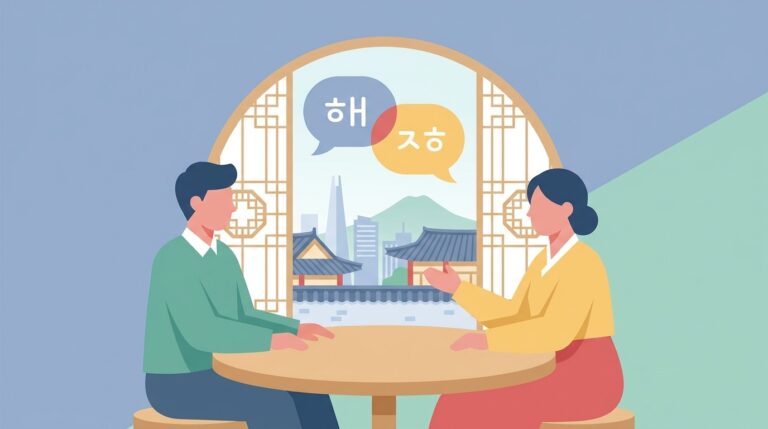
Phase 1: 공감 (Story-Immersive Opening)
안녕하세요! 매일한글 에디터입니다.
Have you ever found yourself sitting in a Korean university group meeting (조별과제) or an office brainstorming session, watching arguments zip back and forth like a high-stakes table tennis match in a K-variety show? You understand the key arguments, your brain is churning with insights, but suddenly the room falls into a prolonged, awkward silence. Everyone is waiting for someone to step up, synthesize the scattered opinions, and steer the discussion toward a decisive ending. You desperately want to say, “Looking at everything we’ve discussed so far, here is our bottom line…” but your mind freezes. You worry: What if I sound too aggressive? What if my Korean sounds like a stiff legal contract from a 1990s textbook?
This is one of the single greatest pain points for B2 intermediate learners. At this level, you already know your grammar rules and possess a solid vocabulary bank, yet leading a group to consensus (합의) requires nuanced transitions, diplomatic tone control, and native discourse markers. This guide is crafted directly from real learner struggles and ten years of coaching expats, international students, and business professionals in Seoul. By the end of this masterclass, you won’t just participate in Korean discussions—you will command the room with warmth, logic, and undeniable native flair.
Phase 2: 핵심 표현 3선 심층 분석 (Core 3 Expressions In-Depth)
1. 결론부터 말씀드리자면 (Gyeollonbuteo malsseumdeurijamyeon)
- Pronunciation: [Gyeol-lon-bu-teo mal-sseum-deu-ri-ja-myeon] (Think of ‘gyeol’ like the ‘gy’ in ‘regular’, ‘buteo’ like ‘boot-uh’, and ‘malsseum’ like ‘mull-soom’.)
- Meaning: Literal: “If I speak starting from the conclusion…” | Actual Nuance: “To get straight to the point / Bottom line is…”
- K-Culture Moment: Picture a high-stakes K-Drama boardroom scene in Misaeng (미생) or Agency (대행사). While colleagues bicker over trivial details, the sharp project lead steps up, silences the clutter, and delivers the bottom line with total poise.
- Editor’s Insight: This phrase signals utmost respect for your listeners’ time. By using the humble verb 말씀드리다 (malsseumdeurida) instead of the plain 말하다 (malhada), you assert intellectual leadership without sounding arrogant.
- Situation Spectrum: Casual (🚫) | Semi-formal (⚠️) | Formal (✅)
- 🤔 Think About It: In Western debates, giving the bottom line first can sometimes sound confrontational unless heavily hedged. Why does combining a direct conclusion with humble honorifics create immediate respect in Korean society?
2. 지금까지 나온 의견을 종합해 보면 (Jigeumkkaji naon uigyeoneul jonghaphae bomyeon)
- Pronunciation: [Ji-geum-kka-ji na-on ui-gyeo-neul jong-hap-hae bo-myeon] (Rhyme ‘jonghap’ with ‘song-top’.)
- Meaning: Literal: “If we synthesize the opinions that have come out until now…” | Actual Nuance: “Taking into account all the points raised so far / Synthesizing our discussion…”
- K-Culture Moment: Think of an MC on Going Seventeen or Running Man during a chaotic game debate. When team members argue over hilarious loophole strategies, the host steps in with this phrase to turn madness into structured team consensus.
- Editor’s Insight: This is the ultimate nunchi bridge. It overtly signals to your peers: “I have listened to every single one of you.” In Korean corporate and academic cultures, making people feel heard is half the battle won.
- Situation Spectrum: Casual (⚠️) | Semi-formal (✅) | Formal (✅)
- 🤔 Think About It: Why does explicitly acknowledging collective input (종합) yield significantly better teamwork outcomes in Korea compared to pushing purely individual analyses?
3. 결국 중요한 건 ~라는 점인 것 같아요 (Gyeolguk jungyohan geon ~raneun jeomin geot gat-ayo)
- Pronunciation: [Gyeol-guk jung-yo-han geon … -ra-neun jeo-min geot ga-ta-yo] (Crisp ‘k’ sound at the end of ‘gyeolguk’.)
- Meaning: Literal: “In the end, the important thing seems to be the point that…” | Actual Nuance: “At the end of the day, what really matters boils down to…”
- K-Culture Moment: Frequently heard in warm, collaborative workplace dramas like Hospital Playlist. When doctors debate different surgical risks, the senior professor grounds the team by refocusing everyone on what truly matters: patient recovery.
- Editor’s Insight: Notice the brilliant double-cushioning: ~라는 점 (the objective anchor point) paired with ~인 것 같아요 (it seems to be). While English debate coaches advise avoiding “I think / It seems,” in B2+ Korean, this soft phrasing is the gold standard of non-threatening, collaborative decisiveness.
- Situation Spectrum: Casual (✅) | Semi-formal (✅) | Formal (⚠️ – upgrade to ~점이라고 생각합니다 for strict boardrooms)
- 🤔 Think About It: How does phrasing a firm conclusion as an observation (~것 같아요) protect team solidarity while still driving your agenda forward?
Phase 3: 교과서 한국어 vs 진짜 한국어 (Textbook vs. Real-World Korean)
Situation 1: Summarizing a rambling group discussion
- 📖 교과서 한국어: “요약하자면 그렇습니다.” (Yoyakhajamyeon geureotsumnida. / “To summarize, it is so.”)
- 🗣️ 진짜 한국어: “한마디로 정리하면 이거예요.” (Hanmadiro jeongrihamyeon igeoyeyo. / “To sum it up in one sentence, it boils down to this.”)
- 💡 왜 다를까?: “요약하자면 그렇습니다” feels like a stiff line pulled from an outdated 1980s business manual. Native speakers in dynamic discussions prefer “한마디로 정리하면” (organizing it in a single phrase), which immediately hooks attention and sounds clear, vibrant, and approachable.
Situation 2: Proposing a win-win compromise after deadlock
- 📖 교과서 한국어: “따라서 우리의 합의점은 다음과 같습니다.” (Ttaraseo uriui hab-uijeomeun da-eumgwa gatseumnida. / “Therefore, our point of agreement is as follows.”)
- 🗣️ 진짜 한국어: “결국 둘 다 살리는 쪽으로 가보죠.” (Gyeolguk dul da sallineun jjogeuro gabojyo. / “In the end, let’s go with the direction that keeps both ideas alive.”)
- 💡 왜 다를까?: Words like “합의점은 다음과 같습니다” sound like you are reading a legal treaty out loud. Using conversational expressions like “둘 다 살리다” (saving/salvaging both sides) exhibits creative problem-solving and organic leadership.
Phase 4: K-Culture 딥다이브 & 비언어적 매너 (Deep Dive & Non-Verbal Manners)
4-1. 눈치(Nunchi) & Body Language
When delivering a summary in Korea, non-verbal cues carry as much weight as your words.
* Hand Gestures: Never point an index finger or slice the air aggressively to emphasize a conclusion. Instead, keep both hands relaxed, open-palmed, and resting gently on the table, gesturing inward to symbolize bringing diverse ideas together.
* Active Eye Contact & Micro-Nods (끄덕임): Before launching into your wrap-up, make eye contact with each speaker who shared an opinion and give a subtle, respectful nod. This validates their contribution before you deliver the synthesized consensus.
4-2. Cultural Code Analysis: 합의 (Consensus) vs. 독단 (Unilateral Decision)
In Korean organizational culture—from university jo-moim (조별과제) to corporate strategy war-rooms—debate is seldom designed to produce an aggressive “winner takes all” victor. Dominating someone into silence is considered poor form (독단). The true winner is the person who exhibits supreme social intelligence: synthesizing divergent viewpoints into a unified plan without wounding anyone’s pride (기분).
Phase 5: 실전 롤플레이 시나리오 (Real-World Roleplay Scenario)
Setting: A sunlit meeting room inside a creative marketing agency in Seongsu-dong. Empty Americano cups and colorful sticky notes cover the whiteboard.
Characters:
* Minho (민호): Senior Strategist. Pragmatic, fast-paced, looking at his smartwatch.
* You (학습자): Intermediate Korean speaker responsible for synthesizing the strategy for an upcoming K-Beauty influencer launch.
- Turn 1 (Minho): “인플루언서 마케팅 예산이 부족해서 유튜브 쇼츠랑 팝업스토어 중 하나만 골라야 할 것 같아요. 의견이 계속 갈리네요.”
(Inpeullueonseo maketing yesani bujokhaeseo yutyubeu syocheurang papeopseuto-eo jung hanaman gollaya hal geot gat-ayo. Uigyeoni gyesok gallineyjo.)
[🎭 Sighs softly, tapping his pen on his notebook.]
“We don’t have enough budget for influencer marketing, so we might have to choose between YouTube Shorts and a pop-up store. Opinions are completely split.” -
Turn 2 (You): “지금까지 나온 의견을 종합해 보면, 타깃층에 대한 접근 방식이 다른 것 같아요.”
(Jigeumkkaji naon uigyeoneul jonghaphae bomyeon, tagitchunge daehan jeoggeun bangsigi dareun geot gat-ayo.)
[🎭 Leans slightly forward with open hands, maintaining steady eye contact.]
“Synthesizing the opinions shared so far, it seems our fundamental approaches to reaching the target demographic differ.” -
Turn 3 (Minho): “맞아요. 쇼츠는 도달 범위가 넓고, 팝업은 팬덤 충성도를 높이니까요. 둘 다 포기하기 아쉬운데요.”
(Maj-ayo. Syocheuneun dodal beomwiga neolpgo, papeobeun paendeom chungseongdoreul nop-inikkayo. Dul da pogihagi aswiundeoyo.)
[🎭 Crosses arms thoughtfully, looking intrigued.]
“Exactly. Shorts offer massive reach, while pop-ups build fan loyalty. It feels difficult to abandon either.” -
Turn 4 (You): “결론부터 말씀드리자면, 두 안의 장점을 결합하는 게 가능할 것 같습니다.”
(Gyeollonbuteo malsseumdeurijamyeon, du anui jangjeomeul gyeolhabhaneun ge ganeunghal geot gatseumnida.)
[🎭 Smiles calmly and gestures toward the whiteboard notes.]
“To get straight to the conclusion, I believe it is entirely possible to combine the strengths of both proposals.” -
Turn 5 (Minho): “오, 어떤 방법이 있죠? 예산 한도는 이미 정해져 있는데…”
(O, eotteon bangbeobi itjyo? Yesan handoneun imi jeonghaejeo inneunde…)
[🎭 Raises eyebrows with genuine curiosity.]
“Oh, what method do you have in mind? Our budget ceiling is firmly set, though…” -
Turn 6 (You): “한마디로 정리하면, 팝업 공간에서 크리에이터들이 직접 쇼츠를 촬영하게 만드는 거예요.”
(Hanmadiro jeongrihamyeon, papeop gongganeseo keurieiteodeuri jigjeop syocheureul chwaryeonghage mandeuneun geoyeyo.)
[🎭 Connects two points on the table with index fingers brought together.]
“To sum it up in one sentence: we design the pop-up space specifically for creators to film their Shorts on-site.” -
Turn 7 (Minho): “아! 팝업 규모를 조금 줄이고, 현장을 콘텐츠 제작 허브로 쓰자는 거군요? 예산도 아끼고요!”
(A! Papeop gyumoreul jogeum jurigo, hyeonjangeul kontencheu jejag heobeuro sseujaneun geogunyo? Yesando akkigoyo!)
[🎭 Claps his hands together enthusiastically.]
“Ah! So we downsize the venue footprint slightly and turn the space into a content hub? Saving budget at the same time!” -
Turn 8 (You): “결국 중요한 건 오프라인 경험을 온라인으로 확산시키는 점인 것 같아요. 이렇게 정리하면 될까요?”
(Gyeolguk jungyohan geon opeurain gyeongheomeul onraineuro hwaksansikineun jeomin geot gat-ayo. Ireoke jeongrihamyeon doelkkayo?)
[🎭 Looks around the room, inviting warm team alignment.]
“In the end, what matters most is amplifying the offline experience online. Shall we conclude our plan this way?”
🔀 인터랙티브 분기점 (Interactive Decision Point)
Minho is thrilled with your summary and asks: “그럼 구체적인 세부 일정표는 누가 맡는 게 좋을까요?” (Then who should take charge of drawing up the detailed schedule?) How do you respond?
- Choice A: “제가 결론을 냈으니까, 민호 님이 일정표를 맡아주세요.” (Since I came up with the conclusion, Minho-nim, please take care of the schedule.)
- Choice B: “제가 오늘 나온 내용 회의록으로 요약해서 공유하고, 내일까지 초안 잡아볼게요.” (I will summarize today’s discussion into meeting minutes and draft a timeline by tomorrow.)
- Choice C: “글쎄요, 그건 나중에 단톡방에서 투표로 정하는 게 어떨까요?” (Well, how about we decide that later via a poll in our KakaoTalk group chat?)
Decision Feedback:
* Choice A [Bad]: Defeating your own momentum! Shifting administrative burden onto a senior colleague right after presenting a conclusion comes across as entitled and abrasive.
* Choice B [Best]: Absolute leadership gold. Offering to produce the 회의록 (meeting minutes) and a draft timeline cements your reputation as an organized, dependable, and indispensable team player.
* Choice C [Risk]: Defers action unnecessarily. Pushing immediate meeting momentum into an ambiguous chat poll displays indecisiveness and slows down team progress.
Phase 6: 10초 감정 섀도잉 드릴 (10-Second Emotional Shadowing Drill)
Practice these lines out loud! The slashes (/) represent natural pause points for rhythmic breath control.
- [🤝 차분하고 신뢰감 있게 – Calm & Trustworthy]
“지금까지 나온 의견을 / 종합해 보면, / 우리가 집중해야 할 방향은 / 명확합니다.”
(Jigeumkkaji naon uigyeoneul / jonghaphae bomyeon, / uriga jipjunghaeya hal banghyangeun / myeonghwakhapnida.)
“Synthesizing the opinions shared so far, the direction we need to focus on is clear.” -
[💡 결단력 있고 스마트하게 – Decisive & Sharp]
“결론부터 말씀드리자면, / 비용 대비 효과가 가장 높은 안을 / 먼저 시도해보는 게 좋겠습니다.”
(Gyeollonbuteo malsseumdeurijamyeon, / biyong daebi hyogwaga gajang nopeun aneul / meonjeo sidohaeboneun ge joketseumnida.)
“To state the conclusion first, it would be best to first test the option with the highest cost-effectiveness.” -
[😊 따뜻하게 합의를 이끌며 – Warm & Diplomatic]
“결국 중요한 건 / 팀원 모두가 납득할 수 있는 / 현실적인 해결책이라는 점인 것 같아요.”
(Gyeolguk jungyohan geon / timwon moduga napdeukhal su inneun / hyeonsiljeogin haegyeolchaegiraneun jeomin geot gat-ayo.)
“In the end, what truly matters seems to be reaching a realistic solution that every team member can agree on.”
Phase 7: K-Culture 미니 사전 (Mini Cultural Dictionary)
- 조별과제 (Jo-byeol gwaje) | Group Assignment / Team Project
The legendary rite of passage in Korean universities. It is notorious for testing interpersonal tact, division of labor, and surviving dynamic social negotiations with peers. - 빌런 (Billeon) | ‘Villain’ / Disruptive Member
Slang adopted from comic franchises, commonly used among students and young professionals to describe someone who disappears right before deadlines (free-riders) or derails meetings. - 합의점 (Hab-uijeom) | Point of Consensus / Compromise Ground
An essential professional term for negotiations. It denotes the harmonious equilibrium where both parties give a little without losing face. - 마무리 (Mamuri) | Wrap-up / Finishing Touch
Ubiquitous across Korean life: from “회의 마무리” (wrapping up a conference call) to eating fried rice as the grand “마무리” after a hearty meal of Korean BBQ.
Phase 8: 여행자를 위한 생존 키트 (Survival Kit for Expats & Travelers)
서바이벌 표현 TOP 3
- “오늘 얘기는 여기까지 하고 정리할까요?”
(Oneul yaegineun yeogikkaji hago jeongrihalkkayo?)
“Shall we wrap up our conversation here for today and summarize?”
👉 Pro Tip: Invaluable when an evening hangout or travel planning session at a late-night cafe starts stretching past the last subway train. - “핵심만 간단히 말씀해주실 수 있나요?”
(Haeksimman gandani malsseumhaejusil su innayo?)
“Could you please share just the core points briefly?”
👉 Pro Tip: Lifesaver when a government officer, clinic receptionist, or landlord explains complicated terms with rapid-fire speed. - “제가 이해한 내용이 맞는지 확인 부탁드립니다.”
(Jega ihaehan naeyongi manneunji hwagin butakdeurimnida.)
“Please verify whether what I have understood is correct.”
👉 Pro Tip: Use this right before finalizing apartment leases, tour reservations, or project deadlines to avoid costly miscommunications.
Editor’s Travel Note
When debating travel itineraries with Korean travel companions, transit choices often trigger long discussions. Keep discussions swift by downloading the 네이버 지도 앱 다운로드 to present immediate, indisputable data on subway transfer times and optimal bus routes. Having quick visual proof helps everyone settle debates in seconds!
Phase 9: “한 발 더 깊이” (Reflective Cultural Essay)
In Western debate traditions inherited from Greco-Roman rhetoric, intellectual clarity is forged through dialectical clash: thesis collides directly with antithesis until the stronger argument triumphs. In contrast, Korean discursive thought prizes synthetic balance (조화). Grammatical hedging markers such as ~것 같아요 (it seems that) or ~라는 생각이 듭니다 (I get the thought that) are not symptoms of timid hesitation; they are linguistic cushions designed to protect interpersonal dignity. Mastering high-level Korean debate does not mean flattening your opponent with relentless logic; it means guiding everyone into a collective harbor where all participants feel respected.
💬 Your Turn: In your native culture, do people value having the conclusion stated upfront, or do they expect a gradual build-up? Have you ever felt that Korean indirect phrasing sounds too ambiguous? Share your thoughts below!
Phase 10: FAQ & 흔한 실수 (FAQ & Common Mistakes)
Q: Is using “~것 같아요” in business debates seen as lacking confidence?
A: At intermediate and advanced levels, it is all about context and dosage. Softening a summary statement once with ~것 같아요 reflects collaborative maturity. However, if every single sentence trails off in ~것 같아요, you risk sounding hesitant. In high-stakes executive boardrooms, upgrade your wrap-up to ~라고 판단됩니다 (“It is assessed that…”) or ~라는 결론에 도달했습니다 (“We have arrived at the conclusion that…”).
Q: What is the practical difference between “요약” (yoyak) and “정리” (jeongri)?
A: 요약 (yoyak) refers strictly to condensing textual content or speeches into an executive abstract. 정리 (jeongri) is far broader: it means organizing clutter, clarifying tangled ideas, or bringing a clean ending to a process. In conversational debate, Koreans say “정리해 보겠습니다” (Let me organize/wrap up our thoughts) far more often than “요약해 보겠습니다”.
Q: How can I politely interrupt someone who is rambling to move toward a conclusion?
A: Use this respectful verbal buffer: “말씀 중에 죄송하지만, 시간 관계상 슬슬 결론을 정리해봐야 할 것 같습니다.” (Malsseum junge joesonghajiman, sigan gwangyesang seulseul gyeolloneul jeongrihaebwaya hal geot gatseumnida. / “I apologize for interrupting, but considering our time limit, I believe we should start pulling our conclusions together.”)
🚨 흔한 실수 (Common Mistakes) 경고판
- Literal Translation Trap: Translating “In conclusion” directly as 결론에서 (Gyeollonese).
👉 Correct Action: Say 결론부터 말씀드리자면 (To start from the conclusion) or 결론적으로 (In conclusion). - Abrupt Register Shift: Slipping into informal casual phrasing (결국엔 말이야) in team presentations.
👉 Correct Action: Maintain the polite B2 baseline: 결국 중요한 건 ~라는 점인 것 같아요. - Skipping the Alignment Question: Stating a conclusion and immediately sitting down in silence without checking room consensus.
👉 Correct Action: Always close with an inviting check-in: “이렇게 정리하면 괜찮을까요?” (Would it be good if we finalize it this way?)
Phase 11: 액션 미션 & 참여 유도 (Action Missions)
- 🥉 Bronze Mission (Solo Practice): Record yourself reading the 3 sentences in Phase 6 on your smartphone’s voice memo app. Focus on pausing naturally at the
/marks. - 🥈 Silver Mission (Social Share): Write your own summary sentence using “결론부터 말씀드리자면…” in the comments below or share it on Instagram tagging
@DailyHangul! - 🥇 Gold Mission (Real-World Execution): In your next Korean language exchange meetup or study group, step up to conclude the chat: “지금까지 나온 의견을 종합해 보면…”
- 🎮 K-Culture Mission: Watch an episode of a Korean debate variety show (e.g., Going Seventeen ‘Debate Night’ or Running Man). Spot at least one moment where the host uses 정리 or 결론 and write it down in your study journal!
Phase 12: 인터랙티브 퀴즈 챌린지 (Interactive Quiz Challenge)
1. Situational Judgment:
You are participating in a group assignment meeting. The members have been repeating the same points for 30 minutes. What is the most polite and effective sentence to guide them toward a decision?
(A) “다들 말이 너무 많으시네요. 제 말대로 끝내죠.”
(B) “지금까지 나온 의견들을 종합해 보고, 슬슬 결론을 내려볼까요?”
(C) “요약하자면 그렇습니다. 이제 그만합시다.”
2. Fill-in-the-Blank:
Choose the most natural verb for concluding a debate:
“오늘 회의에서 나온 아이디어를 한마디로 [ ______ ] 이번 프로젝트는 오프라인 팬덤에 집중해야 합니다.”
(A) 포기하면 (If we give up)
(B) 정리하면 (If we summarize/organize)
(C) 거짓말하면 (If we lie)
3. Cultural True or False:
In Korean group discussions, using softening endings like ~것 같아요 when suggesting a wrap-up is universally considered a sign of linguistic weakness.
(True / False)
👉 Click to reveal answers & explanations!
- Answer: (B)
Explanation: (B) gracefully recognizes everyone’s input (종합해 보고) while diplomatically suggesting a conclusion. Option (A) is rude, and option (C) is abruptly cold. - Answer: (B) 정리하면
Explanation: “한마디로 정리하면” is the quintessential idiomatic set-phrase meaning “To sum it up in one sentence.” - Answer: False
Explanation: Far from weakness, diplomatic softening (완곡어법) is an advanced cultural tool used by leaders to maintain harmony (화합) while asserting logical direction.







