

안녕하세요! 매일한글 에디터입니다.
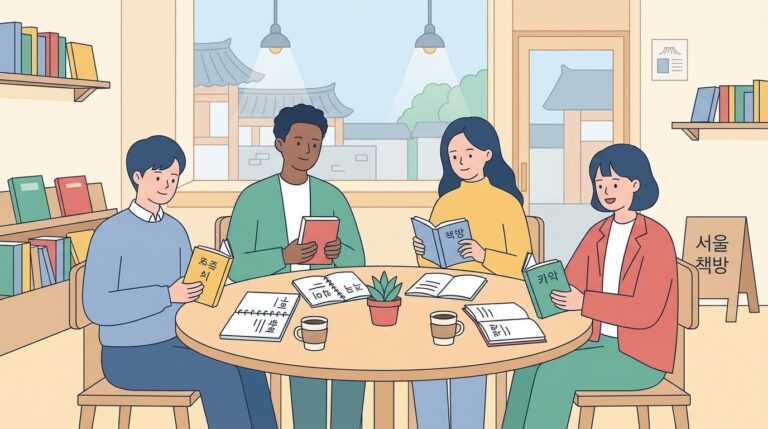
Picture this: You are sitting in a softly lit, independent bookstore in Mangwon-dong on a rainy Saturday afternoon. Around a sturdy walnut table, six Korean book lovers are sipping filter coffee, flipping through dog-eared copies of Han Kang’s Human Acts or Cho Nam-joo’s Kim Jiyoung, Born 1982. The host smiles warmly, turns to you, and asks: “오늘 발제 맡으신 톰 님, 이번 챕터 어떻게 읽으셨어요?” (Tom, as today’s presenter, how did you read this chapter?)
Suddenly, your mind goes blank. In your head, you have profound reflections on existential trauma, societal expectations, and metaphoric allegories. But what comes out of your mouth? “이 책은… 재미있었습니다.” (This book was… fun.) Oh, the agony! A textbook “fun” feels painfully juvenile when everyone else is discussing subtle psychological currents and poetic resonance.
Many of our intermediate (B2) learners tell us that joining a Korean book club (독서 모임, dokseo moim) is their ultimate cultural bucket list item, yet it feels like their biggest linguistic roadblock. You don’t lack thoughts; you lack the discourse markers, reflective verbs, and culturally attuned hesitation devices that Koreans use to share literary impressions without sounding rigid or abrasive. This guide is built directly from years of moderating bilingual literary circles in Seoul to give you the exact conversational scaffolding you need to lead a book presentation (발제, balje) with absolute confidence.
Phase 2: Core Expressions Deep-Dive
Let’s transform your literary vocabulary from surface-level textbook summaries into evocative, natural discussions.
1. 이 구절이 특히 마음에 와닿았어요. (I gujeori teukhi maeume wadahasseyo.)
- Pronunciation: [I gu-jeo-ri teu-khi ma-eu-me wa-da-ha-sseo-yo] (Think of “wa” like the joyful cry “Wah!”, followed by “da-ha”, ending with a soft “saw-yo”).
- Meaning: Literal: “This passage especially touched my heart.” / Nuance: “This sentence really resonated with me on a deep, emotional frequency.”
- K-Culture Moment: Commonly heard in cozy literary talk shows or introspective K-Dramas like When the Weather Is Fine, where characters share underlined passages in a town book club.
- Editor’s Insight: In Korean literature discussions, stating something “resonated” (와닿다) is far more organic than saying “이 문장이 좋았어요” (I liked this sentence). It describes how the words physically arrived at and struck your inner self.
- Situation Spectrum: Casual (✅ 마음에 와닿았어), Semi-formal (✅ 마음에 와닿았어요), Formal (✅ 마음에 와닿았습니다).
- 🤔 Think About It: Why does Korean emphasize emotion touching (닿다) the heart rather than an individual actively analyzing the text?
2. 작가의 의도를 어떻게 해석하셨는지 궁금해요. (Jakgaui uidoreul eotteohke haeseokhasyeonneunji gunggeumhaeyo.)
- Pronunciation: [Jak-ga-ui ui-do-reul eo-tteo-khe hae-seok-ha-syeon-neun-ji gung-geum-hae-yo] (Flow smoothly over hae-seok, rhyming roughly with deck).
- Meaning: Literal: “I am curious how you interpreted the author’s intention.” / Nuance: “I’d love to hear how everyone parsed what the author was getting at here.”
- K-Culture Moment: The quintessential 발제자 (discussion leader) phrase used to open the floor and pivot the conversation away from the presenter to the group.
- Editor’s Insight: Ending with 궁금해요 (I’m curious) softens what could otherwise sound like an academic examination question (“해석해 보세요”). It invites collective brainstorming rather than testing someone’s knowledge.
- Situation Spectrum: Casual (⚠️ 어떻게 해석했어? – use only with close peers), Semi-formal (✅ 어떻게 해석하셨는지 궁금해요), Formal (✅ 어떻게 해석하셨는지 여쭙고 싶습니다).
- 🤔 Think About It: In English, we often ask “What do you think the author meant?” How does framing it as 궁금해요 (I am genuinely wondering) create a safer space for interpretation?
3. 인물의 심리에 공감이 가면서도 한편으로는 안타까웠어요. (Inmurui simnie gonggami gamyeonseodo hanpyeoneuroneun antakkawasseoyo.)
- Pronunciation: [In-mu-rui sim-ni-e gong-ga-mi ga-myeon-seo-do han-pyeo-neu-ro-neun an-ta-kka-wa-sseo-yo] (Notice the sound change in 심리: sim-li assimilates to sim-ni).
- Meaning: Literal: “While empathy went toward the character’s psychology, on the other hand, it was tragic/regrettable.” / Nuance: “I deeply related to what the character was going through, but at the same time, my heart broke for them.”
- K-Culture Moment: Often said when reviewing protagonists in modern realist Korean fiction who make heartbreaking choices under societal pressure.
- Editor’s Insight: B2 fluency shines when you balance two conflicting feelings using ~면서도 한편으로는 (while doing X, on the other hand Y). 안타깝다 is an untranslatable Korean emotion combining pity, frustration, and deep sorrow.
- Situation Spectrum: Casual (✅ 공감 가면서도 안타까웠어), Semi-formal (✅ 공감이 가면서도 한편으로는 안타까웠어요), Formal (✅ 공감이 가면서도 안타까운 마음이 들었습니다).
- 🤔 Think About It: Notice the phrasing 공감이 가다 (empathy goes). Empathy is framed as an intuitive movement toward the person, not a calculated judgment.
Phase 3: Textbook Korean vs. Real Korean
Scenario 1: Describing an emotional, heavy ending
- 📖 교과서 한국어 (Textbook): “저는 이 책의 결말이 매우 슬펐습니다.” (I found the ending of this book very sad.)
- 🗣️ 진짜 한국어 (Real-Life): “결말을 읽고 나니까 마음이 진짜 먹먹해지더라고요.” (After reading the ending, my chest felt completely tight and overwhelmed with emotion.)
- 💡 Why the difference?: Textbook Korean defaults to binary adjectives like 슬프다 (sad) or 기쁘다 (happy). Native speakers discuss complex literature using sensory, visceral emotional states like 먹먹하다 (a choked-up, heavy feeling in the chest or ears).
Scenario 2: Asking for everyone’s view on a specific theme
- 📖 교과서 한국어 (Textbook): “다음 주제에 대해 질문이 있습니다. 답변해 주세요.” (I have a question about the next topic. Please answer.)
- 🗣️ 진짜 한국어 (Real-Life): “이 장면에 대해서는 다들 어떻게 보셨는지 의견을 나눠보고 싶어요.” (I’d love to hear everyone’s perspective on how you viewed this particular scene.)
- 💡 Why the difference?: The textbook version sounds like a police interrogation or a school test. In authentic Korean book clubs (독서 모임), leaders frame prompts as 의견을 나누다 (sharing thoughts together) to encourage egalitarian dialogue.
Phase 4: K-Culture Deep Dive & Non-Verbal Manners
4-1. 눈치 (Nunchi) & Gestures in a Korean Book Club
When presenting (발제) in Korea, your posture carries as much weight as your words.
* The Head Tilt and Gaze: When another member is speaking, maintain soft eye contact, tilting your head slightly while giving slow, deliberate nods (끄덕임). This displays active listening (경청). Never stare down at your notes while someone is pouring their heart out about a chapter.
* The Two-Handed Page Reference: When directing everyone to a specific passage, hold your book with both hands or gesture towards the page with your open palm facing upward rather than pointing aggressively with a single index finger: “124쪽 세 번째 줄을 보시면…” (If you look at the third line on page 124…).
* The Cushioning Breath: Koreans rarely jump into an answer instantly. Take a gentle breath, say “음, 제 생각에는…” (Well, in my view…) or “그 부분에 덧붙이자면…” (To add on to that point…). This micro-pause is essential Nunchi—it shows you absorbed their comment rather than merely waiting for your turn to talk.
4-2. Cultural Code: The Rise of the Themed 독서 모임
Over the past few years, Korea has seen an explosion of subscription-based and neighborhood book communities (such as Trevari or independent bookshop salons in Yeonnam-dong and Seongsu-dong). Following the global recognition of writers like Han Kang, reading has shifted from a solitary, competitive activity into a communal healing ritual (힐링 문화). People join these clubs not just to analyze rhetoric, but to discuss existential loneliness, workplace burnout, and gender dynamics in contemporary Korea through literary metaphors.
Phase 5: Real-World Roleplay Scenario
Setting: Book & Rest, a tranquil basement book cafe in Hapjeong. Rain patters against the skylight. Minseo (민서), the seasoned and empathetic club leader, turns the discussion toward you.
- 민서: 자, 톰 님! 이번 단편 소설 발제를 맡으셨잖아요. 전체적인 소감이 어떠셨어요?
(Ja, Tom nim! Ibeon danpyeon soseol baljereul mateusyeotjanhayo. Jeonchejeogin sogami eotteosyeosseoyo?)
“Alright, Tom! You prepared the discussion for this short story. What were your overall thoughts?”
🎭 따뜻한 미소를 지으며 찻잔을 내려놓는다 (Smiling warmly, setting down her teacup) -
톰: 네, 주인공이 끝내 고향을 떠나는 장면에서 마음이 진짜 먹먹해지더라고요.
(Ne, juingongi kkeunnae gohyangeul tteonaneun jangmyeoneseo maeumi jinjja meongmeokhaejideoragoyo.)
“Well, in the scene where the protagonist finally leaves their hometown, I felt a real, heavy lump in my chest.”
🎭 책에 붙여둔 포스트잇을 가볍게 매만지며 (Lightly touching the sticky notes marked in the book) -
민서: 오, 먹먹하셨군요. 어떤 구절 때문에 더 그렇게 느끼셨어요?
(O, meongmeokhasyeotgunyo. Eotteon gujeol ttaemune deo geureohke neukkisyeosseoyo?)
“Oh, it made you feel choked up. Which passage made you feel that way especially?”
🎭 흥미롭다는 듯 고개를 살짝 끄덕인다 (Nodding slightly with keen interest) -
톰: 78쪽에 ‘그림자조차 낯설어졌다’라는 구절이 특히 마음에 와닿았어요.
(Chilsippal-jjoge ‘geurimjajocha natseoreojyeotda’raneun gujeori teukhi maeume wadahasseyo.)
“On page 78, the passage saying ‘even my own shadow had become unfamiliar’ resonated deeply with me.”
🎭 책을 두 손으로 받쳐 들고 구절을 가리킨다 (Holding the book with both hands and pointing to the line) -
민서: 와, 그 표현 정말 서늘하죠. 저도 거기서 한참 멈췄어요.
(Wa, geu pyohyeon jeongmal seoneulhajyo. Jeodo geogiseo hancham meomchwosseoyo.)
“Wow, that expression is so chilling, isn’t it? I paused there for a long time too.”
🎭 가슴에 손을 얹으며 깊이 공감한다 (Placing a hand over her heart in deep agreement) -
톰: 맞아요. 인물의 쓸쓸한 심리에 공감이 가면서도 한편으로는 안타까웠어요.
(Majayo. Inmurui sseulsseulhan simnie gonggami gamyeonseodo hanpyeoneuroneun antakkawasseoyo.)
“Exactly. While I related to the character’s lonely psychology, my heart broke for him at the same time.”
🎭 차분한 목소리로 멤버들과 눈을 맞춘다 (Making gentle eye contact with the members in a calm voice) -
민서: 그럼 이 결말에 대해서 다른 분들은 어떻게 해석하셨는지 발제 질문으로 넘어가 볼까요?
(Geureom i gyeolmare daehae dareun bundeureun eotteohke haeseokhasyeonneunji balje jilmuneuro neomeoga bolkkayo?)
“Then, shall we move on to your discussion prompt on how others interpreted this ending?”
🎭 펜을 쥐고 멤버들을 둘러본다 (Holding her pen, looking around at the circle) -
톰: 네! 작가의 의도를 다들 어떻게 해석하셨는지 궁금해요.
(Ne! Jakgaui uidoreul dadeul eotteohke haeseokhasyeonneunji gunggeumhaeyo.)
“Yes! I’d love to hear how everyone parsed what the author was aiming for.”
🎭 미소를 띠며 질문을 던진다 (Throwing out the question with an inviting smile)
🔀 Interactive Decision Point: What should Tom say next?
Imagine member 지훈 (Jihoon) gives a completely opposite interpretation of the ending, claiming the protagonist was actually selfish.
- Choice A: “지훈 님 의견은 틀린 것 같아요. 작가는 절대 그런 뜻으로 쓴 게 아니에요.”
- Feedback (Bad): ❌ Literary discussions in Korea thrive on multiple perspectives (다양한 시각). Directly saying someone is “wrong” (틀렸다) destroys the psychological safety of the circle and creates awkward coldness (갑분싸).
- Choice B: “아, 지훈 님 말씀을 듣고 보니 그렇게 볼 수도 있겠네요! 관점의 차이가 흥미로워요.”
- Feedback (Best): 🌟 Perfect! You validate their perspective first (“듣고 보니 그렇게 볼 수도 있겠네요” – Hearing you say that, it could be seen that way), highlighting the value of differing viewpoints.
- Choice C: “네, 알겠습니다. 그럼 다음 질문으로 바로 넘어갈까요?”
- Feedback (Risk): ⚠️ Cutting off someone’s earnest thoughts and rushing to the next question makes you seem dismissive or rigid as a moderator.
Phase 6: 10-Second Emotion Shadowing Drill
Practice reading these out loud, observing the slash marks (/) for breath pauses:
- [🥺 먹먹하고 여운을 남기며 – Choked up with lingering emotion]
“결말을 읽고 나니까… / 가슴 한구석이 / 진짜 먹먹해지더라고요.”
(Gyeolmareul ikgo nanikka… / gaseum hanguseogi / jinjja meongmeokhaejideoragoyo.) -
[💡 영감을 받아 눈빛을 반짝이며 – Inspired with shining eyes]
“이 구절을 읽는 순간, / 작가가 전하려는 메시지가 / 마음에 확 와닿았어요.”
(I gujeoreul ingneun sungan, / jakgaga jeonharyeoneun mesijiga / maeume hwak wadahasseyo.) -
[🤝 상대방의 의견을 부드럽게 이끌어내며 – Gently encouraging dialogue]
“인물의 선택에 대해서 / 다들 어떻게 보셨는지, / 편하게 의견 나눠주세요.”
(Inmurui seontaeke daehae / dadeul eotteohke bosyeonneunji, / pyeonhage uigyeon nanwojuseyo.)
Phase 7: K-Culture Mini Dictionary
- 발제 (Balje) | Discussion Presentation / Prompt: The act of presenting a selected theme, summarizing key questions, and driving the book club’s conversation.
- 여운 (Yeoun) | Lingering Aftertaste / Resonance: The emotional vibrations that remain in your heart long after closing the back cover of a book.
- 최애 구절 (Choeae Gujeol) | Ultimate Favorite Passage: Your absolute favorite quote or line from a book, often transcribed into reading journals.
- 밑줄 긋기 (Mitjul Geutgi) | Underlining Sentences: A physical hallmark of active reading in Korea; members often compare what they underlined with pencil or highlighter.
Phase 8: Literary Traveler’s Survival Kit
Survival Phrases TOP 3
- “혹시 이 책 관련해서 추천해주실 만한 다른 작품이 있을까요?”
(Hoksi i chaek gwanryeonhaeseo chucheonhaejusil manhan dareun jakpumi isseulkkayo?)
Pro Tip: Use this when talking to independent bookstore owners in Seoul; they are living literary encyclopedias! - “독서 모임 멤버들과 함께 읽을 책을 찾고 있어요.”
(Dokseo moim membeodeulgwa hamkke ilgeul chaegeul chatgo isseoyo.)
Pro Tip: This immediately signals that you appreciate contemporary literary trends, and staff will direct you to the book club recommendation table. - “이 소설집에서 가장 반응이 좋은 단편이 뭐예요?”
(I soseoljibeseo gajang baneungi joeun danpyeoni mwoyeyo?)
Pro Tip: Perfect for short story anthologies (단편집) when you want to prep a single standout story for discussion.
Editor’s Travel Note: Exploring Korea’s Literary Spots
- Finding Literary Salons: Search on the Naver Map App for Indie Bookshops using keywords like
독립서점(independent bookstore) or동네책방(neighborhood bookshop) around Yeonnam-dong, Seochon, or Mangwon-dong. - Purchasing Etiquette: Many small literary cafes in Seoul curate their selections with personal handwritten notes from the owner. Photographing book pages without purchasing is considered bad etiquette (비매너). Always buy at least one book or an iced Americano before settling in to read!
Phase 9: “One Step Deeper” (한 발 더 깊이)
In Western literary salons, debate is frequently structured around dialectics—challenging premises, deconstructing arguments, and contrasting strong opposing theories. However, in a Korean 독서 모임, the subtle undercurrent is often grounded in 공감 (sympathetic resonance) and 연대 (solidarity). When Koreans discuss a novel, they are frequently asking: How did this person’s sorrow or struggle touch my own daily life? Expressing that a sentence was “먹먹했다” or that a character felt “안타까웠다” is an invitation to communal vulnerability, transforming a simple book talk into a shared emotional sanctuary.
💬 Your Turn: What is a quote from a book or movie that recently made your heart feel 먹먹? Share it in the comments below using today’s expression: “~구절이 마음에 와닿았어요.”
Phase 10: FAQ & Avoiding Misunderstandings
Q: Can I use 반말 (informal speech) in a book club if everyone is the same age?
A: Even if all participants are in their twenties or thirties, Korean book clubs almost universally maintain 존댓말 (polite language, ending in ~요 / ~습니다). It maintains mutual respect and ensures that deep, vulnerable literary opinions do not accidentally cross into personal boundaries.
Q: What if I didn’t understand the complex symbolism in a chapter?
A: Do not pretend to understand! Native speakers love intellectual honesty. Simply say: “솔직히 이 부분의 상징은 조금 난해하게 느껴졌어요. 다른 분들은 어떻게 해석하셨는지 궁금해요.” (Honestly, the symbolism here felt a bit obscure to me. I’m curious how others interpreted it.) It actually makes for a fantastic discussion prompt!
Q: How do I disagree politely with someone’s reading of a character?
A: Use the classic cushion formula: validate, then diverge. Start with “그렇게 보실 수도 있겠네요. 다만 저는…” (I can see how you might view it that way. However, in my case…).
🚨 Common Mistakes Warning Board
- Calling a tragic novel “재미있었어요” (It was fun)
- Correct Action: If the book is sad or reflective, say “인상 깊게 읽었어요” (It left a deep impression) or “많은 생각을 하게 만드는 책이었어요” (It made me think a lot).
- Using “틀렸어요” (You are wrong) during literary debates
- Correct Action: Literature has no single answer! Use “저와는 조금 다른 시각이시네요” (That’s a slightly different perspective from mine).
- Monologuing your presentation for 15 minutes straight
- Correct Action: Korean 발제 should take 3 to 5 minutes maximum, wrapping up by throwing a thoughtful question (궁금해요) back to the table.
Phase 11: Action Missions
- 🥉 Bronze Mission (Solo Practice): Pick one line from any Korean book, poem, or song lyric you like, and record a 10-second voice memo saying: “[책 이름]에서 이 구절이 특히 마음에 와닿았어요.”
- 🥈 Silver Mission (Social Connection): Post a photo of your current read on Instagram or Threads with the caption: “결말의 여운이 길게 남는 책. 다들 어떻게 읽으셨는지 궁금해요!”
- 🥇 Gold Mission (Real Challenge): Join an online or offline Korean reading club (or participate in our Daily Hangul literature community) and deliver your 발제 question using “~한편으로는 안타까웠어요”!
- 🎮 K-Culture Mission: Watch an episode of a Korean literary or talk program (like 알쓸인잡 or Book Cafe) and spot how many times the hosts use the word 공감 (empathy) or 먹먹하다 (choked up).
Phase 12: Interactive Quiz Challenge
Test your book club intuition with these three questions!
1. Situational Judgment: You are presenting a chapter where the main character sacrifices everything for family. How do you describe your complex feelings?
* A) 이 장면은 너무 재미있어서 웃겼어요.
* B) 인물의 선택에 공감이 가면서도 한편으로는 안타까웠어요.
* C) 주인공의 선택은 완전히 틀렸다고 생각합니다.
2. Fill-in-the-Blank: Choose the natural verb for expressing how a quote deeply touched you.
* “소설 45쪽에 나오는 문장이 제 마음에 깊이 (___________).”
* A) 와닿았어요
* B) 들어왔어요
* C) 던져졌어요
3. True or False: In a standard Korean indie book club (독서 모임), members usually drop polite speech (존댓말) once they introduce their names and discover they are the same age.
* (True / False)
🔍 Click to view answers & explanations
- Answer: B | While choice C is overly aggressive and A is tone-deaf, B elegantly shows intermediate B2 mastery by balancing two nuanced emotions (공감 and 안타까움).
- Answer: A (와닿았어요) | The set expression is 마음에 와닿다 (to strike/touch one’s heart emotionally).
- Answer: False | Korean book clubs preserve polite honorifics (상호 존대) as a social shield that allows candid, respectful intellectual vulnerability among strangers.







