

Stop Freezing at the Counter: How to Count Anything in Korean with Confidence
Phase 1: Empathy (The Street Food Dilemma)
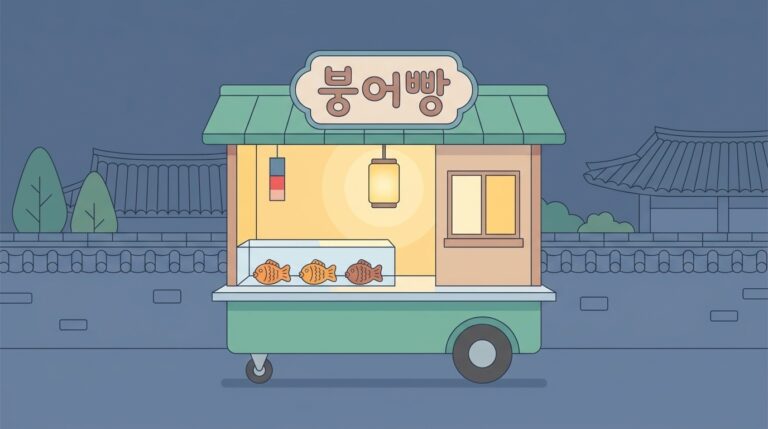
안녕하세요! (Annyeonghaseyo!) It’s your Daily Hangul editor and cultural navigator here. Picture this: It is a crisp autumn evening in Seoul. You are standing outside a buzzing street stall in Myeongdong. The golden, piping-hot bungeoppang (carp-shaped pastry filled with sweet red bean) smells heavenly. The vendor smiles warmly and asks, “몇 개 드릴까요? (Myeot gae deurilkkayo? / How many can I get you?)”
Suddenly, your mind goes blank. Your brain scrambles through textbook charts. Is it “Il-gae”? No, wait… “Hana-gae”? Or is it “Han-gae”? You freeze, panic, and end up holding up two awkward fingers with a shy grin.
If you have ever experienced this exact freeze-up, take a deep breath: you are not alone! Over the past ten years coaching beginner Korean learners, this is easily the number-one stumbling block everyone hits during their first week in Korea. Korean has two distinct number systems, and things get tricky because the numbers change their shape when counting items! In this guide, we are going to unlock the secret rhythm of native Korean counters so you can order snacks, coffee, and souvenirs smoothly without breaking a sweat.
Phase 2: 3 Core Expressions for Counting Items
Here are the three essential phrases you will use every single day in Korea.
1. 한 개 주세요 (Han gae juseyo)
- Pronunciation: [Han gae ju-se-yo] (Think of ‘Han’ rhyming with ‘Sun’ spoken quickly, and ‘gae’ sounding like ‘get’ without the ‘t’.)
- Meaning: “One (item), please.”
- K-Culture Moment: Seen constantly in convenience store dramas when the lead character buys a single warm canned coffee for someone they secretly care about.
- Editor’s Insight: The standalone native number for “one” is 하나 (hana). But the moment it hugs a counting noun like 개 (gae), it shrinks into 한 (han)! It is like casual linguistic shorthand to make speech flow faster.
- Situation Spectrum: Casual: ⚠️ (Use 한 개 줘 with close friends) | Semi-formal: ✅ (Perfect for cashiers, restaurants, cafes) | Formal: ✅
- 🤔 Think About It: In English, you say “one apple” directly, but Korean almost always prefers:
Item + Quantity + Counter(사과 한 개 주세요). How does placing the object first change how you visualize what you want?
2. 두 개 주세요 (Du gae juseyo)
- Pronunciation: [Du gae ju-se-yo] (Sounds like ‘Do’ in ‘Do-re-mi’ followed by ‘gae ju-se-yo’.)
- Meaning: “Two (items), please.”
- K-Culture Moment: You are at a trendy photo booth in Hongdae with your travel buddy and need two printed photo strips to share the memories.
- Editor’s Insight: Just like 하나 becomes 한, the native number for “two” (둘 / dul) drops its bottom consonant and transforms cleanly into 두 (du).
- Situation Spectrum: Casual: ⚠️ | Semi-formal: ✅ | Formal: ✅
- 🤔 Think About It: Notice how natural the transition is: 하나 -> 한 (Hana -> Han), 둘 -> 두 (Dul -> Du). Korean grammar loves reducing harsh tongue movements!
3. 세 개, 네 개 포장해 주세요 (Se gae, ne gae pojanghae juseyo)
- Pronunciation: [Se gae, ne gae po-jang-hae ju-se-yo] (‘Se’ rhymes with ‘say’, and ‘ne’ rhymes with ‘net’ minus the ‘t’.)
- Meaning: “Please pack three (or four) to go.”
- K-Culture Moment: Ordering iconic street snacks like tteokbokki skewers or sweet potato fries to take back to your Han River picnic spot.
- Editor’s Insight: 셋 (set) becomes 세 (se) and 넷 (net) becomes 네 (ne). Spot the pattern? The final ‘ㅅ’ consonant disappears into thin air whenever a counter follows! 포장 (pojang) means takeout/packaging.
- Situation Spectrum: Casual: ⚠️ | Semi-formal: ✅ | Formal: ✅
- 🤔 Think About It: Packaging food to go is a massive lifestyle staple in Korea. Knowing the exact word 포장 (pojang) alongside your numbers instantly marks you as an experienced traveler.
Phase 3: Textbook Korean vs. Real Korean
Let’s bust some robotic textbook habits and upgrade your daily spoken Korean.
Situation 1: Ordering drinks or pastries at a bakery
- 📖 Textbook Korean: 사과 세 개를 주십시오. (Sagwa se gaereul jusipsio. – “Please grant me three apples.”)
- 🗣️ Real Korean: 사과 세 개 주세요! (Sagwa se gae juseyo!) or naturally: 사과 세 개요! (Sagwa se gaeyo!)
- 💡 Why is it different? Nobody speaks like a historical drama scholar when grabbing baked goods. Dropping the object particle -를 (-reul) and ending with a bright -요 (-yo) sounds warm, modern, and effortless.
Situation 2: Confirming quantity at a convenience store
- 📖 Textbook Korean: 저는 이것을 두 개 구매하겠습니다. (Jeoneun igeoseul du gae gumaehagessseumnida. – “I shall purchase two units of this.”)
- 🗣️ Real Korean: 이거 두 개 계산해 주세요. (Igeo du gae gyesanhae juseyo. – “Please ring up these two.”)
- 💡 Why is it different? Real Koreans prioritize speed and efficiency. 이것을 (Igeoseul) is trimmed down to 이거 (Igeo), and the formal business term 구매 (purchase) is replaced by the relatable 계산 (pay/check out).
Phase 4: K-Culture Deep Dive & Non-Verbal Manners
4-1. Nunchi & Gestures: The Two-Handed Magic & Finger Counting
When ordering at counters, visual cues matter just as much as your pronunciation:
* The Two-Handed Hand-off: When handing your payment card or receiving your bag of hot pastries, hold it with both hands, or support your right wrist/forearm lightly with your left hand. This small gesture radiates politeness and instant respect.
* Finger Counting: If the noise inside a noisy market drowns out your voice, show your fingers with your palm facing the vendor, not toward yourself. Start counting with your thumb tucked in and raise your index finger for one, middle finger for two.
4-2. Cultural Code: The Generosity of “Deom” (덤) and 1+1 Deals
In Korea, counting isn’t just math; it is a doorway into everyday hospitality (jeong / 정). At traditional street stalls, if you order 세 개 (se gae / three), an elderly vendor (Imo-nim or Sajang-nim) might toss in an extra one with a hearty wink, saying “서비스! (Seobiseu! / Service – freebie!)” or “덤이에요 (Deomieyo! / It’s a bonus!).”
Meanwhile, inside Korean convenience stores like GS25 or CU, you will constantly spot tags saying 1+1 (One-Plus-One) or 2+1. If you bring only one item to the counter, the friendly clerk will often tell you to go grab another one for free!
Phase 5: Real-Life Roleplay Scenario
Setting: A steamy winter night outside a famous snack cart in Insadong.
Characters: You (an excited food lover) and Imo-nim (the warm, energetic stall owner flipping hotteok).
- Imo-nim: 어서 오세요! 뭐 드릴까요? (Eoseo oseyo! Mwo deurilkkayo?)
🎭 Leaning over the sizzling grill with a spatula in hand, smiling warmly.
“Welcome! What can I get for you?” -
You: 저… 붕어빵 있어요? (Jeo… bungeoppang isseoyo?)
🎭 Peeking curiously into the glass display.
“Um… do you have carp bread?” -
Imo-nim: 그럼요! 팥이랑 슈크림 있어. 몇 개 줄까? (Geureomyo! Pat-irang syukeurim isseo. Myeot gae julkka?)
🎭 Tapping the metal tray rhythmically.
“Of course! We have red bean and custard cream. How many do you want?” -
You: 팥 두 개 주세요. (Pat du gae juseyo.)
🎭 Showing two fingers politely.
“Two red bean ones, please.” -
Imo-nim: 슈크림은 안 필요해? 슈크림도 맛있는데! (Syukeurimeun an piryohae? Syukeurimdo masinneunde!)
🎭 Winking playfully and pointing at the golden custard ones.
“Don’t you need custard? Custard is delicious too!” -
You: 그럼 슈크림도 한 개 주세요! (Geureom syukeurimdo han gae juseyo!)
🎭 Nodding enthusiastically with a bright smile.
“Then please give me one custard one too!” -
Imo-nim: 그래, 총 세 개! 포장해 줄까? (Geurae, chong se gae! Pojanghae julkka?)
🎭 Slipping the piping-hot pastries into a brown paper bag.
“Alright, three in total! Pack it to go?” -
You: 네, 포장해 주세요. 감사합니다! (Ne, pojanghae juseyo. Gamsahamnida!)
🎭 Handing over your card using both hands.
“Yes, to go, please. Thank you!”
🔀 Interactive Choice Point: The Vendor asks “드시고 가요? (Deusigo gayo? / Eating here?)”
How do you respond?
- Option A: “아니요, 포장해 주세요! (Aniyo, pojanghae juseyo!)”
- Outcome (Best): Perfection! Clear, polite, and directly tells them you want it packed in a bag to take away.
- Option B: “두 개 먹어요! (Du gae meogeoyo!)”
- Outcome (Risk): Slightly confusing. You are stating that you eat two, but you didn’t answer whether you are staying or leaving.
- Option C: “이 개 밖으로 가요. (I gae bakkeuro gayo.)”
- Outcome (Bad): Awkward literal translation! 이 개 (I gae) uses the wrong number system (Sino-Korean), and “going outside” sounds unnatural.
Phase 6: 10-Second Emotional Shadowing Drill
Practice reading these out loud, pausing at the / marks to capture genuine Korean cadence:
[😊 Cheerful & Polite]
사과 / 한 개 주세요!
(Sagwa / han gae juseyo!)
“One apple, please!”-
[😋 Hungry & Enthusiastic]
붕어빵 / 두 개 / 포장해 주세요!
(Bungeoppang / du gae / pojanghae juseyo!)
“Two carp breads to go, please!” -
[🤔 Thoughtful & Inquiring]
이거 / 세 개에 / 얼마예요?
(Igeo / se gae-e / eolmayeyo?)
“How much for three of these?”
Phase 7: K-Culture Mini Dictionary
- 개 (Gae) | Counter noun for generic objects | The ultimate universal counter! If you forget specific counters like bottles (병) or cups (잔), using 개 (gae) will always be understood.
- 덤 (Deom) | Extra bonus / Freebie | The heart of Korean market culture. An extra treat thrown in by the shopkeeper out of affection.
- 원플러스원 (Won-peulleo-seu-won) | Buy-One-Get-One-Free (1+1) | The most common promotional phrase across all Korean convenience stores and beauty boutiques.
- 포장 (Pojang) | Takeout / Packaging | Essential travel vocabulary when getting food to eat back at your hotel or at an open park.
Phase 8: Traveler’s Survival Kit
Top 3 Survival Expressions
- 이거 한 개 주세요. (Igeo han gae juseyo.) – Pro Tip: Point at any item on the shelf or menu and say this. It works 100% of the time.
- 따로따로 포장해 주세요. (Ttarottaro pojanghae juseyo.) – Pro Tip: Use this when you are buying two gifts and want them packed in separate bags.
- 몇 개 남았어요? (Myeot gae namasseoyo?) – Pro Tip: Perfect when you arrive at a famous dessert bakery and want to know how many are left before selling out.
Editor’s Travel Note
- Navigation: Never rely on Google Maps in Korea for walking routes. Make sure to download the Official Naver Map App for iOS and Android before landing in Incheon.
- Transit & Snack Payments: You can tap your rechargeable transit card (T-Money or WOWPASS) directly at convenience stores to pay for your single drinks or snacks without fumbling with small coins.
Phase 9: One Step Deeper (Reflective Thought)
Have you ever wondered why Korean maintains two distinct numbering systems? While Sino-Korean numbers (일, 이, 삼) arrived via Chinese historical influence and handle abstract concepts like phone numbers, bus routes, and money, Native Korean numbers (하나, 둘, 셋) originated from the heart of indigenous Korean life. They were created to count things you can physically see, touch, and hold in your hands—baskets of fruit, hot buns, and cherished companions. Using native numbers to count physical objects feels grounding and personal.
💬 Your Turn: What is the very first street food you want to order using “두 개 주세요” when you land in Seoul? Let me know in the comments below!
Phase 10: FAQ & Avoiding Misunderstandings
Q: Can I use “일 개 (Il gae)” instead of “한 개 (Han gae)”?
A: No, native Koreans never use Sino-Korean numbers (일, 이, 삼) with the generic item counter 개 (gae). It sounds like saying “one-th items” in English. Always pair 개 with native Korean numbers: 한 개 (1), 두 개 (2), 세 개 (3), 네 개 (4).
Q: What happens after four? Do the numbers keep changing form?
A: Good news: after number four, the changes stop! 다섯 (daseot – 5) stays 다섯 개, 여섯 (yeoseot – 6) stays 여섯 개, and so on. Only numbers 1 through 4 undergo this special haircut (하나->한, 둘->두, 셋->세, 넷->네)!
Q: Is it rude to use “개 (gae)” for everything?
A: It is completely fine for inanimate objects, foods, and products! However, never use 개 (gae) to count people. For people, always use the respectful counter 명 (myeong), as in 두 명 (du myeong / two people).
🚨 Common Mistakes Warning Board
- ❌ Mistake 1: Saying 하나 개 (Hana gae) instead of 한 개 (Han gae).
👉 Correct Action: Remember to drop the last syllable whenever you attach the counter 개! - ❌ Mistake 2: Using 일, 이, 삼 for snacks (“이 개 주세요!”).
👉 Correct Action: Switch to 한, 두, 세, 네 for physical objects. - ❌ Mistake 3: Counting people with 개 (“친구 세 개”).
👉 Correct Action: Use 명 (myeong) for humans (“친구 세 명”).
Phase 11: Action Missions
- 🥉 Bronze Mission (Solo Vocalizer): Look around your desk right now. Find an item and say out loud three times: “[Item name] 한 개 주세요!”
- 🥈 Silver Mission (Social Learner): Record a 5-second audio clip saying “커피 두 개 포장해 주세요!” (Two coffees to go, please!) and share it with your language exchange buddy or tag Daily Hangul.
- 🥇 Gold Mission (Real Life Action): Visit your local Asian supermarket or K-town bakery this week. Order your favorite snack entirely in Korean using 한 개 or 두 개!
- 🎮 K-Culture Mission: Watch the latest episode of your favorite Korean variety show (like Running Man) and listen for the cast shouting “하나, 둘, 셋!” before a game starts!
Phase 12: Interactive Quiz Challenge
Test what you have learned today! Click to reveal the answers.
1. Situational Judgment:
You are at a cafe and want to order two cups of iced Americano for takeout. What should you say?
* A) 아메리카노 이 개 주세요.
* B) 아메리카노 두 개 포장해 주세요.
* C) 아메리카노 둘 개 주세요.
🔍 Click to reveal the answer and explanation
Correct Answer: B
Explanation: We use the modified native number 두 (du) with the counter 개 (gae), and 포장해 주세요 means “please pack it to go.” Option A uses the Sino-Korean number 이, and Option C fails to change 둘 into 두.
2. Fill-in-the-Blank:
“I want to buy 3 hotteok, please.”
-> 호떡 _______ 개 주세요.
(Hint: The native word for 3 is 셋, but what happens before a counter?)
🔍 Click to reveal the answer
Correct Answer: 세 (Se)
Full Sentence: 호떡 세 개 주세요. (Hotteok se gae juseyo.)
3. True or False Culture Quiz:
True or False: If you see a label that says “1+1” in a Korean convenience store, you should take both items to the counter, and one will be scanned as free.
🔍 Click to reveal the answer
Correct Answer: True!
Explanation: You must bring both items to the checkout counter yourself so the cashier can scan both barcodes. If you only bring one, you miss out on your free treat!







