

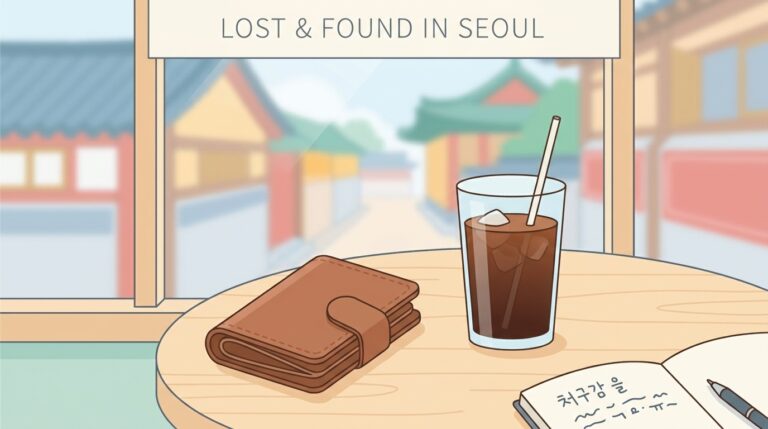
How I Lost and Found My Wallet in Seoul: Tell Your Story in Natural Korean
Phase 1: Empathy (Storytelling Opening)
안녕하세요! 매일한글 에디터입니다. (Annyeonghaseyo! I’m your Daily Hangul editor.)
Picture this: You are having the dreamiest afternoon in a sunlit café in Yeonnam-dong. You sip your iced Americano, devour an egg tart, and hop on Subway Line 2 toward Hongdae. But the moment you reach into your tote bag to tap your transit card… cold shock shoots down your spine. Your pocket is empty. Your wallet—containing your credit cards, alien registration card (ARC), and that precious souvenir photocard of your favorite K-pop bias—is gone.
Your breath catches. In most major cities around the globe, losing a wallet in a crowded transit hub feels like a permanent farewell. But if you have spent even a few days in South Korea, you have probably heard urban legends of people leaving laptops unattended on café tables for hours without a second thought. Is that trust real when disaster strikes you directly?
Narrating personal crises and their resolutions is a critical milestone at the B1 intermediate stage. While beginners can only stammer basic isolated facts like “지갑 없어요” (I don’t have a wallet), native speakers tell rich, cinematic stories filled with suspense, turning points, and heartfelt relief. When international students share their emergency stories in our community, their biggest pain point is sounding too robotic—relying solely on repetitive past tense markers like “-았어요/-었어요.”
Today, we will turn your real-life panic into a vivid, conversational Korean story that will make your Korean friends listen with wide eyes, laugh in sympathy, and celebrate your happy ending together.
Phase 2: Deep Dive into 3 Key Expressions
Here are three essential B1 expressions that transform a dry incident report into an engaging personal narrative.
1. 지갑을 잃어버렸다가 다시 찾았어요.
- Pronunciation: [Jigabeul ireobeoryeotdaga dasi chajasseoyo] (Sound analogy: Imagine saying “Ee-ruh-buh-ryut-da-ga” with a quick pivot on “da-ga”, like shifting gears in a car.)
- Meaning: “I lost my wallet, but then I found it again.”
- Literal vs Nuance: Literally “I lost my wallet and in that state transitioned to finding it.” The grammar pattern
-다가signals that a completed past state was reversed or interrupted by a new outcome. It highlights the dynamic reversal of your situation. - K-Culture Moment: Seen frequently on variety shows like I Live Alone (나 혼자 산다) when celebrities recall chaotic travel days where an item vanished and reappeared in unexpected spots.
- Editor’s Insight: Beginners often say “지갑을 잃어버렸어요. 그리고 찾았어요.” Connecting them with
-았/었다가instantly elevates your fluency to natural intermediate storytelling. - Situation Spectrum: Casual ✅ | Semi-formal ✅ | Formal ✅
- 🤔 Think About It: In English, we often link these with “and then” or “but fortunately.” How does combining the reversal into a single connective ending (
-다가) change the momentum of the story?
2. 가슴이 철렁 내려앉았어요.
- Pronunciation: [Gaseumi cheolleong naeryeoanjasseoyo] (Sound analogy: “Cheol-leong” echoes the heavy splash of an anchor dropping into deep water.)
- Meaning: “My heart sank into my stomach.”
- Literal vs Nuance: Literally “My chest dropped down with a clunk.” It captures the visceral somatic feeling of panic before your brain even finishes processing what happened.
- K-Culture Moment: A staple line in K-Dramas when a protagonist realizes they misplaced an heirloom ring or critical USB drive during a high-stakes sequence.
- Editor’s Insight: Avoid just saying “너무 무서웠어요” (I was so scared) or “당황했어요” (I was flustered). Expressive sound-symbolic adverbs (의태어) like 철렁 show native-level emotional depth.
- Situation Spectrum: Casual ✅ | Semi-formal ✅ | Formal ⚠️ (Too emotional for legal testimony, but perfect for casual or work conversations)
- 🤔 Think About It: Korean has dozens of bodily idioms for fear and shock involving the liver (간) or chest (가슴). Why do you think Korean culture links heart drops so closely to unexpected loss?
3. 다행히 분실물 센터에 보관되어 있었어요.
- Pronunciation: [Dahaenghi bunsilmul senteoe bogwandwoeeo isseosseoyo] (Sound analogy: “Da-haeng-hee” sounds like breathing out a gentle sigh of relief: “Da-heng-hee”).
- Meaning: “Fortunately, it was being kept safely at the lost and found center.”
- Literal vs Nuance: “By good fortune, it was maintained in storage at the lost items facility.” The passive state grammar
-되어 있다indicates that someone else carefully preserved it for you. - K-Culture Moment: Every international traveler’s triumphant Instagram story post in Seoul after discovering their missing backpack was safely tagged and cataloged at Seoul Metro’s Lost & Found.
- Editor’s Insight: Combining 다행히 (fortunately) with the passive result
-어/여 있다is the gold standard for expressing gratitude toward public safety systems without sounding overly clinical. - Situation Spectrum: Casual ✅ | Semi-formal ✅ | Formal ✅
- 🤔 Think About It: Notice the distinction between “they kept it” (active) and “it was preserved safely” (state). Korean often emphasizes the peaceful resultant state rather than interrogating who did it.
Phase 3: Textbook Korean vs Real Korean
Let’s compare classroom Korean against the living phrases native speakers use over coffee.
Situation 1: Describing the moment you realized it was missing
- 📖 교과서 한국어 (Textbook): 저는 지갑을 잃어버려서 너무 당황했습니다. (Jeoneun jigabeul ireobeoryeoseo neomu danghwanghaetseumnida. / “Because I lost my wallet, I was very perplexed.”)
- 🗣️ 진짜 한국어 (Real Spoken): 지갑 없어진 거 알고 진짜 멘붕 왔었어요! (Jigap eopseojin geo algo jinjja menbung wasseosseoyo! / “The moment I realized my wallet was gone, I had an absolute mental breakdown!”)
- 💡 왜 다를까? (Why is it different?): Textbook formulations use rigid honorific endings and clinical words like 당황. Real conversation favors nominalization (
-ㄴ 거 알고) paired with 멘붕 (a blend of ‘mental’ and ‘붕괴’ / collapse) to capture raw panic vividly.
Situation 2: Explaining that a good samaritan turned it in
- 📖 교과서 한국어 (Textbook): 착한 사람이 지갑을 주워서 경찰관에게 주었습니다. (Chakhan sarami jigabeul juwoseo gyeongchalgwanege jueotseumnida. / “A good person picked up the wallet and gave it to the police officer.”)
- 🗣️ 진짜 한국어 (Real Spoken): 다행히 어떤 천사 같은 분이 주워서 맡겨 주셨더라고요. (Dahaenghi eotteon cheonsa gateun buni juwoseo matgyeo jusyeotdeoragoyo. / “Fortunately, some absolute angel picked it up and kindly left it in safekeeping.”)
- 💡 왜 다를까? (Why is it different?): Instead of “착한 사람,” natives use 천사 같은 분 (an angel-like person) with high honorific verbs (
주셨더라고요) to display deep personal gratitude to the unknown finder.
Phase 4: K-Culture Deep Dive & Non-Verbal Manners
4-1. Nunchi & Gestures: When Relief Takes Over
When retrieving a lost possession in Korea—whether from a station master, taxi driver, or café clerk—body language speaks louder than grammar:
* The Two-Handed Receive (두 손 받기): Never grab your wallet with one hand. Reach out with both hands, elbows tucked slightly close to your ribs, or support your right wrist/forearm with your left hand.
* The Double Bow of Relief: A standard 15-degree greeting bow is good, but when retrieving an item, Koreans perform an empathetic, slightly lingering bow (30 to 45 degrees) with a soft clasp of the hands over the chest, signifying: “You saved my life today.”
* Sincerity Gaze: Do not aggressively stare down the counter staff. Lower your eyes slightly in humble appreciation when they check your identification.
4-2. Cultural Code: The Civic Trust & The “CCTV + Nunchi” Synergy
Foreigners are frequently stunned that you can recover a wallet with every single bill inside. This phenomenon is built on two pillars: Social Covenant (도덕적 양심) and Institutional Design (CCTV망과 유실물 통합시스템).
Taking an unattended item is classified legally as 점유이탈물횡령죄 (Embezzlement of Lost Property), punishable by heavy fines or imprisonment. Paired with high-definition surveillance coverage in virtually all public transport and street corners, civic duty is strongly reinforced. Koreans grow up with the reflex: “If it is not mine, don’t touch it—or bring it directly to the nearest counter or police station.”
Phase 5: Real-World Roleplay Scenario
Setting: Hongik University Subway Station (홍대입구역) Customer Safety Center / Lost & Found desk.
Characters:
* 민우 (Minwoo): An international exchange student breathing heavily after running back from the exit.
* 김 주임 (Officer Kim): A veteran subway official who has seen every kind of panicked passenger.
민우: 저… 저기요, 죄송한데요, 제가 방금 열차에 지갑을 두고 내린 것 같아요!
(Jeo… jeogiyo, joesonghandeyo, jega banggeum yeolchae jigabeul dugo naerin geot gatayo!)
(🎭 Clutching backpack straps with both hands, eyes wide with anxiety)
“Um… Excuse me, I am so sorry, but I think I just left my wallet on the train!”
김 주임: 아이고, 진정하시고요. 몇 호선, 무슨 역에서 몇 시쯤 내리셨어요?
(Aigo, jinjeonghasigoyo. Myeot hoseon, museun yeogeseo myeot sijjeum naerisyeosseoyo?)
(🎭 Speaks calmly, hands a paper cup of water across the desk)
“Oh dear, take a deep breath. Which line, at which station, and around what time did you get off?”
민우: 2호선 시청 방면 열차였고요, 3-2번 문에서 10분 전에 내렸어요.
(Ihoseon Sicheong bangmyeon yeolchayeotgoyo, sam-dasi-ibeon muneseo sibun jeone naeryeosseoyo.)
(🎭 Checking subway transit app history on the phone to verify details)
“It was the Line 2 train bound for City Hall, and I got off at door 3-2 about ten minutes ago.”
김 주임: 지갑 색깔이랑 안에 든 내용물 말씀해 주실 수 있나요?
(Jigap saekkkalirang ane deun naeyongmul malsseumhae jusil su innayo?)
(🎭 Picks up a ballpoint pen and clicks it ready over an incident log)
“Can you tell me the color of the wallet and what’s inside it?”
민우: 갈색 가죽 지갑인데요, 외국인등록증이랑 하늘색 체크카드가 들어 있어요.
(Galsaek gajuk jigabindeyo, oegugindeongrokjeung-irang haneulsaek chekeukadeuga deureo isseoyo.)
(🎭 Swallows nervously while gesturing the rectangle shape with hands)
“It’s a brown leather wallet, and my ARC and a sky-blue debit card are inside.”
김 주임: 아! 마침 다음 역 역무실에서 방금 비슷한 분실물이 접수됐다고 연락 왔습니다.
(A! Machim daeum yeok yeongmusireseo banggeum biseuthan bunsilmuri jeopsudwaetdago yeollak wasseumnida.)
(🎭 Glances at the internal monitor, pointing with a reassuring smile)
“Ah! Exactly just now, the station office at the next stop called saying a matching item was turned in.”
민우: 아… 진짜요? 가슴이 철렁 내려앉았었는데… 정말 다행이에요!
(A… jinjjayo? Gaseumi cheolleong naeryeoanjasseonneunde… jeongmal dahaeng-ieyo!)
(🎭 Lets out a deep sigh, shoulders dropping as relief washes over)
“Oh… really? My heart had totally sunk… that is such an enormous relief!”
김 주임: 신분 확인하고 수령증 쓰시면 바로 찾아가실 수 있어요. 조심히 가세요!
(Sinbun hwaginhago suryeongjeung sseusimyeon baro chajagasil su isseoyo. Josimhi gaseyo!)
(🎭 Warmly hands over a routing slip to the next station)
“Once we verify your identity and you sign the receipt slip, you can pick it up right away. Safe travels!”
🔀 Interactive Branching Point
Officer Kim offers you the routing slip. How do you respond before leaving the station office?
- Choice A: “정말 감사합니다! 덕분에 살았어요. 복 받으실 거예요!”
- Choice B: “지갑 찾아줬으니까 사례금 얼마 드려야 해요?”
- Choice C: “알겠어요. 그럼 제가 직접 거기 가서 가져올게요. ㅃ2!”
Feedback:
* Choice A [BEST]: Perfect Korean cultural touch! Expressing dramatic gratitude (“You saved my life! May you receive many blessings!”) alongside a deep bow builds instant warmth.
* Choice B [RISK]: Public station officials cannot accept reward money. While offering a finder’s reward (보상금) to a private citizen is legally standard (5-20%), asking a station master feels awkward and transactional.
* Choice C [BAD]: Using super-casual slang (ㅃ2 = bb/bye) to an elder public employee breaks honorific decorum completely.
Phase 6: 10-Second Emotion Shadowing Drill
Practice reading these out loud, pausing at each / to lock in authentic conversational cadence.
[😱 당황과 공포]
지갑이 없어진 걸 알았을 때 / 진짜 가슴이 철렁 내려앉았어요!
(Jigabi eopseojin geol arasseul ttae / jinjja gaseumi cheolleong naeryeoanjasseoyo!)
“When I realized my wallet was missing / my heart literally dropped into my stomach!”-
[😮💨 안도와 한숨]
다행히 / 친절한 분이 주워서 / 역무실에 맡겨 주셨더라고요.
(Dahaenghi / chinjeolhan buni juwoseo / yeongmusire matgyeo jusyeotdeoragoyo.)
“Fortunately / a kind person picked it up / and turned it into the station office for me.” -
[🙏 깊은 감동과 감사]
한국에서는 / 지갑을 잃어버렸다가도 / 다시 찾을 수 있어서 / 정말 감동했어요.
(Hangugeseoneun / jigabeul ireobeoryeotdagado / dasi chajeul su isseoseo / jeongmal gamdonghaesseoyo.)
“In Korea / even after losing a wallet / you can get it back, so / I was genuinely touched.”
Phase 7: K-Culture Mini Dictionary
-
유실물 센터 (Yusilmul Senteo) | Lost and Found Center
Used specifically for official metropolitan transit centers (subway, airport, railroad) where cataloged items are held before being transferred to the national police database. -
파출소 (Pachulso) | Neighborhood Police Substation
Smaller than a full police station (경찰서), these neighborhood outposts are where street finds, dropped keys, and recovered wallets are taken by local residents. -
식은땀 (Sigeunddam) | Cold Sweat
Collocation: “식은땀이 났다” (I broke out in a cold sweat). Frequently paired with sudden realizations of missing valuables or missed train stops. -
천만다행 (Cheonmandahaeng) | A Million Fortunes / Immense Relief
A four-character idiom (사자성어) frequently used as an exclamation: “천만다행이다!” meaning “Thank goodness! What a miraculous blessing!”
Phase 8: Traveler’s Survival Kit
Top 3 Survival Phrases for Emergencies
-
혹시 여기 분실물 들어온 거 있나요?
(Hoksi yeogi bunsilmul deureoon geo innayo?)
“By any chance, have any lost items been turned in here?”
👉 Pro Tip: Use this when walking back into the café, restaurant, or convenience store you visited 20 minutes ago. -
택시에 지갑을 두고 내렸는데 영수증이 있어요.
(Taeksie jigabeul dugo naeryeonneunde yeongsujeungi isseoyo.)
“I left my wallet in a taxi, but I have the receipt.”
👉 Pro Tip: The paper receipt contains the taxi’s vehicle plate number and the driver’s direct business dispatch phone number! -
분실 신고서 작성하고 싶은데요.
(Bunsil singgoseo jakseonghago sipeundeyo.)
“I would like to fill out a lost property report.”
👉 Pro Tip: Say this upon entering a local 파출소 (police box).
Editor’s Travel Note: Don’t Panic, Follow These Steps
If you lose something in Korea, avoid aimless searching. First, check 경찰청 유실물 통합포털 (LOST112) 바로가기 where every single item logged by police stations, subways, and bus companies nationwide is uploaded with high-resolution photos and timestamps within 24 hours. For subway emergencies within Seoul, call the 120 Dasan Call Center for immediate multilingual interpretation and station relay.
Phase 9: “한 발 더 깊이” (Going Deeper)
Losing something valuable exposes the invisible fabric of the society around you. In Korea, returning lost property is rooted in 정 (Jeong) and a deep sense of shared communal space—the instinctive understanding that causing someone unnecessary anguish disrupts the collective harmony. While modern technology like ubiquitously networked CCTVs certainly enforces accountability, Koreans still take pride in the quiet civic reflex that an item without an owner deserves to find its way home. Telling this story in Korean is never just about recounting lost money; it is your personal testimony of experiencing Korean civic trust firsthand.
💬 Your Turn: Have you ever lost an item while traveling or in your home country? How did people react, and how would you describe that feeling using today’s expressions? Leave your thoughts in Korean or English in the comments below!
Phase 10: FAQ & Avoiding Misunderstandings
Q: What is the difference between 잃어버리다 and 잊어버리다?
A: While they sound almost identical to beginner ears, their meanings are totally distinct! 잃어버리다 (Ireobeorida) means to physically lose an object (e.g., wallet, phone, keys). 잊어버리다 (Ijeobeorida) means to forget information, memories, or a scheduled appointment. Remember: “잃” has the extra consonant ‘ㅎ’ representing a lost item falling away!
Q: What does the grammar pattern “-다가” specifically mean here?
A: -다가 indicates an action or state that was in progress and then was either cut short or transitioned into another unexpected action. When you say “지갑을 잃어버렸다가 찾았어요,” you convey: “I entered the state of having lost my wallet, but that state reversed, and I found it.”
Q: Is it legally required to give a reward to the person who found my wallet?
A: Under Korea’s Lost Articles Act (유실물법), the owner must provide a reward between 5% and 20% of the item’s value if the finder requests it within one month. However, ordinary citizens who turn wallets into station offices or police boxes usually decline rewards with a polite smile, simply saying “찾아서 다행이네요” (Glad you found it).
🚨 흔한 실수 (Common Mistakes) Warning Board
- ❌ Mistake 1: “지갑을 잊어버렸어요!” (Saying you forgot your physical wallet from your memory, instead of losing it).
➡️ Correct Action: Use 잃어버렸어요 (Ireobeoryeosseoyo) for tangible lost objects. - ❌ Mistake 2: “역무원에게 지갑을 찾아 달라고 명령하기” (Demanding station staff to find it with “지갑 찾으세요”).
➡️ Correct Action: Use polite request grammar: “지갑 찾는 것 좀 도와주실 수 있나요?” (Could you please help me look for my wallet?). - ❌ Mistake 3: Saying “저는 죽을 뻔했어요” (I almost died) in a formal police station report.
➡️ Correct Action: Save extreme hyperbole for friends over drinks. In front of officials, say “너무 놀랐어요” or “정말 다행입니다.”
Phase 11: Action Missions
- 🥉 Bronze Mission (Solo Shadowing): Stand in front of your mirror. Practice saying: “지갑을 잃어버렸다가 다시 찾았어요!” three times with authentic, relieved facial expressions.
- 🥈 Silver Mission (Social Audio Practice): Post an audio clip on your language exchange app (like HelloTalk or Tandem) narrating a one-sentence past crisis using
-았/었다가. - 🥇 Gold Mission (Real-life / Tutoring Application): Next time your Korean tutor or friend asks “주말에 뭐 했어요?”, share an actual or hypothetical lost-and-found story using 가슴이 철렁 내려앉다 and 다행히.
- 🎮 K-Culture Mission: Watch an episode of a Korean reality travel show (like Youth Over Flowers or Adventure by Accident). Note down the exact moment a cast member panics over a lost ticket or passport, and spot whether they say 멘붕 or 식은땀!
Phase 12: Interactive Quiz Challenge
Test your instincts below! Click each question to expand and reveal the answers.
Quiz 1. Situation Judgment
You left your clutch at a trendy Seongsu-dong dessert café. You run back in. What is the most natural sentence to say to the barista?
1. 야, 내 지갑 어디 있어?
2. 혹시 여기 갈색 지갑 분실물 들어온 거 있나요?
3. 저는 지갑을 잊어버렸는데 찾아 주세요.
👉 Click to reveal Answer & Explanation
Correct Answer: 2번!
Explanation: Option 1 uses rude banmal (informal speech). Option 3 mistakenly uses 잊어버리다 (to forget from mind) instead of 잃어버리다 (to misplace physically). Option 2 is polite, natural, and accurately refers to the missing item as a 분실물.
Quiz 2. Fill in the Blank
Complete the sentence to mean: “My heart sank the moment I realized it was missing.”
지갑이 없는 걸 확인하고 가슴이 __________ 내려앉았어요.
👉 Click to reveal Answer & Explanation
Correct Answer: 철렁 (cheolleong)
Explanation: 가슴이 철렁 내려앉다 is the iconic Korean idiom for when your heart drops in sudden shock or terror.
Quiz 3. True or False Cultural Quiz
True or False: If you lose your phone or wallet in a Seoul taxi, you should immediately give up because private taxis do not log lost items into public police systems.
👉 Click to reveal Answer & Explanation
Correct Answer: False!
Explanation: Almost all Korean taxis record card payments through T-Money or Kakao T. If you have the receipt or check your bank app, you can track down the car’s license plate and dispatch center within minutes. Many drivers also deliver the item to the nearest 파출소 (police box) or LOST112 system!







