

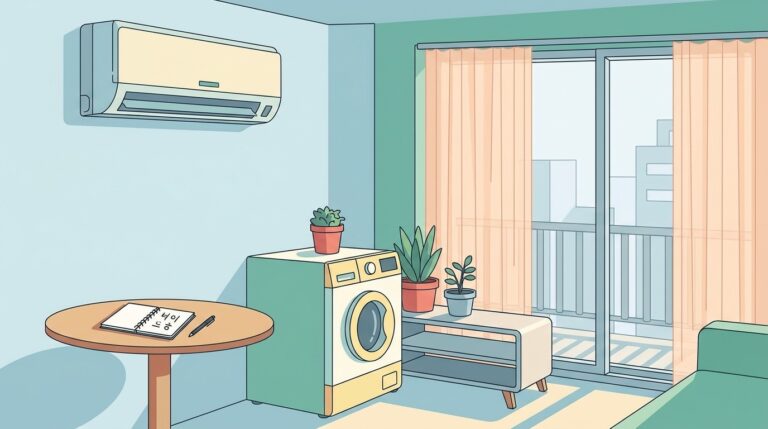
Phase 1: Empathy (Story Opening)
안녕하세요! 매일한글 에디터입니다. (Annyeonghaseyo! This is your Daily Hangul editor.)
Picture this: You just touched down in Seoul after a grueling 14-hour flight. The summer heat is thick, humid, and merciless. You finally unlock your charming Airbnb in Hongdae, kick off your shoes, grab the sleek white remote on the wall, and press the power button on the air conditioner. You wait. Five minutes pass… then ten. Instead of an arctic breeze, the unit emits a sad, high-pitched beep and blinks a menacing red error code: E4. Your shirt is soaked, your phone battery is at 12%, and panic begins to creep in. How on earth do you message your host without sounding rude or hopelessly lost?
If you have ever stared blankly at a high-tech Korean washing machine covered in buttons like ‘탈수’ (spin-dry) or wondered why your floor heating thermostat won’t turn on, you are definitely not alone! This is one of the top SOS moments our A1 beginner students bring to our tutoring sessions every single week. In this guide, we will transform that panic into total confidence. With just a few simple, pocket-sized phrases, you will be able to explain any appliance malfunction gracefully, earn instant respect from local hosts and technicians, and get your room back to peak comfort in no time. Let’s dive right in!
Phase 2: Top 3 Core Expressions
1. 고장 났어요 (Gojang nasseoyo)
- Pronunciation: [Gojang nasseoyo] (Sounds like: Go-jahng nah-ssuh-yo — imagine a go-kart with a noisy jangle that suddenly goes nah… so sorry!)
- Meaning: Literal: “A breakdown occurred” | Real Nuance: “It’s broken” or “It’s out of order.”
- K-Culture Moment: Remember that hilarious scene in Fight for My Way where the quirky rooftop apartment’s appliances constantly give up? The characters sigh and yell this exact phrase into their phones!
- Editor’s Insight: Notice how Korean says a breakdown “happened” rather than “I broke it.” It naturally shifts blame away from you, making it the safest, most polite way to report an issue without feeling guilty.
- Situation Spectrum: Casual: 고장 났어 (Gojang nasseo) ⚠️ | Semi-formal: 고장 났어요 (Gojang nasseoyo) ✅ | Formal: 고장 났습니다 (Gojang nasseumnida) ✅
- 🤔 Think About It: In your native language, do you say “it broke” or “I broke it”? How does Korean focus on the state of the object rather than who touched it last?
2. 안 돼요 (An dwaeyo)
- Pronunciation: [An dwaeyo] (Sounds like: Ahn dway-yo — “ahn” like onion + “dway” rhyming with sway + friendly “yo”).
- Meaning: Literal: “It does not become” | Real Nuance: “It’s not working” / “It won’t turn on.”
- K-Culture Moment: In workplace K-dramas like Misaeng or Gaus Electronics, whenever the office printer jams or a digital keycard refuses to beep, characters frantically tap it while chanting this word.
- Editor’s Insight: This is the ultimate Swiss Army knife phrase of the Korean language. You can point at literally anything that refuses to function—a remote, a stove, Wi-Fi—and simply say this phrase.
- Situation Spectrum: Casual: 안 돼 (An dwae) ⚠️ | Semi-formal: 안 돼요 (An dwaeyo) ✅ | Formal: 안 됩니다 (An doemnida) ✅
- 🤔 Think About It: Why do you think one short phrase can mean both “It doesn’t work” and “You cannot do that” in Korean? What does this say about context in Korean culture?
3. 도와주세요 (Dowajuseyo)
- Pronunciation: [Dowajuseyo] (Sounds like: Doh-wah-joo-seh-yo — “doh” like bread dough + “wah” + “joo” like jewel + “seh-yo”).
- Meaning: Literal: “Help and give to me” | Real Nuance: “Please help me!”
- K-Culture Moment: The classic text message sent to a warmhearted studio apartment landlord (집주인 아줌마 – Jipjuin ajumma) when something mysterious starts leaking under the sink.
- Editor’s Insight: Ending with “~주세요” (~juseyo) creates an instant bridge of warmth and politeness. It softens your plea for assistance so it sounds cooperative rather than demanding.
- Situation Spectrum: Casual: 도와줘 (Dowajwo) ⚠️ | Semi-formal: 도와주세요 (Dowajuseyo) ✅ | Formal: 도와주십시오 (Dowajusipsio) ✅
- 🤔 Think About It: In English, “help me” can sometimes sound like an emergency 911 call. In Korean, adding “~주세요” makes it an everyday polite request for neighborly support.
Phase 3: Textbook Korean vs Real Korean
Situation 1: The Air Conditioner Remote Won’t Respond
- 📖 Textbook Korean: 에어컨이 작동하지 않습니다. (Eeokeoni jakdonghaji anseumnida. / “The air conditioning unit is not operating.”)
- 🗣️ Real Korean: 에어컨이 안 켜져요. (Eeokeoni an kyeojyeoyo. / “The AC won’t turn on.”)
- 💡 Why is it different?: While textbooks teach formal mechanical terms like “작동” (operation), native speakers simply express the direct action: “It won’t turn on” (안 켜져요 – an kyeojyeoyo).
Situation 2: The Washing Machine Froze Mid-Cycle
- 📖 Textbook Korean: 세탁기가 고장 상태입니다. (Setakgiga gojang sangtaeimnida. / “The washing machine is in a state of malfunction.”)
- 🗣️ Real Korean: 세탁기가 멈췄어요! (Setakgiga meomchwosseoyo! / “The washer just stopped!”)
- 💡 Why is it different?: In real life, locals describe what the machine physically did right before their eyes. Saying “it stopped” (멈췄어요 – meomchwosseoyo) sounds natural, urgent, and vividly descriptive.
Phase 4: K-Culture Deep Dive & Non-verbal Manners
4-1. Nunchi (눈치) & Gestures: Reporting Appliance Troubles Politely
When you need to report a broken item in Korea, how you deliver the message is just as important as the words. Koreans value social harmony and saving face.
* The Two-Handed Show: When pointing at an appliance in front of a landlord or repair person, never point with a single index finger (which can feel accusatory). Instead, open your palm upward and gesture gently toward the device with both hands.
* The Photo Evidence Courtesy: Before calling your host, take a clean 5-second video or a close-up photo of the flashing lights or error code. Texting this immediately with your Korean message demonstrates considerate nunchi—it saves the host time and prevents unnecessary back-and-forth guessing.
4-2. Cultural Code: Korea’s Legendary ‘A/S’ Culture
In Korea, after-sales service and repair is famously referred to as 에이에스 (A/S), short for “After Service.” Korean electronics giants (like Samsung and LG) and local property managers pride themselves on 빨리빨리 (Palli-palli – hurry, hurry) speed. If an appliance breaks down, repair technicians (기사님 – Gisanim) frequently arrive on the same day or the next morning. Because service is so swift, approaching your host with calm politeness will almost always yield an immediate and cheerful resolution!
Phase 5: Real-World Roleplay Scenario
Setting: You are staying in a cozy studio apartment (원룸 – wonrum) in Mapo-gu. The digital induction cooktop refuses to heat up while you’re trying to cook midnight ramyeon. Your building manager, Mr. Park, comes up to check.
- Turn 1 (Manager Park): 무슨 일 있어요? (Museun il isseoyo?)
🎭 [Knocks gently on the doorframe, looking curious]
“Is something the matter?” - Turn 2 (You): 안녕하세요, 관리실 아저씨. 인덕션이 안 돼요. (Annyeonghaseyo, gwallisil ajeossi. Indeoksyeoni an dwaeyo.)
🎭 [Bows politely at 15 degrees, gesturing toward the kitchen counter with an open hand]
“Hello, building manager. The induction stove isn’t working.” - Turn 3 (Manager Park): 어라? 전원 버튼 눌렀어요? (Eora? Jeonwon beoteun nulleosseoyo?)
🎭 [Steps into the kitchen and inspects the glass cooktop surface]
“Oh? Did you press the power button?” - Turn 4 (You): 네, 눌렀는데 불이 안 들어와요. (Ne, nulleonneunde buri an deureowayo.)
🎭 [Demonstrates by tapping the red power symbol lightly]
“Yes, I pressed it, but the light doesn’t come on.” - Turn 5 (Manager Park): 고장 났나 보네요. 코드 한번 확인해 볼게요. (Gojang nanna boneyo. Kodeu hanbeon hwaginhae bolgeyo.)
🎭 [Crouches down and checks the cabinet wall outlet beneath the counter]
“Looks like it might be out of order. Let me check the power cord underneath.” - Turn 6 (Manager Park): 아! 플러그가 빠져 있었어요! 이제 켜질 거예요. (A! Peulleogeuga ppajyeo isseosseoyo! Ije kyeojil geoyeyo.)
🎭 [Pushes the thick plug firmly into the socket; a cheerful chime sounds]
“Ah! The plug was pulled out! It will turn on now.” - Turn 7 (You): 와, 켜졌어요! 도와주셔서 정말 감사합니다. (Wa, kyeojyeosseoyo! Dowajusyeoseo jeongmal gamsahamnida.)
🎭 [Claps hands softly with a bright, relieved smile]
“Wow, it turned on! Thank you so very much for your help.” - Turn 8 (Manager Park): 다행이네요. 라면 맛있게 끓여 드세요! (Dahaeng-ineyo. Ramyeon mas-itge kkeullyeo deuseyo!)
🎭 [Chuckles warmly and waves goodbye as he steps out]
“What a relief. Enjoy cooking your delicious ramyeon!”
🔀 Interactive Branching Point: What would you text your host if the air conditioner started leaking water?
- Option A: “에어컨 고장 났어요. 물이 새요. 도와주세요!” (Eeokeon gojang nasseoyo. Muri saeyo. Dowajuseyo.)
- Feedback (BEST): ⭐⭐⭐ Outstanding! You combined the appliance name, the problem (“water leaks”), and a polite cry for help. Clear, concise, and courteous.
- Option B: “야! 에어컨 왜 이래? 고쳐줘.” (Ya! Eeokeon wae irae? Gochyeojwo.)
- Feedback (BAD): 🚫 Extreme danger! “야” (Hey) and “왜 이래” (What’s wrong with this?) are very blunt, aggressive, and rude to use with hosts or elders.
- Option C: “에어컨이 작동을 멈추었사옵니다.” (Eeokeoni jakdong-eul meomchueossaomnida.)
- Feedback (RISK): ⚠️ Funny but awkward! This sounds like a Joseon Dynasty historical drama (sageuk). Your host will laugh, but it feels like you stepped out of a royal palace!
Phase 6: 10-Second Emotional Shadowing Drill
Practice these lines out loud with the designated pitch and pauses (/ marks where to take a mini-breath):
[🥺 Flustered & Helpless]
저기요… / 에어컨이 / 고장 났어요.
(Jeogiyo… / eeokeoni / gojang nasseoyo.)
“Excuse me… / the air conditioner / is broken.”-
[🤔 Puzzled & Pointing]
전원이 / 안 켜져요. / 왜 안 되죠?
(Jeonwoni / an kyeojyeoyo. / Wae an doejo?)
“The power / won’t turn on. / Why isn’t it working?” -
[🙏 Earnest & Deeply Grateful]
정말 급해요. / 한 번만 / 도와주세요!
(Jeongmal geuphaeyo. / Han beonman / dowajuseyo!)
“It’s really urgent. / Just this once / please help me!”
Phase 7: K-Culture Mini Dictionary
- 에이에스 (A/S – [E-i-e-seu]) | Translation: After-Sales Service / Repair
Usage: The universal term in Korea for repair services. You will see signs saying “삼성 A/S 센터” (Samsung Customer Service Center) all across Korean cities. - 리모컨 (Rimokon – [Ri-mo-keon]) | Translation: Remote Control
Usage: A classic Konglish word derived from “remote controller.” You’ll use this constantly to ask for AC, TV, or lighting controls: “리모컨 어디 있어요?” (Where is the remote?). - 전원 (Jeonwon – [Jeon-won]) | Translation: Power Source / Power Button
Usage: Printed on almost every electronic gadget in Korea. If an appliance isn’t working, the first question anyone asks is: “전원 켰어요?” (Did you turn the power on?). - 기사님 (Gisanim – [Gi-sa-nim]) | Translation: Technician / Driver / Specialist
Usage: An honorific, respectful title for skilled professionals like repair technicians, bus drivers, and taxi drivers. Always address your repair person as “기사님”!
Phase 8: Survival Kit for Travelers
Top 3 Survival Phrases
- 불이 안 들어와요. (Buri an deureowayo.)
Translation: “The light doesn’t turn on.”
Pro Tip: Use this whenever an electronic panel stays dark and lifeless. - 소리가 이상해요. (Soriga isanghaeyo.)
Translation: “It’s making a strange noise.”
Pro Tip: Perfect for loud washing machines or rattling mini-fridges. - 확인해 주세요. (Hwaginhae juseyo.)
Translation: “Please check it for me.”
Pro Tip: Add this to the end of any text message with a photo to sound like an experienced resident.
Editor’s Travel Note
- When staying in Korean accommodations, always use KakaoTalk messenger app download to communicate with your host. Send a photo of the appliance alongside your short Korean sentence.
- Many modern Korean studios feature a master switch near the front entrance labeled 일괄소등 (Master Power Off). If nothing in your room turns on, make sure this wall switch near the door is flipped ON before assuming all appliances are broken!
Phase 9: “One Step Deeper” (Reflective Mini-Essay)
In English, we often say, “I broke the washing machine,” or “You broke the remote!” allocating clear agency and responsibility. In Korean culture, however, harmony and mutual face-saving dominate linguistic habits. By phrasing malfunctions as “고장 났어요” (a breakdown occurred) or “안 돼요” (it doesn’t become), the language intentionally distances human fault from physical mishaps. It treats the problem as an unfortunate event that happened to both you and the host, rather than an error committed by someone’s clumsy hands. This linguistic softness prevents unnecessary defensive friction and creates an instant atmosphere of teamwork to solve the issue.
💬 Your Turn: Have you ever felt awkward admitting something stopped working while staying in a foreign hotel or Airbnb? How does shifting the blame away from yourself make you feel more comfortable speaking up? Let us know in the comments below!
Phase 10: FAQ & Common Mistakes
Q: What is the exact difference between ‘고장 났어요’ and ‘안 돼요’?
A: “고장 났어요” specifically means the machine has a physical, mechanical, or hardware breakdown (it requires repair or replacement). “안 돼요” simply means it is not operating right now (perhaps it’s unplugged, on child-lock, or there’s no internet signal). When in doubt, start with “안 돼요”!
Q: Can I use ‘고장 났어요’ if my body hurts or I feel sick?
A: No! “고장” (breakdown) is exclusively reserved for mechanical items, electronics, and machinery. For people, use “아파요” (Apwayo – I am hurt/sick) or “다쳤어요” (Dachyeosseoyo – I got injured).
Q: How do I tell my host that the hot water won’t come out?
A: Say: “따뜻한 물이 안 나와요.” (Ttatteut-han muri an nawayo. / “Warm water doesn’t come out.”) This is an essential phrase during crisp Korean autumns and cold winters!
🚨 Common Mistakes Alert
| Mistake | Why It Happens | Correct Action |
|---|---|---|
| ❌ “내가 세탁기 부러뜨렸어요!” | Translating “I broke the washer” literally using 부러뜨리다 (to physically snap a stick). | ✅ Say: “세탁기가 고장 났어요.” (Keep it passive and simple!) |
| ❌ “리모컨이 죽었어요!” | Using English slang (“The remote is dead”) literally translated with 죽다 (to die). | ✅ Say: “리모컨 배터리가 없어요.” (The remote has no battery.) |
| ❌ “안 켜다!” | Using the raw dictionary verb without polite present tense conjugation. | ✅ Say: “안 켜져요.” (It won’t turn on.) |
Phase 11: Action Missions & Community
- 🥉 Bronze Mission: Stand in front of your microwave or desk lamp right now. Point at it and repeat three times with feeling: “안 돼요! 고장 났어요!” (An dwaeyo! Gojang nasseoyo!).
- 🥈 Silver Mission: Open KakaoTalk or your phone notes app. Type the sentence “기사님, 도와주세요!” (Gisanim, dowajuseyo!) and screenshot your practice to share in the Daily Hangul community study chat.
- 🥇 Gold Mission: The next time you watch a K-Drama or a travel vlog set in Korea, spot at least one appliance label (like 전원, 온수, or 냉방) and jot it down in your learning diary!
- 🎮 K-Culture Bonus Mission: Watch an episode of a Korean reality variety show (like I Live Alone – 나 혼자 산다). Notice how Korean celebrities react when their smart home tech acts up—can you catch them muttering “어? 왜 안 되지?” (Huh? Why isn’t this working?)?
Phase 12: Interactive Quiz Challenge
Question 1 (Situation Judgment): You just pressed the power button on the microwave, but nothing happens. How do you tell your roommate politely?
* A) 마이크로웨이브 사망했습니다. (Maikeurowe-ibeu samanghaesseumnida.)
* B) 전자레인지가 안 켜져요. (Jeonjareinjiga an kyeojyeoyo.)
* C) 전자레인지가 아파요. (Jeonjareinjiga apwayo.)
Question 2 (Fill in the Blank): Complete the phrase to politely ask for help:
* “너무 더워요. 에어컨 좀 ________.” (It’s too hot. Please check the AC.)
* Word bank: [확인해 주세요 / 부숴 주세요 / 청소하십시오]
Question 3 (True or False):
* You can say “제 다리가 고장 났어요” when your leg falls asleep from sitting on the floor.
* (True / False)
👉 Click to view answers and explanations!
- Question 1 Answer: B (전자레인지가 안 켜져요.)
Explanation: In Korean, a microwave is called a “전자레인지” (jeonjareinji), and “안 켜져요” means it won’t turn on. Option A uses a dramatic legal word for death (사망), and Option C uses the human sickness word (아파요)! - Question 2 Answer: 확인해 주세요 (Hwaginhae juseyo)
Explanation: This creates the natural sentence: “에어컨 좀 확인해 주세요” (Please check the air conditioner for me). - Question 3 Answer: False
Explanation: Remember, “고장” is strictly for machines! For a numb leg, Koreans say “다리에 쥐가 났어요” (A cramp happened in my leg) or “다리가 저려요” (My leg is numb/tingling).







